Products

NTN NTN 6313LLU Deep Groove Ball Bearings , D=65
NTN 6313LLU Deep Groove Ball Bearings , D=65 SPECIFICATIONS Type of Product : Deep Groove Ball Bearing Model No : 6313LLU Width : 33 mm Inner Diameter : 65 mm 1. Design features and characteristics Deep groove ball bearings are very widely used. A deep groove is formed on the inner and outer ring of the bearing enabling the bearing to sustain radial and axial loads in either direction as well as the complex loads which result from the combination of these forces. Deep groove ball bearings are suitable for high speed applications. When two or more deep groove ball bearings are used in combination and mounted adjacent to each other a duplex set (D2) should be used. Duplex bearings (D2) utilize controlled tolerances to more evenly distribute the loading between the individual bearing rows which improves the overall performance of the assembly. In addition to unsealed and unlubricated “open” bearings, NTN provides deep groove ball bearings that are pre-lubricated with grease and enclosed by seals or shields. See section “11. Lubrication” for a list of some of the greases which can be used. Table 1 shows the construction and special characteristics of various sealed deep groove ball bearings. Types and codes N Shielded type Shielded type Non-contact type ZZ Non-contact type LLB Contact type LLU Low torque type LLH Construction Metal shield plate is affixed to the outside ring; the inner ring incorporates a V-groove and labyrinth clearance. The outer ring incorporates synthetic rubber molded to a steel plate; seal edge is aligned with V-groove along inner ring surface with labyrinth clearance The outer ring incorporates synthetic rubber molded to a steel plate; seal edge contacts V-groove along inner ring surface Basic construction is the same as LLU type, but a specially designed lip on the edge of the seal prevents foreign matter penetration; low torque construction. Torque Small Small Higher Medium Dust proofing Good Better than ZZ-type Excellent Much better than LLB-type Water proofing Poor Poor Very good Good High speed capacity Same as open type Same as open type Limited by contact seals Much better than LLU-type Allowable temp. range Depends on lubricant −25 to 120°C −25 to 110°C −25 to 120°C
$74.61

NTN NTN 6314LLU Deep Groove Ball Bearings , D=70
NTN 6314LLU Deep Groove Ball Bearings , D=70 SPECIFICATIONS Type of Product : Deep Groove Ball Bearing Model No : 6314LLU Width : 35 mm Inner Diameter : 70 mm 1. Design features and characteristics Deep groove ball bearings are very widely used. A deep groove is formed on the inner and outer ring of the bearing enabling the bearing to sustain radial and axial loads in either direction as well as the complex loads which result from the combination of these forces. Deep groove ball bearings are suitable for high speed applications. When two or more deep groove ball bearings are used in combination and mounted adjacent to each other a duplex set (D2) should be used. Duplex bearings (D2) utilize controlled tolerances to more evenly distribute the loading between the individual bearing rows which improves the overall performance of the assembly. In addition to unsealed and unlubricated “open” bearings, NTN provides deep groove ball bearings that are pre-lubricated with grease and enclosed by seals or shields. See section “11. Lubrication” for a list of some of the greases which can be used. Table 1 shows the construction and special characteristics of various sealed deep groove ball bearings. Types and codes N Shielded type Shielded type Non-contact type ZZ Non-contact type LLB Contact type LLU Low torque type LLH Construction Metal shield plate is affixed to the outside ring; the inner ring incorporates a V-groove and labyrinth clearance. The outer ring incorporates synthetic rubber molded to a steel plate; seal edge is aligned with V-groove along inner ring surface with labyrinth clearance The outer ring incorporates synthetic rubber molded to a steel plate; seal edge contacts V-groove along inner ring surface Basic construction is the same as LLU type, but a specially designed lip on the edge of the seal prevents foreign matter penetration; low torque construction. Torque Small Small Higher Medium Dust proofing Good Better than ZZ-type Excellent Much better than LLB-type Water proofing Poor Poor Very good Good High speed capacity Same as open type Same as open type Limited by contact seals Much better than LLU-type Allowable temp. range Depends on lubricant −25 to 120°C −25 to 110°C −25 to 120°C
$87.35

NTN NTN 6314LLUC3 Deep Groove Ball Bearings , D=70
NTN 6314LLUC3 Deep Groove Ball Bearings , D=70 SPECIFICATIONS Type of Product : Deep Groove Ball Bearing Model No : 6314LLUC3 Width : 35 mm Inner Diameter : 70 mm 1. Design features and characteristics Deep groove ball bearings are very widely used. A deep groove is formed on the inner and outer ring of the bearing enabling the bearing to sustain radial and axial loads in either direction as well as the complex loads which result from the combination of these forces. Deep groove ball bearings are suitable for high speed applications. When two or more deep groove ball bearings are used in combination and mounted adjacent to each other a duplex set (D2) should be used. Duplex bearings (D2) utilize controlled tolerances to more evenly distribute the loading between the individual bearing rows which improves the overall performance of the assembly. In addition to unsealed and unlubricated “open” bearings, NTN provides deep groove ball bearings that are pre-lubricated with grease and enclosed by seals or shields. See section “11. Lubrication” for a list of some of the greases which can be used. Table 1 shows the construction and special characteristics of various sealed deep groove ball bearings. Types and codes N Shielded type Shielded type Non-contact type ZZ Non-contact type LLB Contact type LLU Low torque type LLH Construction Metal shield plate is affixed to the outside ring; the inner ring incorporates a V-groove and labyrinth clearance. The outer ring incorporates synthetic rubber molded to a steel plate; seal edge is aligned with V-groove along inner ring surface with labyrinth clearance The outer ring incorporates synthetic rubber molded to a steel plate; seal edge contacts V-groove along inner ring surface Basic construction is the same as LLU type, but a specially designed lip on the edge of the seal prevents foreign matter penetration; low torque construction. Torque Small Small Higher Medium Dust proofing Good Better than ZZ-type Excellent Much better than LLB-type Water proofing Poor Poor Very good Good High speed capacity Same as open type Same as open type Limited by contact seals Much better than LLU-type Allowable temp. range Depends on lubricant −25 to 120°C −25 to 110°C −25 to 120°C
$87.35

NTN NTN 6315LLU Deep Groove Ball Bearings , D=75
NTN 6315LLU Deep Groove Ball Bearings , D=75 SPECIFICATIONS Type of Product : Deep Groove Ball Bearing Model No : 6315LLU Width : 37 mm Inner Diameter : 75 mm 1. Design features and characteristics Deep groove ball bearings are very widely used. A deep groove is formed on the inner and outer ring of the bearing enabling the bearing to sustain radial and axial loads in either direction as well as the complex loads which result from the combination of these forces. Deep groove ball bearings are suitable for high speed applications. When two or more deep groove ball bearings are used in combination and mounted adjacent to each other a duplex set (D2) should be used. Duplex bearings (D2) utilize controlled tolerances to more evenly distribute the loading between the individual bearing rows which improves the overall performance of the assembly. In addition to unsealed and unlubricated “open” bearings, NTN provides deep groove ball bearings that are pre-lubricated with grease and enclosed by seals or shields. See section “11. Lubrication” for a list of some of the greases which can be used. Table 1 shows the construction and special characteristics of various sealed deep groove ball bearings. Types and codes N Shielded type Shielded type Non-contact type ZZ Non-contact type LLB Contact type LLU Low torque type LLH Construction Metal shield plate is affixed to the outside ring; the inner ring incorporates a V-groove and labyrinth clearance. The outer ring incorporates synthetic rubber molded to a steel plate; seal edge is aligned with V-groove along inner ring surface with labyrinth clearance The outer ring incorporates synthetic rubber molded to a steel plate; seal edge contacts V-groove along inner ring surface Basic construction is the same as LLU type, but a specially designed lip on the edge of the seal prevents foreign matter penetration; low torque construction. Torque Small Small Higher Medium Dust proofing Good Better than ZZ-type Excellent Much better than LLB-type Water proofing Poor Poor Very good Good High speed capacity Same as open type Same as open type Limited by contact seals Much better than LLU-type Allowable temp. range Depends on lubricant −25 to 120°C −25 to 110°C −25 to 120°C
$132.92

NTN NTN 6315LLUC3 Deep Groove Ball Bearings , D=75
NTN 6315LLUC3 Deep Groove Ball Bearings , D=75 SPECIFICATIONS Type of Product : Deep Groove Ball Bearing Model No : 6315LLUC3 Width : 37 mm Inner Diameter : 75 mm 1. Design features and characteristics Deep groove ball bearings are very widely used. A deep groove is formed on the inner and outer ring of the bearing enabling the bearing to sustain radial and axial loads in either direction as well as the complex loads which result from the combination of these forces. Deep groove ball bearings are suitable for high speed applications. When two or more deep groove ball bearings are used in combination and mounted adjacent to each other a duplex set (D2) should be used. Duplex bearings (D2) utilize controlled tolerances to more evenly distribute the loading between the individual bearing rows which improves the overall performance of the assembly. In addition to unsealed and unlubricated “open” bearings, NTN provides deep groove ball bearings that are pre-lubricated with grease and enclosed by seals or shields. See section “11. Lubrication” for a list of some of the greases which can be used. Table 1 shows the construction and special characteristics of various sealed deep groove ball bearings. Types and codes N Shielded type Shielded type Non-contact type ZZ Non-contact type LLB Contact type LLU Low torque type LLH Construction Metal shield plate is affixed to the outside ring; the inner ring incorporates a V-groove and labyrinth clearance. The outer ring incorporates synthetic rubber molded to a steel plate; seal edge is aligned with V-groove along inner ring surface with labyrinth clearance The outer ring incorporates synthetic rubber molded to a steel plate; seal edge contacts V-groove along inner ring surface Basic construction is the same as LLU type, but a specially designed lip on the edge of the seal prevents foreign matter penetration; low torque construction. Torque Small Small Higher Medium Dust proofing Good Better than ZZ-type Excellent Much better than LLB-type Water proofing Poor Poor Very good Good High speed capacity Same as open type Same as open type Limited by contact seals Much better than LLU-type Allowable temp. range Depends on lubricant −25 to 120°C −25 to 110°C −25 to 120°C
$132.92

NTN NTN 6316LLU Deep Groove Ball Bearings , D=80
NTN 6316LLU Deep Groove Ball Bearings , D=80 SPECIFICATIONS Type of Product : Deep Groove Ball Bearing Model No : 6316LLU Width : 39 mm Inner Diameter : 80 mm 1. Design features and characteristics Deep groove ball bearings are very widely used. A deep groove is formed on the inner and outer ring of the bearing enabling the bearing to sustain radial and axial loads in either direction as well as the complex loads which result from the combination of these forces. Deep groove ball bearings are suitable for high speed applications. When two or more deep groove ball bearings are used in combination and mounted adjacent to each other a duplex set (D2) should be used. Duplex bearings (D2) utilize controlled tolerances to more evenly distribute the loading between the individual bearing rows which improves the overall performance of the assembly. In addition to unsealed and unlubricated “open” bearings, NTN provides deep groove ball bearings that are pre-lubricated with grease and enclosed by seals or shields. See section “11. Lubrication” for a list of some of the greases which can be used. Table 1 shows the construction and special characteristics of various sealed deep groove ball bearings. Types and codes N Shielded type Shielded type Non-contact type ZZ Non-contact type LLB Contact type LLU Low torque type LLH Construction Metal shield plate is affixed to the outside ring; the inner ring incorporates a V-groove and labyrinth clearance. The outer ring incorporates synthetic rubber molded to a steel plate; seal edge is aligned with V-groove along inner ring surface with labyrinth clearance The outer ring incorporates synthetic rubber molded to a steel plate; seal edge contacts V-groove along inner ring surface Basic construction is the same as LLU type, but a specially designed lip on the edge of the seal prevents foreign matter penetration; low torque construction. Torque Small Small Higher Medium Dust proofing Good Better than ZZ-type Excellent Much better than LLB-type Water proofing Poor Poor Very good Good High speed capacity Same as open type Same as open type Limited by contact seals Much better than LLU-type Allowable temp. range Depends on lubricant −25 to 120°C −25 to 110°C −25 to 120°C
$168.54

NTN NTN 6316LLUC3 Deep Groove Ball Bearings , D=80
NTN 6316LLUC3 Deep Groove Ball Bearings , D=80 SPECIFICATIONS Type of Product : Deep Groove Ball Bearing Model No : 6316LLUC3 Width : 39 mm Inner Diameter : 80 mm 1. Design features and characteristics Deep groove ball bearings are very widely used. A deep groove is formed on the inner and outer ring of the bearing enabling the bearing to sustain radial and axial loads in either direction as well as the complex loads which result from the combination of these forces. Deep groove ball bearings are suitable for high speed applications. When two or more deep groove ball bearings are used in combination and mounted adjacent to each other a duplex set (D2) should be used. Duplex bearings (D2) utilize controlled tolerances to more evenly distribute the loading between the individual bearing rows which improves the overall performance of the assembly. In addition to unsealed and unlubricated “open” bearings, NTN provides deep groove ball bearings that are pre-lubricated with grease and enclosed by seals or shields. See section “11. Lubrication” for a list of some of the greases which can be used. Table 1 shows the construction and special characteristics of various sealed deep groove ball bearings. Types and codes N Shielded type Shielded type Non-contact type ZZ Non-contact type LLB Contact type LLU Low torque type LLH Construction Metal shield plate is affixed to the outside ring; the inner ring incorporates a V-groove and labyrinth clearance. The outer ring incorporates synthetic rubber molded to a steel plate; seal edge is aligned with V-groove along inner ring surface with labyrinth clearance The outer ring incorporates synthetic rubber molded to a steel plate; seal edge contacts V-groove along inner ring surface Basic construction is the same as LLU type, but a specially designed lip on the edge of the seal prevents foreign matter penetration; low torque construction. Torque Small Small Higher Medium Dust proofing Good Better than ZZ-type Excellent Much better than LLB-type Water proofing Poor Poor Very good Good High speed capacity Same as open type Same as open type Limited by contact seals Much better than LLU-type Allowable temp. range Depends on lubricant −25 to 120°C −25 to 110°C −25 to 120°C
$168.54

NTN NTN 7000CP5 Angular Contact Bearing - D=10
NTN 7000CP5 Angular Contact Bearing - D=10 Angular contact ball bearings are non-separable bearings in which the straight line connecting the contact points between the balls and the inner and outer rings has a certain angle (contact angle) with respect to the radial direction, and a radial load and an axial load in one direction are applied. Can be done.In addition, when a radial load acts, an axial component force is generated, so two are generally used facing each other. SPECIFICATIONS Inner Diameter d (Φmm) 10 Contact Angle (°) 15° Outer Diameter D (Φmm) 26 JIS Grade 5 Width B (mm) 8 Race Ring Shape Angular contact ball bearing Outer Ring Type Flat Material (Main Unit) High carbon chromium bearing steel Rolling Element Material High carbon chromium bearing steel Shield Shape Open type Load Direction Radial Angular Contact Ball Bearings 1. Design features and characteristics 1.1 Angular contact ball bearing Angular contact ball bearings are non-separable bearings with a defined contact angle in the radial direction relative to the straight line that runs through the point where each ball makes contact with the inner and outer rings (see Fig. 1). Table 1 provides information on contact angles and their designated codes. In addition to radial loads, angular contact ball bearings can accommodate single direction axial loads. Since an axial load is generated from a radial force, these bearings are generally used in pairs. Table 2 shows general angular contact ball bearing characteristics, Table 3 shows information on using duplex (side by side) angular contact ball bearings, and Table 4 shows information on multiple-row angular contact ball bearings. For bearings with a contact angle of 15° and bearing tolerance JIS Class 5 or higher, see special catalog “Precision rolling bearings (CAT. No. 2260/E)”. 1.2 Four-point angular contact ball bearings Four-point angular contact ball bearings have a contact angle of 30° and a split inner ring. As shown in Fig. 2, when the inner and outer rings receive a radial load, the ball contacts the inner and outer rings at four points. This construction enables a single bearing to accommodate axial loads from either direction, and when under a simple axial load or heavy axial load, the bearing relies on two contact points like ordinary bearings. 1.3 Double row angular contact ball bearings The structure of double row angular contact ball bearings is designed by arranging two single row angular contact bearings back-to-back in duplex (DB) to form a single bearing with a contact angle of 25°.These bearings are capable of accommodating radial loads, axial loads in either direction, and have a high capacity for moment loads.As shown in Fig. 4, sealed and shielded type double row angular contact ball bearings are also available. Standard loads vary from those of open type bearings.
$21.68

NTN NTN 7005 Angular Contact Bearing - D=25
NTN 7005 Angular Contact Bearing - 25 mm Bore, 47 mm OD, 12 mm Width, Open, Without Snap Ring, 30 ° Contact Angle, C0 SPECIFICATIONS Bore Diameter 25 mm Outside Diameter 47 mm Width 12 mm Overall Width 0.4724 in, 12.000 mm Contact Angle 30 ° Row Type & Fill Slot Single-Row Non-Fill Slot Closure Type Open Cage Type Fiber Glass Reinforced Internal Clearance C0 Snap Ring Included Without Snap Ring Bearing Material High Carbon Chrome Steel Radial Dynamic Load Capacity 10700 N Radial Static Load Capacity 6850 N Cage Material Nylon Harmonization Code 8482.10.5028 Outer Ring Width 12 mm Inner Ring Width 0.4724 in, 12.000 mm Configuration One Maximum RPM (Grease) 16000 rpm Maximum RPM 21000 rpm Finish/Coating Uncoated Precision Rating ISO Class 0 Fillet Radius 0.6 mm Series 70 Dynamic Load Capacity 2410 lbf Static Load Capacity 1540 lbf Weight 0.20 lbs Manufacturer UPC Number 4547359427752 Angular Contact Ball Bearings 1. Design features and characteristics 1.1 Angular contact ball bearing Angular contact ball bearings are non-separable bearings with a defined contact angle in the radial direction relative to the straight line that runs through the point where each ball makes contact with the inner and outer rings (see Fig. 1). Table 1 provides information on contact angles and their designated codes. In addition to radial loads, angular contact ball bearings can accommodate single direction axial loads. Since an axial load is generated from a radial force, these bearings are generally used in pairs. Table 2 shows general angular contact ball bearing characteristics, Table 3 shows information on using duplex (side by side) angular contact ball bearings, and Table 4 shows information on multiple-row angular contact ball bearings. For bearings with a contact angle of 15° and bearing tolerance JIS Class 5 or higher, see special catalog “Precision rolling bearings (CAT. No. 2260/E)”. 1.2 Four-point angular contact ball bearings Four-point angular contact ball bearings have a contact angle of 30° and a split inner ring. As shown in Fig. 2, when the inner and outer rings receive a radial load, the ball contacts the inner and outer rings at four points. This construction enables a single bearing to accommodate axial loads from either direction, and when under a simple axial load or heavy axial load, the bearing relies on two contact points like ordinary bearings. 1.3 Double row angular contact ball bearings The structure of double row angular contact ball bearings is designed by arranging two single row angular contact bearings back-to-back in duplex (DB) to form a single bearing with a contact angle of 25°.These bearings are capable of accommodating radial loads, axial loads in either direction, and have a high capacity for moment loads.As shown in Fig. 4, sealed and shielded type double row angular contact ball bearings are also available. Standard loads vary from those of open type bearings.
$12.60

NTN NTN 7006 Angular Contact Bearing - D=30
NTN 7006 Angular Contact Bearing - 30 mm Bore, 55 mm OD, 13 mm Width, Open, Without Snap Ring, 30 ° Contact Angle, C0 SPECIFICATIONS Bore Diameter 30 mm Outside Diameter 55 mm Width 13 mm Overall Width 13.000 mm, 0.5118 in Contact Angle 30 ° Row Type & Fill Slot Single-Row Non-Fill Slot Closure Type Open Cage Type Fiber Glass Reinforced Internal Clearance C0 Snap Ring Included Without Snap Ring Bearing Material High Carbon Chrome Steel Radial Dynamic Load Capacity 13900 N Radial Static Load Capacity 9450 N Cage Material Nylon Harmonization Code 8482.10.5028 Outer Ring Width 13 mm Inner Ring Width 13.000 mm, 0.5118 in Configuration One Maximum RPM (Grease) 13000 rpm Maximum RPM 18000 rpm Finish/Coating Uncoated Precision Rating ISO Class 0 Fillet Radius 1 mm Series 70 Dynamic Load Capacity 3150 lbf Static Load Capacity 2120 lbf Weight 0.29 lbs Manufacturer UPC Number 4547359428322 Angular Contact Ball Bearings 1. Design features and characteristics 1.1 Angular contact ball bearing Angular contact ball bearings are non-separable bearings with a defined contact angle in the radial direction relative to the straight line that runs through the point where each ball makes contact with the inner and outer rings (see Fig. 1). Table 1 provides information on contact angles and their designated codes. In addition to radial loads, angular contact ball bearings can accommodate single direction axial loads. Since an axial load is generated from a radial force, these bearings are generally used in pairs. Table 2 shows general angular contact ball bearing characteristics, Table 3 shows information on using duplex (side by side) angular contact ball bearings, and Table 4 shows information on multiple-row angular contact ball bearings. For bearings with a contact angle of 15° and bearing tolerance JIS Class 5 or higher, see special catalog “Precision rolling bearings (CAT. No. 2260/E)”. 1.2 Four-point angular contact ball bearings Four-point angular contact ball bearings have a contact angle of 30° and a split inner ring. As shown in Fig. 2, when the inner and outer rings receive a radial load, the ball contacts the inner and outer rings at four points. This construction enables a single bearing to accommodate axial loads from either direction, and when under a simple axial load or heavy axial load, the bearing relies on two contact points like ordinary bearings. 1.3 Double row angular contact ball bearings The structure of double row angular contact ball bearings is designed by arranging two single row angular contact bearings back-to-back in duplex (DB) to form a single bearing with a contact angle of 25°.These bearings are capable of accommodating radial loads, axial loads in either direction, and have a high capacity for moment loads.As shown in Fig. 4, sealed and shielded type double row angular contact ball bearings are also available. Standard loads vary from those of open type bearings.
$15.61
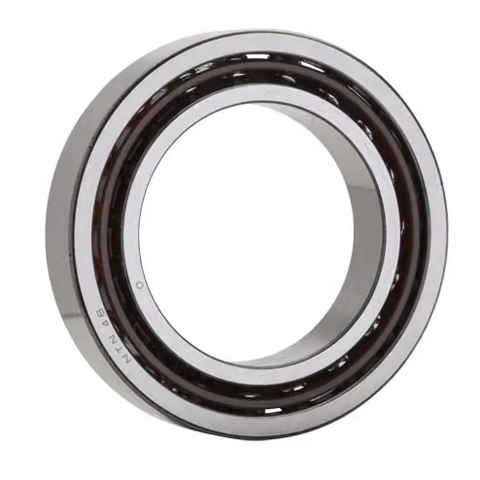
NTN NTN 7007 Angular Contact Bearing - D=35
NTN 7007 Angular Contact Bearing - 35 mm Bore, 62 mm OD, 14 mm Width, Open, Without Snap Ring, 30 ° Contact Angle, C0 SPECIFICATIONS Bore Diameter 35 mm Outside Diameter 62 mm Width 14 mm Overall Width 14.000 mm, 0.5512 in Contact Angle 30 ° Row Type & Fill Slot Single-Row Non-Fill Slot Closure Type Open Cage Type Fiber Glass Reinforced Internal Clearance C0 Snap Ring Included Without Snap Ring Bearing Material High Carbon Chrome Steel Radial Dynamic Load Capacity 17500 N Radial Static Load Capacity 12600 N Cage Material Nylon Harmonization Code 8482.10.5028 Outer Ring Width 14 mm Inner Ring Width 14.000 mm, 0.5512 in Configuration One Maximum RPM (Grease) 12000 rpm Maximum RPM 16000 rpm Finish/Coating Uncoated Precision Rating ISO Class 0 Fillet Radius 1 mm Series 70 Dynamic Load Capacity 3950 lbf Static Load Capacity 2830 lbf Weight 0.38 lbs Manufacturer UPC Number 4547359428902 Angular Contact Ball Bearings 1. Design features and characteristics 1.1 Angular contact ball bearing Angular contact ball bearings are non-separable bearings with a defined contact angle in the radial direction relative to the straight line that runs through the point where each ball makes contact with the inner and outer rings (see Fig. 1). Table 1 provides information on contact angles and their designated codes. In addition to radial loads, angular contact ball bearings can accommodate single direction axial loads. Since an axial load is generated from a radial force, these bearings are generally used in pairs. Table 2 shows general angular contact ball bearing characteristics, Table 3 shows information on using duplex (side by side) angular contact ball bearings, and Table 4 shows information on multiple-row angular contact ball bearings. For bearings with a contact angle of 15° and bearing tolerance JIS Class 5 or higher, see special catalog “Precision rolling bearings (CAT. No. 2260/E)”. 1.2 Four-point angular contact ball bearings Four-point angular contact ball bearings have a contact angle of 30° and a split inner ring. As shown in Fig. 2, when the inner and outer rings receive a radial load, the ball contacts the inner and outer rings at four points. This construction enables a single bearing to accommodate axial loads from either direction, and when under a simple axial load or heavy axial load, the bearing relies on two contact points like ordinary bearings. 1.3 Double row angular contact ball bearings The structure of double row angular contact ball bearings is designed by arranging two single row angular contact bearings back-to-back in duplex (DB) to form a single bearing with a contact angle of 25°.These bearings are capable of accommodating radial loads, axial loads in either direction, and have a high capacity for moment loads.As shown in Fig. 4, sealed and shielded type double row angular contact ball bearings are also available. Standard loads vary from those of open type bearings.
$19.76

NTN NTN 7018 Angular Contact Bearing - D=90
NTN 7018 Single Angular Contact Ball Bearing - Open Type SPECIFICATIONS Bore Diameter 90 mm, 3.5433 in Outside Diameter 140 mm, 5.5118 in Overall Width 24 mm, 0.9449 in Contact Angle 30 ° Closure Type Open Cage Type High Strength, 2 piece, Machined Bore Type Round Bearing Material High Carbon Chrome Steel Cage Material Brass Harmonization Code 8482.10.5028 Outer Ring Width 0.9449 in; 24.000 mm Inner Ring Width 24.000 mm, 0.9449 in Configuration One Maximum RPM (Grease) 4900 rpm Maximum RPM 6500 rpm Precision Rating ISO Class 0 Fillet Radius 0.0591 in, 1.500 mm Dynamic Load Capacity 14600 lbf Static Load Capacity 14300 lbf Manufacturer UPC Number 4547359433906 Angular Contact Ball Bearings 1. Design features and characteristics 1.1 Angular contact ball bearing Angular contact ball bearings are non-separable bearings with a defined contact angle in the radial direction relative to the straight line that runs through the point where each ball makes contact with the inner and outer rings (see Fig. 1). Table 1 provides information on contact angles and their designated codes. In addition to radial loads, angular contact ball bearings can accommodate single direction axial loads. Since an axial load is generated from a radial force, these bearings are generally used in pairs. Table 2 shows general angular contact ball bearing characteristics, Table 3 shows information on using duplex (side by side) angular contact ball bearings, and Table 4 shows information on multiple-row angular contact ball bearings. For bearings with a contact angle of 15° and bearing tolerance JIS Class 5 or higher, see special catalog “Precision rolling bearings (CAT. No. 2260/E)”. 1.2 Four-point angular contact ball bearings Four-point angular contact ball bearings have a contact angle of 30° and a split inner ring. As shown in Fig. 2, when the inner and outer rings receive a radial load, the ball contacts the inner and outer rings at four points. This construction enables a single bearing to accommodate axial loads from either direction, and when under a simple axial load or heavy axial load, the bearing relies on two contact points like ordinary bearings. 1.3 Double row angular contact ball bearings The structure of double row angular contact ball bearings is designed by arranging two single row angular contact bearings back-to-back in duplex (DB) to form a single bearing with a contact angle of 25°.These bearings are capable of accommodating radial loads, axial loads in either direction, and have a high capacity for moment loads.As shown in Fig. 4, sealed and shielded type double row angular contact ball bearings are also available. Standard loads vary from those of open type bearings.
$128.85

NTN NTN 7020 Angular Contact Bearing - D=100
NTN 7020 Angular Contact Bearing - 100 mm Bore, 150 mm OD, 24 mm Width, Open, Without Snap Ring, 30 ° Contact Angle, C0 SPECIFICATIONS Bore Diameter 100 mm Outside Diameter 150 mm Width 24 mm Overall Width 24.000 mm, 0.9449 in Contact Angle 30 ° Row Type & Fill Slot Single-Row Non-Fill Slot Closure Type Open Cage Type High Strength, 2 piece, Machined Internal Clearance C0 Snap Ring Included Without Snap Ring Bearing Material High Carbon Chrome Steel Radial Dynamic Load Capacity 68500 N Radial Static Load Capacity 70500 N Cage Material Brass Harmonization Code 8482.10.5028 Outer Ring Width 24 mm Inner Ring Width 24.000 mm, 0.9449 in Configuration One Maximum RPM (Grease) 4400 rpm Maximum RPM 5800 rpm Finish/Coating Uncoated Precision Rating ISO Class 0 Fillet Radius 1.5 mm Series 70 Dynamic Load Capacity 15400 lbf Static Load Capacity 15800 lbf Weight 3.15 lbs Manufacturer UPC Number 4547359434521 Angular Contact Ball Bearings 1. Design features and characteristics 1.1 Angular contact ball bearing Angular contact ball bearings are non-separable bearings with a defined contact angle in the radial direction relative to the straight line that runs through the point where each ball makes contact with the inner and outer rings (see Fig. 1). Table 1 provides information on contact angles and their designated codes. In addition to radial loads, angular contact ball bearings can accommodate single direction axial loads. Since an axial load is generated from a radial force, these bearings are generally used in pairs. Table 2 shows general angular contact ball bearing characteristics, Table 3 shows information on using duplex (side by side) angular contact ball bearings, and Table 4 shows information on multiple-row angular contact ball bearings. For bearings with a contact angle of 15° and bearing tolerance JIS Class 5 or higher, see special catalog “Precision rolling bearings (CAT. No. 2260/E)”. 1.2 Four-point angular contact ball bearings Four-point angular contact ball bearings have a contact angle of 30° and a split inner ring. As shown in Fig. 2, when the inner and outer rings receive a radial load, the ball contacts the inner and outer rings at four points. This construction enables a single bearing to accommodate axial loads from either direction, and when under a simple axial load or heavy axial load, the bearing relies on two contact points like ordinary bearings. 1.3 Double row angular contact ball bearings The structure of double row angular contact ball bearings is designed by arranging two single row angular contact bearings back-to-back in duplex (DB) to form a single bearing with a contact angle of 25°.These bearings are capable of accommodating radial loads, axial loads in either direction, and have a high capacity for moment loads.As shown in Fig. 4, sealed and shielded type double row angular contact ball bearings are also available. Standard loads vary from those of open type bearings.
$176.80

NTN NTN 7024 Angular Contact Bearing - D=120
NTN 7024 Single Angular Contact Ball Bearing - Open Type SPECIFICATIONS Bore Diameter 120 mm, 4.7244 in Outside Diameter 180 mm, 7.0866 in Overall Width 28 mm, 1.1024 in Contact Angle 30 ° Closure Type Open Cage Type High Strength, 2 piece, Machined Bore Type Round Bearing Material High Carbon Chrome Steel Cage Material Brass Harmonization Code 8482.10.5028 Outer Ring Width 1.1024 in; 28.000 mm Inner Ring Width 28.000 mm, 1.1024 in Configuration One Maximum RPM (Grease) 3600 rpm Maximum RPM 4800 rpm Precision Rating ISO Class 0 Fillet Radius 2.000 mm, 0.0787 in Dynamic Load Capacity 21000 lbf Static Load Capacity 22100 lbf Manufacturer UPC Number 4547359435160 Angular Contact Ball Bearings 1. Design features and characteristics 1.1 Angular contact ball bearing Angular contact ball bearings are non-separable bearings with a defined contact angle in the radial direction relative to the straight line that runs through the point where each ball makes contact with the inner and outer rings (see Fig. 1). Table 1 provides information on contact angles and their designated codes. In addition to radial loads, angular contact ball bearings can accommodate single direction axial loads. Since an axial load is generated from a radial force, these bearings are generally used in pairs. Table 2 shows general angular contact ball bearing characteristics, Table 3 shows information on using duplex (side by side) angular contact ball bearings, and Table 4 shows information on multiple-row angular contact ball bearings. For bearings with a contact angle of 15° and bearing tolerance JIS Class 5 or higher, see special catalog “Precision rolling bearings (CAT. No. 2260/E)”. 1.2 Four-point angular contact ball bearings Four-point angular contact ball bearings have a contact angle of 30° and a split inner ring. As shown in Fig. 2, when the inner and outer rings receive a radial load, the ball contacts the inner and outer rings at four points. This construction enables a single bearing to accommodate axial loads from either direction, and when under a simple axial load or heavy axial load, the bearing relies on two contact points like ordinary bearings. 1.3 Double row angular contact ball bearings The structure of double row angular contact ball bearings is designed by arranging two single row angular contact bearings back-to-back in duplex (DB) to form a single bearing with a contact angle of 25°.These bearings are capable of accommodating radial loads, axial loads in either direction, and have a high capacity for moment loads.As shown in Fig. 4, sealed and shielded type double row angular contact ball bearings are also available. Standard loads vary from those of open type bearings.
$298.01

NTN NTN 7028 Angular Contact Bearing - D=140
NTN 7028 Single Angular Contact Ball Bearing - Open Type SPECIFICATIONS Bore Diameter 140 mm, 5.5118 in Outside Diameter 210 mm, 8.2677 in Overall Width 33 mm, 1.2992 in Contact Angle 30 ° Closure Type Open Cage Type High Strength, 2 piece, Machined Bore Type Round Bearing Material High Carbon Chrome Steel Cage Material Brass Harmonization Code 8482.10.5028 Outer Ring Width 1.2992 in; 33.000 mm Inner Ring Width 33.000 mm, 1.2992 in Configuration One Maximum RPM (Grease) 3100 rpm Maximum RPM 4100 rpm Precision Rating ISO Class 0 Fillet Radius 2.000 mm, 0.0787 in Dynamic Load Capacity 27000 lbf Static Load Capacity 29900 lbf Manufacturer UPC Number 4547359435542 Angular Contact Ball Bearings 1. Design features and characteristics 1.1 Angular contact ball bearing Angular contact ball bearings are non-separable bearings with a defined contact angle in the radial direction relative to the straight line that runs through the point where each ball makes contact with the inner and outer rings (see Fig. 1). Table 1 provides information on contact angles and their designated codes. In addition to radial loads, angular contact ball bearings can accommodate single direction axial loads. Since an axial load is generated from a radial force, these bearings are generally used in pairs. Table 2 shows general angular contact ball bearing characteristics, Table 3 shows information on using duplex (side by side) angular contact ball bearings, and Table 4 shows information on multiple-row angular contact ball bearings. For bearings with a contact angle of 15° and bearing tolerance JIS Class 5 or higher, see special catalog “Precision rolling bearings (CAT. No. 2260/E)”. 1.2 Four-point angular contact ball bearings Four-point angular contact ball bearings have a contact angle of 30° and a split inner ring. As shown in Fig. 2, when the inner and outer rings receive a radial load, the ball contacts the inner and outer rings at four points. This construction enables a single bearing to accommodate axial loads from either direction, and when under a simple axial load or heavy axial load, the bearing relies on two contact points like ordinary bearings. 1.3 Double row angular contact ball bearings The structure of double row angular contact ball bearings is designed by arranging two single row angular contact bearings back-to-back in duplex (DB) to form a single bearing with a contact angle of 25°.These bearings are capable of accommodating radial loads, axial loads in either direction, and have a high capacity for moment loads.As shown in Fig. 4, sealed and shielded type double row angular contact ball bearings are also available. Standard loads vary from those of open type bearings.
$453.20

NTN NTN 7200 Angular Contact Bearing - D=10
NTN 7200 Single Angular Contact Ball Bearing - Open Type SPECIFICATIONS Bore Diameter 10 mm, 0.3937 in Outside Diameter 30 mm, 1.1811 in Overall Width 9 mm, 0.3543 in Contact Angle 30 ° Closure Type Open Cage Type Pressed Bore Type Round Bearing Material High Carbon Chrome Steel Cage Material Steel Harmonization Code 8482.10.5028 Outer Ring Width 0.3543 in; 9.000 mm Inner Ring Width 9.000 mm, 0.3543 in Configuration One Maximum RPM (Grease) 28000 rpm Maximum RPM 37000 rpm Precision Rating ISO Class 0 Fillet Radius 0.600 mm, 0.0236 in Dynamic Load Capacity 1230 lbf Static Load Capacity 615 lbf Manufacturer UPC Number 4547359436198 Angular Contact Ball Bearings 1. Design features and characteristics 1.1 Angular contact ball bearing Angular contact ball bearings are non-separable bearings with a defined contact angle in the radial direction relative to the straight line that runs through the point where each ball makes contact with the inner and outer rings (see Fig. 1). Table 1 provides information on contact angles and their designated codes. In addition to radial loads, angular contact ball bearings can accommodate single direction axial loads. Since an axial load is generated from a radial force, these bearings are generally used in pairs. Table 2 shows general angular contact ball bearing characteristics, Table 3 shows information on using duplex (side by side) angular contact ball bearings, and Table 4 shows information on multiple-row angular contact ball bearings. For bearings with a contact angle of 15° and bearing tolerance JIS Class 5 or higher, see special catalog “Precision rolling bearings (CAT. No. 2260/E)”. 1.2 Four-point angular contact ball bearings Four-point angular contact ball bearings have a contact angle of 30° and a split inner ring. As shown in Fig. 2, when the inner and outer rings receive a radial load, the ball contacts the inner and outer rings at four points. This construction enables a single bearing to accommodate axial loads from either direction, and when under a simple axial load or heavy axial load, the bearing relies on two contact points like ordinary bearings. 1.3 Double row angular contact ball bearings The structure of double row angular contact ball bearings is designed by arranging two single row angular contact bearings back-to-back in duplex (DB) to form a single bearing with a contact angle of 25°.These bearings are capable of accommodating radial loads, axial loads in either direction, and have a high capacity for moment loads.As shown in Fig. 4, sealed and shielded type double row angular contact ball bearings are also available. Standard loads vary from those of open type bearings.
$8.95

NTN NTN 7201CP5 Angular Contact Bearing - D=12
NTN 7201CP5 Angular Contact Bearing - D=12 7201C P5 high precision Angular Ball Bearing with 15 degrees contact angle,ABEC 5 (P5) quality. Inner diameter is 12mm, outer diameter is 32mm and width is 10mm. SPECIFICATIONS Item: 7201C P5 Angular Ball Bearing Type: High Precision Angular Ball Bearing Cage: PA66+ 30% NTE264B Cage Quality: ABEC-5 (P5 quality) Dimensions: 12mm x 32mm x 10mm/Metric ID (inner diameter)/Bore: 12mm OD (outer diameter): 32mm Width/Height/thickness: 10mm Size: 12 x 32 x 10 mm Quantity: One Bearing Dynamic load rating Cr: 7,950 N Static load rating Cor: 3,900 N Limiting Speed: Grease Lubrication: 36,000 RPM Oil Lubrication: 50,000 RPM Angular Contact Ball Bearings 1. Design features and characteristics 1.1 Angular contact ball bearing Angular contact ball bearings are non-separable bearings with a defined contact angle in the radial direction relative to the straight line that runs through the point where each ball makes contact with the inner and outer rings (see Fig. 1). Table 1 provides information on contact angles and their designated codes. In addition to radial loads, angular contact ball bearings can accommodate single direction axial loads. Since an axial load is generated from a radial force, these bearings are generally used in pairs. Table 2 shows general angular contact ball bearing characteristics, Table 3 shows information on using duplex (side by side) angular contact ball bearings, and Table 4 shows information on multiple-row angular contact ball bearings. For bearings with a contact angle of 15° and bearing tolerance JIS Class 5 or higher, see special catalog “Precision rolling bearings (CAT. No. 2260/E)”. 1.2 Four-point angular contact ball bearings Four-point angular contact ball bearings have a contact angle of 30° and a split inner ring. As shown in Fig. 2, when the inner and outer rings receive a radial load, the ball contacts the inner and outer rings at four points. This construction enables a single bearing to accommodate axial loads from either direction, and when under a simple axial load or heavy axial load, the bearing relies on two contact points like ordinary bearings. 1.3 Double row angular contact ball bearings The structure of double row angular contact ball bearings is designed by arranging two single row angular contact bearings back-to-back in duplex (DB) to form a single bearing with a contact angle of 25°.These bearings are capable of accommodating radial loads, axial loads in either direction, and have a high capacity for moment loads.As shown in Fig. 4, sealed and shielded type double row angular contact ball bearings are also available. Standard loads vary from those of open type bearings.
$27.11

NTN NTN 7202 Angular Contact Bearing - D=15
NTN 7202 Angular Contact Bearing - 15 mm Bore, 35 mm OD, 11 mm Width, Open, Without Snap Ring, 30 ° Contact Angle, C0 SPECIFICATIONS Bore Diameter 15 mm Outside Diameter 35 mm Width 11 mm Overall Width 11.000 mm, 0.4331 in Contact Angle 30 ° Row Type & Fill Slot Single-Row Non-Fill Slot Closure Type Open Cage Type Pressed Internal Clearance C0 Snap Ring Included Without Snap Ring Bearing Material High Carbon Chrome Steel Radial Dynamic Load Capacity 9050 N Radial Static Load Capacity 4700 N Cage Material Steel Harmonization Code 8482.10.5028 Outer Ring Width 11 mm Inner Ring Width 11.000 mm, 0.4331 in Configuration One Maximum RPM (Grease) 22000 rpm Maximum RPM 29000 rpm Finish/Coating Uncoated Precision Rating ISO Class 0 Fillet Radius 0.6 mm Series 72 Dynamic Load Capacity 2030 lbf Static Load Capacity 1060 lbf Weight 0.10 lbs Manufacturer UPC Number 4547359436655 Angular Contact Ball Bearings 1. Design features and characteristics 1.1 Angular contact ball bearing Angular contact ball bearings are non-separable bearings with a defined contact angle in the radial direction relative to the straight line that runs through the point where each ball makes contact with the inner and outer rings (see Fig. 1). Table 1 provides information on contact angles and their designated codes. In addition to radial loads, angular contact ball bearings can accommodate single direction axial loads. Since an axial load is generated from a radial force, these bearings are generally used in pairs. Table 2 shows general angular contact ball bearing characteristics, Table 3 shows information on using duplex (side by side) angular contact ball bearings, and Table 4 shows information on multiple-row angular contact ball bearings. For bearings with a contact angle of 15° and bearing tolerance JIS Class 5 or higher, see special catalog “Precision rolling bearings (CAT. No. 2260/E)”. 1.2 Four-point angular contact ball bearings Four-point angular contact ball bearings have a contact angle of 30° and a split inner ring. As shown in Fig. 2, when the inner and outer rings receive a radial load, the ball contacts the inner and outer rings at four points. This construction enables a single bearing to accommodate axial loads from either direction, and when under a simple axial load or heavy axial load, the bearing relies on two contact points like ordinary bearings. 1.3 Double row angular contact ball bearings The structure of double row angular contact ball bearings is designed by arranging two single row angular contact bearings back-to-back in duplex (DB) to form a single bearing with a contact angle of 25°.These bearings are capable of accommodating radial loads, axial loads in either direction, and have a high capacity for moment loads.As shown in Fig. 4, sealed and shielded type double row angular contact ball bearings are also available. Standard loads vary from those of open type bearings.
$9.42

NTN NTN 7203 Angular Contact Bearing - D=17
NTN 7203 Angular Contact Bearing - 17 mm Bore, 40 mm OD, 12 mm Width, Open, Without Snap Ring, 30 ° Contact Angle, C0 SPECIFICATIONS Bore Diameter 17 mm Outside Diameter 40 mm Width 12 mm Overall Width 0.4724 in, 12.000 mm Contact Angle 30 ° Row Type & Fill Slot Single-Row Non-Fill Slot Closure Type Open Cage Type Pressed Internal Clearance C0 Snap Ring Included Without Snap Ring Bearing Material High Carbon Chrome Steel Radial Dynamic Load Capacity 12000 N Radial Static Load Capacity 6600 N Cage Material Steel Harmonization Code 8482.10.5028 Outer Ring Width 12 mm Inner Ring Width 0.4724 in, 12.000 mm Configuration One Maximum RPM (Grease) 19000 rpm Maximum RPM 26000 rpm Finish/Coating Uncoated Precision Rating ISO Class 0 Fillet Radius 0.6 mm Series 72 Dynamic Load Capacity 2700 lbf Static Load Capacity 1480 lbf Weight 0.14 lbs Manufacturer UPC Number 4547359437126 Angular Contact Ball Bearings 1. Design features and characteristics 1.1 Angular contact ball bearing Angular contact ball bearings are non-separable bearings with a defined contact angle in the radial direction relative to the straight line that runs through the point where each ball makes contact with the inner and outer rings (see Fig. 1). Table 1 provides information on contact angles and their designated codes. In addition to radial loads, angular contact ball bearings can accommodate single direction axial loads. Since an axial load is generated from a radial force, these bearings are generally used in pairs. Table 2 shows general angular contact ball bearing characteristics, Table 3 shows information on using duplex (side by side) angular contact ball bearings, and Table 4 shows information on multiple-row angular contact ball bearings. For bearings with a contact angle of 15° and bearing tolerance JIS Class 5 or higher, see special catalog “Precision rolling bearings (CAT. No. 2260/E)”. 1.2 Four-point angular contact ball bearings Four-point angular contact ball bearings have a contact angle of 30° and a split inner ring. As shown in Fig. 2, when the inner and outer rings receive a radial load, the ball contacts the inner and outer rings at four points. This construction enables a single bearing to accommodate axial loads from either direction, and when under a simple axial load or heavy axial load, the bearing relies on two contact points like ordinary bearings. 1.3 Double row angular contact ball bearings The structure of double row angular contact ball bearings is designed by arranging two single row angular contact bearings back-to-back in duplex (DB) to form a single bearing with a contact angle of 25°.These bearings are capable of accommodating radial loads, axial loads in either direction, and have a high capacity for moment loads.As shown in Fig. 4, sealed and shielded type double row angular contact ball bearings are also available. Standard loads vary from those of open type bearings.
$9.99

NTN NTN 7205 Angular Contact Bearing - D=25
NTN 7205 Angular Contact Bearing - 25 mm Bore, 52 mm OD, 15 mm Width, Open, Without Snap Ring, 30 ° Contact Angle, C0 SPECIFICATIONS Bore Diameter 25 mm Outside Diameter 52 mm Width 15 mm Overall Width 15.000 mm, 0.5906 in Contact Angle 30 ° Row Type & Fill Slot Single-Row Non-Fill Slot Closure Type Open Cage Type Pressed Internal Clearance C0 Snap Ring Included Without Snap Ring Bearing Material High Carbon Chrome Steel Radial Dynamic Load Capacity 16200 N Radial Static Load Capacity 10300 N Cage Material Steel Harmonization Code 8482.10.5028 Outer Ring Width 15 mm Inner Ring Width 15.000 mm, 0.5906 in Configuration One Maximum RPM (Grease) 14000 rpm Maximum RPM 19000 rpm Finish/Coating Uncoated Precision Rating ISO Class 0 Fillet Radius 1 mm Series 72 Dynamic Load Capacity 3650 lbf Static Load Capacity 2320 lbf Weight 0.28 lbs Manufacturer UPC Number 4547359438376 Angular Contact Ball Bearings 1. Design features and characteristics 1.1 Angular contact ball bearing Angular contact ball bearings are non-separable bearings with a defined contact angle in the radial direction relative to the straight line that runs through the point where each ball makes contact with the inner and outer rings (see Fig. 1). Table 1 provides information on contact angles and their designated codes. In addition to radial loads, angular contact ball bearings can accommodate single direction axial loads. Since an axial load is generated from a radial force, these bearings are generally used in pairs. Table 2 shows general angular contact ball bearing characteristics, Table 3 shows information on using duplex (side by side) angular contact ball bearings, and Table 4 shows information on multiple-row angular contact ball bearings. For bearings with a contact angle of 15° and bearing tolerance JIS Class 5 or higher, see special catalog “Precision rolling bearings (CAT. No. 2260/E)”. 1.2 Four-point angular contact ball bearings Four-point angular contact ball bearings have a contact angle of 30° and a split inner ring. As shown in Fig. 2, when the inner and outer rings receive a radial load, the ball contacts the inner and outer rings at four points. This construction enables a single bearing to accommodate axial loads from either direction, and when under a simple axial load or heavy axial load, the bearing relies on two contact points like ordinary bearings. 1.3 Double row angular contact ball bearings The structure of double row angular contact ball bearings is designed by arranging two single row angular contact bearings back-to-back in duplex (DB) to form a single bearing with a contact angle of 25°.These bearings are capable of accommodating radial loads, axial loads in either direction, and have a high capacity for moment loads.As shown in Fig. 4, sealed and shielded type double row angular contact ball bearings are also available. Standard loads vary from those of open type bearings.
$12.74

NTN NTN 7209CP5 High Precision Angular Contact Bearing - D=45
NTN 7209CP5 High Precision Angular Contact Bearing - D=45 7209C P4 High Precision Angular Ball Bearing with 15 degrees contact angle.bearing is ABEC 5 (P5) quality. SPECIFICATIONS Item: 7209C P5 Ball Bearing Type: High Precision Angular Ball Bearing Cage: PA66 + 30% NTE264B Quality: ABEC-5 (P5 quality) Dimensions: 45mm x 85mm x 19mm/Metric ID (inner diameter)/Bore: 45mm OD (outer diameter): 85mm Width/Height/thickness: 19mm Size: 45 x 85 x 19 mm Quantity: One Bearing Dynamic load rating Cr: 41,000 N Static load rating Cor: 29,000 N Limiting Speed: Grease Lubrication: 12,000 RPM Oil Lubrication: 17,000 RPM Dimensions d D B r r1 a 45mm 85mm 19mm 1.1mm 0.6mm -2mm Angular Contact Ball Bearings 1. Design features and characteristics 1.1 Angular contact ball bearing Angular contact ball bearings are non-separable bearings with a defined contact angle in the radial direction relative to the straight line that runs through the point where each ball makes contact with the inner and outer rings (see Fig. 1). Table 1 provides information on contact angles and their designated codes. In addition to radial loads, angular contact ball bearings can accommodate single direction axial loads. Since an axial load is generated from a radial force, these bearings are generally used in pairs. Table 2 shows general angular contact ball bearing characteristics, Table 3 shows information on using duplex (side by side) angular contact ball bearings, and Table 4 shows information on multiple-row angular contact ball bearings. For bearings with a contact angle of 15° and bearing tolerance JIS Class 5 or higher, see special catalog “Precision rolling bearings (CAT. No. 2260/E)”. 1.2 Four-point angular contact ball bearings Four-point angular contact ball bearings have a contact angle of 30° and a split inner ring. As shown in Fig. 2, when the inner and outer rings receive a radial load, the ball contacts the inner and outer rings at four points. This construction enables a single bearing to accommodate axial loads from either direction, and when under a simple axial load or heavy axial load, the bearing relies on two contact points like ordinary bearings. 1.3 Double row angular contact ball bearings The structure of double row angular contact ball bearings is designed by arranging two single row angular contact bearings back-to-back in duplex (DB) to form a single bearing with a contact angle of 25°.These bearings are capable of accommodating radial loads, axial loads in either direction, and have a high capacity for moment loads.As shown in Fig. 4, sealed and shielded type double row angular contact ball bearings are also available. Standard loads vary from those of open type bearings.
$62.93

NTN NTN 7212CP5 High Precision Angular Contact Bearing - D=60
NTN 7212CP5 High Precision Angular Contact Bearing - D=60 7212C P5 High Precision Angular Ball Bearing with 15 degrees contact angle. Bearing is ABEC 5 (P5) quality .7212C P5 inner diameter is 60mm, outer diameter is 110mm, width is 22mm. SPECIFICATIONS Item: 7212C P5 Ball Bearing Type: High precision Angular Ball Bearing Cage: PA66+ 30% NTE264B Quality: ABEC-5 (P5 quality) Dimensions: 60mm x 110mm x 22mm/Metric ID (inner diameter)/Bore: 60mm OD (outer diameter): 110mm Width/Height/thickness: 22mm Size: 60 x 110 x 22 mm Quantity: One Bearing Dynamic load rating Cr: 64,500 N Static load rating Cor: 49,500 N Limiting Speed: Grease Lubrication: 9,400 RPM Oil Lubrication: 13,000 RPM Dimensions d D B r r1 a 60mm 110mm 22mm 1.5mm 1mm -1.2mm Angular Contact Ball Bearings 1. Design features and characteristics 1.1 Angular contact ball bearing Angular contact ball bearings are non-separable bearings with a defined contact angle in the radial direction relative to the straight line that runs through the point where each ball makes contact with the inner and outer rings (see Fig. 1). Table 1 provides information on contact angles and their designated codes. In addition to radial loads, angular contact ball bearings can accommodate single direction axial loads. Since an axial load is generated from a radial force, these bearings are generally used in pairs. Table 2 shows general angular contact ball bearing characteristics, Table 3 shows information on using duplex (side by side) angular contact ball bearings, and Table 4 shows information on multiple-row angular contact ball bearings. For bearings with a contact angle of 15° and bearing tolerance JIS Class 5 or higher, see special catalog “Precision rolling bearings (CAT. No. 2260/E)”. 1.2 Four-point angular contact ball bearings Four-point angular contact ball bearings have a contact angle of 30° and a split inner ring. As shown in Fig. 2, when the inner and outer rings receive a radial load, the ball contacts the inner and outer rings at four points. This construction enables a single bearing to accommodate axial loads from either direction, and when under a simple axial load or heavy axial load, the bearing relies on two contact points like ordinary bearings. 1.3 Double row angular contact ball bearings The structure of double row angular contact ball bearings is designed by arranging two single row angular contact bearings back-to-back in duplex (DB) to form a single bearing with a contact angle of 25°.These bearings are capable of accommodating radial loads, axial loads in either direction, and have a high capacity for moment loads.As shown in Fig. 4, sealed and shielded type double row angular contact ball bearings are also available. Standard loads vary from those of open type bearings.
$98.70

NTN NTN 7214BDB Angular Contact Bearing - D=70
NTN 7214BDB Angular Contact Bearing - D=70 The values in the “Width (mm)” section of product specification are per-row (single-row) width even when a double-row combination product is selected (B Dimension in catalog).Please be aware that the overall width for double-row products is twice as wide (2B) as those indicated dimensions. SPECIFICATIONS Type Angular Contact Ball Bearing (Double Row) Inner/Outer Ring Material [Steel] Steel Bearing Style Double Shielded Outer Ring Shape Flat Precision Grade 0 I.D.(Ø) 70 O.D.(Ø) 125 Width(mm) 24 Basic Dynamic Load Rating(N) 69000 Max. Allowed rpm(rpm) - Specifications, Environment Standard / For high Speed Load Direction Radial Outer Ring With Outer Ring Size Standards Metric System Rolling Element Material [Steel] Steel Combination of Angular Contact Ball Bearings - Retainer Type Resin Forming Basic Load Rating, Static Rating(N) - Clearance sign No Preload No Contact angle(Degree) 40 Holder Symbol No Symbol of Bearing Ring Shape No Seal, Shield Symbols No Precision Grade Symbol No Symbol of contact angle B Combination symbol DB Preload Mark No Special Configurations Code No Bearing type symbol No Type symbol No Material Symbol No Spacer, Sleeve symbol No RoHS 10 Angular Contact Ball Bearings 1. Design features and characteristics 1.1 Angular contact ball bearing Angular contact ball bearings are non-separable bearings with a defined contact angle in the radial direction relative to the straight line that runs through the point where each ball makes contact with the inner and outer rings (see Fig. 1). Table 1 provides information on contact angles and their designated codes. In addition to radial loads, angular contact ball bearings can accommodate single direction axial loads. Since an axial load is generated from a radial force, these bearings are generally used in pairs. Table 2 shows general angular contact ball bearing characteristics, Table 3 shows information on using duplex (side by side) angular contact ball bearings, and Table 4 shows information on multiple-row angular contact ball bearings. For bearings with a contact angle of 15° and bearing tolerance JIS Class 5 or higher, see special catalog “Precision rolling bearings (CAT. No. 2260/E)”. 1.2 Four-point angular contact ball bearings Four-point angular contact ball bearings have a contact angle of 30° and a split inner ring. As shown in Fig. 2, when the inner and outer rings receive a radial load, the ball contacts the inner and outer rings at four points. This construction enables a single bearing to accommodate axial loads from either direction, and when under a simple axial load or heavy axial load, the bearing relies on two contact points like ordinary bearings. 1.3 Double row angular contact ball bearings The structure of double row angular contact ball bearings is designed by arranging two single row angular contact bearings back-to-back in duplex (DB) to form a single bearing with a contact angle of 25°.These bearings are capable of accommodating radial loads, axial loads in either direction, and have a high capacity for moment loads.As shown in Fig. 4, sealed and shielded type double row angular contact ball bearings are also available. Standard loads vary from those of open type bearings.
$61.88

NTN NTN 7216 Angular Contact Bearing - D=80
NTN 7216 Angular Contact Bearing - 80 mm Bore, 140 mm OD, 26 mm Width, Open, Without Snap Ring, 30 ° Contact Angle, C0 SPECIFICATIONS Bore Diameter 80 mm Outside Diameter 140 mm Width 26 mm Overall Width 26.000 mm, 1.0236 in Contact Angle 30 ° Row Type & Fill Slot Single-Row Non-Fill Slot Closure Type Open Cage Type Pressed Internal Clearance C0 Snap Ring Included Without Snap Ring Bearing Material High Carbon Chrome Steel Radial Dynamic Load Capacity 89000 N Radial Static Load Capacity 76000 N Cage Material Steel Harmonization Code 8482.10.5028 Outer Ring Width 26 mm Inner Ring Width 26.000 mm, 1.0236 in Configuration One Maximum RPM (Grease) 5000 rpm Maximum RPM 6600 rpm Finish/Coating Uncoated Precision Rating ISO Class 0 Fillet Radius 2 mm Series 72 Dynamic Load Capacity 20000 lbf Static Load Capacity 17100 lbf Weight 3.20 lbs Manufacturer UPC Number 4547359445039 Angular Contact Ball Bearings 1. Design features and characteristics 1.1 Angular contact ball bearing Angular contact ball bearings are non-separable bearings with a defined contact angle in the radial direction relative to the straight line that runs through the point where each ball makes contact with the inner and outer rings (see Fig. 1). Table 1 provides information on contact angles and their designated codes. In addition to radial loads, angular contact ball bearings can accommodate single direction axial loads. Since an axial load is generated from a radial force, these bearings are generally used in pairs. Table 2 shows general angular contact ball bearing characteristics, Table 3 shows information on using duplex (side by side) angular contact ball bearings, and Table 4 shows information on multiple-row angular contact ball bearings. For bearings with a contact angle of 15° and bearing tolerance JIS Class 5 or higher, see special catalog “Precision rolling bearings (CAT. No. 2260/E)”. 1.2 Four-point angular contact ball bearings Four-point angular contact ball bearings have a contact angle of 30° and a split inner ring. As shown in Fig. 2, when the inner and outer rings receive a radial load, the ball contacts the inner and outer rings at four points. This construction enables a single bearing to accommodate axial loads from either direction, and when under a simple axial load or heavy axial load, the bearing relies on two contact points like ordinary bearings. 1.3 Double row angular contact ball bearings The structure of double row angular contact ball bearings is designed by arranging two single row angular contact bearings back-to-back in duplex (DB) to form a single bearing with a contact angle of 25°.These bearings are capable of accommodating radial loads, axial loads in either direction, and have a high capacity for moment loads.As shown in Fig. 4, sealed and shielded type double row angular contact ball bearings are also available. Standard loads vary from those of open type bearings.
$71.54

NTN NTN 7220 Angular Contact Bearing - D=100
NTN 7220 Single Angular Contact Ball Bearing - Open Type SPECIFICATIONS Bore Diameter 100 mm, 3.9370 in Outside Diameter 180 mm, 7.0866 in Overall Width 34 mm, 1.3386 in Contact Angle 30 ° Closure Type Open Cage Type Pressed Bore Type Round Bearing Material High Carbon Chrome Steel Cage Material Steel Harmonization Code 8482.10.5028 Outer Ring Width 1.3386 in; 34.000 mm Inner Ring Width 34.000 mm, 1.3386 in Configuration One Maximum RPM (Grease) 3900 rpm Maximum RPM 5200 rpm Precision Rating ISO Class 0 Fillet Radius 0.0827 in, 2.100 mm Dynamic Load Capacity 32500 lbf Static Load Capacity 28300 lbf Manufacturer UPC Number 4547359446548 Angular Contact Ball Bearings 1. Design features and characteristics 1.1 Angular contact ball bearing Angular contact ball bearings are non-separable bearings with a defined contact angle in the radial direction relative to the straight line that runs through the point where each ball makes contact with the inner and outer rings (see Fig. 1). Table 1 provides information on contact angles and their designated codes. In addition to radial loads, angular contact ball bearings can accommodate single direction axial loads. Since an axial load is generated from a radial force, these bearings are generally used in pairs. Table 2 shows general angular contact ball bearing characteristics, Table 3 shows information on using duplex (side by side) angular contact ball bearings, and Table 4 shows information on multiple-row angular contact ball bearings. For bearings with a contact angle of 15° and bearing tolerance JIS Class 5 or higher, see special catalog “Precision rolling bearings (CAT. No. 2260/E)”. 1.2 Four-point angular contact ball bearings Four-point angular contact ball bearings have a contact angle of 30° and a split inner ring. As shown in Fig. 2, when the inner and outer rings receive a radial load, the ball contacts the inner and outer rings at four points. This construction enables a single bearing to accommodate axial loads from either direction, and when under a simple axial load or heavy axial load, the bearing relies on two contact points like ordinary bearings. 1.3 Double row angular contact ball bearings The structure of double row angular contact ball bearings is designed by arranging two single row angular contact bearings back-to-back in duplex (DB) to form a single bearing with a contact angle of 25°.These bearings are capable of accommodating radial loads, axial loads in either direction, and have a high capacity for moment loads.As shown in Fig. 4, sealed and shielded type double row angular contact ball bearings are also available. Standard loads vary from those of open type bearings.
$139.63

NTN NTN 7302 Angular Contact Bearing - D=15
NTN7302 Angular Contact Bearing - 15 mm Bore, 42 mm OD, 13 mm Width, Open, Without Snap Ring, 30 ° Contact Angle SPECIFICATIONS Bore Diameter 15 mm Outside Diameter 42 mm Width 13 mm Overall Width 13.000 mm, 0.5118 in Contact Angle 30 ° Row Type & Fill Slot Single-Row Non-Fill Slot Closure Type Open Cage Type Pressed Snap Ring Included Without Snap Ring Bearing Material High Carbon Chrome Steel Radial Dynamic Load Capacity 13500 N Radial Static Load Capacity 7200 N Cage Material Steel Harmonization Code 8482.10.5028 Outer Ring Width 0.5118 in; 13.000 mm Inner Ring Width 13.000 mm, 0.5118 in Configuration One Maximum RPM (Grease) 19000 rpm Maximum RPM 26000 rpm Finish/Coating Uncoated Precision Rating ISO Class 0 Fillet Radius 1 mm Dynamic Load Capacity 3050 lbf Static Load Capacity 1620 lbf Weight 0.18 lbs Manufacturer UPC Number 4547359447989 Angular Contact Ball Bearings 1. Design features and characteristics 1.1 Angular contact ball bearing Angular contact ball bearings are non-separable bearings with a defined contact angle in the radial direction relative to the straight line that runs through the point where each ball makes contact with the inner and outer rings (see Fig. 1). Table 1 provides information on contact angles and their designated codes. In addition to radial loads, angular contact ball bearings can accommodate single direction axial loads. Since an axial load is generated from a radial force, these bearings are generally used in pairs. Table 2 shows general angular contact ball bearing characteristics, Table 3 shows information on using duplex (side by side) angular contact ball bearings, and Table 4 shows information on multiple-row angular contact ball bearings. For bearings with a contact angle of 15° and bearing tolerance JIS Class 5 or higher, see special catalog “Precision rolling bearings (CAT. No. 2260/E)”. 1.2 Four-point angular contact ball bearings Four-point angular contact ball bearings have a contact angle of 30° and a split inner ring. As shown in Fig. 2, when the inner and outer rings receive a radial load, the ball contacts the inner and outer rings at four points. This construction enables a single bearing to accommodate axial loads from either direction, and when under a simple axial load or heavy axial load, the bearing relies on two contact points like ordinary bearings. 1.3 Double row angular contact ball bearings The structure of double row angular contact ball bearings is designed by arranging two single row angular contact bearings back-to-back in duplex (DB) to form a single bearing with a contact angle of 25°.These bearings are capable of accommodating radial loads, axial loads in either direction, and have a high capacity for moment loads.As shown in Fig. 4, sealed and shielded type double row angular contact ball bearings are also available. Standard loads vary from those of open type bearings.
$12.33

NTN NTN 7303 Angular Contact Bearing - D=17
NTN 7303 Single Angular Contact Ball Bearing - Open Type SPECIFICATIONS Bore Diameter 17 mm, 0.6693 in Outside Diameter 47 mm, 1.8504 in Overall Width 14 mm, 0.5512 in Contact Angle 30 ° Closure Type Open Cage Type Pressed Bore Type Round Bearing Material High Carbon Chrome Steel Cage Material Steel Harmonization Code 8482.10.5028 Outer Ring Width 0.5512 in; 14.000 mm Inner Ring Width 14.000 mm, 0.5512 in Configuration One Maximum RPM (Grease) 18000 rpm Maximum RPM 24000 rpm Precision Rating ISO Class 0 Fillet Radius 1.000 mm, 0.0394 in Dynamic Load Capacity 3550 lbf Static Load Capacity 1940 lbf Manufacturer UPC Number 4547359448153 Angular Contact Ball Bearings 1. Design features and characteristics 1.1 Angular contact ball bearing Angular contact ball bearings are non-separable bearings with a defined contact angle in the radial direction relative to the straight line that runs through the point where each ball makes contact with the inner and outer rings (see Fig. 1). Table 1 provides information on contact angles and their designated codes. In addition to radial loads, angular contact ball bearings can accommodate single direction axial loads. Since an axial load is generated from a radial force, these bearings are generally used in pairs. Table 2 shows general angular contact ball bearing characteristics, Table 3 shows information on using duplex (side by side) angular contact ball bearings, and Table 4 shows information on multiple-row angular contact ball bearings. For bearings with a contact angle of 15° and bearing tolerance JIS Class 5 or higher, see special catalog “Precision rolling bearings (CAT. No. 2260/E)”. 1.2 Four-point angular contact ball bearings Four-point angular contact ball bearings have a contact angle of 30° and a split inner ring. As shown in Fig. 2, when the inner and outer rings receive a radial load, the ball contacts the inner and outer rings at four points. This construction enables a single bearing to accommodate axial loads from either direction, and when under a simple axial load or heavy axial load, the bearing relies on two contact points like ordinary bearings. 1.3 Double row angular contact ball bearings The structure of double row angular contact ball bearings is designed by arranging two single row angular contact bearings back-to-back in duplex (DB) to form a single bearing with a contact angle of 25°.These bearings are capable of accommodating radial loads, axial loads in either direction, and have a high capacity for moment loads.As shown in Fig. 4, sealed and shielded type double row angular contact ball bearings are also available. Standard loads vary from those of open type bearings.
$13.85

NTN NTN 7304 Angular Contact Bearing - D=20
NTN 7304 Single Angular Contact Ball Bearing - Open Type SPECIFICATIONS Bore Diameter 20 mm, 0.7874 in Outside Diameter 52 mm, 2.0472 in Overall Width 15 mm, 0.5906 in Contact Angle 30 ° Closure Type Open Cage Type Pressed Bore Type Round Bearing Material High Carbon Chrome Steel Cage Material Steel Outer Ring Width 0.5906 in; 15.000 mm Inner Ring Width 15.000 mm, 0.5906 in Configuration One Maximum RPM (Grease) 16000 rpm Maximum RPM 21000 rpm Fillet Radius 1.100 mm, 0.0433 in Dynamic Load Capacity 4200 lbf Static Load Capacity 2340 lbf Manufacturer UPC Number 4547359448405 Angular Contact Ball Bearings 1. Design features and characteristics 1.1 Angular contact ball bearing Angular contact ball bearings are non-separable bearings with a defined contact angle in the radial direction relative to the straight line that runs through the point where each ball makes contact with the inner and outer rings (see Fig. 1). Table 1 provides information on contact angles and their designated codes. In addition to radial loads, angular contact ball bearings can accommodate single direction axial loads. Since an axial load is generated from a radial force, these bearings are generally used in pairs. Table 2 shows general angular contact ball bearing characteristics, Table 3 shows information on using duplex (side by side) angular contact ball bearings, and Table 4 shows information on multiple-row angular contact ball bearings. For bearings with a contact angle of 15° and bearing tolerance JIS Class 5 or higher, see special catalog “Precision rolling bearings (CAT. No. 2260/E)”. 1.2 Four-point angular contact ball bearings Four-point angular contact ball bearings have a contact angle of 30° and a split inner ring. As shown in Fig. 2, when the inner and outer rings receive a radial load, the ball contacts the inner and outer rings at four points. This construction enables a single bearing to accommodate axial loads from either direction, and when under a simple axial load or heavy axial load, the bearing relies on two contact points like ordinary bearings. 1.3 Double row angular contact ball bearings The structure of double row angular contact ball bearings is designed by arranging two single row angular contact bearings back-to-back in duplex (DB) to form a single bearing with a contact angle of 25°.These bearings are capable of accommodating radial loads, axial loads in either direction, and have a high capacity for moment loads.As shown in Fig. 4, sealed and shielded type double row angular contact ball bearings are also available. Standard loads vary from those of open type bearings.
$14.26

NTN NTN 7308 Angular Contact Bearing - D=40
NTN 7308 Single Angular Contact Ball Bearing - Open Type SPECIFICATIONS Bore Diameter 40 mm, 1.5748 in Outside Diameter 90 mm, 3.5433 in Overall Width 23 mm, 0.9055 in Contact Angle 30 ° Closure Type Open Cage Type Pressed Bore Type Round Bearing Material High Carbon Chrome Steel Cage Material Steel Harmonization Code 8482.10.5028 Outer Ring Width 0.9055 in; 23.000 mm Inner Ring Width 23.000 mm, 0.9055 in Configuration One Maximum RPM (Grease) 8600 rpm Maximum RPM 12000 rpm Precision Rating ISO Class 0 Fillet Radius 0.0591 in, 1.500 mm Dynamic Load Capacity 11000 lbf Static Load Capacity 7400 lbf Manufacturer UPC Number 4547359449839 Angular Contact Ball Bearings 1. Design features and characteristics 1.1 Angular contact ball bearing Angular contact ball bearings are non-separable bearings with a defined contact angle in the radial direction relative to the straight line that runs through the point where each ball makes contact with the inner and outer rings (see Fig. 1). Table 1 provides information on contact angles and their designated codes. In addition to radial loads, angular contact ball bearings can accommodate single direction axial loads. Since an axial load is generated from a radial force, these bearings are generally used in pairs. Table 2 shows general angular contact ball bearing characteristics, Table 3 shows information on using duplex (side by side) angular contact ball bearings, and Table 4 shows information on multiple-row angular contact ball bearings. For bearings with a contact angle of 15° and bearing tolerance JIS Class 5 or higher, see special catalog “Precision rolling bearings (CAT. No. 2260/E)”. 1.2 Four-point angular contact ball bearings Four-point angular contact ball bearings have a contact angle of 30° and a split inner ring. As shown in Fig. 2, when the inner and outer rings receive a radial load, the ball contacts the inner and outer rings at four points. This construction enables a single bearing to accommodate axial loads from either direction, and when under a simple axial load or heavy axial load, the bearing relies on two contact points like ordinary bearings. 1.3 Double row angular contact ball bearings The structure of double row angular contact ball bearings is designed by arranging two single row angular contact bearings back-to-back in duplex (DB) to form a single bearing with a contact angle of 25°.These bearings are capable of accommodating radial loads, axial loads in either direction, and have a high capacity for moment loads.As shown in Fig. 4, sealed and shielded type double row angular contact ball bearings are also available. Standard loads vary from those of open type bearings.
$28.30

NTN NTN 7324 Angular Contact Bearing - D=120
NTN 7324 Single Angular Contact Ball Bearing - Open Type SPECIFICATIONS Bore Diameter 120 mm, 4.7244 in Outside Diameter 260 mm, 10.2362 in Overall Width 55 mm, 2.1654 in Contact Angle 30 ° Closure Type Open Cage Type High Strength, 2 piece, Machined Bore Type Round Bearing Material High Carbon Chrome Steel Cage Material Brass Harmonization Code 8482.10.5028 Outer Ring Width 2.1654 in; 55.000 mm Inner Ring Width 55.000 mm, 2.1654 in Configuration One Maximum RPM (Grease) 2900 rpm Maximum RPM 3900 rpm Precision Rating ISO Class 0 Fillet Radius 0.1181 in, 3.000 mm Dynamic Load Capacity 55500 lbf Static Load Capacity 56500 lbf Manufacturer UPC Number 4547359453911 Angular Contact Ball Bearings 1. Design features and characteristics 1.1 Angular contact ball bearing Angular contact ball bearings are non-separable bearings with a defined contact angle in the radial direction relative to the straight line that runs through the point where each ball makes contact with the inner and outer rings (see Fig. 1). Table 1 provides information on contact angles and their designated codes. In addition to radial loads, angular contact ball bearings can accommodate single direction axial loads. Since an axial load is generated from a radial force, these bearings are generally used in pairs. Table 2 shows general angular contact ball bearing characteristics, Table 3 shows information on using duplex (side by side) angular contact ball bearings, and Table 4 shows information on multiple-row angular contact ball bearings. For bearings with a contact angle of 15° and bearing tolerance JIS Class 5 or higher, see special catalog “Precision rolling bearings (CAT. No. 2260/E)”. 1.2 Four-point angular contact ball bearings Four-point angular contact ball bearings have a contact angle of 30° and a split inner ring. As shown in Fig. 2, when the inner and outer rings receive a radial load, the ball contacts the inner and outer rings at four points. This construction enables a single bearing to accommodate axial loads from either direction, and when under a simple axial load or heavy axial load, the bearing relies on two contact points like ordinary bearings. 1.3 Double row angular contact ball bearings The structure of double row angular contact ball bearings is designed by arranging two single row angular contact bearings back-to-back in duplex (DB) to form a single bearing with a contact angle of 25°.These bearings are capable of accommodating radial loads, axial loads in either direction, and have a high capacity for moment loads.As shown in Fig. 4, sealed and shielded type double row angular contact ball bearings are also available. Standard loads vary from those of open type bearings.
$1,068.27

NTN NTN Ball Thrust Bearing, Single Direction Thrust Ball Bearings, 51100
Item # d D B r Static Load Rating Dynamic Load Rating 51100 0.3937 in 10.000 mm 0.9449 in 24.000 mm 0.3543 in 9.000 mm 0.0118 in 0.300 mm 3150 lbf 14000 N 14.00 kN 2250 lbf 10000 N 10.00 kN Thrust bearings are designed primarily to support axial loads at contact angles between 30° and 90°. Similar to radial bearings, thrust bearing designs may incorporate balls or rollers as rolling elements.The configuration and characteristics of each type of bearing are given below.With thrust bearings, it is necessary to supply an axial preload in order to prevent slipping between the bearing’s rolling elements and raceways.For more detailed information, please refer to section “8.3 Bearing preload.” 1. Single direction thrust ball bearings As shown in Fig. 1, the steel balls of single direction thrust ball bearings are arranged between a pair of a pair of washers (shaft washer and housing washer), and the normal contact angle is 90°. Axial loads can be supported in only one direction, and radial loads cannot be accommodated. These bearings are not suitable for high speed operation.Table 1 lists the standard cage types for single direction thrust ball bearings 2. Thrust spherical roller bearings Just like spherical roller bearings, the center of the spherical surface for thrust spherical roller bearings is the point where the raceway surface of the housing raceway washer meets the center axis of the bearing. Since thrust spherical roller bearings incorporate barrel-shaped rollers as rolling elements, they also have self-aligning properties. (See Fig. 2) Under normal load conditions, the allowable misalignment is 1/60 to 1/30, although this will vary depending upon the bearing’s dimension series.These bearings use machined copper alloy cages and a guide sleeve for the cage is attached to the inner ring. These bearings have a high axial load capacity, and can accommodate some radial load when the ring is axially loaded. It is necessary to operate these bearings where the load condition meets Fr / Fa ≦ 0.55.The design for spherical thrust bearings is such that lubricant cannot enter the gap between the cage and the guide sleeve. Therefore, oil lubrication should be used, even in low speed operation. 3. Thrust cylindrical roller bearings Thrust bearings incorporating cylindrical rollers are available in single row, double row, triple row, and four row varieties. (See Fig. 3) NTN Engineering offers the 811, 812 and 893 series that conform to dimension series 11, 12 and 93 prescribed in JIS, as well as other special dimensions.While thrust cylindrical roller bearings are only able to receive axial loads, the axial loads can be heavy due to the high axial rigidity of the bearing. For series 811, 812, and 893, the dimension tables are listed section “E. Needle roller bearings.” Bearings with dimensions not listed in the dimension tables are also manufactured. Contact NTN Engineering for more information. 4. Thrust tapered roller bearings Although not listed in the dimension tables, tapered roller bearings like those in Fig. 4 are also manufactured. Contact NTN Engineering for more detailed information.
$5.15

NTN NTN Ball Thrust Bearing, Single Direction Thrust Ball Bearings, 51101
Item # d D B r Static Load Rating Dynamic Load Rating 51101 0.4724 in 12.000 mm 1.0236 in 26.000 mm 0.3543 in 9.000 mm 0.0118 in 0.300 mm 3450 lbf 15400 N 15.40 kN 2320 lbf 10300 N 10.30 kN Thrust bearings are designed primarily to support axial loads at contact angles between 30° and 90°. Similar to radial bearings, thrust bearing designs may incorporate balls or rollers as rolling elements.The configuration and characteristics of each type of bearing are given below.With thrust bearings, it is necessary to supply an axial preload in order to prevent slipping between the bearing’s rolling elements and raceways.For more detailed information, please refer to section “8.3 Bearing preload.” 1. Single direction thrust ball bearings As shown in Fig. 1, the steel balls of single direction thrust ball bearings are arranged between a pair of a pair of washers (shaft washer and housing washer), and the normal contact angle is 90°. Axial loads can be supported in only one direction, and radial loads cannot be accommodated. These bearings are not suitable for high speed operation.Table 1 lists the standard cage types for single direction thrust ball bearings 2. Thrust spherical roller bearings Just like spherical roller bearings, the center of the spherical surface for thrust spherical roller bearings is the point where the raceway surface of the housing raceway washer meets the center axis of the bearing. Since thrust spherical roller bearings incorporate barrel-shaped rollers as rolling elements, they also have self-aligning properties. (See Fig. 2) Under normal load conditions, the allowable misalignment is 1/60 to 1/30, although this will vary depending upon the bearing’s dimension series.These bearings use machined copper alloy cages and a guide sleeve for the cage is attached to the inner ring. These bearings have a high axial load capacity, and can accommodate some radial load when the ring is axially loaded. It is necessary to operate these bearings where the load condition meets Fr / Fa ≦ 0.55.The design for spherical thrust bearings is such that lubricant cannot enter the gap between the cage and the guide sleeve. Therefore, oil lubrication should be used, even in low speed operation. 3. Thrust cylindrical roller bearings Thrust bearings incorporating cylindrical rollers are available in single row, double row, triple row, and four row varieties. (See Fig. 3) NTN Engineering offers the 811, 812 and 893 series that conform to dimension series 11, 12 and 93 prescribed in JIS, as well as other special dimensions.While thrust cylindrical roller bearings are only able to receive axial loads, the axial loads can be heavy due to the high axial rigidity of the bearing. For series 811, 812, and 893, the dimension tables are listed section “E. Needle roller bearings.” Bearings with dimensions not listed in the dimension tables are also manufactured. Contact NTN Engineering for more information. 4. Thrust tapered roller bearings Although not listed in the dimension tables, tapered roller bearings like those in Fig. 4 are also manufactured. Contact NTN Engineering for more detailed information.
$5.26

NTN NTN Ball Thrust Bearing, Single Direction Thrust Ball Bearings, 51104
Item # d D B r Static Load Rating Dynamic Load Rating 51104 0.7874 in 20.000 mm 1.3780 in 35.000 mm 0.3937 in 10.000 mm 0.0118 in 0.300 mm 5550 lbf 24700 N 24.70 kN 3200 lbf 14200 N 14.20 kN Thrust bearings are designed primarily to support axial loads at contact angles between 30° and 90°. Similar to radial bearings, thrust bearing designs may incorporate balls or rollers as rolling elements.The configuration and characteristics of each type of bearing are given below.With thrust bearings, it is necessary to supply an axial preload in order to prevent slipping between the bearing’s rolling elements and raceways.For more detailed information, please refer to section “8.3 Bearing preload.” 1. Single direction thrust ball bearings As shown in Fig. 1, the steel balls of single direction thrust ball bearings are arranged between a pair of a pair of washers (shaft washer and housing washer), and the normal contact angle is 90°. Axial loads can be supported in only one direction, and radial loads cannot be accommodated. These bearings are not suitable for high speed operation.Table 1 lists the standard cage types for single direction thrust ball bearings 2. Thrust spherical roller bearings Just like spherical roller bearings, the center of the spherical surface for thrust spherical roller bearings is the point where the raceway surface of the housing raceway washer meets the center axis of the bearing. Since thrust spherical roller bearings incorporate barrel-shaped rollers as rolling elements, they also have self-aligning properties. (See Fig. 2) Under normal load conditions, the allowable misalignment is 1/60 to 1/30, although this will vary depending upon the bearing’s dimension series.These bearings use machined copper alloy cages and a guide sleeve for the cage is attached to the inner ring. These bearings have a high axial load capacity, and can accommodate some radial load when the ring is axially loaded. It is necessary to operate these bearings where the load condition meets Fr / Fa ≦ 0.55.The design for spherical thrust bearings is such that lubricant cannot enter the gap between the cage and the guide sleeve. Therefore, oil lubrication should be used, even in low speed operation. 3. Thrust cylindrical roller bearings Thrust bearings incorporating cylindrical rollers are available in single row, double row, triple row, and four row varieties. (See Fig. 3) NTN Engineering offers the 811, 812 and 893 series that conform to dimension series 11, 12 and 93 prescribed in JIS, as well as other special dimensions.While thrust cylindrical roller bearings are only able to receive axial loads, the axial loads can be heavy due to the high axial rigidity of the bearing. For series 811, 812, and 893, the dimension tables are listed section “E. Needle roller bearings.” Bearings with dimensions not listed in the dimension tables are also manufactured. Contact NTN Engineering for more information. 4. Thrust tapered roller bearings Although not listed in the dimension tables, tapered roller bearings like those in Fig. 4 are also manufactured. Contact NTN Engineering for more detailed information.
$6.04

NTN NTN Ball Thrust Bearing, Single Direction Thrust Ball Bearings, 51107
Item # d D B r Static Load Rating Dynamic Load Rating 51107 1.3780 in 35.000 mm 2.0472 in 52.000 mm 0.4724 in 12.000 mm 0.0236 in 0.600 mm 10000 lbf 44500 N 44.50 kN 4600 lbf 20400 N 20.40 kN Thrust bearings are designed primarily to support axial loads at contact angles between 30° and 90°. Similar to radial bearings, thrust bearing designs may incorporate balls or rollers as rolling elements.The configuration and characteristics of each type of bearing are given below.With thrust bearings, it is necessary to supply an axial preload in order to prevent slipping between the bearing’s rolling elements and raceways.For more detailed information, please refer to section “8.3 Bearing preload.” 1. Single direction thrust ball bearings As shown in Fig. 1, the steel balls of single direction thrust ball bearings are arranged between a pair of a pair of washers (shaft washer and housing washer), and the normal contact angle is 90°. Axial loads can be supported in only one direction, and radial loads cannot be accommodated. These bearings are not suitable for high speed operation.Table 1 lists the standard cage types for single direction thrust ball bearings 2. Thrust spherical roller bearings Just like spherical roller bearings, the center of the spherical surface for thrust spherical roller bearings is the point where the raceway surface of the housing raceway washer meets the center axis of the bearing. Since thrust spherical roller bearings incorporate barrel-shaped rollers as rolling elements, they also have self-aligning properties. (See Fig. 2) Under normal load conditions, the allowable misalignment is 1/60 to 1/30, although this will vary depending upon the bearing’s dimension series.These bearings use machined copper alloy cages and a guide sleeve for the cage is attached to the inner ring. These bearings have a high axial load capacity, and can accommodate some radial load when the ring is axially loaded. It is necessary to operate these bearings where the load condition meets Fr / Fa ≦ 0.55.The design for spherical thrust bearings is such that lubricant cannot enter the gap between the cage and the guide sleeve. Therefore, oil lubrication should be used, even in low speed operation. 3. Thrust cylindrical roller bearings Thrust bearings incorporating cylindrical rollers are available in single row, double row, triple row, and four row varieties. (See Fig. 3) NTN Engineering offers the 811, 812 and 893 series that conform to dimension series 11, 12 and 93 prescribed in JIS, as well as other special dimensions.While thrust cylindrical roller bearings are only able to receive axial loads, the axial loads can be heavy due to the high axial rigidity of the bearing. For series 811, 812, and 893, the dimension tables are listed section “E. Needle roller bearings.” Bearings with dimensions not listed in the dimension tables are also manufactured. Contact NTN Engineering for more information. 4. Thrust tapered roller bearings Although not listed in the dimension tables, tapered roller bearings like those in Fig. 4 are also manufactured. Contact NTN Engineering for more detailed information.
$7.72

NTN NTN Ball Thrust Bearing, Single Direction Thrust Ball Bearings, 51109
Item # d D B r Static Load Rating Dynamic Load Rating 51109 1.7717 in 45.000 mm 2.5591 in 65.000 mm 0.5512 in 14.000 mm 0.0236 in 0.600 mm 15500 lbf 69000 N 69.00 kN 6250 lbf 27900 N 27.90 kN Thrust bearings are designed primarily to support axial loads at contact angles between 30° and 90°. Similar to radial bearings, thrust bearing designs may incorporate balls or rollers as rolling elements.The configuration and characteristics of each type of bearing are given below.With thrust bearings, it is necessary to supply an axial preload in order to prevent slipping between the bearing’s rolling elements and raceways.For more detailed information, please refer to section “8.3 Bearing preload.” 1. Single direction thrust ball bearings As shown in Fig. 1, the steel balls of single direction thrust ball bearings are arranged between a pair of a pair of washers (shaft washer and housing washer), and the normal contact angle is 90°. Axial loads can be supported in only one direction, and radial loads cannot be accommodated. These bearings are not suitable for high speed operation.Table 1 lists the standard cage types for single direction thrust ball bearings 2. Thrust spherical roller bearings Just like spherical roller bearings, the center of the spherical surface for thrust spherical roller bearings is the point where the raceway surface of the housing raceway washer meets the center axis of the bearing. Since thrust spherical roller bearings incorporate barrel-shaped rollers as rolling elements, they also have self-aligning properties. (See Fig. 2) Under normal load conditions, the allowable misalignment is 1/60 to 1/30, although this will vary depending upon the bearing’s dimension series.These bearings use machined copper alloy cages and a guide sleeve for the cage is attached to the inner ring. These bearings have a high axial load capacity, and can accommodate some radial load when the ring is axially loaded. It is necessary to operate these bearings where the load condition meets Fr / Fa ≦ 0.55.The design for spherical thrust bearings is such that lubricant cannot enter the gap between the cage and the guide sleeve. Therefore, oil lubrication should be used, even in low speed operation. 3. Thrust cylindrical roller bearings Thrust bearings incorporating cylindrical rollers are available in single row, double row, triple row, and four row varieties. (See Fig. 3) NTN Engineering offers the 811, 812 and 893 series that conform to dimension series 11, 12 and 93 prescribed in JIS, as well as other special dimensions.While thrust cylindrical roller bearings are only able to receive axial loads, the axial loads can be heavy due to the high axial rigidity of the bearing. For series 811, 812, and 893, the dimension tables are listed section “E. Needle roller bearings.” Bearings with dimensions not listed in the dimension tables are also manufactured. Contact NTN Engineering for more information. 4. Thrust tapered roller bearings Although not listed in the dimension tables, tapered roller bearings like those in Fig. 4 are also manufactured. Contact NTN Engineering for more detailed information.
$10.66

NTN NTN Ball Thrust Bearing, Single Direction Thrust Ball Bearings, 51110
Item # d D B r Static Load Rating Dynamic Load Rating 51110 1.9685 in 50.000 mm 2.7559 in 70.000 mm 0.5512 in 14.000 mm 0.0236 in 0.600 mm 17000 lbf 75500 N 75.50 kN 6450 lbf 28800 N 28.80 kN Thrust bearings are designed primarily to support axial loads at contact angles between 30° and 90°. Similar to radial bearings, thrust bearing designs may incorporate balls or rollers as rolling elements.The configuration and characteristics of each type of bearing are given below.With thrust bearings, it is necessary to supply an axial preload in order to prevent slipping between the bearing’s rolling elements and raceways.For more detailed information, please refer to section “8.3 Bearing preload.” 1. Single direction thrust ball bearings As shown in Fig. 1, the steel balls of single direction thrust ball bearings are arranged between a pair of a pair of washers (shaft washer and housing washer), and the normal contact angle is 90°. Axial loads can be supported in only one direction, and radial loads cannot be accommodated. These bearings are not suitable for high speed operation.Table 1 lists the standard cage types for single direction thrust ball bearings 2. Thrust spherical roller bearings Just like spherical roller bearings, the center of the spherical surface for thrust spherical roller bearings is the point where the raceway surface of the housing raceway washer meets the center axis of the bearing. Since thrust spherical roller bearings incorporate barrel-shaped rollers as rolling elements, they also have self-aligning properties. (See Fig. 2) Under normal load conditions, the allowable misalignment is 1/60 to 1/30, although this will vary depending upon the bearing’s dimension series.These bearings use machined copper alloy cages and a guide sleeve for the cage is attached to the inner ring. These bearings have a high axial load capacity, and can accommodate some radial load when the ring is axially loaded. It is necessary to operate these bearings where the load condition meets Fr / Fa ≦ 0.55.The design for spherical thrust bearings is such that lubricant cannot enter the gap between the cage and the guide sleeve. Therefore, oil lubrication should be used, even in low speed operation. 3. Thrust cylindrical roller bearings Thrust bearings incorporating cylindrical rollers are available in single row, double row, triple row, and four row varieties. (See Fig. 3) NTN Engineering offers the 811, 812 and 893 series that conform to dimension series 11, 12 and 93 prescribed in JIS, as well as other special dimensions.While thrust cylindrical roller bearings are only able to receive axial loads, the axial loads can be heavy due to the high axial rigidity of the bearing. For series 811, 812, and 893, the dimension tables are listed section “E. Needle roller bearings.” Bearings with dimensions not listed in the dimension tables are also manufactured. Contact NTN Engineering for more information. 4. Thrust tapered roller bearings Although not listed in the dimension tables, tapered roller bearings like those in Fig. 4 are also manufactured. Contact NTN Engineering for more detailed information.
$11.41

NTN NTN Ball Thrust Bearing, Single Direction Thrust Ball Bearings, 51114
Item # d D B r Static Load Rating Dynamic Load Rating 51114 2.7559 in 70.000 mm 3.7402 in 95.000 mm 0.7087 in 18.000 mm 0.0394 in 1.000 mm 28600 lbf 127000 N 127.00 kN 9650 lbf 43000 N 43.00 kN Thrust bearings are designed primarily to support axial loads at contact angles between 30° and 90°. Similar to radial bearings, thrust bearing designs may incorporate balls or rollers as rolling elements.The configuration and characteristics of each type of bearing are given below.With thrust bearings, it is necessary to supply an axial preload in order to prevent slipping between the bearing’s rolling elements and raceways.For more detailed information, please refer to section “8.3 Bearing preload.” 1. Single direction thrust ball bearings As shown in Fig. 1, the steel balls of single direction thrust ball bearings are arranged between a pair of a pair of washers (shaft washer and housing washer), and the normal contact angle is 90°. Axial loads can be supported in only one direction, and radial loads cannot be accommodated. These bearings are not suitable for high speed operation.Table 1 lists the standard cage types for single direction thrust ball bearings 2. Thrust spherical roller bearings Just like spherical roller bearings, the center of the spherical surface for thrust spherical roller bearings is the point where the raceway surface of the housing raceway washer meets the center axis of the bearing. Since thrust spherical roller bearings incorporate barrel-shaped rollers as rolling elements, they also have self-aligning properties. (See Fig. 2) Under normal load conditions, the allowable misalignment is 1/60 to 1/30, although this will vary depending upon the bearing’s dimension series.These bearings use machined copper alloy cages and a guide sleeve for the cage is attached to the inner ring. These bearings have a high axial load capacity, and can accommodate some radial load when the ring is axially loaded. It is necessary to operate these bearings where the load condition meets Fr / Fa ≦ 0.55.The design for spherical thrust bearings is such that lubricant cannot enter the gap between the cage and the guide sleeve. Therefore, oil lubrication should be used, even in low speed operation. 3. Thrust cylindrical roller bearings Thrust bearings incorporating cylindrical rollers are available in single row, double row, triple row, and four row varieties. (See Fig. 3) NTN Engineering offers the 811, 812 and 893 series that conform to dimension series 11, 12 and 93 prescribed in JIS, as well as other special dimensions.While thrust cylindrical roller bearings are only able to receive axial loads, the axial loads can be heavy due to the high axial rigidity of the bearing. For series 811, 812, and 893, the dimension tables are listed section “E. Needle roller bearings.” Bearings with dimensions not listed in the dimension tables are also manufactured. Contact NTN Engineering for more information. 4. Thrust tapered roller bearings Although not listed in the dimension tables, tapered roller bearings like those in Fig. 4 are also manufactured. Contact NTN Engineering for more detailed information.
$22.37

NTN NTN Ball Thrust Bearing, Single Direction Thrust Ball Bearings, 51116
Item # d D B r Static Load Rating Dynamic Load Rating 51116 3.1496 in 80.000 mm 4.1339 in 105.000 mm 0.7480 in 19.000 mm 0.0394 in 1.000 mm 31500 lbf 141000 N 141.00 kN 10000 lbf 44500 N 44.50 kN Thrust bearings are designed primarily to support axial loads at contact angles between 30° and 90°. Similar to radial bearings, thrust bearing designs may incorporate balls or rollers as rolling elements.The configuration and characteristics of each type of bearing are given below.With thrust bearings, it is necessary to supply an axial preload in order to prevent slipping between the bearing’s rolling elements and raceways.For more detailed information, please refer to section “8.3 Bearing preload.” 1. Single direction thrust ball bearings As shown in Fig. 1, the steel balls of single direction thrust ball bearings are arranged between a pair of a pair of washers (shaft washer and housing washer), and the normal contact angle is 90°. Axial loads can be supported in only one direction, and radial loads cannot be accommodated. These bearings are not suitable for high speed operation.Table 1 lists the standard cage types for single direction thrust ball bearings 2. Thrust spherical roller bearings Just like spherical roller bearings, the center of the spherical surface for thrust spherical roller bearings is the point where the raceway surface of the housing raceway washer meets the center axis of the bearing. Since thrust spherical roller bearings incorporate barrel-shaped rollers as rolling elements, they also have self-aligning properties. (See Fig. 2) Under normal load conditions, the allowable misalignment is 1/60 to 1/30, although this will vary depending upon the bearing’s dimension series.These bearings use machined copper alloy cages and a guide sleeve for the cage is attached to the inner ring. These bearings have a high axial load capacity, and can accommodate some radial load when the ring is axially loaded. It is necessary to operate these bearings where the load condition meets Fr / Fa ≦ 0.55.The design for spherical thrust bearings is such that lubricant cannot enter the gap between the cage and the guide sleeve. Therefore, oil lubrication should be used, even in low speed operation. 3. Thrust cylindrical roller bearings Thrust bearings incorporating cylindrical rollers are available in single row, double row, triple row, and four row varieties. (See Fig. 3) NTN Engineering offers the 811, 812 and 893 series that conform to dimension series 11, 12 and 93 prescribed in JIS, as well as other special dimensions.While thrust cylindrical roller bearings are only able to receive axial loads, the axial loads can be heavy due to the high axial rigidity of the bearing. For series 811, 812, and 893, the dimension tables are listed section “E. Needle roller bearings.” Bearings with dimensions not listed in the dimension tables are also manufactured. Contact NTN Engineering for more information. 4. Thrust tapered roller bearings Although not listed in the dimension tables, tapered roller bearings like those in Fig. 4 are also manufactured. Contact NTN Engineering for more detailed information.
$28.03

NTN NTN Ball Thrust Bearing, Single Direction Thrust Ball Bearings, 51117
Item # d D B r Static Load Rating Dynamic Load Rating 51117 3.3465 in 85.000 mm 4.3307 in 110.000 mm 0.7480 in 19.000 mm 0.0394 in 1.000 mm 33500 lbf 150000 N 150.00 kN 10300 lbf 46000 N 46.00 kN Thrust bearings are designed primarily to support axial loads at contact angles between 30° and 90°. Similar to radial bearings, thrust bearing designs may incorporate balls or rollers as rolling elements.The configuration and characteristics of each type of bearing are given below.With thrust bearings, it is necessary to supply an axial preload in order to prevent slipping between the bearing’s rolling elements and raceways.For more detailed information, please refer to section “8.3 Bearing preload.” 1. Single direction thrust ball bearings As shown in Fig. 1, the steel balls of single direction thrust ball bearings are arranged between a pair of a pair of washers (shaft washer and housing washer), and the normal contact angle is 90°. Axial loads can be supported in only one direction, and radial loads cannot be accommodated. These bearings are not suitable for high speed operation.Table 1 lists the standard cage types for single direction thrust ball bearings 2. Thrust spherical roller bearings Just like spherical roller bearings, the center of the spherical surface for thrust spherical roller bearings is the point where the raceway surface of the housing raceway washer meets the center axis of the bearing. Since thrust spherical roller bearings incorporate barrel-shaped rollers as rolling elements, they also have self-aligning properties. (See Fig. 2) Under normal load conditions, the allowable misalignment is 1/60 to 1/30, although this will vary depending upon the bearing’s dimension series.These bearings use machined copper alloy cages and a guide sleeve for the cage is attached to the inner ring. These bearings have a high axial load capacity, and can accommodate some radial load when the ring is axially loaded. It is necessary to operate these bearings where the load condition meets Fr / Fa ≦ 0.55.The design for spherical thrust bearings is such that lubricant cannot enter the gap between the cage and the guide sleeve. Therefore, oil lubrication should be used, even in low speed operation. 3. Thrust cylindrical roller bearings Thrust bearings incorporating cylindrical rollers are available in single row, double row, triple row, and four row varieties. (See Fig. 3) NTN Engineering offers the 811, 812 and 893 series that conform to dimension series 11, 12 and 93 prescribed in JIS, as well as other special dimensions.While thrust cylindrical roller bearings are only able to receive axial loads, the axial loads can be heavy due to the high axial rigidity of the bearing. For series 811, 812, and 893, the dimension tables are listed section “E. Needle roller bearings.” Bearings with dimensions not listed in the dimension tables are also manufactured. Contact NTN Engineering for more information. 4. Thrust tapered roller bearings Although not listed in the dimension tables, tapered roller bearings like those in Fig. 4 are also manufactured. Contact NTN Engineering for more detailed information.
$30.27

NTN NTN Ball Thrust Bearing, Single Direction Thrust Ball Bearings, 51118
Item # d D B r Static Load Rating Dynamic Load Rating 51118 3.5433 in 90.000 mm 4.7244 in 120.000 mm 0.8661 in 22.000 mm 0.0394 in 1.000 mm 42500 lbf 190000 N 190.00 kN 13400 lbf 59500 N 59.50 kN Thrust bearings are designed primarily to support axial loads at contact angles between 30° and 90°. Similar to radial bearings, thrust bearing designs may incorporate balls or rollers as rolling elements.The configuration and characteristics of each type of bearing are given below.With thrust bearings, it is necessary to supply an axial preload in order to prevent slipping between the bearing’s rolling elements and raceways.For more detailed information, please refer to section “8.3 Bearing preload.” 1. Single direction thrust ball bearings As shown in Fig. 1, the steel balls of single direction thrust ball bearings are arranged between a pair of a pair of washers (shaft washer and housing washer), and the normal contact angle is 90°. Axial loads can be supported in only one direction, and radial loads cannot be accommodated. These bearings are not suitable for high speed operation.Table 1 lists the standard cage types for single direction thrust ball bearings 2. Thrust spherical roller bearings Just like spherical roller bearings, the center of the spherical surface for thrust spherical roller bearings is the point where the raceway surface of the housing raceway washer meets the center axis of the bearing. Since thrust spherical roller bearings incorporate barrel-shaped rollers as rolling elements, they also have self-aligning properties. (See Fig. 2) Under normal load conditions, the allowable misalignment is 1/60 to 1/30, although this will vary depending upon the bearing’s dimension series.These bearings use machined copper alloy cages and a guide sleeve for the cage is attached to the inner ring. These bearings have a high axial load capacity, and can accommodate some radial load when the ring is axially loaded. It is necessary to operate these bearings where the load condition meets Fr / Fa ≦ 0.55.The design for spherical thrust bearings is such that lubricant cannot enter the gap between the cage and the guide sleeve. Therefore, oil lubrication should be used, even in low speed operation. 3. Thrust cylindrical roller bearings Thrust bearings incorporating cylindrical rollers are available in single row, double row, triple row, and four row varieties. (See Fig. 3) NTN Engineering offers the 811, 812 and 893 series that conform to dimension series 11, 12 and 93 prescribed in JIS, as well as other special dimensions.While thrust cylindrical roller bearings are only able to receive axial loads, the axial loads can be heavy due to the high axial rigidity of the bearing. For series 811, 812, and 893, the dimension tables are listed section “E. Needle roller bearings.” Bearings with dimensions not listed in the dimension tables are also manufactured. Contact NTN Engineering for more information. 4. Thrust tapered roller bearings Although not listed in the dimension tables, tapered roller bearings like those in Fig. 4 are also manufactured. Contact NTN Engineering for more detailed information.
$33.68

NTN NTN Ball Thrust Bearing, Single Direction Thrust Ball Bearings, 51120
Item # d D B r Static Load Rating Dynamic Load Rating 51120 3.9370 in 100.000 mm 5.3150 in 135.000 mm 0.9843 in 25.000 mm 0.0394 in 1.000 mm 60500 lbf 268000 N 268.00 kN 19100 lbf 85000 N 85.00 kN Thrust bearings are designed primarily to support axial loads at contact angles between 30° and 90°. Similar to radial bearings, thrust bearing designs may incorporate balls or rollers as rolling elements.The configuration and characteristics of each type of bearing are given below.With thrust bearings, it is necessary to supply an axial preload in order to prevent slipping between the bearing’s rolling elements and raceways.For more detailed information, please refer to section “8.3 Bearing preload.” 1. Single direction thrust ball bearings As shown in Fig. 1, the steel balls of single direction thrust ball bearings are arranged between a pair of a pair of washers (shaft washer and housing washer), and the normal contact angle is 90°. Axial loads can be supported in only one direction, and radial loads cannot be accommodated. These bearings are not suitable for high speed operation.Table 1 lists the standard cage types for single direction thrust ball bearings 2. Thrust spherical roller bearings Just like spherical roller bearings, the center of the spherical surface for thrust spherical roller bearings is the point where the raceway surface of the housing raceway washer meets the center axis of the bearing. Since thrust spherical roller bearings incorporate barrel-shaped rollers as rolling elements, they also have self-aligning properties. (See Fig. 2) Under normal load conditions, the allowable misalignment is 1/60 to 1/30, although this will vary depending upon the bearing’s dimension series.These bearings use machined copper alloy cages and a guide sleeve for the cage is attached to the inner ring. These bearings have a high axial load capacity, and can accommodate some radial load when the ring is axially loaded. It is necessary to operate these bearings where the load condition meets Fr / Fa ≦ 0.55.The design for spherical thrust bearings is such that lubricant cannot enter the gap between the cage and the guide sleeve. Therefore, oil lubrication should be used, even in low speed operation. 3. Thrust cylindrical roller bearings Thrust bearings incorporating cylindrical rollers are available in single row, double row, triple row, and four row varieties. (See Fig. 3) NTN Engineering offers the 811, 812 and 893 series that conform to dimension series 11, 12 and 93 prescribed in JIS, as well as other special dimensions.While thrust cylindrical roller bearings are only able to receive axial loads, the axial loads can be heavy due to the high axial rigidity of the bearing. For series 811, 812, and 893, the dimension tables are listed section “E. Needle roller bearings.” Bearings with dimensions not listed in the dimension tables are also manufactured. Contact NTN Engineering for more information. 4. Thrust tapered roller bearings Although not listed in the dimension tables, tapered roller bearings like those in Fig. 4 are also manufactured. Contact NTN Engineering for more detailed information.
$58.18

NTN NTN Ball Thrust Bearing, Single Direction Thrust Ball Bearings, 51122
Item # d D B r Static Load Rating Dynamic Load Rating 51122 4.3307 in 110.000 mm 5.7087 in 145.000 mm 0.9843 in 25.000 mm 0.0394 in 1.000 mm 64500 lbf 288000 N 288.00 kN 19600 lbf 87000 N 87.00 kN Thrust bearings are designed primarily to support axial loads at contact angles between 30° and 90°. Similar to radial bearings, thrust bearing designs may incorporate balls or rollers as rolling elements.The configuration and characteristics of each type of bearing are given below.With thrust bearings, it is necessary to supply an axial preload in order to prevent slipping between the bearing’s rolling elements and raceways.For more detailed information, please refer to section “8.3 Bearing preload.” 1. Single direction thrust ball bearings As shown in Fig. 1, the steel balls of single direction thrust ball bearings are arranged between a pair of a pair of washers (shaft washer and housing washer), and the normal contact angle is 90°. Axial loads can be supported in only one direction, and radial loads cannot be accommodated. These bearings are not suitable for high speed operation.Table 1 lists the standard cage types for single direction thrust ball bearings 2. Thrust spherical roller bearings Just like spherical roller bearings, the center of the spherical surface for thrust spherical roller bearings is the point where the raceway surface of the housing raceway washer meets the center axis of the bearing. Since thrust spherical roller bearings incorporate barrel-shaped rollers as rolling elements, they also have self-aligning properties. (See Fig. 2) Under normal load conditions, the allowable misalignment is 1/60 to 1/30, although this will vary depending upon the bearing’s dimension series.These bearings use machined copper alloy cages and a guide sleeve for the cage is attached to the inner ring. These bearings have a high axial load capacity, and can accommodate some radial load when the ring is axially loaded. It is necessary to operate these bearings where the load condition meets Fr / Fa ≦ 0.55.The design for spherical thrust bearings is such that lubricant cannot enter the gap between the cage and the guide sleeve. Therefore, oil lubrication should be used, even in low speed operation. 3. Thrust cylindrical roller bearings Thrust bearings incorporating cylindrical rollers are available in single row, double row, triple row, and four row varieties. (See Fig. 3) NTN Engineering offers the 811, 812 and 893 series that conform to dimension series 11, 12 and 93 prescribed in JIS, as well as other special dimensions.While thrust cylindrical roller bearings are only able to receive axial loads, the axial loads can be heavy due to the high axial rigidity of the bearing. For series 811, 812, and 893, the dimension tables are listed section “E. Needle roller bearings.” Bearings with dimensions not listed in the dimension tables are also manufactured. Contact NTN Engineering for more information. 4. Thrust tapered roller bearings Although not listed in the dimension tables, tapered roller bearings like those in Fig. 4 are also manufactured. Contact NTN Engineering for more detailed information.
$86.17

NTN NTN Ball Thrust Bearing, Single Direction Thrust Ball Bearings, 51124
Item # d D B r Static Load Rating Dynamic Load Rating 51124 4.7244 in 120.000 mm 6.1024 in 155.000 mm 0.9843 in 25.000 mm 0.0394 in 1.000 mm 69500 lbf 310000 N 310.00 kN 20000 lbf 89000 N 89.00 kN Thrust bearings are designed primarily to support axial loads at contact angles between 30° and 90°. Similar to radial bearings, thrust bearing designs may incorporate balls or rollers as rolling elements.The configuration and characteristics of each type of bearing are given below.With thrust bearings, it is necessary to supply an axial preload in order to prevent slipping between the bearing’s rolling elements and raceways.For more detailed information, please refer to section “8.3 Bearing preload.” 1. Single direction thrust ball bearings As shown in Fig. 1, the steel balls of single direction thrust ball bearings are arranged between a pair of a pair of washers (shaft washer and housing washer), and the normal contact angle is 90°. Axial loads can be supported in only one direction, and radial loads cannot be accommodated. These bearings are not suitable for high speed operation.Table 1 lists the standard cage types for single direction thrust ball bearings 2. Thrust spherical roller bearings Just like spherical roller bearings, the center of the spherical surface for thrust spherical roller bearings is the point where the raceway surface of the housing raceway washer meets the center axis of the bearing. Since thrust spherical roller bearings incorporate barrel-shaped rollers as rolling elements, they also have self-aligning properties. (See Fig. 2) Under normal load conditions, the allowable misalignment is 1/60 to 1/30, although this will vary depending upon the bearing’s dimension series.These bearings use machined copper alloy cages and a guide sleeve for the cage is attached to the inner ring. These bearings have a high axial load capacity, and can accommodate some radial load when the ring is axially loaded. It is necessary to operate these bearings where the load condition meets Fr / Fa ≦ 0.55.The design for spherical thrust bearings is such that lubricant cannot enter the gap between the cage and the guide sleeve. Therefore, oil lubrication should be used, even in low speed operation. 3. Thrust cylindrical roller bearings Thrust bearings incorporating cylindrical rollers are available in single row, double row, triple row, and four row varieties. (See Fig. 3) NTN Engineering offers the 811, 812 and 893 series that conform to dimension series 11, 12 and 93 prescribed in JIS, as well as other special dimensions.While thrust cylindrical roller bearings are only able to receive axial loads, the axial loads can be heavy due to the high axial rigidity of the bearing. For series 811, 812, and 893, the dimension tables are listed section “E. Needle roller bearings.” Bearings with dimensions not listed in the dimension tables are also manufactured. Contact NTN Engineering for more information. 4. Thrust tapered roller bearings Although not listed in the dimension tables, tapered roller bearings like those in Fig. 4 are also manufactured. Contact NTN Engineering for more detailed information.
$110.79

NTN NTN Ball Thrust Bearing, Single Direction Thrust Ball Bearings, 51126
Item # d D B r Static Load Rating Dynamic Load Rating 51126 5.1181 in 130.000 mm 6.6929 in 170.000 mm 1.1811 in 30.000 mm 0.0394 in 1.000 mm 78500 lbf 350000 N 350.00 kN 23400 lbf 104000 N 104.00 kN Thrust bearings are designed primarily to support axial loads at contact angles between 30° and 90°. Similar to radial bearings, thrust bearing designs may incorporate balls or rollers as rolling elements.The configuration and characteristics of each type of bearing are given below.With thrust bearings, it is necessary to supply an axial preload in order to prevent slipping between the bearing’s rolling elements and raceways.For more detailed information, please refer to section “8.3 Bearing preload.” 1. Single direction thrust ball bearings As shown in Fig. 1, the steel balls of single direction thrust ball bearings are arranged between a pair of a pair of washers (shaft washer and housing washer), and the normal contact angle is 90°. Axial loads can be supported in only one direction, and radial loads cannot be accommodated. These bearings are not suitable for high speed operation.Table 1 lists the standard cage types for single direction thrust ball bearings 2. Thrust spherical roller bearings Just like spherical roller bearings, the center of the spherical surface for thrust spherical roller bearings is the point where the raceway surface of the housing raceway washer meets the center axis of the bearing. Since thrust spherical roller bearings incorporate barrel-shaped rollers as rolling elements, they also have self-aligning properties. (See Fig. 2) Under normal load conditions, the allowable misalignment is 1/60 to 1/30, although this will vary depending upon the bearing’s dimension series.These bearings use machined copper alloy cages and a guide sleeve for the cage is attached to the inner ring. These bearings have a high axial load capacity, and can accommodate some radial load when the ring is axially loaded. It is necessary to operate these bearings where the load condition meets Fr / Fa ≦ 0.55.The design for spherical thrust bearings is such that lubricant cannot enter the gap between the cage and the guide sleeve. Therefore, oil lubrication should be used, even in low speed operation. 3. Thrust cylindrical roller bearings Thrust bearings incorporating cylindrical rollers are available in single row, double row, triple row, and four row varieties. (See Fig. 3) NTN Engineering offers the 811, 812 and 893 series that conform to dimension series 11, 12 and 93 prescribed in JIS, as well as other special dimensions.While thrust cylindrical roller bearings are only able to receive axial loads, the axial loads can be heavy due to the high axial rigidity of the bearing. For series 811, 812, and 893, the dimension tables are listed section “E. Needle roller bearings.” Bearings with dimensions not listed in the dimension tables are also manufactured. Contact NTN Engineering for more information. 4. Thrust tapered roller bearings Although not listed in the dimension tables, tapered roller bearings like those in Fig. 4 are also manufactured. Contact NTN Engineering for more detailed information.
$152.94

NTN NTN Ball Thrust Bearing, Single Direction Thrust Ball Bearings, 51128
Item # d D B r Static Load Rating Dynamic Load Rating 51128 5.5118 in 140.000 mm 7.0866 in 180.000 mm 1.2205 in 31.000 mm 0.0394 in 1.000 mm 84500 lbf 375000 N 375.00 kN 24100 lbf 107000 N 107.00 kN Thrust bearings are designed primarily to support axial loads at contact angles between 30° and 90°. Similar to radial bearings, thrust bearing designs may incorporate balls or rollers as rolling elements.The configuration and characteristics of each type of bearing are given below.With thrust bearings, it is necessary to supply an axial preload in order to prevent slipping between the bearing’s rolling elements and raceways.For more detailed information, please refer to section “8.3 Bearing preload.” 1. Single direction thrust ball bearings As shown in Fig. 1, the steel balls of single direction thrust ball bearings are arranged between a pair of a pair of washers (shaft washer and housing washer), and the normal contact angle is 90°. Axial loads can be supported in only one direction, and radial loads cannot be accommodated. These bearings are not suitable for high speed operation.Table 1 lists the standard cage types for single direction thrust ball bearings 2. Thrust spherical roller bearings Just like spherical roller bearings, the center of the spherical surface for thrust spherical roller bearings is the point where the raceway surface of the housing raceway washer meets the center axis of the bearing. Since thrust spherical roller bearings incorporate barrel-shaped rollers as rolling elements, they also have self-aligning properties. (See Fig. 2) Under normal load conditions, the allowable misalignment is 1/60 to 1/30, although this will vary depending upon the bearing’s dimension series.These bearings use machined copper alloy cages and a guide sleeve for the cage is attached to the inner ring. These bearings have a high axial load capacity, and can accommodate some radial load when the ring is axially loaded. It is necessary to operate these bearings where the load condition meets Fr / Fa ≦ 0.55.The design for spherical thrust bearings is such that lubricant cannot enter the gap between the cage and the guide sleeve. Therefore, oil lubrication should be used, even in low speed operation. 3. Thrust cylindrical roller bearings Thrust bearings incorporating cylindrical rollers are available in single row, double row, triple row, and four row varieties. (See Fig. 3) NTN Engineering offers the 811, 812 and 893 series that conform to dimension series 11, 12 and 93 prescribed in JIS, as well as other special dimensions.While thrust cylindrical roller bearings are only able to receive axial loads, the axial loads can be heavy due to the high axial rigidity of the bearing. For series 811, 812, and 893, the dimension tables are listed section “E. Needle roller bearings.” Bearings with dimensions not listed in the dimension tables are also manufactured. Contact NTN Engineering for more information. 4. Thrust tapered roller bearings Although not listed in the dimension tables, tapered roller bearings like those in Fig. 4 are also manufactured. Contact NTN Engineering for more detailed information.
$179.96

NTN NTN Ball Thrust Bearing, Single Direction Thrust Ball Bearings, 51130
Item # d D B r Static Load Rating Dynamic Load Rating 51130 5.9055 in 150.000 mm 7.4803 in 190.000 mm 1.2205 in 31.000 mm 0.0394 in 1.000 mm 90000 lbf 400000 N 400.00 kN 24500 lbf 109000 N 109.00 kN Thrust bearings are designed primarily to support axial loads at contact angles between 30° and 90°. Similar to radial bearings, thrust bearing designs may incorporate balls or rollers as rolling elements.The configuration and characteristics of each type of bearing are given below.With thrust bearings, it is necessary to supply an axial preload in order to prevent slipping between the bearing’s rolling elements and raceways.For more detailed information, please refer to section “8.3 Bearing preload.” 1. Single direction thrust ball bearings As shown in Fig. 1, the steel balls of single direction thrust ball bearings are arranged between a pair of a pair of washers (shaft washer and housing washer), and the normal contact angle is 90°. Axial loads can be supported in only one direction, and radial loads cannot be accommodated. These bearings are not suitable for high speed operation.Table 1 lists the standard cage types for single direction thrust ball bearings 2. Thrust spherical roller bearings Just like spherical roller bearings, the center of the spherical surface for thrust spherical roller bearings is the point where the raceway surface of the housing raceway washer meets the center axis of the bearing. Since thrust spherical roller bearings incorporate barrel-shaped rollers as rolling elements, they also have self-aligning properties. (See Fig. 2) Under normal load conditions, the allowable misalignment is 1/60 to 1/30, although this will vary depending upon the bearing’s dimension series.These bearings use machined copper alloy cages and a guide sleeve for the cage is attached to the inner ring. These bearings have a high axial load capacity, and can accommodate some radial load when the ring is axially loaded. It is necessary to operate these bearings where the load condition meets Fr / Fa ≦ 0.55.The design for spherical thrust bearings is such that lubricant cannot enter the gap between the cage and the guide sleeve. Therefore, oil lubrication should be used, even in low speed operation. 3. Thrust cylindrical roller bearings Thrust bearings incorporating cylindrical rollers are available in single row, double row, triple row, and four row varieties. (See Fig. 3) NTN Engineering offers the 811, 812 and 893 series that conform to dimension series 11, 12 and 93 prescribed in JIS, as well as other special dimensions.While thrust cylindrical roller bearings are only able to receive axial loads, the axial loads can be heavy due to the high axial rigidity of the bearing. For series 811, 812, and 893, the dimension tables are listed section “E. Needle roller bearings.” Bearings with dimensions not listed in the dimension tables are also manufactured. Contact NTN Engineering for more information. 4. Thrust tapered roller bearings Although not listed in the dimension tables, tapered roller bearings like those in Fig. 4 are also manufactured. Contact NTN Engineering for more detailed information.
$196.24

NTN NTN Ball Thrust Bearing, Single Direction Thrust Ball Bearings, 51132
Item # d D B r Static Load Rating Dynamic Load Rating 51132 6.2992 in 160.000 mm 7.8740 in 200.000 mm 1.2205 in 31.000 mm 0.0394 in 1.000 mm 95500 lbf 425000 N 425.00 kN 25200 lbf 112000 N 112.00 kN Thrust bearings are designed primarily to support axial loads at contact angles between 30° and 90°. Similar to radial bearings, thrust bearing designs may incorporate balls or rollers as rolling elements.The configuration and characteristics of each type of bearing are given below.With thrust bearings, it is necessary to supply an axial preload in order to prevent slipping between the bearing’s rolling elements and raceways.For more detailed information, please refer to section “8.3 Bearing preload.” 1. Single direction thrust ball bearings As shown in Fig. 1, the steel balls of single direction thrust ball bearings are arranged between a pair of a pair of washers (shaft washer and housing washer), and the normal contact angle is 90°. Axial loads can be supported in only one direction, and radial loads cannot be accommodated. These bearings are not suitable for high speed operation.Table 1 lists the standard cage types for single direction thrust ball bearings 2. Thrust spherical roller bearings Just like spherical roller bearings, the center of the spherical surface for thrust spherical roller bearings is the point where the raceway surface of the housing raceway washer meets the center axis of the bearing. Since thrust spherical roller bearings incorporate barrel-shaped rollers as rolling elements, they also have self-aligning properties. (See Fig. 2) Under normal load conditions, the allowable misalignment is 1/60 to 1/30, although this will vary depending upon the bearing’s dimension series.These bearings use machined copper alloy cages and a guide sleeve for the cage is attached to the inner ring. These bearings have a high axial load capacity, and can accommodate some radial load when the ring is axially loaded. It is necessary to operate these bearings where the load condition meets Fr / Fa ≦ 0.55.The design for spherical thrust bearings is such that lubricant cannot enter the gap between the cage and the guide sleeve. Therefore, oil lubrication should be used, even in low speed operation. 3. Thrust cylindrical roller bearings Thrust bearings incorporating cylindrical rollers are available in single row, double row, triple row, and four row varieties. (See Fig. 3) NTN Engineering offers the 811, 812 and 893 series that conform to dimension series 11, 12 and 93 prescribed in JIS, as well as other special dimensions.While thrust cylindrical roller bearings are only able to receive axial loads, the axial loads can be heavy due to the high axial rigidity of the bearing. For series 811, 812, and 893, the dimension tables are listed section “E. Needle roller bearings.” Bearings with dimensions not listed in the dimension tables are also manufactured. Contact NTN Engineering for more information. 4. Thrust tapered roller bearings Although not listed in the dimension tables, tapered roller bearings like those in Fig. 4 are also manufactured. Contact NTN Engineering for more detailed information.
$230.40

NTN NTN Ball Thrust Bearing, Single Direction Thrust Ball Bearings, 51134
Item # d D B r Static Load Rating Dynamic Load Rating 51134 6.6929 in 170.000 mm 8.4646 in 215.000 mm 1.3386 in 34.000 mm 0.0433 in 1.100 mm 115000 lbf 510000 N 510.00 kN 30000 lbf 134000 N 134.00 kN Thrust bearings are designed primarily to support axial loads at contact angles between 30° and 90°. Similar to radial bearings, thrust bearing designs may incorporate balls or rollers as rolling elements.The configuration and characteristics of each type of bearing are given below.With thrust bearings, it is necessary to supply an axial preload in order to prevent slipping between the bearing’s rolling elements and raceways.For more detailed information, please refer to section “8.3 Bearing preload.” 1. Single direction thrust ball bearings As shown in Fig. 1, the steel balls of single direction thrust ball bearings are arranged between a pair of a pair of washers (shaft washer and housing washer), and the normal contact angle is 90°. Axial loads can be supported in only one direction, and radial loads cannot be accommodated. These bearings are not suitable for high speed operation.Table 1 lists the standard cage types for single direction thrust ball bearings 2. Thrust spherical roller bearings Just like spherical roller bearings, the center of the spherical surface for thrust spherical roller bearings is the point where the raceway surface of the housing raceway washer meets the center axis of the bearing. Since thrust spherical roller bearings incorporate barrel-shaped rollers as rolling elements, they also have self-aligning properties. (See Fig. 2) Under normal load conditions, the allowable misalignment is 1/60 to 1/30, although this will vary depending upon the bearing’s dimension series.These bearings use machined copper alloy cages and a guide sleeve for the cage is attached to the inner ring. These bearings have a high axial load capacity, and can accommodate some radial load when the ring is axially loaded. It is necessary to operate these bearings where the load condition meets Fr / Fa ≦ 0.55.The design for spherical thrust bearings is such that lubricant cannot enter the gap between the cage and the guide sleeve. Therefore, oil lubrication should be used, even in low speed operation. 3. Thrust cylindrical roller bearings Thrust bearings incorporating cylindrical rollers are available in single row, double row, triple row, and four row varieties. (See Fig. 3) NTN Engineering offers the 811, 812 and 893 series that conform to dimension series 11, 12 and 93 prescribed in JIS, as well as other special dimensions.While thrust cylindrical roller bearings are only able to receive axial loads, the axial loads can be heavy due to the high axial rigidity of the bearing. For series 811, 812, and 893, the dimension tables are listed section “E. Needle roller bearings.” Bearings with dimensions not listed in the dimension tables are also manufactured. Contact NTN Engineering for more information. 4. Thrust tapered roller bearings Although not listed in the dimension tables, tapered roller bearings like those in Fig. 4 are also manufactured. Contact NTN Engineering for more detailed information.
$284.99


