Products
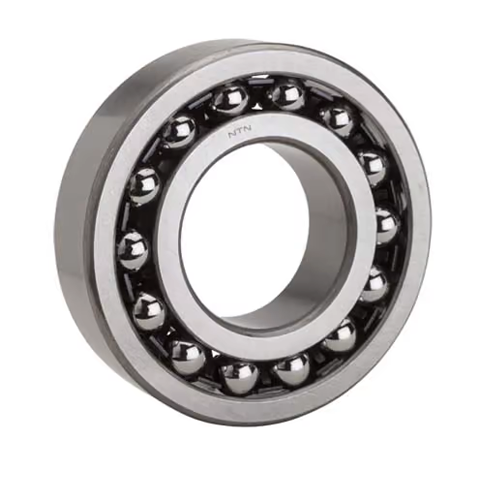
NTN NTN Self-Aligning Ball Bearing - Straight Bore, 1318
Item # d D B r Static Load Rating Dynamic Load Rating 1301 0.4724 in 12.000 mm 1.4567 in 37.000 mm 0.4724 in 12.000 mm 0.0394 in 1.000 mm 365 lbf 1620 N 1.62 kN 1650 lbf 7350 N 7.35 kN 1302 0.5906 in 15.000 mm 1.6535 in 42.000 mm 0.5118 in 13.000 mm 0.0394 in 1.000 mm 515 lbf 2290 N 2.29 kN 2180 lbf 9700 N 9.70 kN 1303 0.6693 in 17.000 mm 1.8504 in 47.000 mm 0.5512 in 14.000 mm 0.0394 in 1.000 mm 720 lbf 3200 N 3.20 kN 2860 lbf 12700 N 12.70 kN 1304 0.7874 in 20.000 mm 2.0472 in 52.000 mm 0.5906 in 15.000 mm 0.0433 in 1.100 mm 755 lbf 3350 N 3.35 kN 2830 lbf 12600 N 12.60 kN 1305 0.9843 in 25.000 mm 2.4409 in 62.000 mm 0.6693 in 17.000 mm 0.0433 in 1.100 mm 1120 lbf 5000 N 5.00 kN 4100 lbf 18200 N 18.20 kN 1306 1.1811 in 30.000 mm 2.8346 in 72.000 mm 0.7480 in 19.000 mm 0.0433 in 1.100 mm 1420 lbf 6300 N 6.30 kN 4800 lbf 21400 N 21.40 kN 1307 1.3780 in 35.000 mm 3.1496 in 80.000 mm 0.8268 in 21.000 mm 0.0591 in 1.500 mm 1760 lbf 7850 N 7.85 kN 5700 lbf 25300 N 25.30 kN 1308 1.5748 in 40.000 mm 3.5433 in 90.000 mm 0.9055 in 23.000 mm 0.0591 in 1.500 mm 2180 lbf 9700 N 9.70 kN 6700 lbf 29800 N 29.80 kN 1309 1.7717 in 45.000 mm 3.9370 in 100.000 mm 0.9843 in 25.000 mm 0.0591 in 1.500 mm 2860 lbf 12700 N 12.70 kN 8650 lbf 38500 N 38.50 kN 1310 1.9685 in 50.000 mm 4.3307 in 110.000 mm 1.0630 in 27.000 mm 0.0787 in 2.000 mm 3150 lbf 14100 N 14.10 kN 9800 lbf 43500 N 43.50 kN 1311 2.1654 in 55.000 mm 4.7244 in 120.000 mm 1.1417 in 29.000 mm 0.0787 in 2.000 mm 4000 lbf 17900 N 17.90 kN 11600 lbf 51500 N 51.50 kN 1312 2.3622 in 60.000 mm 5.1181 in 130.000 mm 1.2205 in 31.000 mm 0.0827 in 2.100 mm 4700 lbf 20800 N 20.80 kN 12900 lbf 57500 N 57.50 kN 1313 2.5591 in 65.000 mm 5.5118 in 140.000 mm 1.2992 in 33.000 mm 0.0827 in 2.100 mm 5150 lbf 22900 N 22.90 kN 14100 lbf 62500 N 62.50 kN 1314 2.7559 in 70.000 mm 5.9055 in 150.000 mm 1.3780 in 35.000 mm 0.0827 in 2.100 mm 6250 lbf 27700 N 27.70 kN 16900 lbf 75000 N 75.00 kN 1315 2.9528 in 75.000 mm 6.2992 in 160.000 mm 1.4567 in 37.000 mm 0.0827 in 2.100 mm 6750 lbf 30000 N 30.00 kN 18000 lbf 80000 N 80.00 kN 1316 3.1496 in 80.000 mm 6.6929 in 170.000 mm 1.5354 in 39.000 mm 0.0827 in 2.100 mm 7400 lbf 33000 N 33.00 kN 20000 lbf 89000 N 89.00 kN 1317 3.3465 in 85.000 mm 7.0866 in 180.000 mm 1.6142 in 41.000 mm 0.1181 in 3.000 mm 8550 lbf 38000 N 38.00 kN 22100 lbf 98500 N 98.50 kN 1318 3.5433 in 90.000 mm 7.4803 in 190.000 mm 1.6929 in 43.000 mm 0.1181 in 3.000 mm 10000 lbf 44500 N 44.50 kN 26300 lbf 117000 N 117.00 kN 1319 3.7402 in 95.000 mm 7.8740 in 200.000 mm 1.7717 in 45.000 mm 0.1181 in 3.000 mm 11500 lbf 51000 N 51.00 kN 29000 lbf 129000 N 129.00 kN 1320 3.9370 in 100.000 mm 8.4646 in 215.000 mm 1.8504 in 47.000 mm 0.1181 in 3.000 mm 12900 lbf 57500 N 57.50 kN 31500 lbf 140000 N 140.00 kN 1. Design features and characteristics The outer ring raceway of self-aligning ball bearings forms a spherical surface whose center is common to the bearing center. The inner ring of the bearing has two raceways.The balls, cage, and inner ring of these bearings are capable of shifting in order to compensate for a certain degree of misalignment with the outer rings. As a result, the bearing is able to align itself and compensate for shaft / housing finishing unevenness, bearing fitting error, and other sources of misalignment as shown in Fig. 1.Since axial load capacity is limited, self- aligning ball bearing are not suitable for applications with heavy axial loads. It is recommended to use an adapter on a self-aligning ball bearing with a tapered bore inner diameter for ease of installation and disassembly. These bearings and adapters are often used on drive shaft applications. 2. Standard cage type All bearing series are equipped with a pressed cage, except 2321S and 2322S, which are equipped with a machined cage.Self-Aligning Ball BearingsIt is recommended to use an adapter on a self-aligning ball bearing with a tapered bore inner diameter for ease of installation and disassembly. These bearings and adapters are often used on drive shaft applications. Table 1 Standard cage types of spherical ball bearings 3. Ball protrusion Bearings with part numbers listed in Table 2 below have balls which protrude slightly from the bearing face as illustrated in Fig. 2. The total width dimensions are shown in Table 2. 4. Allowable misalignment angle The allowable misalignment angle can be determined by the following function. This degree of allowable misalignment may be limited by the design of mating components around the bearing.Normal load ....................... 1/15 5. Precautions for using self-aligning ball bearings Self-aligning ball bearings are unable to support large axial loads and therefore axial loading shall be limited.Please consider using self-aligning roller bearings when a large axial load is to be applied.
$216.98
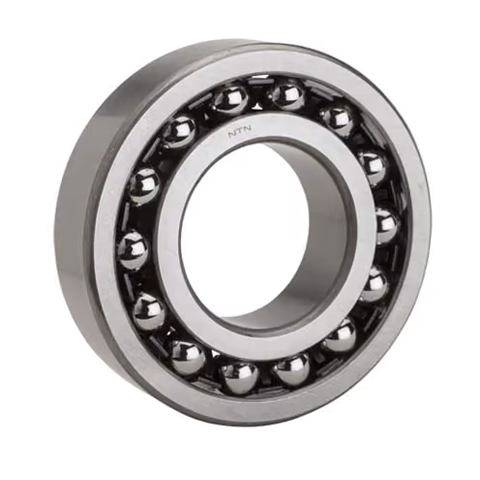
NTN NTN Self-Aligning Ball Bearing - Straight Bore, 1319
Item # d D B r Static Load Rating Dynamic Load Rating 1301 0.4724 in 12.000 mm 1.4567 in 37.000 mm 0.4724 in 12.000 mm 0.0394 in 1.000 mm 365 lbf 1620 N 1.62 kN 1650 lbf 7350 N 7.35 kN 1302 0.5906 in 15.000 mm 1.6535 in 42.000 mm 0.5118 in 13.000 mm 0.0394 in 1.000 mm 515 lbf 2290 N 2.29 kN 2180 lbf 9700 N 9.70 kN 1303 0.6693 in 17.000 mm 1.8504 in 47.000 mm 0.5512 in 14.000 mm 0.0394 in 1.000 mm 720 lbf 3200 N 3.20 kN 2860 lbf 12700 N 12.70 kN 1304 0.7874 in 20.000 mm 2.0472 in 52.000 mm 0.5906 in 15.000 mm 0.0433 in 1.100 mm 755 lbf 3350 N 3.35 kN 2830 lbf 12600 N 12.60 kN 1305 0.9843 in 25.000 mm 2.4409 in 62.000 mm 0.6693 in 17.000 mm 0.0433 in 1.100 mm 1120 lbf 5000 N 5.00 kN 4100 lbf 18200 N 18.20 kN 1306 1.1811 in 30.000 mm 2.8346 in 72.000 mm 0.7480 in 19.000 mm 0.0433 in 1.100 mm 1420 lbf 6300 N 6.30 kN 4800 lbf 21400 N 21.40 kN 1307 1.3780 in 35.000 mm 3.1496 in 80.000 mm 0.8268 in 21.000 mm 0.0591 in 1.500 mm 1760 lbf 7850 N 7.85 kN 5700 lbf 25300 N 25.30 kN 1308 1.5748 in 40.000 mm 3.5433 in 90.000 mm 0.9055 in 23.000 mm 0.0591 in 1.500 mm 2180 lbf 9700 N 9.70 kN 6700 lbf 29800 N 29.80 kN 1309 1.7717 in 45.000 mm 3.9370 in 100.000 mm 0.9843 in 25.000 mm 0.0591 in 1.500 mm 2860 lbf 12700 N 12.70 kN 8650 lbf 38500 N 38.50 kN 1310 1.9685 in 50.000 mm 4.3307 in 110.000 mm 1.0630 in 27.000 mm 0.0787 in 2.000 mm 3150 lbf 14100 N 14.10 kN 9800 lbf 43500 N 43.50 kN 1311 2.1654 in 55.000 mm 4.7244 in 120.000 mm 1.1417 in 29.000 mm 0.0787 in 2.000 mm 4000 lbf 17900 N 17.90 kN 11600 lbf 51500 N 51.50 kN 1312 2.3622 in 60.000 mm 5.1181 in 130.000 mm 1.2205 in 31.000 mm 0.0827 in 2.100 mm 4700 lbf 20800 N 20.80 kN 12900 lbf 57500 N 57.50 kN 1313 2.5591 in 65.000 mm 5.5118 in 140.000 mm 1.2992 in 33.000 mm 0.0827 in 2.100 mm 5150 lbf 22900 N 22.90 kN 14100 lbf 62500 N 62.50 kN 1314 2.7559 in 70.000 mm 5.9055 in 150.000 mm 1.3780 in 35.000 mm 0.0827 in 2.100 mm 6250 lbf 27700 N 27.70 kN 16900 lbf 75000 N 75.00 kN 1315 2.9528 in 75.000 mm 6.2992 in 160.000 mm 1.4567 in 37.000 mm 0.0827 in 2.100 mm 6750 lbf 30000 N 30.00 kN 18000 lbf 80000 N 80.00 kN 1316 3.1496 in 80.000 mm 6.6929 in 170.000 mm 1.5354 in 39.000 mm 0.0827 in 2.100 mm 7400 lbf 33000 N 33.00 kN 20000 lbf 89000 N 89.00 kN 1317 3.3465 in 85.000 mm 7.0866 in 180.000 mm 1.6142 in 41.000 mm 0.1181 in 3.000 mm 8550 lbf 38000 N 38.00 kN 22100 lbf 98500 N 98.50 kN 1318 3.5433 in 90.000 mm 7.4803 in 190.000 mm 1.6929 in 43.000 mm 0.1181 in 3.000 mm 10000 lbf 44500 N 44.50 kN 26300 lbf 117000 N 117.00 kN 1319 3.7402 in 95.000 mm 7.8740 in 200.000 mm 1.7717 in 45.000 mm 0.1181 in 3.000 mm 11500 lbf 51000 N 51.00 kN 29000 lbf 129000 N 129.00 kN 1320 3.9370 in 100.000 mm 8.4646 in 215.000 mm 1.8504 in 47.000 mm 0.1181 in 3.000 mm 12900 lbf 57500 N 57.50 kN 31500 lbf 140000 N 140.00 kN 1. Design features and characteristics The outer ring raceway of self-aligning ball bearings forms a spherical surface whose center is common to the bearing center. The inner ring of the bearing has two raceways.The balls, cage, and inner ring of these bearings are capable of shifting in order to compensate for a certain degree of misalignment with the outer rings. As a result, the bearing is able to align itself and compensate for shaft / housing finishing unevenness, bearing fitting error, and other sources of misalignment as shown in Fig. 1.Since axial load capacity is limited, self- aligning ball bearing are not suitable for applications with heavy axial loads. It is recommended to use an adapter on a self-aligning ball bearing with a tapered bore inner diameter for ease of installation and disassembly. These bearings and adapters are often used on drive shaft applications. 2. Standard cage type All bearing series are equipped with a pressed cage, except 2321S and 2322S, which are equipped with a machined cage.Self-Aligning Ball BearingsIt is recommended to use an adapter on a self-aligning ball bearing with a tapered bore inner diameter for ease of installation and disassembly. These bearings and adapters are often used on drive shaft applications. Table 1 Standard cage types of spherical ball bearings 3. Ball protrusion Bearings with part numbers listed in Table 2 below have balls which protrude slightly from the bearing face as illustrated in Fig. 2. The total width dimensions are shown in Table 2. 4. Allowable misalignment angle The allowable misalignment angle can be determined by the following function. This degree of allowable misalignment may be limited by the design of mating components around the bearing.Normal load ....................... 1/15 5. Precautions for using self-aligning ball bearings Self-aligning ball bearings are unable to support large axial loads and therefore axial loading shall be limited.Please consider using self-aligning roller bearings when a large axial load is to be applied.
$298.00
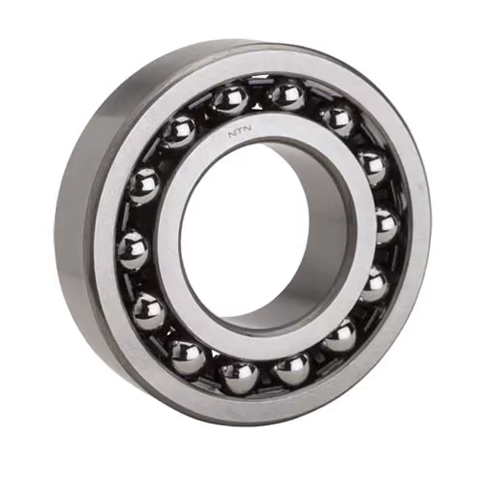
NTN NTN Self-Aligning Ball Bearing - Straight Bore, 1320
Item # d D B r Static Load Rating Dynamic Load Rating 1301 0.4724 in 12.000 mm 1.4567 in 37.000 mm 0.4724 in 12.000 mm 0.0394 in 1.000 mm 365 lbf 1620 N 1.62 kN 1650 lbf 7350 N 7.35 kN 1302 0.5906 in 15.000 mm 1.6535 in 42.000 mm 0.5118 in 13.000 mm 0.0394 in 1.000 mm 515 lbf 2290 N 2.29 kN 2180 lbf 9700 N 9.70 kN 1303 0.6693 in 17.000 mm 1.8504 in 47.000 mm 0.5512 in 14.000 mm 0.0394 in 1.000 mm 720 lbf 3200 N 3.20 kN 2860 lbf 12700 N 12.70 kN 1304 0.7874 in 20.000 mm 2.0472 in 52.000 mm 0.5906 in 15.000 mm 0.0433 in 1.100 mm 755 lbf 3350 N 3.35 kN 2830 lbf 12600 N 12.60 kN 1305 0.9843 in 25.000 mm 2.4409 in 62.000 mm 0.6693 in 17.000 mm 0.0433 in 1.100 mm 1120 lbf 5000 N 5.00 kN 4100 lbf 18200 N 18.20 kN 1306 1.1811 in 30.000 mm 2.8346 in 72.000 mm 0.7480 in 19.000 mm 0.0433 in 1.100 mm 1420 lbf 6300 N 6.30 kN 4800 lbf 21400 N 21.40 kN 1307 1.3780 in 35.000 mm 3.1496 in 80.000 mm 0.8268 in 21.000 mm 0.0591 in 1.500 mm 1760 lbf 7850 N 7.85 kN 5700 lbf 25300 N 25.30 kN 1308 1.5748 in 40.000 mm 3.5433 in 90.000 mm 0.9055 in 23.000 mm 0.0591 in 1.500 mm 2180 lbf 9700 N 9.70 kN 6700 lbf 29800 N 29.80 kN 1309 1.7717 in 45.000 mm 3.9370 in 100.000 mm 0.9843 in 25.000 mm 0.0591 in 1.500 mm 2860 lbf 12700 N 12.70 kN 8650 lbf 38500 N 38.50 kN 1310 1.9685 in 50.000 mm 4.3307 in 110.000 mm 1.0630 in 27.000 mm 0.0787 in 2.000 mm 3150 lbf 14100 N 14.10 kN 9800 lbf 43500 N 43.50 kN 1311 2.1654 in 55.000 mm 4.7244 in 120.000 mm 1.1417 in 29.000 mm 0.0787 in 2.000 mm 4000 lbf 17900 N 17.90 kN 11600 lbf 51500 N 51.50 kN 1312 2.3622 in 60.000 mm 5.1181 in 130.000 mm 1.2205 in 31.000 mm 0.0827 in 2.100 mm 4700 lbf 20800 N 20.80 kN 12900 lbf 57500 N 57.50 kN 1313 2.5591 in 65.000 mm 5.5118 in 140.000 mm 1.2992 in 33.000 mm 0.0827 in 2.100 mm 5150 lbf 22900 N 22.90 kN 14100 lbf 62500 N 62.50 kN 1314 2.7559 in 70.000 mm 5.9055 in 150.000 mm 1.3780 in 35.000 mm 0.0827 in 2.100 mm 6250 lbf 27700 N 27.70 kN 16900 lbf 75000 N 75.00 kN 1315 2.9528 in 75.000 mm 6.2992 in 160.000 mm 1.4567 in 37.000 mm 0.0827 in 2.100 mm 6750 lbf 30000 N 30.00 kN 18000 lbf 80000 N 80.00 kN 1316 3.1496 in 80.000 mm 6.6929 in 170.000 mm 1.5354 in 39.000 mm 0.0827 in 2.100 mm 7400 lbf 33000 N 33.00 kN 20000 lbf 89000 N 89.00 kN 1317 3.3465 in 85.000 mm 7.0866 in 180.000 mm 1.6142 in 41.000 mm 0.1181 in 3.000 mm 8550 lbf 38000 N 38.00 kN 22100 lbf 98500 N 98.50 kN 1318 3.5433 in 90.000 mm 7.4803 in 190.000 mm 1.6929 in 43.000 mm 0.1181 in 3.000 mm 10000 lbf 44500 N 44.50 kN 26300 lbf 117000 N 117.00 kN 1319 3.7402 in 95.000 mm 7.8740 in 200.000 mm 1.7717 in 45.000 mm 0.1181 in 3.000 mm 11500 lbf 51000 N 51.00 kN 29000 lbf 129000 N 129.00 kN 1320 3.9370 in 100.000 mm 8.4646 in 215.000 mm 1.8504 in 47.000 mm 0.1181 in 3.000 mm 12900 lbf 57500 N 57.50 kN 31500 lbf 140000 N 140.00 kN 1. Design features and characteristics The outer ring raceway of self-aligning ball bearings forms a spherical surface whose center is common to the bearing center. The inner ring of the bearing has two raceways.The balls, cage, and inner ring of these bearings are capable of shifting in order to compensate for a certain degree of misalignment with the outer rings. As a result, the bearing is able to align itself and compensate for shaft / housing finishing unevenness, bearing fitting error, and other sources of misalignment as shown in Fig. 1.Since axial load capacity is limited, self- aligning ball bearing are not suitable for applications with heavy axial loads. It is recommended to use an adapter on a self-aligning ball bearing with a tapered bore inner diameter for ease of installation and disassembly. These bearings and adapters are often used on drive shaft applications. 2. Standard cage type All bearing series are equipped with a pressed cage, except 2321S and 2322S, which are equipped with a machined cage.Self-Aligning Ball BearingsIt is recommended to use an adapter on a self-aligning ball bearing with a tapered bore inner diameter for ease of installation and disassembly. These bearings and adapters are often used on drive shaft applications. Table 1 Standard cage types of spherical ball bearings 3. Ball protrusion Bearings with part numbers listed in Table 2 below have balls which protrude slightly from the bearing face as illustrated in Fig. 2. The total width dimensions are shown in Table 2. 4. Allowable misalignment angle The allowable misalignment angle can be determined by the following function. This degree of allowable misalignment may be limited by the design of mating components around the bearing.Normal load ....................... 1/15 5. Precautions for using self-aligning ball bearings Self-aligning ball bearings are unable to support large axial loads and therefore axial loading shall be limited.Please consider using self-aligning roller bearings when a large axial load is to be applied.
$388.23
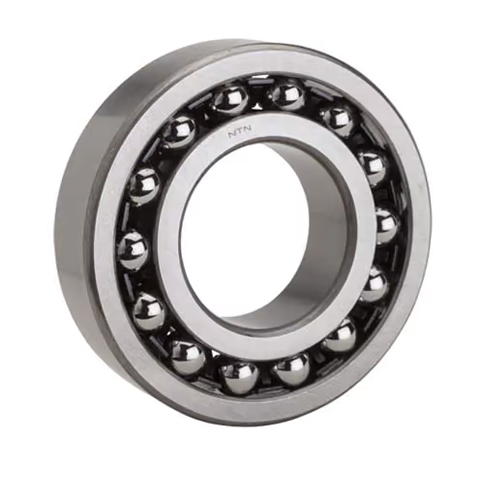
NTN NTN Self-Aligning Ball Bearing - Straight Bore, 2200
Item # d D B r Static Load Rating Dynamic Load Rating 2200 0.3937 in 10.000 mm 1.1811 in 30.000 mm 0.5512 in 14.000 mm 0.0236 in 0.600 mm 355 lbf 1590 N 1.59 kN 1670 lbf 7450 N 7.45 kN 2201 0.4724 in 12.000 mm 1.2598 in 32.000 mm 0.5512 in 14.000 mm 0.0236 in 0.600 mm 390 lbf 1730 N 1.73 kN 1740 lbf 7750 N 7.75 kN 2202 0.5906 in 15.000 mm 1.3780 in 35.000 mm 0.5512 in 14.000 mm 0.0236 in 0.600 mm 415 lbf 1850 N 1.85 kN 1750 lbf 7800 N 7.80 kN 2203 0.6693 in 17.000 mm 1.5748 in 40.000 mm 0.6299 in 16.000 mm 0.0236 in 0.600 mm 545 lbf 2420 N 2.42 kN 2240 lbf 9950 N 9.95 kN 2204 0.7874 in 20.000 mm 1.8504 in 47.000 mm 0.7087 in 18.000 mm 0.0394 in 1.000 mm 740 lbf 3300 N 3.30 kN 2880 lbf 12800 N 12.80 kN 2205 0.9843 in 25.000 mm 2.0472 in 52.000 mm 0.7087 in 18.000 mm 0.0394 in 1.000 mm 775 lbf 3450 N 3.45 kN 2790 lbf 12400 N 12.40 kN 2206 1.1811 in 30.000 mm 2.4409 in 62.000 mm 0.7874 in 20.000 mm 0.0394 in 1.000 mm 1020 lbf 4550 N 4.55 kN 3450 lbf 15300 N 15.30 kN 2207 1.3780 in 35.000 mm 2.8346 in 72.000 mm 0.9055 in 23.000 mm 0.0433 in 1.100 mm 1480 lbf 6600 N 6.60 kN 4900 lbf 21700 N 21.70 kN 2208 1.5748 in 40.000 mm 3.1496 in 80.000 mm 0.9055 in 23.000 mm 0.0433 in 1.100 mm 1650 lbf 7350 N 7.35 kN 5050 lbf 22400 N 22.40 kN 2209 1.7717 in 45.000 mm 3.3465 in 85.000 mm 0.9055 in 23.000 mm 0.0433 in 1.100 mm 1830 lbf 8150 N 8.15 kN 5250 lbf 23300 N 23.30 kN 2210 1.9685 in 50.000 mm 3.5433 in 90.000 mm 0.9055 in 23.000 mm 0.0433 in 1.100 mm 1900 lbf 8450 N 8.45 kN 5250 lbf 23300 N 23.30 kN 2211 2.1654 in 55.000 mm 3.9370 in 100.000 mm 0.9843 in 25.000 mm 0.0591 in 1.500 mm 2230 lbf 9900 N 9.90 kN 6000 lbf 26700 N 26.70 kN 2212 2.3622 in 60.000 mm 4.3307 in 110.000 mm 1.1024 in 28.000 mm 0.0591 in 1.500 mm 2830 lbf 12600 N 12.60 kN 7650 lbf 34000 N 34.00 kN 2213 2.5591 in 65.000 mm 4.7244 in 120.000 mm 1.2205 in 31.000 mm 0.0591 in 1.500 mm 3700 lbf 16400 N 16.40 kN 9800 lbf 43500 N 43.50 kN 2214 2.7559 in 70.000 mm 4.9213 in 125.000 mm 1.2205 in 31.000 mm 0.0591 in 1.500 mm 3850 lbf 17100 N 17.10 kN 9900 lbf 44000 N 44.00 kN 2215 2.9528 in 75.000 mm 5.1181 in 130.000 mm 1.2205 in 31.000 mm 0.0591 in 1.500 mm 4000 lbf 17800 N 17.80 kN 10000 lbf 44500 N 44.50 kN 2216 3.1496 in 80.000 mm 5.5118 in 140.000 mm 1.2992 in 33.000 mm 0.0787 in 2.000 mm 4450 lbf 19900 N 19.90 kN 11000 lbf 49000 N 49.00 kN 2217 3.3465 in 85.000 mm 5.9055 in 150.000 mm 1.4173 in 36.000 mm 0.0787 in 2.000 mm 5300 lbf 23600 N 23.60 kN 13200 lbf 58500 N 58.50 kN 2218 3.5433 in 90.000 mm 6.2992 in 160.000 mm 1.5748 in 40.000 mm 0.0787 in 2.000 mm 6450 lbf 28700 N 28.70 kN 15800 lbf 70500 N 70.50 kN 2219 3.7402 in 95.000 mm 6.6929 in 170.000 mm 1.6929 in 43.000 mm 0.0827 in 2.100 mm 7750 lbf 34500 N 34.50 kN 18900 lbf 84000 N 84.00 kN 2220 3.9370 in 100.000 mm 7.0866 in 180.000 mm 1.8110 in 46.000 mm 0.0827 in 2.100 mm 8650 lbf 38500 N 38.50 kN 21200 lbf 94500 N 94.50 kN 1. Design features and characteristics The outer ring raceway of self-aligning ball bearings forms a spherical surface whose center is common to the bearing center. The inner ring of the bearing has two raceways.The balls, cage, and inner ring of these bearings are capable of shifting in order to compensate for a certain degree of misalignment with the outer rings. As a result, the bearing is able to align itself and compensate for shaft / housing finishing unevenness, bearing fitting error, and other sources of misalignment as shown in Fig. 1.Since axial load capacity is limited, self- aligning ball bearing are not suitable for applications with heavy axial loads. It is recommended to use an adapter on a self-aligning ball bearing with a tapered bore inner diameter for ease of installation and disassembly. These bearings and adapters are often used on drive shaft applications. 2. Standard cage type All bearing series are equipped with a pressed cage, except 2321S and 2322S, which are equipped with a machined cage.Self-Aligning Ball BearingsIt is recommended to use an adapter on a self-aligning ball bearing with a tapered bore inner diameter for ease of installation and disassembly. These bearings and adapters are often used on drive shaft applications. Table 1 Standard cage types of spherical ball bearings 3. Ball protrusion Bearings with part numbers listed in Table 2 below have balls which protrude slightly from the bearing face as illustrated in Fig. 2. The total width dimensions are shown in Table 2. 4. Allowable misalignment angle The allowable misalignment angle can be determined by the following function. This degree of allowable misalignment may be limited by the design of mating components around the bearing.Normal load ....................... 1/15 5. Precautions for using self-aligning ball bearings Self-aligning ball bearings are unable to support large axial loads and therefore axial loading shall be limited.Please consider using self-aligning roller bearings when a large axial load is to be applied.
$9.30
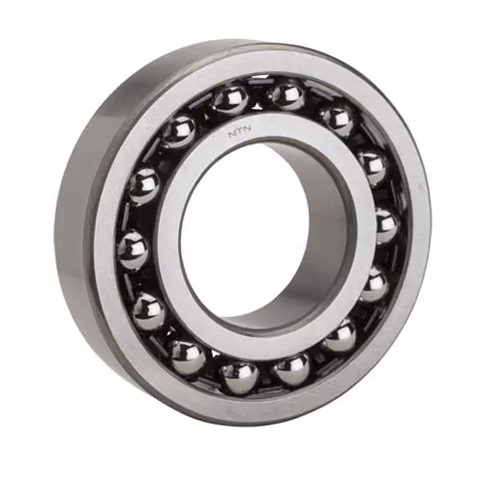
NTN NTN Self-Aligning Ball Bearing - Straight Bore, 2202
Item # d D B r Static Load Rating Dynamic Load Rating 2200 0.3937 in 10.000 mm 1.1811 in 30.000 mm 0.5512 in 14.000 mm 0.0236 in 0.600 mm 355 lbf 1590 N 1.59 kN 1670 lbf 7450 N 7.45 kN 2201 0.4724 in 12.000 mm 1.2598 in 32.000 mm 0.5512 in 14.000 mm 0.0236 in 0.600 mm 390 lbf 1730 N 1.73 kN 1740 lbf 7750 N 7.75 kN 2202 0.5906 in 15.000 mm 1.3780 in 35.000 mm 0.5512 in 14.000 mm 0.0236 in 0.600 mm 415 lbf 1850 N 1.85 kN 1750 lbf 7800 N 7.80 kN 2203 0.6693 in 17.000 mm 1.5748 in 40.000 mm 0.6299 in 16.000 mm 0.0236 in 0.600 mm 545 lbf 2420 N 2.42 kN 2240 lbf 9950 N 9.95 kN 2204 0.7874 in 20.000 mm 1.8504 in 47.000 mm 0.7087 in 18.000 mm 0.0394 in 1.000 mm 740 lbf 3300 N 3.30 kN 2880 lbf 12800 N 12.80 kN 2205 0.9843 in 25.000 mm 2.0472 in 52.000 mm 0.7087 in 18.000 mm 0.0394 in 1.000 mm 775 lbf 3450 N 3.45 kN 2790 lbf 12400 N 12.40 kN 2206 1.1811 in 30.000 mm 2.4409 in 62.000 mm 0.7874 in 20.000 mm 0.0394 in 1.000 mm 1020 lbf 4550 N 4.55 kN 3450 lbf 15300 N 15.30 kN 2207 1.3780 in 35.000 mm 2.8346 in 72.000 mm 0.9055 in 23.000 mm 0.0433 in 1.100 mm 1480 lbf 6600 N 6.60 kN 4900 lbf 21700 N 21.70 kN 2208 1.5748 in 40.000 mm 3.1496 in 80.000 mm 0.9055 in 23.000 mm 0.0433 in 1.100 mm 1650 lbf 7350 N 7.35 kN 5050 lbf 22400 N 22.40 kN 2209 1.7717 in 45.000 mm 3.3465 in 85.000 mm 0.9055 in 23.000 mm 0.0433 in 1.100 mm 1830 lbf 8150 N 8.15 kN 5250 lbf 23300 N 23.30 kN 2210 1.9685 in 50.000 mm 3.5433 in 90.000 mm 0.9055 in 23.000 mm 0.0433 in 1.100 mm 1900 lbf 8450 N 8.45 kN 5250 lbf 23300 N 23.30 kN 2211 2.1654 in 55.000 mm 3.9370 in 100.000 mm 0.9843 in 25.000 mm 0.0591 in 1.500 mm 2230 lbf 9900 N 9.90 kN 6000 lbf 26700 N 26.70 kN 2212 2.3622 in 60.000 mm 4.3307 in 110.000 mm 1.1024 in 28.000 mm 0.0591 in 1.500 mm 2830 lbf 12600 N 12.60 kN 7650 lbf 34000 N 34.00 kN 2213 2.5591 in 65.000 mm 4.7244 in 120.000 mm 1.2205 in 31.000 mm 0.0591 in 1.500 mm 3700 lbf 16400 N 16.40 kN 9800 lbf 43500 N 43.50 kN 2214 2.7559 in 70.000 mm 4.9213 in 125.000 mm 1.2205 in 31.000 mm 0.0591 in 1.500 mm 3850 lbf 17100 N 17.10 kN 9900 lbf 44000 N 44.00 kN 2215 2.9528 in 75.000 mm 5.1181 in 130.000 mm 1.2205 in 31.000 mm 0.0591 in 1.500 mm 4000 lbf 17800 N 17.80 kN 10000 lbf 44500 N 44.50 kN 2216 3.1496 in 80.000 mm 5.5118 in 140.000 mm 1.2992 in 33.000 mm 0.0787 in 2.000 mm 4450 lbf 19900 N 19.90 kN 11000 lbf 49000 N 49.00 kN 2217 3.3465 in 85.000 mm 5.9055 in 150.000 mm 1.4173 in 36.000 mm 0.0787 in 2.000 mm 5300 lbf 23600 N 23.60 kN 13200 lbf 58500 N 58.50 kN 2218 3.5433 in 90.000 mm 6.2992 in 160.000 mm 1.5748 in 40.000 mm 0.0787 in 2.000 mm 6450 lbf 28700 N 28.70 kN 15800 lbf 70500 N 70.50 kN 2219 3.7402 in 95.000 mm 6.6929 in 170.000 mm 1.6929 in 43.000 mm 0.0827 in 2.100 mm 7750 lbf 34500 N 34.50 kN 18900 lbf 84000 N 84.00 kN 2220 3.9370 in 100.000 mm 7.0866 in 180.000 mm 1.8110 in 46.000 mm 0.0827 in 2.100 mm 8650 lbf 38500 N 38.50 kN 21200 lbf 94500 N 94.50 kN 1. Design features and characteristics The outer ring raceway of self-aligning ball bearings forms a spherical surface whose center is common to the bearing center. The inner ring of the bearing has two raceways.The balls, cage, and inner ring of these bearings are capable of shifting in order to compensate for a certain degree of misalignment with the outer rings. As a result, the bearing is able to align itself and compensate for shaft / housing finishing unevenness, bearing fitting error, and other sources of misalignment as shown in Fig. 1.Since axial load capacity is limited, self- aligning ball bearing are not suitable for applications with heavy axial loads. It is recommended to use an adapter on a self-aligning ball bearing with a tapered bore inner diameter for ease of installation and disassembly. These bearings and adapters are often used on drive shaft applications. 2. Standard cage type All bearing series are equipped with a pressed cage, except 2321S and 2322S, which are equipped with a machined cage.Self-Aligning Ball BearingsIt is recommended to use an adapter on a self-aligning ball bearing with a tapered bore inner diameter for ease of installation and disassembly. These bearings and adapters are often used on drive shaft applications. Table 1 Standard cage types of spherical ball bearings 3. Ball protrusion Bearings with part numbers listed in Table 2 below have balls which protrude slightly from the bearing face as illustrated in Fig. 2. The total width dimensions are shown in Table 2. 4. Allowable misalignment angle The allowable misalignment angle can be determined by the following function. This degree of allowable misalignment may be limited by the design of mating components around the bearing.Normal load ....................... 1/15 5. Precautions for using self-aligning ball bearings Self-aligning ball bearings are unable to support large axial loads and therefore axial loading shall be limited.Please consider using self-aligning roller bearings when a large axial load is to be applied.
$8.90
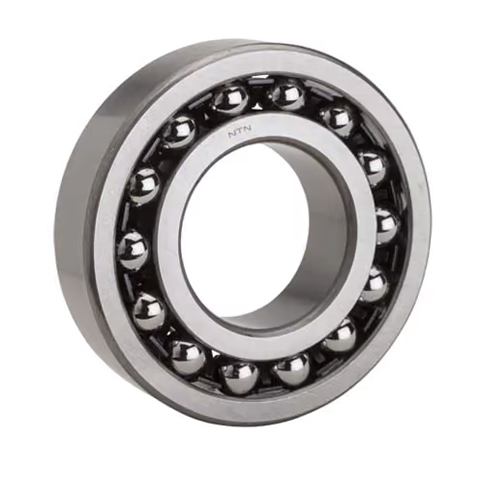
NTN NTN Self-Aligning Ball Bearing - Straight Bore, 2203
Item # d D B r Static Load Rating Dynamic Load Rating 2200 0.3937 in 10.000 mm 1.1811 in 30.000 mm 0.5512 in 14.000 mm 0.0236 in 0.600 mm 355 lbf 1590 N 1.59 kN 1670 lbf 7450 N 7.45 kN 2201 0.4724 in 12.000 mm 1.2598 in 32.000 mm 0.5512 in 14.000 mm 0.0236 in 0.600 mm 390 lbf 1730 N 1.73 kN 1740 lbf 7750 N 7.75 kN 2202 0.5906 in 15.000 mm 1.3780 in 35.000 mm 0.5512 in 14.000 mm 0.0236 in 0.600 mm 415 lbf 1850 N 1.85 kN 1750 lbf 7800 N 7.80 kN 2203 0.6693 in 17.000 mm 1.5748 in 40.000 mm 0.6299 in 16.000 mm 0.0236 in 0.600 mm 545 lbf 2420 N 2.42 kN 2240 lbf 9950 N 9.95 kN 2204 0.7874 in 20.000 mm 1.8504 in 47.000 mm 0.7087 in 18.000 mm 0.0394 in 1.000 mm 740 lbf 3300 N 3.30 kN 2880 lbf 12800 N 12.80 kN 2205 0.9843 in 25.000 mm 2.0472 in 52.000 mm 0.7087 in 18.000 mm 0.0394 in 1.000 mm 775 lbf 3450 N 3.45 kN 2790 lbf 12400 N 12.40 kN 2206 1.1811 in 30.000 mm 2.4409 in 62.000 mm 0.7874 in 20.000 mm 0.0394 in 1.000 mm 1020 lbf 4550 N 4.55 kN 3450 lbf 15300 N 15.30 kN 2207 1.3780 in 35.000 mm 2.8346 in 72.000 mm 0.9055 in 23.000 mm 0.0433 in 1.100 mm 1480 lbf 6600 N 6.60 kN 4900 lbf 21700 N 21.70 kN 2208 1.5748 in 40.000 mm 3.1496 in 80.000 mm 0.9055 in 23.000 mm 0.0433 in 1.100 mm 1650 lbf 7350 N 7.35 kN 5050 lbf 22400 N 22.40 kN 2209 1.7717 in 45.000 mm 3.3465 in 85.000 mm 0.9055 in 23.000 mm 0.0433 in 1.100 mm 1830 lbf 8150 N 8.15 kN 5250 lbf 23300 N 23.30 kN 2210 1.9685 in 50.000 mm 3.5433 in 90.000 mm 0.9055 in 23.000 mm 0.0433 in 1.100 mm 1900 lbf 8450 N 8.45 kN 5250 lbf 23300 N 23.30 kN 2211 2.1654 in 55.000 mm 3.9370 in 100.000 mm 0.9843 in 25.000 mm 0.0591 in 1.500 mm 2230 lbf 9900 N 9.90 kN 6000 lbf 26700 N 26.70 kN 2212 2.3622 in 60.000 mm 4.3307 in 110.000 mm 1.1024 in 28.000 mm 0.0591 in 1.500 mm 2830 lbf 12600 N 12.60 kN 7650 lbf 34000 N 34.00 kN 2213 2.5591 in 65.000 mm 4.7244 in 120.000 mm 1.2205 in 31.000 mm 0.0591 in 1.500 mm 3700 lbf 16400 N 16.40 kN 9800 lbf 43500 N 43.50 kN 2214 2.7559 in 70.000 mm 4.9213 in 125.000 mm 1.2205 in 31.000 mm 0.0591 in 1.500 mm 3850 lbf 17100 N 17.10 kN 9900 lbf 44000 N 44.00 kN 2215 2.9528 in 75.000 mm 5.1181 in 130.000 mm 1.2205 in 31.000 mm 0.0591 in 1.500 mm 4000 lbf 17800 N 17.80 kN 10000 lbf 44500 N 44.50 kN 2216 3.1496 in 80.000 mm 5.5118 in 140.000 mm 1.2992 in 33.000 mm 0.0787 in 2.000 mm 4450 lbf 19900 N 19.90 kN 11000 lbf 49000 N 49.00 kN 2217 3.3465 in 85.000 mm 5.9055 in 150.000 mm 1.4173 in 36.000 mm 0.0787 in 2.000 mm 5300 lbf 23600 N 23.60 kN 13200 lbf 58500 N 58.50 kN 2218 3.5433 in 90.000 mm 6.2992 in 160.000 mm 1.5748 in 40.000 mm 0.0787 in 2.000 mm 6450 lbf 28700 N 28.70 kN 15800 lbf 70500 N 70.50 kN 2219 3.7402 in 95.000 mm 6.6929 in 170.000 mm 1.6929 in 43.000 mm 0.0827 in 2.100 mm 7750 lbf 34500 N 34.50 kN 18900 lbf 84000 N 84.00 kN 2220 3.9370 in 100.000 mm 7.0866 in 180.000 mm 1.8110 in 46.000 mm 0.0827 in 2.100 mm 8650 lbf 38500 N 38.50 kN 21200 lbf 94500 N 94.50 kN 1. Design features and characteristics The outer ring raceway of self-aligning ball bearings forms a spherical surface whose center is common to the bearing center. The inner ring of the bearing has two raceways.The balls, cage, and inner ring of these bearings are capable of shifting in order to compensate for a certain degree of misalignment with the outer rings. As a result, the bearing is able to align itself and compensate for shaft / housing finishing unevenness, bearing fitting error, and other sources of misalignment as shown in Fig. 1.Since axial load capacity is limited, self- aligning ball bearing are not suitable for applications with heavy axial loads. It is recommended to use an adapter on a self-aligning ball bearing with a tapered bore inner diameter for ease of installation and disassembly. These bearings and adapters are often used on drive shaft applications. 2. Standard cage type All bearing series are equipped with a pressed cage, except 2321S and 2322S, which are equipped with a machined cage.Self-Aligning Ball BearingsIt is recommended to use an adapter on a self-aligning ball bearing with a tapered bore inner diameter for ease of installation and disassembly. These bearings and adapters are often used on drive shaft applications. Table 1 Standard cage types of spherical ball bearings 3. Ball protrusion Bearings with part numbers listed in Table 2 below have balls which protrude slightly from the bearing face as illustrated in Fig. 2. The total width dimensions are shown in Table 2. 4. Allowable misalignment angle The allowable misalignment angle can be determined by the following function. This degree of allowable misalignment may be limited by the design of mating components around the bearing.Normal load ....................... 1/15 5. Precautions for using self-aligning ball bearings Self-aligning ball bearings are unable to support large axial loads and therefore axial loading shall be limited.Please consider using self-aligning roller bearings when a large axial load is to be applied.
$9.37
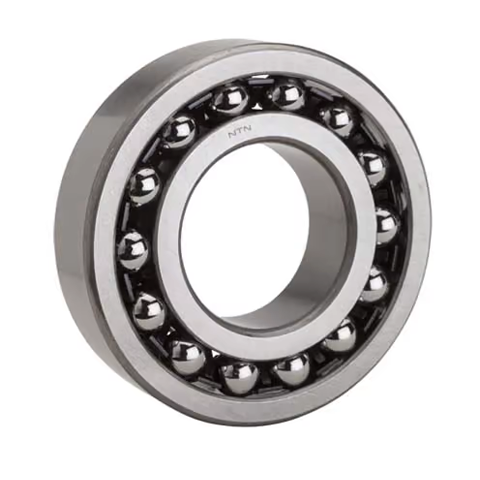
NTN NTN Self-Aligning Ball Bearing - Straight Bore, 2204
Item # d D B r Static Load Rating Dynamic Load Rating 2200 0.3937 in 10.000 mm 1.1811 in 30.000 mm 0.5512 in 14.000 mm 0.0236 in 0.600 mm 355 lbf 1590 N 1.59 kN 1670 lbf 7450 N 7.45 kN 2201 0.4724 in 12.000 mm 1.2598 in 32.000 mm 0.5512 in 14.000 mm 0.0236 in 0.600 mm 390 lbf 1730 N 1.73 kN 1740 lbf 7750 N 7.75 kN 2202 0.5906 in 15.000 mm 1.3780 in 35.000 mm 0.5512 in 14.000 mm 0.0236 in 0.600 mm 415 lbf 1850 N 1.85 kN 1750 lbf 7800 N 7.80 kN 2203 0.6693 in 17.000 mm 1.5748 in 40.000 mm 0.6299 in 16.000 mm 0.0236 in 0.600 mm 545 lbf 2420 N 2.42 kN 2240 lbf 9950 N 9.95 kN 2204 0.7874 in 20.000 mm 1.8504 in 47.000 mm 0.7087 in 18.000 mm 0.0394 in 1.000 mm 740 lbf 3300 N 3.30 kN 2880 lbf 12800 N 12.80 kN 2205 0.9843 in 25.000 mm 2.0472 in 52.000 mm 0.7087 in 18.000 mm 0.0394 in 1.000 mm 775 lbf 3450 N 3.45 kN 2790 lbf 12400 N 12.40 kN 2206 1.1811 in 30.000 mm 2.4409 in 62.000 mm 0.7874 in 20.000 mm 0.0394 in 1.000 mm 1020 lbf 4550 N 4.55 kN 3450 lbf 15300 N 15.30 kN 2207 1.3780 in 35.000 mm 2.8346 in 72.000 mm 0.9055 in 23.000 mm 0.0433 in 1.100 mm 1480 lbf 6600 N 6.60 kN 4900 lbf 21700 N 21.70 kN 2208 1.5748 in 40.000 mm 3.1496 in 80.000 mm 0.9055 in 23.000 mm 0.0433 in 1.100 mm 1650 lbf 7350 N 7.35 kN 5050 lbf 22400 N 22.40 kN 2209 1.7717 in 45.000 mm 3.3465 in 85.000 mm 0.9055 in 23.000 mm 0.0433 in 1.100 mm 1830 lbf 8150 N 8.15 kN 5250 lbf 23300 N 23.30 kN 2210 1.9685 in 50.000 mm 3.5433 in 90.000 mm 0.9055 in 23.000 mm 0.0433 in 1.100 mm 1900 lbf 8450 N 8.45 kN 5250 lbf 23300 N 23.30 kN 2211 2.1654 in 55.000 mm 3.9370 in 100.000 mm 0.9843 in 25.000 mm 0.0591 in 1.500 mm 2230 lbf 9900 N 9.90 kN 6000 lbf 26700 N 26.70 kN 2212 2.3622 in 60.000 mm 4.3307 in 110.000 mm 1.1024 in 28.000 mm 0.0591 in 1.500 mm 2830 lbf 12600 N 12.60 kN 7650 lbf 34000 N 34.00 kN 2213 2.5591 in 65.000 mm 4.7244 in 120.000 mm 1.2205 in 31.000 mm 0.0591 in 1.500 mm 3700 lbf 16400 N 16.40 kN 9800 lbf 43500 N 43.50 kN 2214 2.7559 in 70.000 mm 4.9213 in 125.000 mm 1.2205 in 31.000 mm 0.0591 in 1.500 mm 3850 lbf 17100 N 17.10 kN 9900 lbf 44000 N 44.00 kN 2215 2.9528 in 75.000 mm 5.1181 in 130.000 mm 1.2205 in 31.000 mm 0.0591 in 1.500 mm 4000 lbf 17800 N 17.80 kN 10000 lbf 44500 N 44.50 kN 2216 3.1496 in 80.000 mm 5.5118 in 140.000 mm 1.2992 in 33.000 mm 0.0787 in 2.000 mm 4450 lbf 19900 N 19.90 kN 11000 lbf 49000 N 49.00 kN 2217 3.3465 in 85.000 mm 5.9055 in 150.000 mm 1.4173 in 36.000 mm 0.0787 in 2.000 mm 5300 lbf 23600 N 23.60 kN 13200 lbf 58500 N 58.50 kN 2218 3.5433 in 90.000 mm 6.2992 in 160.000 mm 1.5748 in 40.000 mm 0.0787 in 2.000 mm 6450 lbf 28700 N 28.70 kN 15800 lbf 70500 N 70.50 kN 2219 3.7402 in 95.000 mm 6.6929 in 170.000 mm 1.6929 in 43.000 mm 0.0827 in 2.100 mm 7750 lbf 34500 N 34.50 kN 18900 lbf 84000 N 84.00 kN 2220 3.9370 in 100.000 mm 7.0866 in 180.000 mm 1.8110 in 46.000 mm 0.0827 in 2.100 mm 8650 lbf 38500 N 38.50 kN 21200 lbf 94500 N 94.50 kN 1. Design features and characteristics The outer ring raceway of self-aligning ball bearings forms a spherical surface whose center is common to the bearing center. The inner ring of the bearing has two raceways.The balls, cage, and inner ring of these bearings are capable of shifting in order to compensate for a certain degree of misalignment with the outer rings. As a result, the bearing is able to align itself and compensate for shaft / housing finishing unevenness, bearing fitting error, and other sources of misalignment as shown in Fig. 1.Since axial load capacity is limited, self- aligning ball bearing are not suitable for applications with heavy axial loads. It is recommended to use an adapter on a self-aligning ball bearing with a tapered bore inner diameter for ease of installation and disassembly. These bearings and adapters are often used on drive shaft applications. 2. Standard cage type All bearing series are equipped with a pressed cage, except 2321S and 2322S, which are equipped with a machined cage.Self-Aligning Ball BearingsIt is recommended to use an adapter on a self-aligning ball bearing with a tapered bore inner diameter for ease of installation and disassembly. These bearings and adapters are often used on drive shaft applications. Table 1 Standard cage types of spherical ball bearings 3. Ball protrusion Bearings with part numbers listed in Table 2 below have balls which protrude slightly from the bearing face as illustrated in Fig. 2. The total width dimensions are shown in Table 2. 4. Allowable misalignment angle The allowable misalignment angle can be determined by the following function. This degree of allowable misalignment may be limited by the design of mating components around the bearing.Normal load ....................... 1/15 5. Precautions for using self-aligning ball bearings Self-aligning ball bearings are unable to support large axial loads and therefore axial loading shall be limited.Please consider using self-aligning roller bearings when a large axial load is to be applied.
$11.29
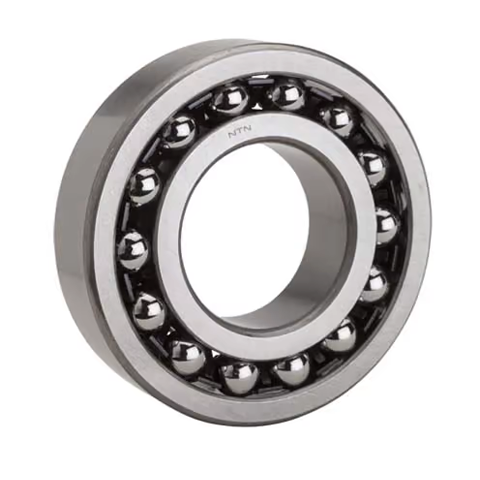
NTN NTN Self-Aligning Ball Bearing - Straight Bore, 2205
Item # d D B r Static Load Rating Dynamic Load Rating 2200 0.3937 in 10.000 mm 1.1811 in 30.000 mm 0.5512 in 14.000 mm 0.0236 in 0.600 mm 355 lbf 1590 N 1.59 kN 1670 lbf 7450 N 7.45 kN 2201 0.4724 in 12.000 mm 1.2598 in 32.000 mm 0.5512 in 14.000 mm 0.0236 in 0.600 mm 390 lbf 1730 N 1.73 kN 1740 lbf 7750 N 7.75 kN 2202 0.5906 in 15.000 mm 1.3780 in 35.000 mm 0.5512 in 14.000 mm 0.0236 in 0.600 mm 415 lbf 1850 N 1.85 kN 1750 lbf 7800 N 7.80 kN 2203 0.6693 in 17.000 mm 1.5748 in 40.000 mm 0.6299 in 16.000 mm 0.0236 in 0.600 mm 545 lbf 2420 N 2.42 kN 2240 lbf 9950 N 9.95 kN 2204 0.7874 in 20.000 mm 1.8504 in 47.000 mm 0.7087 in 18.000 mm 0.0394 in 1.000 mm 740 lbf 3300 N 3.30 kN 2880 lbf 12800 N 12.80 kN 2205 0.9843 in 25.000 mm 2.0472 in 52.000 mm 0.7087 in 18.000 mm 0.0394 in 1.000 mm 775 lbf 3450 N 3.45 kN 2790 lbf 12400 N 12.40 kN 2206 1.1811 in 30.000 mm 2.4409 in 62.000 mm 0.7874 in 20.000 mm 0.0394 in 1.000 mm 1020 lbf 4550 N 4.55 kN 3450 lbf 15300 N 15.30 kN 2207 1.3780 in 35.000 mm 2.8346 in 72.000 mm 0.9055 in 23.000 mm 0.0433 in 1.100 mm 1480 lbf 6600 N 6.60 kN 4900 lbf 21700 N 21.70 kN 2208 1.5748 in 40.000 mm 3.1496 in 80.000 mm 0.9055 in 23.000 mm 0.0433 in 1.100 mm 1650 lbf 7350 N 7.35 kN 5050 lbf 22400 N 22.40 kN 2209 1.7717 in 45.000 mm 3.3465 in 85.000 mm 0.9055 in 23.000 mm 0.0433 in 1.100 mm 1830 lbf 8150 N 8.15 kN 5250 lbf 23300 N 23.30 kN 2210 1.9685 in 50.000 mm 3.5433 in 90.000 mm 0.9055 in 23.000 mm 0.0433 in 1.100 mm 1900 lbf 8450 N 8.45 kN 5250 lbf 23300 N 23.30 kN 2211 2.1654 in 55.000 mm 3.9370 in 100.000 mm 0.9843 in 25.000 mm 0.0591 in 1.500 mm 2230 lbf 9900 N 9.90 kN 6000 lbf 26700 N 26.70 kN 2212 2.3622 in 60.000 mm 4.3307 in 110.000 mm 1.1024 in 28.000 mm 0.0591 in 1.500 mm 2830 lbf 12600 N 12.60 kN 7650 lbf 34000 N 34.00 kN 2213 2.5591 in 65.000 mm 4.7244 in 120.000 mm 1.2205 in 31.000 mm 0.0591 in 1.500 mm 3700 lbf 16400 N 16.40 kN 9800 lbf 43500 N 43.50 kN 2214 2.7559 in 70.000 mm 4.9213 in 125.000 mm 1.2205 in 31.000 mm 0.0591 in 1.500 mm 3850 lbf 17100 N 17.10 kN 9900 lbf 44000 N 44.00 kN 2215 2.9528 in 75.000 mm 5.1181 in 130.000 mm 1.2205 in 31.000 mm 0.0591 in 1.500 mm 4000 lbf 17800 N 17.80 kN 10000 lbf 44500 N 44.50 kN 2216 3.1496 in 80.000 mm 5.5118 in 140.000 mm 1.2992 in 33.000 mm 0.0787 in 2.000 mm 4450 lbf 19900 N 19.90 kN 11000 lbf 49000 N 49.00 kN 2217 3.3465 in 85.000 mm 5.9055 in 150.000 mm 1.4173 in 36.000 mm 0.0787 in 2.000 mm 5300 lbf 23600 N 23.60 kN 13200 lbf 58500 N 58.50 kN 2218 3.5433 in 90.000 mm 6.2992 in 160.000 mm 1.5748 in 40.000 mm 0.0787 in 2.000 mm 6450 lbf 28700 N 28.70 kN 15800 lbf 70500 N 70.50 kN 2219 3.7402 in 95.000 mm 6.6929 in 170.000 mm 1.6929 in 43.000 mm 0.0827 in 2.100 mm 7750 lbf 34500 N 34.50 kN 18900 lbf 84000 N 84.00 kN 2220 3.9370 in 100.000 mm 7.0866 in 180.000 mm 1.8110 in 46.000 mm 0.0827 in 2.100 mm 8650 lbf 38500 N 38.50 kN 21200 lbf 94500 N 94.50 kN 1. Design features and characteristics The outer ring raceway of self-aligning ball bearings forms a spherical surface whose center is common to the bearing center. The inner ring of the bearing has two raceways.The balls, cage, and inner ring of these bearings are capable of shifting in order to compensate for a certain degree of misalignment with the outer rings. As a result, the bearing is able to align itself and compensate for shaft / housing finishing unevenness, bearing fitting error, and other sources of misalignment as shown in Fig. 1.Since axial load capacity is limited, self- aligning ball bearing are not suitable for applications with heavy axial loads. It is recommended to use an adapter on a self-aligning ball bearing with a tapered bore inner diameter for ease of installation and disassembly. These bearings and adapters are often used on drive shaft applications. 2. Standard cage type All bearing series are equipped with a pressed cage, except 2321S and 2322S, which are equipped with a machined cage.Self-Aligning Ball BearingsIt is recommended to use an adapter on a self-aligning ball bearing with a tapered bore inner diameter for ease of installation and disassembly. These bearings and adapters are often used on drive shaft applications. Table 1 Standard cage types of spherical ball bearings 3. Ball protrusion Bearings with part numbers listed in Table 2 below have balls which protrude slightly from the bearing face as illustrated in Fig. 2. The total width dimensions are shown in Table 2. 4. Allowable misalignment angle The allowable misalignment angle can be determined by the following function. This degree of allowable misalignment may be limited by the design of mating components around the bearing.Normal load ....................... 1/15 5. Precautions for using self-aligning ball bearings Self-aligning ball bearings are unable to support large axial loads and therefore axial loading shall be limited.Please consider using self-aligning roller bearings when a large axial load is to be applied.
$13.43
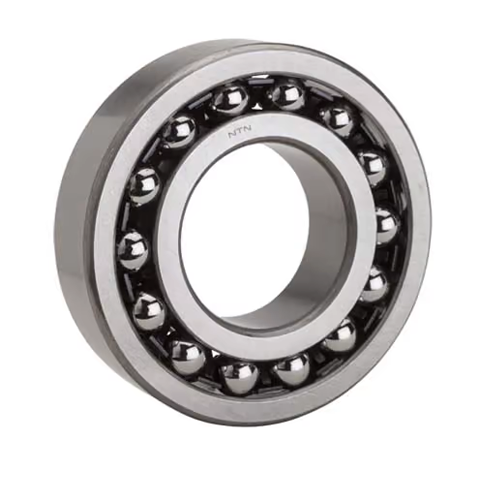
NTN NTN Self-Aligning Ball Bearing - Straight Bore, 2206
Item # d D B r Static Load Rating Dynamic Load Rating 2200 0.3937 in 10.000 mm 1.1811 in 30.000 mm 0.5512 in 14.000 mm 0.0236 in 0.600 mm 355 lbf 1590 N 1.59 kN 1670 lbf 7450 N 7.45 kN 2201 0.4724 in 12.000 mm 1.2598 in 32.000 mm 0.5512 in 14.000 mm 0.0236 in 0.600 mm 390 lbf 1730 N 1.73 kN 1740 lbf 7750 N 7.75 kN 2202 0.5906 in 15.000 mm 1.3780 in 35.000 mm 0.5512 in 14.000 mm 0.0236 in 0.600 mm 415 lbf 1850 N 1.85 kN 1750 lbf 7800 N 7.80 kN 2203 0.6693 in 17.000 mm 1.5748 in 40.000 mm 0.6299 in 16.000 mm 0.0236 in 0.600 mm 545 lbf 2420 N 2.42 kN 2240 lbf 9950 N 9.95 kN 2204 0.7874 in 20.000 mm 1.8504 in 47.000 mm 0.7087 in 18.000 mm 0.0394 in 1.000 mm 740 lbf 3300 N 3.30 kN 2880 lbf 12800 N 12.80 kN 2205 0.9843 in 25.000 mm 2.0472 in 52.000 mm 0.7087 in 18.000 mm 0.0394 in 1.000 mm 775 lbf 3450 N 3.45 kN 2790 lbf 12400 N 12.40 kN 2206 1.1811 in 30.000 mm 2.4409 in 62.000 mm 0.7874 in 20.000 mm 0.0394 in 1.000 mm 1020 lbf 4550 N 4.55 kN 3450 lbf 15300 N 15.30 kN 2207 1.3780 in 35.000 mm 2.8346 in 72.000 mm 0.9055 in 23.000 mm 0.0433 in 1.100 mm 1480 lbf 6600 N 6.60 kN 4900 lbf 21700 N 21.70 kN 2208 1.5748 in 40.000 mm 3.1496 in 80.000 mm 0.9055 in 23.000 mm 0.0433 in 1.100 mm 1650 lbf 7350 N 7.35 kN 5050 lbf 22400 N 22.40 kN 2209 1.7717 in 45.000 mm 3.3465 in 85.000 mm 0.9055 in 23.000 mm 0.0433 in 1.100 mm 1830 lbf 8150 N 8.15 kN 5250 lbf 23300 N 23.30 kN 2210 1.9685 in 50.000 mm 3.5433 in 90.000 mm 0.9055 in 23.000 mm 0.0433 in 1.100 mm 1900 lbf 8450 N 8.45 kN 5250 lbf 23300 N 23.30 kN 2211 2.1654 in 55.000 mm 3.9370 in 100.000 mm 0.9843 in 25.000 mm 0.0591 in 1.500 mm 2230 lbf 9900 N 9.90 kN 6000 lbf 26700 N 26.70 kN 2212 2.3622 in 60.000 mm 4.3307 in 110.000 mm 1.1024 in 28.000 mm 0.0591 in 1.500 mm 2830 lbf 12600 N 12.60 kN 7650 lbf 34000 N 34.00 kN 2213 2.5591 in 65.000 mm 4.7244 in 120.000 mm 1.2205 in 31.000 mm 0.0591 in 1.500 mm 3700 lbf 16400 N 16.40 kN 9800 lbf 43500 N 43.50 kN 2214 2.7559 in 70.000 mm 4.9213 in 125.000 mm 1.2205 in 31.000 mm 0.0591 in 1.500 mm 3850 lbf 17100 N 17.10 kN 9900 lbf 44000 N 44.00 kN 2215 2.9528 in 75.000 mm 5.1181 in 130.000 mm 1.2205 in 31.000 mm 0.0591 in 1.500 mm 4000 lbf 17800 N 17.80 kN 10000 lbf 44500 N 44.50 kN 2216 3.1496 in 80.000 mm 5.5118 in 140.000 mm 1.2992 in 33.000 mm 0.0787 in 2.000 mm 4450 lbf 19900 N 19.90 kN 11000 lbf 49000 N 49.00 kN 2217 3.3465 in 85.000 mm 5.9055 in 150.000 mm 1.4173 in 36.000 mm 0.0787 in 2.000 mm 5300 lbf 23600 N 23.60 kN 13200 lbf 58500 N 58.50 kN 2218 3.5433 in 90.000 mm 6.2992 in 160.000 mm 1.5748 in 40.000 mm 0.0787 in 2.000 mm 6450 lbf 28700 N 28.70 kN 15800 lbf 70500 N 70.50 kN 2219 3.7402 in 95.000 mm 6.6929 in 170.000 mm 1.6929 in 43.000 mm 0.0827 in 2.100 mm 7750 lbf 34500 N 34.50 kN 18900 lbf 84000 N 84.00 kN 2220 3.9370 in 100.000 mm 7.0866 in 180.000 mm 1.8110 in 46.000 mm 0.0827 in 2.100 mm 8650 lbf 38500 N 38.50 kN 21200 lbf 94500 N 94.50 kN 1. Design features and characteristics The outer ring raceway of self-aligning ball bearings forms a spherical surface whose center is common to the bearing center. The inner ring of the bearing has two raceways.The balls, cage, and inner ring of these bearings are capable of shifting in order to compensate for a certain degree of misalignment with the outer rings. As a result, the bearing is able to align itself and compensate for shaft / housing finishing unevenness, bearing fitting error, and other sources of misalignment as shown in Fig. 1.Since axial load capacity is limited, self- aligning ball bearing are not suitable for applications with heavy axial loads. It is recommended to use an adapter on a self-aligning ball bearing with a tapered bore inner diameter for ease of installation and disassembly. These bearings and adapters are often used on drive shaft applications. 2. Standard cage type All bearing series are equipped with a pressed cage, except 2321S and 2322S, which are equipped with a machined cage.Self-Aligning Ball BearingsIt is recommended to use an adapter on a self-aligning ball bearing with a tapered bore inner diameter for ease of installation and disassembly. These bearings and adapters are often used on drive shaft applications. Table 1 Standard cage types of spherical ball bearings 3. Ball protrusion Bearings with part numbers listed in Table 2 below have balls which protrude slightly from the bearing face as illustrated in Fig. 2. The total width dimensions are shown in Table 2. 4. Allowable misalignment angle The allowable misalignment angle can be determined by the following function. This degree of allowable misalignment may be limited by the design of mating components around the bearing.Normal load ....................... 1/15 5. Precautions for using self-aligning ball bearings Self-aligning ball bearings are unable to support large axial loads and therefore axial loading shall be limited.Please consider using self-aligning roller bearings when a large axial load is to be applied.
$15.44
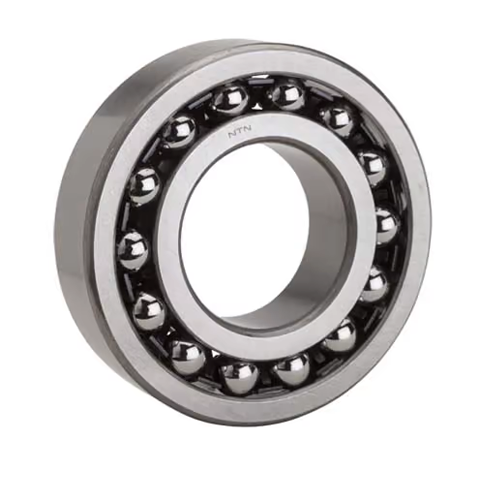
NTN NTN Self-Aligning Ball Bearing - Straight Bore, 2207
Item # d D B r Static Load Rating Dynamic Load Rating 2200 0.3937 in 10.000 mm 1.1811 in 30.000 mm 0.5512 in 14.000 mm 0.0236 in 0.600 mm 355 lbf 1590 N 1.59 kN 1670 lbf 7450 N 7.45 kN 2201 0.4724 in 12.000 mm 1.2598 in 32.000 mm 0.5512 in 14.000 mm 0.0236 in 0.600 mm 390 lbf 1730 N 1.73 kN 1740 lbf 7750 N 7.75 kN 2202 0.5906 in 15.000 mm 1.3780 in 35.000 mm 0.5512 in 14.000 mm 0.0236 in 0.600 mm 415 lbf 1850 N 1.85 kN 1750 lbf 7800 N 7.80 kN 2203 0.6693 in 17.000 mm 1.5748 in 40.000 mm 0.6299 in 16.000 mm 0.0236 in 0.600 mm 545 lbf 2420 N 2.42 kN 2240 lbf 9950 N 9.95 kN 2204 0.7874 in 20.000 mm 1.8504 in 47.000 mm 0.7087 in 18.000 mm 0.0394 in 1.000 mm 740 lbf 3300 N 3.30 kN 2880 lbf 12800 N 12.80 kN 2205 0.9843 in 25.000 mm 2.0472 in 52.000 mm 0.7087 in 18.000 mm 0.0394 in 1.000 mm 775 lbf 3450 N 3.45 kN 2790 lbf 12400 N 12.40 kN 2206 1.1811 in 30.000 mm 2.4409 in 62.000 mm 0.7874 in 20.000 mm 0.0394 in 1.000 mm 1020 lbf 4550 N 4.55 kN 3450 lbf 15300 N 15.30 kN 2207 1.3780 in 35.000 mm 2.8346 in 72.000 mm 0.9055 in 23.000 mm 0.0433 in 1.100 mm 1480 lbf 6600 N 6.60 kN 4900 lbf 21700 N 21.70 kN 2208 1.5748 in 40.000 mm 3.1496 in 80.000 mm 0.9055 in 23.000 mm 0.0433 in 1.100 mm 1650 lbf 7350 N 7.35 kN 5050 lbf 22400 N 22.40 kN 2209 1.7717 in 45.000 mm 3.3465 in 85.000 mm 0.9055 in 23.000 mm 0.0433 in 1.100 mm 1830 lbf 8150 N 8.15 kN 5250 lbf 23300 N 23.30 kN 2210 1.9685 in 50.000 mm 3.5433 in 90.000 mm 0.9055 in 23.000 mm 0.0433 in 1.100 mm 1900 lbf 8450 N 8.45 kN 5250 lbf 23300 N 23.30 kN 2211 2.1654 in 55.000 mm 3.9370 in 100.000 mm 0.9843 in 25.000 mm 0.0591 in 1.500 mm 2230 lbf 9900 N 9.90 kN 6000 lbf 26700 N 26.70 kN 2212 2.3622 in 60.000 mm 4.3307 in 110.000 mm 1.1024 in 28.000 mm 0.0591 in 1.500 mm 2830 lbf 12600 N 12.60 kN 7650 lbf 34000 N 34.00 kN 2213 2.5591 in 65.000 mm 4.7244 in 120.000 mm 1.2205 in 31.000 mm 0.0591 in 1.500 mm 3700 lbf 16400 N 16.40 kN 9800 lbf 43500 N 43.50 kN 2214 2.7559 in 70.000 mm 4.9213 in 125.000 mm 1.2205 in 31.000 mm 0.0591 in 1.500 mm 3850 lbf 17100 N 17.10 kN 9900 lbf 44000 N 44.00 kN 2215 2.9528 in 75.000 mm 5.1181 in 130.000 mm 1.2205 in 31.000 mm 0.0591 in 1.500 mm 4000 lbf 17800 N 17.80 kN 10000 lbf 44500 N 44.50 kN 2216 3.1496 in 80.000 mm 5.5118 in 140.000 mm 1.2992 in 33.000 mm 0.0787 in 2.000 mm 4450 lbf 19900 N 19.90 kN 11000 lbf 49000 N 49.00 kN 2217 3.3465 in 85.000 mm 5.9055 in 150.000 mm 1.4173 in 36.000 mm 0.0787 in 2.000 mm 5300 lbf 23600 N 23.60 kN 13200 lbf 58500 N 58.50 kN 2218 3.5433 in 90.000 mm 6.2992 in 160.000 mm 1.5748 in 40.000 mm 0.0787 in 2.000 mm 6450 lbf 28700 N 28.70 kN 15800 lbf 70500 N 70.50 kN 2219 3.7402 in 95.000 mm 6.6929 in 170.000 mm 1.6929 in 43.000 mm 0.0827 in 2.100 mm 7750 lbf 34500 N 34.50 kN 18900 lbf 84000 N 84.00 kN 2220 3.9370 in 100.000 mm 7.0866 in 180.000 mm 1.8110 in 46.000 mm 0.0827 in 2.100 mm 8650 lbf 38500 N 38.50 kN 21200 lbf 94500 N 94.50 kN 1. Design features and characteristics The outer ring raceway of self-aligning ball bearings forms a spherical surface whose center is common to the bearing center. The inner ring of the bearing has two raceways.The balls, cage, and inner ring of these bearings are capable of shifting in order to compensate for a certain degree of misalignment with the outer rings. As a result, the bearing is able to align itself and compensate for shaft / housing finishing unevenness, bearing fitting error, and other sources of misalignment as shown in Fig. 1.Since axial load capacity is limited, self- aligning ball bearing are not suitable for applications with heavy axial loads. It is recommended to use an adapter on a self-aligning ball bearing with a tapered bore inner diameter for ease of installation and disassembly. These bearings and adapters are often used on drive shaft applications. 2. Standard cage type All bearing series are equipped with a pressed cage, except 2321S and 2322S, which are equipped with a machined cage.Self-Aligning Ball BearingsIt is recommended to use an adapter on a self-aligning ball bearing with a tapered bore inner diameter for ease of installation and disassembly. These bearings and adapters are often used on drive shaft applications. Table 1 Standard cage types of spherical ball bearings 3. Ball protrusion Bearings with part numbers listed in Table 2 below have balls which protrude slightly from the bearing face as illustrated in Fig. 2. The total width dimensions are shown in Table 2. 4. Allowable misalignment angle The allowable misalignment angle can be determined by the following function. This degree of allowable misalignment may be limited by the design of mating components around the bearing.Normal load ....................... 1/15 5. Precautions for using self-aligning ball bearings Self-aligning ball bearings are unable to support large axial loads and therefore axial loading shall be limited.Please consider using self-aligning roller bearings when a large axial load is to be applied.
$17.87
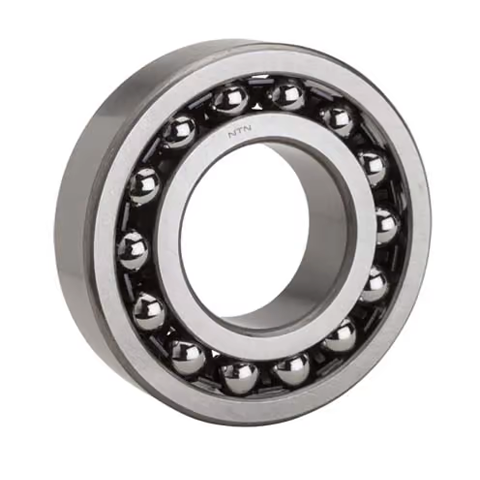
NTN NTN Self-Aligning Ball Bearing - Straight Bore, 2210
Item # d D B r Static Load Rating Dynamic Load Rating 2200 0.3937 in 10.000 mm 1.1811 in 30.000 mm 0.5512 in 14.000 mm 0.0236 in 0.600 mm 355 lbf 1590 N 1.59 kN 1670 lbf 7450 N 7.45 kN 2201 0.4724 in 12.000 mm 1.2598 in 32.000 mm 0.5512 in 14.000 mm 0.0236 in 0.600 mm 390 lbf 1730 N 1.73 kN 1740 lbf 7750 N 7.75 kN 2202 0.5906 in 15.000 mm 1.3780 in 35.000 mm 0.5512 in 14.000 mm 0.0236 in 0.600 mm 415 lbf 1850 N 1.85 kN 1750 lbf 7800 N 7.80 kN 2203 0.6693 in 17.000 mm 1.5748 in 40.000 mm 0.6299 in 16.000 mm 0.0236 in 0.600 mm 545 lbf 2420 N 2.42 kN 2240 lbf 9950 N 9.95 kN 2204 0.7874 in 20.000 mm 1.8504 in 47.000 mm 0.7087 in 18.000 mm 0.0394 in 1.000 mm 740 lbf 3300 N 3.30 kN 2880 lbf 12800 N 12.80 kN 2205 0.9843 in 25.000 mm 2.0472 in 52.000 mm 0.7087 in 18.000 mm 0.0394 in 1.000 mm 775 lbf 3450 N 3.45 kN 2790 lbf 12400 N 12.40 kN 2206 1.1811 in 30.000 mm 2.4409 in 62.000 mm 0.7874 in 20.000 mm 0.0394 in 1.000 mm 1020 lbf 4550 N 4.55 kN 3450 lbf 15300 N 15.30 kN 2207 1.3780 in 35.000 mm 2.8346 in 72.000 mm 0.9055 in 23.000 mm 0.0433 in 1.100 mm 1480 lbf 6600 N 6.60 kN 4900 lbf 21700 N 21.70 kN 2208 1.5748 in 40.000 mm 3.1496 in 80.000 mm 0.9055 in 23.000 mm 0.0433 in 1.100 mm 1650 lbf 7350 N 7.35 kN 5050 lbf 22400 N 22.40 kN 2209 1.7717 in 45.000 mm 3.3465 in 85.000 mm 0.9055 in 23.000 mm 0.0433 in 1.100 mm 1830 lbf 8150 N 8.15 kN 5250 lbf 23300 N 23.30 kN 2210 1.9685 in 50.000 mm 3.5433 in 90.000 mm 0.9055 in 23.000 mm 0.0433 in 1.100 mm 1900 lbf 8450 N 8.45 kN 5250 lbf 23300 N 23.30 kN 2211 2.1654 in 55.000 mm 3.9370 in 100.000 mm 0.9843 in 25.000 mm 0.0591 in 1.500 mm 2230 lbf 9900 N 9.90 kN 6000 lbf 26700 N 26.70 kN 2212 2.3622 in 60.000 mm 4.3307 in 110.000 mm 1.1024 in 28.000 mm 0.0591 in 1.500 mm 2830 lbf 12600 N 12.60 kN 7650 lbf 34000 N 34.00 kN 2213 2.5591 in 65.000 mm 4.7244 in 120.000 mm 1.2205 in 31.000 mm 0.0591 in 1.500 mm 3700 lbf 16400 N 16.40 kN 9800 lbf 43500 N 43.50 kN 2214 2.7559 in 70.000 mm 4.9213 in 125.000 mm 1.2205 in 31.000 mm 0.0591 in 1.500 mm 3850 lbf 17100 N 17.10 kN 9900 lbf 44000 N 44.00 kN 2215 2.9528 in 75.000 mm 5.1181 in 130.000 mm 1.2205 in 31.000 mm 0.0591 in 1.500 mm 4000 lbf 17800 N 17.80 kN 10000 lbf 44500 N 44.50 kN 2216 3.1496 in 80.000 mm 5.5118 in 140.000 mm 1.2992 in 33.000 mm 0.0787 in 2.000 mm 4450 lbf 19900 N 19.90 kN 11000 lbf 49000 N 49.00 kN 2217 3.3465 in 85.000 mm 5.9055 in 150.000 mm 1.4173 in 36.000 mm 0.0787 in 2.000 mm 5300 lbf 23600 N 23.60 kN 13200 lbf 58500 N 58.50 kN 2218 3.5433 in 90.000 mm 6.2992 in 160.000 mm 1.5748 in 40.000 mm 0.0787 in 2.000 mm 6450 lbf 28700 N 28.70 kN 15800 lbf 70500 N 70.50 kN 2219 3.7402 in 95.000 mm 6.6929 in 170.000 mm 1.6929 in 43.000 mm 0.0827 in 2.100 mm 7750 lbf 34500 N 34.50 kN 18900 lbf 84000 N 84.00 kN 2220 3.9370 in 100.000 mm 7.0866 in 180.000 mm 1.8110 in 46.000 mm 0.0827 in 2.100 mm 8650 lbf 38500 N 38.50 kN 21200 lbf 94500 N 94.50 kN 1. Design features and characteristics The outer ring raceway of self-aligning ball bearings forms a spherical surface whose center is common to the bearing center. The inner ring of the bearing has two raceways.The balls, cage, and inner ring of these bearings are capable of shifting in order to compensate for a certain degree of misalignment with the outer rings. As a result, the bearing is able to align itself and compensate for shaft / housing finishing unevenness, bearing fitting error, and other sources of misalignment as shown in Fig. 1.Since axial load capacity is limited, self- aligning ball bearing are not suitable for applications with heavy axial loads. It is recommended to use an adapter on a self-aligning ball bearing with a tapered bore inner diameter for ease of installation and disassembly. These bearings and adapters are often used on drive shaft applications. 2. Standard cage type All bearing series are equipped with a pressed cage, except 2321S and 2322S, which are equipped with a machined cage.Self-Aligning Ball BearingsIt is recommended to use an adapter on a self-aligning ball bearing with a tapered bore inner diameter for ease of installation and disassembly. These bearings and adapters are often used on drive shaft applications. Table 1 Standard cage types of spherical ball bearings 3. Ball protrusion Bearings with part numbers listed in Table 2 below have balls which protrude slightly from the bearing face as illustrated in Fig. 2. The total width dimensions are shown in Table 2. 4. Allowable misalignment angle The allowable misalignment angle can be determined by the following function. This degree of allowable misalignment may be limited by the design of mating components around the bearing.Normal load ....................... 1/15 5. Precautions for using self-aligning ball bearings Self-aligning ball bearings are unable to support large axial loads and therefore axial loading shall be limited.Please consider using self-aligning roller bearings when a large axial load is to be applied.
$33.66
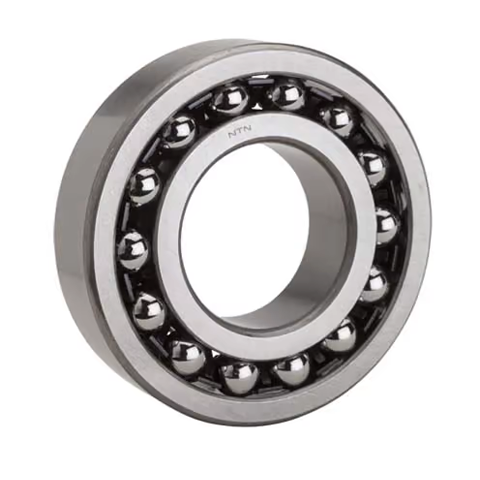
NTN NTN Self-Aligning Ball Bearing - Straight Bore, 2211
Item # d D B r Static Load Rating Dynamic Load Rating 2200 0.3937 in 10.000 mm 1.1811 in 30.000 mm 0.5512 in 14.000 mm 0.0236 in 0.600 mm 355 lbf 1590 N 1.59 kN 1670 lbf 7450 N 7.45 kN 2201 0.4724 in 12.000 mm 1.2598 in 32.000 mm 0.5512 in 14.000 mm 0.0236 in 0.600 mm 390 lbf 1730 N 1.73 kN 1740 lbf 7750 N 7.75 kN 2202 0.5906 in 15.000 mm 1.3780 in 35.000 mm 0.5512 in 14.000 mm 0.0236 in 0.600 mm 415 lbf 1850 N 1.85 kN 1750 lbf 7800 N 7.80 kN 2203 0.6693 in 17.000 mm 1.5748 in 40.000 mm 0.6299 in 16.000 mm 0.0236 in 0.600 mm 545 lbf 2420 N 2.42 kN 2240 lbf 9950 N 9.95 kN 2204 0.7874 in 20.000 mm 1.8504 in 47.000 mm 0.7087 in 18.000 mm 0.0394 in 1.000 mm 740 lbf 3300 N 3.30 kN 2880 lbf 12800 N 12.80 kN 2205 0.9843 in 25.000 mm 2.0472 in 52.000 mm 0.7087 in 18.000 mm 0.0394 in 1.000 mm 775 lbf 3450 N 3.45 kN 2790 lbf 12400 N 12.40 kN 2206 1.1811 in 30.000 mm 2.4409 in 62.000 mm 0.7874 in 20.000 mm 0.0394 in 1.000 mm 1020 lbf 4550 N 4.55 kN 3450 lbf 15300 N 15.30 kN 2207 1.3780 in 35.000 mm 2.8346 in 72.000 mm 0.9055 in 23.000 mm 0.0433 in 1.100 mm 1480 lbf 6600 N 6.60 kN 4900 lbf 21700 N 21.70 kN 2208 1.5748 in 40.000 mm 3.1496 in 80.000 mm 0.9055 in 23.000 mm 0.0433 in 1.100 mm 1650 lbf 7350 N 7.35 kN 5050 lbf 22400 N 22.40 kN 2209 1.7717 in 45.000 mm 3.3465 in 85.000 mm 0.9055 in 23.000 mm 0.0433 in 1.100 mm 1830 lbf 8150 N 8.15 kN 5250 lbf 23300 N 23.30 kN 2210 1.9685 in 50.000 mm 3.5433 in 90.000 mm 0.9055 in 23.000 mm 0.0433 in 1.100 mm 1900 lbf 8450 N 8.45 kN 5250 lbf 23300 N 23.30 kN 2211 2.1654 in 55.000 mm 3.9370 in 100.000 mm 0.9843 in 25.000 mm 0.0591 in 1.500 mm 2230 lbf 9900 N 9.90 kN 6000 lbf 26700 N 26.70 kN 2212 2.3622 in 60.000 mm 4.3307 in 110.000 mm 1.1024 in 28.000 mm 0.0591 in 1.500 mm 2830 lbf 12600 N 12.60 kN 7650 lbf 34000 N 34.00 kN 2213 2.5591 in 65.000 mm 4.7244 in 120.000 mm 1.2205 in 31.000 mm 0.0591 in 1.500 mm 3700 lbf 16400 N 16.40 kN 9800 lbf 43500 N 43.50 kN 2214 2.7559 in 70.000 mm 4.9213 in 125.000 mm 1.2205 in 31.000 mm 0.0591 in 1.500 mm 3850 lbf 17100 N 17.10 kN 9900 lbf 44000 N 44.00 kN 2215 2.9528 in 75.000 mm 5.1181 in 130.000 mm 1.2205 in 31.000 mm 0.0591 in 1.500 mm 4000 lbf 17800 N 17.80 kN 10000 lbf 44500 N 44.50 kN 2216 3.1496 in 80.000 mm 5.5118 in 140.000 mm 1.2992 in 33.000 mm 0.0787 in 2.000 mm 4450 lbf 19900 N 19.90 kN 11000 lbf 49000 N 49.00 kN 2217 3.3465 in 85.000 mm 5.9055 in 150.000 mm 1.4173 in 36.000 mm 0.0787 in 2.000 mm 5300 lbf 23600 N 23.60 kN 13200 lbf 58500 N 58.50 kN 2218 3.5433 in 90.000 mm 6.2992 in 160.000 mm 1.5748 in 40.000 mm 0.0787 in 2.000 mm 6450 lbf 28700 N 28.70 kN 15800 lbf 70500 N 70.50 kN 2219 3.7402 in 95.000 mm 6.6929 in 170.000 mm 1.6929 in 43.000 mm 0.0827 in 2.100 mm 7750 lbf 34500 N 34.50 kN 18900 lbf 84000 N 84.00 kN 2220 3.9370 in 100.000 mm 7.0866 in 180.000 mm 1.8110 in 46.000 mm 0.0827 in 2.100 mm 8650 lbf 38500 N 38.50 kN 21200 lbf 94500 N 94.50 kN 1. Design features and characteristics The outer ring raceway of self-aligning ball bearings forms a spherical surface whose center is common to the bearing center. The inner ring of the bearing has two raceways.The balls, cage, and inner ring of these bearings are capable of shifting in order to compensate for a certain degree of misalignment with the outer rings. As a result, the bearing is able to align itself and compensate for shaft / housing finishing unevenness, bearing fitting error, and other sources of misalignment as shown in Fig. 1.Since axial load capacity is limited, self- aligning ball bearing are not suitable for applications with heavy axial loads. It is recommended to use an adapter on a self-aligning ball bearing with a tapered bore inner diameter for ease of installation and disassembly. These bearings and adapters are often used on drive shaft applications. 2. Standard cage type All bearing series are equipped with a pressed cage, except 2321S and 2322S, which are equipped with a machined cage.Self-Aligning Ball BearingsIt is recommended to use an adapter on a self-aligning ball bearing with a tapered bore inner diameter for ease of installation and disassembly. These bearings and adapters are often used on drive shaft applications. Table 1 Standard cage types of spherical ball bearings 3. Ball protrusion Bearings with part numbers listed in Table 2 below have balls which protrude slightly from the bearing face as illustrated in Fig. 2. The total width dimensions are shown in Table 2. 4. Allowable misalignment angle The allowable misalignment angle can be determined by the following function. This degree of allowable misalignment may be limited by the design of mating components around the bearing.Normal load ....................... 1/15 5. Precautions for using self-aligning ball bearings Self-aligning ball bearings are unable to support large axial loads and therefore axial loading shall be limited.Please consider using self-aligning roller bearings when a large axial load is to be applied.
$41.76
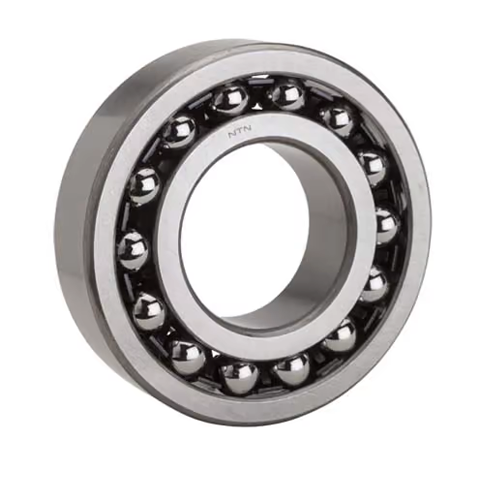
NTN NTN Self-Aligning Ball Bearing - Straight Bore, 2212
Item # d D B r Static Load Rating Dynamic Load Rating 2200 0.3937 in 10.000 mm 1.1811 in 30.000 mm 0.5512 in 14.000 mm 0.0236 in 0.600 mm 355 lbf 1590 N 1.59 kN 1670 lbf 7450 N 7.45 kN 2201 0.4724 in 12.000 mm 1.2598 in 32.000 mm 0.5512 in 14.000 mm 0.0236 in 0.600 mm 390 lbf 1730 N 1.73 kN 1740 lbf 7750 N 7.75 kN 2202 0.5906 in 15.000 mm 1.3780 in 35.000 mm 0.5512 in 14.000 mm 0.0236 in 0.600 mm 415 lbf 1850 N 1.85 kN 1750 lbf 7800 N 7.80 kN 2203 0.6693 in 17.000 mm 1.5748 in 40.000 mm 0.6299 in 16.000 mm 0.0236 in 0.600 mm 545 lbf 2420 N 2.42 kN 2240 lbf 9950 N 9.95 kN 2204 0.7874 in 20.000 mm 1.8504 in 47.000 mm 0.7087 in 18.000 mm 0.0394 in 1.000 mm 740 lbf 3300 N 3.30 kN 2880 lbf 12800 N 12.80 kN 2205 0.9843 in 25.000 mm 2.0472 in 52.000 mm 0.7087 in 18.000 mm 0.0394 in 1.000 mm 775 lbf 3450 N 3.45 kN 2790 lbf 12400 N 12.40 kN 2206 1.1811 in 30.000 mm 2.4409 in 62.000 mm 0.7874 in 20.000 mm 0.0394 in 1.000 mm 1020 lbf 4550 N 4.55 kN 3450 lbf 15300 N 15.30 kN 2207 1.3780 in 35.000 mm 2.8346 in 72.000 mm 0.9055 in 23.000 mm 0.0433 in 1.100 mm 1480 lbf 6600 N 6.60 kN 4900 lbf 21700 N 21.70 kN 2208 1.5748 in 40.000 mm 3.1496 in 80.000 mm 0.9055 in 23.000 mm 0.0433 in 1.100 mm 1650 lbf 7350 N 7.35 kN 5050 lbf 22400 N 22.40 kN 2209 1.7717 in 45.000 mm 3.3465 in 85.000 mm 0.9055 in 23.000 mm 0.0433 in 1.100 mm 1830 lbf 8150 N 8.15 kN 5250 lbf 23300 N 23.30 kN 2210 1.9685 in 50.000 mm 3.5433 in 90.000 mm 0.9055 in 23.000 mm 0.0433 in 1.100 mm 1900 lbf 8450 N 8.45 kN 5250 lbf 23300 N 23.30 kN 2211 2.1654 in 55.000 mm 3.9370 in 100.000 mm 0.9843 in 25.000 mm 0.0591 in 1.500 mm 2230 lbf 9900 N 9.90 kN 6000 lbf 26700 N 26.70 kN 2212 2.3622 in 60.000 mm 4.3307 in 110.000 mm 1.1024 in 28.000 mm 0.0591 in 1.500 mm 2830 lbf 12600 N 12.60 kN 7650 lbf 34000 N 34.00 kN 2213 2.5591 in 65.000 mm 4.7244 in 120.000 mm 1.2205 in 31.000 mm 0.0591 in 1.500 mm 3700 lbf 16400 N 16.40 kN 9800 lbf 43500 N 43.50 kN 2214 2.7559 in 70.000 mm 4.9213 in 125.000 mm 1.2205 in 31.000 mm 0.0591 in 1.500 mm 3850 lbf 17100 N 17.10 kN 9900 lbf 44000 N 44.00 kN 2215 2.9528 in 75.000 mm 5.1181 in 130.000 mm 1.2205 in 31.000 mm 0.0591 in 1.500 mm 4000 lbf 17800 N 17.80 kN 10000 lbf 44500 N 44.50 kN 2216 3.1496 in 80.000 mm 5.5118 in 140.000 mm 1.2992 in 33.000 mm 0.0787 in 2.000 mm 4450 lbf 19900 N 19.90 kN 11000 lbf 49000 N 49.00 kN 2217 3.3465 in 85.000 mm 5.9055 in 150.000 mm 1.4173 in 36.000 mm 0.0787 in 2.000 mm 5300 lbf 23600 N 23.60 kN 13200 lbf 58500 N 58.50 kN 2218 3.5433 in 90.000 mm 6.2992 in 160.000 mm 1.5748 in 40.000 mm 0.0787 in 2.000 mm 6450 lbf 28700 N 28.70 kN 15800 lbf 70500 N 70.50 kN 2219 3.7402 in 95.000 mm 6.6929 in 170.000 mm 1.6929 in 43.000 mm 0.0827 in 2.100 mm 7750 lbf 34500 N 34.50 kN 18900 lbf 84000 N 84.00 kN 2220 3.9370 in 100.000 mm 7.0866 in 180.000 mm 1.8110 in 46.000 mm 0.0827 in 2.100 mm 8650 lbf 38500 N 38.50 kN 21200 lbf 94500 N 94.50 kN 1. Design features and characteristics The outer ring raceway of self-aligning ball bearings forms a spherical surface whose center is common to the bearing center. The inner ring of the bearing has two raceways.The balls, cage, and inner ring of these bearings are capable of shifting in order to compensate for a certain degree of misalignment with the outer rings. As a result, the bearing is able to align itself and compensate for shaft / housing finishing unevenness, bearing fitting error, and other sources of misalignment as shown in Fig. 1.Since axial load capacity is limited, self- aligning ball bearing are not suitable for applications with heavy axial loads. It is recommended to use an adapter on a self-aligning ball bearing with a tapered bore inner diameter for ease of installation and disassembly. These bearings and adapters are often used on drive shaft applications. 2. Standard cage type All bearing series are equipped with a pressed cage, except 2321S and 2322S, which are equipped with a machined cage.Self-Aligning Ball BearingsIt is recommended to use an adapter on a self-aligning ball bearing with a tapered bore inner diameter for ease of installation and disassembly. These bearings and adapters are often used on drive shaft applications. Table 1 Standard cage types of spherical ball bearings 3. Ball protrusion Bearings with part numbers listed in Table 2 below have balls which protrude slightly from the bearing face as illustrated in Fig. 2. The total width dimensions are shown in Table 2. 4. Allowable misalignment angle The allowable misalignment angle can be determined by the following function. This degree of allowable misalignment may be limited by the design of mating components around the bearing.Normal load ....................... 1/15 5. Precautions for using self-aligning ball bearings Self-aligning ball bearings are unable to support large axial loads and therefore axial loading shall be limited.Please consider using self-aligning roller bearings when a large axial load is to be applied.
$44.88

NTN NTN Spherical Roller Bearing , 21308CD1
Item # d D B r Static Load Rating Dynamic Load Rating 21308CD1 1.5748 in 40.000 mm 3.5433 in 90.000 mm 0.9055 in 23.000 mm 0.0591 in 1.500 mm 20200 lbf 90000 N 90.00 kN 19800 lbf 88000 N 88.00 kN 1. Design features and characteristics Spherical roller bearings consist of an outer ring having a continuous spherical raceway and two rows of barrel-shaped rollers guided by an inner ring with two raceways. (Refer to Fig. 1) This bearing has self-aligning properties, and therefore is suited for use where misalignment between the inner and outer rings occurs from housing installation error or shaft bending. Spherical roller bearings have a large capacity for radial loads, axial loads in either direction, and combined loads. They are also suited for applications where vibration and shock loads are encountered. When spherical roller bearings are used with a vertical shaft or under a large axial load, the load on the rollers of the row that is not subject to the axial load becomes small, and the resulting skidding on the rollers may result in wear. If the ratio of the axial load to the radial load exceeds the factor e in the dimension table (Fa/Fr > e), consult NTN Engineering.In addition to spherical roller bearings with cylindrical bores, spherical roller bearings with tapered bores are also available. Bearings with tapered bores are specified by the suffix “K” at the end of the spherical roller bearing part number. The standard taper ratio is 1:12 for bearings with a “K” suffix; for bearings in series 240 and 241, the suffix “K30” indicates the taper ratio for a bearing is 1:30. Most tapered bore bearings incorporate the use of adapters and withdrawal sleeves for shaft mounting.
$70.10

NTN NTN Spherical Roller Bearing , 21310CD1
Item # d D B r Static Load Rating Dynamic Load Rating 21310CD1 1.9685 in 50.000 mm 4.3307 in 110.000 mm 1.0630 in 27.000 mm 0.0787 in 2.000 mm 28600 lbf 127000 N 127.00 kN 26500 lbf 118000 N 118.00 kN 1. Design features and characteristics Spherical roller bearings consist of an outer ring having a continuous spherical raceway and two rows of barrel-shaped rollers guided by an inner ring with two raceways. (Refer to Fig. 1) This bearing has self-aligning properties, and therefore is suited for use where misalignment between the inner and outer rings occurs from housing installation error or shaft bending. Spherical roller bearings have a large capacity for radial loads, axial loads in either direction, and combined loads. They are also suited for applications where vibration and shock loads are encountered. When spherical roller bearings are used with a vertical shaft or under a large axial load, the load on the rollers of the row that is not subject to the axial load becomes small, and the resulting skidding on the rollers may result in wear. If the ratio of the axial load to the radial load exceeds the factor e in the dimension table (Fa/Fr > e), consult NTN Engineering.In addition to spherical roller bearings with cylindrical bores, spherical roller bearings with tapered bores are also available. Bearings with tapered bores are specified by the suffix “K” at the end of the spherical roller bearing part number. The standard taper ratio is 1:12 for bearings with a “K” suffix; for bearings in series 240 and 241, the suffix “K30” indicates the taper ratio for a bearing is 1:30. Most tapered bore bearings incorporate the use of adapters and withdrawal sleeves for shaft mounting.
$82.69

NTN NTN Spherical Roller Bearing , 21311D1
Item # d D B r Static Load Rating Dynamic Load Rating 21311D1 2.1654 in 55.000 mm 4.7244 in 120.000 mm 1.1417 in 29.000 mm 0.0787 in 2.000 mm 36500 lbf 163000 N 163.00 kN 32500 lbf 145000 N 145.00 kN 1. Design features and characteristics Spherical roller bearings consist of an outer ring having a continuous spherical raceway and two rows of barrel-shaped rollers guided by an inner ring with two raceways. (Refer to Fig. 1) This bearing has self-aligning properties, and therefore is suited for use where misalignment between the inner and outer rings occurs from housing installation error or shaft bending. Spherical roller bearings have a large capacity for radial loads, axial loads in either direction, and combined loads. They are also suited for applications where vibration and shock loads are encountered. When spherical roller bearings are used with a vertical shaft or under a large axial load, the load on the rollers of the row that is not subject to the axial load becomes small, and the resulting skidding on the rollers may result in wear. If the ratio of the axial load to the radial load exceeds the factor e in the dimension table (Fa/Fr > e), consult NTN Engineering.In addition to spherical roller bearings with cylindrical bores, spherical roller bearings with tapered bores are also available. Bearings with tapered bores are specified by the suffix “K” at the end of the spherical roller bearing part number. The standard taper ratio is 1:12 for bearings with a “K” suffix; for bearings in series 240 and 241, the suffix “K30” indicates the taper ratio for a bearing is 1:30. Most tapered bore bearings incorporate the use of adapters and withdrawal sleeves for shaft mounting.
$85.74

NTN NTN Spherical Roller Bearing , 21313D1
Item # d D B r Static Load Rating Dynamic Load Rating 21313D1 2.5591 in 65.000 mm 5.5118 in 140.000 mm 1.2992 in 33.000 mm 0.0827 in 2.100 mm 51500 lbf 228000 N 228.00 kN 43500 lbf 194000 N 194.00 kN 1. Design features and characteristics Spherical roller bearings consist of an outer ring having a continuous spherical raceway and two rows of barrel-shaped rollers guided by an inner ring with two raceways. (Refer to Fig. 1) This bearing has self-aligning properties, and therefore is suited for use where misalignment between the inner and outer rings occurs from housing installation error or shaft bending. Spherical roller bearings have a large capacity for radial loads, axial loads in either direction, and combined loads. They are also suited for applications where vibration and shock loads are encountered. When spherical roller bearings are used with a vertical shaft or under a large axial load, the load on the rollers of the row that is not subject to the axial load becomes small, and the resulting skidding on the rollers may result in wear. If the ratio of the axial load to the radial load exceeds the factor e in the dimension table (Fa/Fr > e), consult NTN Engineering.In addition to spherical roller bearings with cylindrical bores, spherical roller bearings with tapered bores are also available. Bearings with tapered bores are specified by the suffix “K” at the end of the spherical roller bearing part number. The standard taper ratio is 1:12 for bearings with a “K” suffix; for bearings in series 240 and 241, the suffix “K30” indicates the taper ratio for a bearing is 1:30. Most tapered bore bearings incorporate the use of adapters and withdrawal sleeves for shaft mounting.
$112.63

NTN NTN Spherical Roller Bearing , 21314D1
Item # d D B r Static Load Rating Dynamic Load Rating 21314D1 2.7559 in 70.000 mm 5.9055 in 150.000 mm 1.3780 in 35.000 mm 0.0827 in 2.100 mm 59000 lbf 262000 N 262.00 kN 49500 lbf 220000 N 220.00 kN 1. Design features and characteristics Spherical roller bearings consist of an outer ring having a continuous spherical raceway and two rows of barrel-shaped rollers guided by an inner ring with two raceways. (Refer to Fig. 1) This bearing has self-aligning properties, and therefore is suited for use where misalignment between the inner and outer rings occurs from housing installation error or shaft bending. Spherical roller bearings have a large capacity for radial loads, axial loads in either direction, and combined loads. They are also suited for applications where vibration and shock loads are encountered. When spherical roller bearings are used with a vertical shaft or under a large axial load, the load on the rollers of the row that is not subject to the axial load becomes small, and the resulting skidding on the rollers may result in wear. If the ratio of the axial load to the radial load exceeds the factor e in the dimension table (Fa/Fr > e), consult NTN Engineering.In addition to spherical roller bearings with cylindrical bores, spherical roller bearings with tapered bores are also available. Bearings with tapered bores are specified by the suffix “K” at the end of the spherical roller bearing part number. The standard taper ratio is 1:12 for bearings with a “K” suffix; for bearings in series 240 and 241, the suffix “K30” indicates the taper ratio for a bearing is 1:30. Most tapered bore bearings incorporate the use of adapters and withdrawal sleeves for shaft mounting.
$130.57

NTN NTN Spherical Roller Bearing , 21315D1
Item # d D B r Static Load Rating Dynamic Load Rating 21315D1 2.9528 in 75.000 mm 6.2992 in 160.000 mm 1.4567 in 37.000 mm 0.0827 in 2.100 mm 64500 lbf 287000 N 287.00 kN 53500 lbf 239000 N 239.00 kN 1. Design features and characteristics Spherical roller bearings consist of an outer ring having a continuous spherical raceway and two rows of barrel-shaped rollers guided by an inner ring with two raceways. (Refer to Fig. 1) This bearing has self-aligning properties, and therefore is suited for use where misalignment between the inner and outer rings occurs from housing installation error or shaft bending. Spherical roller bearings have a large capacity for radial loads, axial loads in either direction, and combined loads. They are also suited for applications where vibration and shock loads are encountered. When spherical roller bearings are used with a vertical shaft or under a large axial load, the load on the rollers of the row that is not subject to the axial load becomes small, and the resulting skidding on the rollers may result in wear. If the ratio of the axial load to the radial load exceeds the factor e in the dimension table (Fa/Fr > e), consult NTN Engineering.In addition to spherical roller bearings with cylindrical bores, spherical roller bearings with tapered bores are also available. Bearings with tapered bores are specified by the suffix “K” at the end of the spherical roller bearing part number. The standard taper ratio is 1:12 for bearings with a “K” suffix; for bearings in series 240 and 241, the suffix “K30” indicates the taper ratio for a bearing is 1:30. Most tapered bore bearings incorporate the use of adapters and withdrawal sleeves for shaft mounting.
$140.66

NTN NTN Spherical Roller Bearing , 21316D1
Item # d D B r Static Load Rating Dynamic Load Rating 21316D1 3.1496 in 80.000 mm 6.6929 in 170.000 mm 1.5354 in 39.000 mm 0.0827 in 2.100 mm 71000 lbf 315000 N 315.00 kN 58500 lbf 260000 N 260.00 kN 1. Design features and characteristics Spherical roller bearings consist of an outer ring having a continuous spherical raceway and two rows of barrel-shaped rollers guided by an inner ring with two raceways. (Refer to Fig. 1) This bearing has self-aligning properties, and therefore is suited for use where misalignment between the inner and outer rings occurs from housing installation error or shaft bending. Spherical roller bearings have a large capacity for radial loads, axial loads in either direction, and combined loads. They are also suited for applications where vibration and shock loads are encountered. When spherical roller bearings are used with a vertical shaft or under a large axial load, the load on the rollers of the row that is not subject to the axial load becomes small, and the resulting skidding on the rollers may result in wear. If the ratio of the axial load to the radial load exceeds the factor e in the dimension table (Fa/Fr > e), consult NTN Engineering.In addition to spherical roller bearings with cylindrical bores, spherical roller bearings with tapered bores are also available. Bearings with tapered bores are specified by the suffix “K” at the end of the spherical roller bearing part number. The standard taper ratio is 1:12 for bearings with a “K” suffix; for bearings in series 240 and 241, the suffix “K30” indicates the taper ratio for a bearing is 1:30. Most tapered bore bearings incorporate the use of adapters and withdrawal sleeves for shaft mounting.
$162.25

NTN NTN Spherical Roller Bearing , 21317D1
Item # d D B r Static Load Rating Dynamic Load Rating 21317D1 3.3465 in 85.000 mm 7.0866 in 180.000 mm 1.6142 in 41.000 mm 0.1181 in 3.000 mm 80000 lbf 355000 N 355.00 kN 65000 lbf 289000 N 289.00 kN 1. Design features and characteristics Spherical roller bearings consist of an outer ring having a continuous spherical raceway and two rows of barrel-shaped rollers guided by an inner ring with two raceways. (Refer to Fig. 1) This bearing has self-aligning properties, and therefore is suited for use where misalignment between the inner and outer rings occurs from housing installation error or shaft bending. Spherical roller bearings have a large capacity for radial loads, axial loads in either direction, and combined loads. They are also suited for applications where vibration and shock loads are encountered. When spherical roller bearings are used with a vertical shaft or under a large axial load, the load on the rollers of the row that is not subject to the axial load becomes small, and the resulting skidding on the rollers may result in wear. If the ratio of the axial load to the radial load exceeds the factor e in the dimension table (Fa/Fr > e), consult NTN Engineering.In addition to spherical roller bearings with cylindrical bores, spherical roller bearings with tapered bores are also available. Bearings with tapered bores are specified by the suffix “K” at the end of the spherical roller bearing part number. The standard taper ratio is 1:12 for bearings with a “K” suffix; for bearings in series 240 and 241, the suffix “K30” indicates the taper ratio for a bearing is 1:30. Most tapered bore bearings incorporate the use of adapters and withdrawal sleeves for shaft mounting.
$188.70

NTN NTN Spherical Roller Bearing , 21318D1
Item # d D B r Static Load Rating Dynamic Load Rating 21318D1 3.5433 in 90.000 mm 7.4803 in 190.000 mm 1.6929 in 43.000 mm 0.1181 in 3.000 mm 90000 lbf 400000 N 400.00 kN 72000 lbf 320000 N 320.00 kN 1. Design features and characteristics Spherical roller bearings consist of an outer ring having a continuous spherical raceway and two rows of barrel-shaped rollers guided by an inner ring with two raceways. (Refer to Fig. 1) This bearing has self-aligning properties, and therefore is suited for use where misalignment between the inner and outer rings occurs from housing installation error or shaft bending. Spherical roller bearings have a large capacity for radial loads, axial loads in either direction, and combined loads. They are also suited for applications where vibration and shock loads are encountered. When spherical roller bearings are used with a vertical shaft or under a large axial load, the load on the rollers of the row that is not subject to the axial load becomes small, and the resulting skidding on the rollers may result in wear. If the ratio of the axial load to the radial load exceeds the factor e in the dimension table (Fa/Fr > e), consult NTN Engineering.In addition to spherical roller bearings with cylindrical bores, spherical roller bearings with tapered bores are also available. Bearings with tapered bores are specified by the suffix “K” at the end of the spherical roller bearing part number. The standard taper ratio is 1:12 for bearings with a “K” suffix; for bearings in series 240 and 241, the suffix “K30” indicates the taper ratio for a bearing is 1:30. Most tapered bore bearings incorporate the use of adapters and withdrawal sleeves for shaft mounting.
$205.90

NTN NTN Spherical Roller Bearing , 21319D1
Item # d D B r Static Load Rating Dynamic Load Rating 21319D1 3.7402 in 95.000 mm 7.8740 in 200.000 mm 1.7717 in 45.000 mm 0.1181 in 3.000 mm 94500 lbf 420000 N 420.00 kN 75500 lbf 335000 N 335.00 kN 1. Design features and characteristics Spherical roller bearings consist of an outer ring having a continuous spherical raceway and two rows of barrel-shaped rollers guided by an inner ring with two raceways. (Refer to Fig. 1) This bearing has self-aligning properties, and therefore is suited for use where misalignment between the inner and outer rings occurs from housing installation error or shaft bending. Spherical roller bearings have a large capacity for radial loads, axial loads in either direction, and combined loads. They are also suited for applications where vibration and shock loads are encountered. When spherical roller bearings are used with a vertical shaft or under a large axial load, the load on the rollers of the row that is not subject to the axial load becomes small, and the resulting skidding on the rollers may result in wear. If the ratio of the axial load to the radial load exceeds the factor e in the dimension table (Fa/Fr > e), consult NTN Engineering.In addition to spherical roller bearings with cylindrical bores, spherical roller bearings with tapered bores are also available. Bearings with tapered bores are specified by the suffix “K” at the end of the spherical roller bearing part number. The standard taper ratio is 1:12 for bearings with a “K” suffix; for bearings in series 240 and 241, the suffix “K30” indicates the taper ratio for a bearing is 1:30. Most tapered bore bearings incorporate the use of adapters and withdrawal sleeves for shaft mounting.
$234.20

NTN NTN Spherical Roller Bearing , 21320D1
Item # d D B r Static Load Rating Dynamic Load Rating 21320D1 3.9370 in 100.000 mm 8.4646 in 215.000 mm 1.8504 in 47.000 mm 0.0984 in 2.500 mm 105000 lbf 465000 N 465.00 kN 83000 lbf 370000 N 370.00 kN 1. Design features and characteristics Spherical roller bearings consist of an outer ring having a continuous spherical raceway and two rows of barrel-shaped rollers guided by an inner ring with two raceways. (Refer to Fig. 1) This bearing has self-aligning properties, and therefore is suited for use where misalignment between the inner and outer rings occurs from housing installation error or shaft bending. Spherical roller bearings have a large capacity for radial loads, axial loads in either direction, and combined loads. They are also suited for applications where vibration and shock loads are encountered. When spherical roller bearings are used with a vertical shaft or under a large axial load, the load on the rollers of the row that is not subject to the axial load becomes small, and the resulting skidding on the rollers may result in wear. If the ratio of the axial load to the radial load exceeds the factor e in the dimension table (Fa/Fr > e), consult NTN Engineering.In addition to spherical roller bearings with cylindrical bores, spherical roller bearings with tapered bores are also available. Bearings with tapered bores are specified by the suffix “K” at the end of the spherical roller bearing part number. The standard taper ratio is 1:12 for bearings with a “K” suffix; for bearings in series 240 and 241, the suffix “K30” indicates the taper ratio for a bearing is 1:30. Most tapered bore bearings incorporate the use of adapters and withdrawal sleeves for shaft mounting.
$293.01

NTN NTN Spherical Roller Bearing , 21322D1
Item # d D B r Static Load Rating Dynamic Load Rating 21322D1 4.3307 in 110.000 mm 9.4488 in 240.000 mm 1.9685 in 50.000 mm 0.1181 in 3.000 mm 138000 lbf 615000 N 615.00 kN 111000 lbf 495000 N 495.00 kN 1. Design features and characteristics Spherical roller bearings consist of an outer ring having a continuous spherical raceway and two rows of barrel-shaped rollers guided by an inner ring with two raceways. (Refer to Fig. 1) This bearing has self-aligning properties, and therefore is suited for use where misalignment between the inner and outer rings occurs from housing installation error or shaft bending. Spherical roller bearings have a large capacity for radial loads, axial loads in either direction, and combined loads. They are also suited for applications where vibration and shock loads are encountered. When spherical roller bearings are used with a vertical shaft or under a large axial load, the load on the rollers of the row that is not subject to the axial load becomes small, and the resulting skidding on the rollers may result in wear. If the ratio of the axial load to the radial load exceeds the factor e in the dimension table (Fa/Fr > e), consult NTN Engineering.In addition to spherical roller bearings with cylindrical bores, spherical roller bearings with tapered bores are also available. Bearings with tapered bores are specified by the suffix “K” at the end of the spherical roller bearing part number. The standard taper ratio is 1:12 for bearings with a “K” suffix; for bearings in series 240 and 241, the suffix “K30” indicates the taper ratio for a bearing is 1:30. Most tapered bore bearings incorporate the use of adapters and withdrawal sleeves for shaft mounting.
$414.40

NTN NTN Spherical Roller Bearing , 22205EAW33
Item # d D B r Static Load Rating Dynamic Load Rating 22205EAW33 0.9843 in 25.000 mm 2.0472 in 52.000 mm 0.7087 in 18.000 mm 0.0394 in 1.000 mm 10400 lbf 46100 N 46.10 kN 12900 lbf 57300 N 57.30 kN 1. Design features and characteristics Spherical roller bearings consist of an outer ring having a continuous spherical raceway and two rows of barrel-shaped rollers guided by an inner ring with two raceways. (Refer to Fig. 1) This bearing has self-aligning properties, and therefore is suited for use where misalignment between the inner and outer rings occurs from housing installation error or shaft bending. Spherical roller bearings have a large capacity for radial loads, axial loads in either direction, and combined loads. They are also suited for applications where vibration and shock loads are encountered. When spherical roller bearings are used with a vertical shaft or under a large axial load, the load on the rollers of the row that is not subject to the axial load becomes small, and the resulting skidding on the rollers may result in wear. If the ratio of the axial load to the radial load exceeds the factor e in the dimension table (Fa/Fr > e), consult NTN Engineering.In addition to spherical roller bearings with cylindrical bores, spherical roller bearings with tapered bores are also available. Bearings with tapered bores are specified by the suffix “K” at the end of the spherical roller bearing part number. The standard taper ratio is 1:12 for bearings with a “K” suffix; for bearings in series 240 and 241, the suffix “K30” indicates the taper ratio for a bearing is 1:30. Most tapered bore bearings incorporate the use of adapters and withdrawal sleeves for shaft mounting.
$59.05

NTN NTN Spherical Roller Bearing , 22206EAW33
Item # d D B r Static Load Rating Dynamic Load Rating 22206EAW33 1.1811 in 30.000 mm 2.4409 in 62.000 mm 0.7874 in 20.000 mm 0.0394 in 1.000 mm 14500 lbf 64500 N 64.50 kN 16200 lbf 72000 N 72.00 kN 1. Design features and characteristics Spherical roller bearings consist of an outer ring having a continuous spherical raceway and two rows of barrel-shaped rollers guided by an inner ring with two raceways. (Refer to Fig. 1) This bearing has self-aligning properties, and therefore is suited for use where misalignment between the inner and outer rings occurs from housing installation error or shaft bending. Spherical roller bearings have a large capacity for radial loads, axial loads in either direction, and combined loads. They are also suited for applications where vibration and shock loads are encountered. When spherical roller bearings are used with a vertical shaft or under a large axial load, the load on the rollers of the row that is not subject to the axial load becomes small, and the resulting skidding on the rollers may result in wear. If the ratio of the axial load to the radial load exceeds the factor e in the dimension table (Fa/Fr > e), consult NTN Engineering.In addition to spherical roller bearings with cylindrical bores, spherical roller bearings with tapered bores are also available. Bearings with tapered bores are specified by the suffix “K” at the end of the spherical roller bearing part number. The standard taper ratio is 1:12 for bearings with a “K” suffix; for bearings in series 240 and 241, the suffix “K30” indicates the taper ratio for a bearing is 1:30. Most tapered bore bearings incorporate the use of adapters and withdrawal sleeves for shaft mounting.
$61.23

NTN NTN Spherical Roller Bearing , 22207EAW33
Item # d D B r Static Load Rating Dynamic Load Rating 22207EAW33 1.3780 in 35.000 mm 2.8346 in 72.000 mm 0.9055 in 23.000 mm 0.0433 in 1.100 mm 20700 lbf 92000 N 92.00 kN 22500 lbf 100000 N 100.00 kN 1. Design features and characteristics Spherical roller bearings consist of an outer ring having a continuous spherical raceway and two rows of barrel-shaped rollers guided by an inner ring with two raceways. (Refer to Fig. 1) This bearing has self-aligning properties, and therefore is suited for use where misalignment between the inner and outer rings occurs from housing installation error or shaft bending. Spherical roller bearings have a large capacity for radial loads, axial loads in either direction, and combined loads. They are also suited for applications where vibration and shock loads are encountered. When spherical roller bearings are used with a vertical shaft or under a large axial load, the load on the rollers of the row that is not subject to the axial load becomes small, and the resulting skidding on the rollers may result in wear. If the ratio of the axial load to the radial load exceeds the factor e in the dimension table (Fa/Fr > e), consult NTN Engineering.In addition to spherical roller bearings with cylindrical bores, spherical roller bearings with tapered bores are also available. Bearings with tapered bores are specified by the suffix “K” at the end of the spherical roller bearing part number. The standard taper ratio is 1:12 for bearings with a “K” suffix; for bearings in series 240 and 241, the suffix “K30” indicates the taper ratio for a bearing is 1:30. Most tapered bore bearings incorporate the use of adapters and withdrawal sleeves for shaft mounting.
$62.23

NTN NTN Spherical Roller Bearing , 22208EAD1
Item # d D B r Static Load Rating Dynamic Load Rating 22208EAD1 1.5748 in 40.000 mm 3.1496 in 80.000 mm 0.9055 in 23.000 mm 0.0433 in 1.100 mm 23600 lbf 105000 N 105.00 kN 26100 lbf 116000 N 116.00 kN 1. Design features and characteristics Spherical roller bearings consist of an outer ring having a continuous spherical raceway and two rows of barrel-shaped rollers guided by an inner ring with two raceways. (Refer to Fig. 1) This bearing has self-aligning properties, and therefore is suited for use where misalignment between the inner and outer rings occurs from housing installation error or shaft bending. Spherical roller bearings have a large capacity for radial loads, axial loads in either direction, and combined loads. They are also suited for applications where vibration and shock loads are encountered. When spherical roller bearings are used with a vertical shaft or under a large axial load, the load on the rollers of the row that is not subject to the axial load becomes small, and the resulting skidding on the rollers may result in wear. If the ratio of the axial load to the radial load exceeds the factor e in the dimension table (Fa/Fr > e), consult NTN Engineering.In addition to spherical roller bearings with cylindrical bores, spherical roller bearings with tapered bores are also available. Bearings with tapered bores are specified by the suffix “K” at the end of the spherical roller bearing part number. The standard taper ratio is 1:12 for bearings with a “K” suffix; for bearings in series 240 and 241, the suffix “K30” indicates the taper ratio for a bearing is 1:30. Most tapered bore bearings incorporate the use of adapters and withdrawal sleeves for shaft mounting.
$64.24

NTN NTN Spherical Roller Bearing , 22212EAD1
Item # d D B r Static Load Rating Dynamic Load Rating 22212EAD1 2.3622 in 60.000 mm 4.3307 in 110.000 mm 1.1024 in 28.000 mm 0.0591 in 1.500 mm 40500 lbf 181000 N 181.00 kN 42000 lbf 187000 N 187.00 kN 1. Design features and characteristics Spherical roller bearings consist of an outer ring having a continuous spherical raceway and two rows of barrel-shaped rollers guided by an inner ring with two raceways. (Refer to Fig. 1) This bearing has self-aligning properties, and therefore is suited for use where misalignment between the inner and outer rings occurs from housing installation error or shaft bending. Spherical roller bearings have a large capacity for radial loads, axial loads in either direction, and combined loads. They are also suited for applications where vibration and shock loads are encountered. When spherical roller bearings are used with a vertical shaft or under a large axial load, the load on the rollers of the row that is not subject to the axial load becomes small, and the resulting skidding on the rollers may result in wear. If the ratio of the axial load to the radial load exceeds the factor e in the dimension table (Fa/Fr > e), consult NTN Engineering.In addition to spherical roller bearings with cylindrical bores, spherical roller bearings with tapered bores are also available. Bearings with tapered bores are specified by the suffix “K” at the end of the spherical roller bearing part number. The standard taper ratio is 1:12 for bearings with a “K” suffix; for bearings in series 240 and 241, the suffix “K30” indicates the taper ratio for a bearing is 1:30. Most tapered bore bearings incorporate the use of adapters and withdrawal sleeves for shaft mounting.
$82.04

NTN NTN Spherical Roller Bearing , 22218EAD1
Item # d D B r Static Load Rating Dynamic Load Rating 22218EAD1 3.5433 in 90.000 mm 6.2992 in 160.000 mm 1.5748 in 40.000 mm 0.0787 in 2.000 mm 89500 lbf 398000 N 398.00 kN 86500 lbf 384000 N 384.00 kN 1. Design features and characteristics Spherical roller bearings consist of an outer ring having a continuous spherical raceway and two rows of barrel-shaped rollers guided by an inner ring with two raceways. (Refer to Fig. 1) This bearing has self-aligning properties, and therefore is suited for use where misalignment between the inner and outer rings occurs from housing installation error or shaft bending. Spherical roller bearings have a large capacity for radial loads, axial loads in either direction, and combined loads. They are also suited for applications where vibration and shock loads are encountered. When spherical roller bearings are used with a vertical shaft or under a large axial load, the load on the rollers of the row that is not subject to the axial load becomes small, and the resulting skidding on the rollers may result in wear. If the ratio of the axial load to the radial load exceeds the factor e in the dimension table (Fa/Fr > e), consult NTN Engineering.In addition to spherical roller bearings with cylindrical bores, spherical roller bearings with tapered bores are also available. Bearings with tapered bores are specified by the suffix “K” at the end of the spherical roller bearing part number. The standard taper ratio is 1:12 for bearings with a “K” suffix; for bearings in series 240 and 241, the suffix “K30” indicates the taper ratio for a bearing is 1:30. Most tapered bore bearings incorporate the use of adapters and withdrawal sleeves for shaft mounting.
$145.98

NTN NTN Spherical Roller Bearing , 22219EAD1
Item # d D B r Static Load Rating Dynamic Load Rating 22219EAD1 3.7402 in 95.000 mm 6.6929 in 170.000 mm 1.6929 in 43.000 mm 0.0827 in 2.100 mm 94000 lbf 417000 N 417.00 kN 93500 lbf 416000 N 416.00 kN 1. Design features and characteristics Spherical roller bearings consist of an outer ring having a continuous spherical raceway and two rows of barrel-shaped rollers guided by an inner ring with two raceways. (Refer to Fig. 1) This bearing has self-aligning properties, and therefore is suited for use where misalignment between the inner and outer rings occurs from housing installation error or shaft bending. Spherical roller bearings have a large capacity for radial loads, axial loads in either direction, and combined loads. They are also suited for applications where vibration and shock loads are encountered. When spherical roller bearings are used with a vertical shaft or under a large axial load, the load on the rollers of the row that is not subject to the axial load becomes small, and the resulting skidding on the rollers may result in wear. If the ratio of the axial load to the radial load exceeds the factor e in the dimension table (Fa/Fr > e), consult NTN Engineering.In addition to spherical roller bearings with cylindrical bores, spherical roller bearings with tapered bores are also available. Bearings with tapered bores are specified by the suffix “K” at the end of the spherical roller bearing part number. The standard taper ratio is 1:12 for bearings with a “K” suffix; for bearings in series 240 and 241, the suffix “K30” indicates the taper ratio for a bearing is 1:30. Most tapered bore bearings incorporate the use of adapters and withdrawal sleeves for shaft mounting.
$168.30

NTN NTN Spherical Roller Bearing , 22220EAD1
Item # d D B r Static Load Rating Dynamic Load Rating 22220EAD1 3.9370 in 100.000 mm 7.0866 in 180.000 mm 1.8110 in 46.000 mm 0.0827 in 2.100 mm 111000 lbf 495000 N 495.00 kN 106000 lbf 472000 N 472.00 kN 1. Design features and characteristics Spherical roller bearings consist of an outer ring having a continuous spherical raceway and two rows of barrel-shaped rollers guided by an inner ring with two raceways. (Refer to Fig. 1) This bearing has self-aligning properties, and therefore is suited for use where misalignment between the inner and outer rings occurs from housing installation error or shaft bending. Spherical roller bearings have a large capacity for radial loads, axial loads in either direction, and combined loads. They are also suited for applications where vibration and shock loads are encountered. When spherical roller bearings are used with a vertical shaft or under a large axial load, the load on the rollers of the row that is not subject to the axial load becomes small, and the resulting skidding on the rollers may result in wear. If the ratio of the axial load to the radial load exceeds the factor e in the dimension table (Fa/Fr > e), consult NTN Engineering.In addition to spherical roller bearings with cylindrical bores, spherical roller bearings with tapered bores are also available. Bearings with tapered bores are specified by the suffix “K” at the end of the spherical roller bearing part number. The standard taper ratio is 1:12 for bearings with a “K” suffix; for bearings in series 240 and 241, the suffix “K30” indicates the taper ratio for a bearing is 1:30. Most tapered bore bearings incorporate the use of adapters and withdrawal sleeves for shaft mounting.
$188.76

NTN NTN Spherical Roller Bearing , 22222EAD1
Item # d D B r Static Load Rating Dynamic Load Rating 22222EAD1 4.3307 in 110.000 mm 7.8740 in 200.000 mm 2.0866 in 53.000 mm 0.0827 in 2.100 mm 145000 lbf 643000 N 643.00 kN 135000 lbf 602000 N 602.00 kN 1. Design features and characteristics Spherical roller bearings consist of an outer ring having a continuous spherical raceway and two rows of barrel-shaped rollers guided by an inner ring with two raceways. (Refer to Fig. 1) This bearing has self-aligning properties, and therefore is suited for use where misalignment between the inner and outer rings occurs from housing installation error or shaft bending. Spherical roller bearings have a large capacity for radial loads, axial loads in either direction, and combined loads. They are also suited for applications where vibration and shock loads are encountered. When spherical roller bearings are used with a vertical shaft or under a large axial load, the load on the rollers of the row that is not subject to the axial load becomes small, and the resulting skidding on the rollers may result in wear. If the ratio of the axial load to the radial load exceeds the factor e in the dimension table (Fa/Fr > e), consult NTN Engineering.In addition to spherical roller bearings with cylindrical bores, spherical roller bearings with tapered bores are also available. Bearings with tapered bores are specified by the suffix “K” at the end of the spherical roller bearing part number. The standard taper ratio is 1:12 for bearings with a “K” suffix; for bearings in series 240 and 241, the suffix “K30” indicates the taper ratio for a bearing is 1:30. Most tapered bore bearings incorporate the use of adapters and withdrawal sleeves for shaft mounting.
$271.50

NTN NTN Spherical Roller Bearing , 22224EAD1
Item # d D B r Static Load Rating Dynamic Load Rating 22224EAD1 4.7244 in 120.000 mm 8.4646 in 215.000 mm 2.2835 in 58.000 mm 0.0827 in 2.100 mm 169000 lbf 753000 N 753.00 kN 155000 lbf 688000 N 688.00 kN 1. Design features and characteristics Spherical roller bearings consist of an outer ring having a continuous spherical raceway and two rows of barrel-shaped rollers guided by an inner ring with two raceways. (Refer to Fig. 1) This bearing has self-aligning properties, and therefore is suited for use where misalignment between the inner and outer rings occurs from housing installation error or shaft bending. Spherical roller bearings have a large capacity for radial loads, axial loads in either direction, and combined loads. They are also suited for applications where vibration and shock loads are encountered. When spherical roller bearings are used with a vertical shaft or under a large axial load, the load on the rollers of the row that is not subject to the axial load becomes small, and the resulting skidding on the rollers may result in wear. If the ratio of the axial load to the radial load exceeds the factor e in the dimension table (Fa/Fr > e), consult NTN Engineering.In addition to spherical roller bearings with cylindrical bores, spherical roller bearings with tapered bores are also available. Bearings with tapered bores are specified by the suffix “K” at the end of the spherical roller bearing part number. The standard taper ratio is 1:12 for bearings with a “K” suffix; for bearings in series 240 and 241, the suffix “K30” indicates the taper ratio for a bearing is 1:30. Most tapered bore bearings incorporate the use of adapters and withdrawal sleeves for shaft mounting.
$313.85

NTN NTN Spherical Roller Bearing , 22226EAD1
Item # d D B r Static Load Rating Dynamic Load Rating 22226EAD1 5.1181 in 130.000 mm 9.0551 in 230.000 mm 2.5197 in 64.000 mm 0.1181 in 3.000 mm 202000 lbf 898000 N 898.00 kN 182000 lbf 808000 N 808.00 kN 1. Design features and characteristics Spherical roller bearings consist of an outer ring having a continuous spherical raceway and two rows of barrel-shaped rollers guided by an inner ring with two raceways. (Refer to Fig. 1) This bearing has self-aligning properties, and therefore is suited for use where misalignment between the inner and outer rings occurs from housing installation error or shaft bending. Spherical roller bearings have a large capacity for radial loads, axial loads in either direction, and combined loads. They are also suited for applications where vibration and shock loads are encountered. When spherical roller bearings are used with a vertical shaft or under a large axial load, the load on the rollers of the row that is not subject to the axial load becomes small, and the resulting skidding on the rollers may result in wear. If the ratio of the axial load to the radial load exceeds the factor e in the dimension table (Fa/Fr > e), consult NTN Engineering.In addition to spherical roller bearings with cylindrical bores, spherical roller bearings with tapered bores are also available. Bearings with tapered bores are specified by the suffix “K” at the end of the spherical roller bearing part number. The standard taper ratio is 1:12 for bearings with a “K” suffix; for bearings in series 240 and 241, the suffix “K30” indicates the taper ratio for a bearing is 1:30. Most tapered bore bearings incorporate the use of adapters and withdrawal sleeves for shaft mounting.
$366.13

NTN NTN Spherical Roller Bearing , 22228EAD1
Item # d D B r Static Load Rating Dynamic Load Rating 22228EAD1 5.5118 in 140.000 mm 9.8425 in 250.000 mm 2.6772 in 68.000 mm 0.1181 in 3.000 mm 227000 lbf 1010000 N 1010.00 kN 205000 lbf 912000 N 912.00 kN 1. Design features and characteristics Spherical roller bearings consist of an outer ring having a continuous spherical raceway and two rows of barrel-shaped rollers guided by an inner ring with two raceways. (Refer to Fig. 1) This bearing has self-aligning properties, and therefore is suited for use where misalignment between the inner and outer rings occurs from housing installation error or shaft bending. Spherical roller bearings have a large capacity for radial loads, axial loads in either direction, and combined loads. They are also suited for applications where vibration and shock loads are encountered. When spherical roller bearings are used with a vertical shaft or under a large axial load, the load on the rollers of the row that is not subject to the axial load becomes small, and the resulting skidding on the rollers may result in wear. If the ratio of the axial load to the radial load exceeds the factor e in the dimension table (Fa/Fr > e), consult NTN Engineering.In addition to spherical roller bearings with cylindrical bores, spherical roller bearings with tapered bores are also available. Bearings with tapered bores are specified by the suffix “K” at the end of the spherical roller bearing part number. The standard taper ratio is 1:12 for bearings with a “K” suffix; for bearings in series 240 and 241, the suffix “K30” indicates the taper ratio for a bearing is 1:30. Most tapered bore bearings incorporate the use of adapters and withdrawal sleeves for shaft mounting.
$415.99
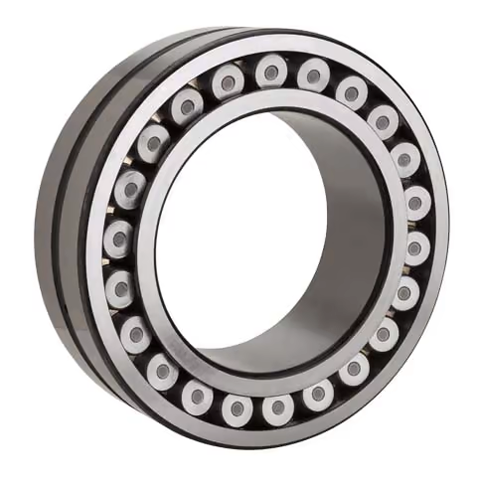
NTN NTN Spherical Roller Bearing , 22230EAD1
Item # d D B r Static Load Rating Dynamic Load Rating 22230EAD1 5.9055 in 150.000 mm 10.6299 in 270.000 mm 2.8740 in 73.000 mm 0.1181 in 3.000 mm 274000 lbf 1220000 N 1220.00 kN 243000 lbf 1080000 N 1080.00 kN 1. Design features and characteristics Spherical roller bearings consist of an outer ring having a continuous spherical raceway and two rows of barrel-shaped rollers guided by an inner ring with two raceways. (Refer to Fig. 1) This bearing has self-aligning properties, and therefore is suited for use where misalignment between the inner and outer rings occurs from housing installation error or shaft bending. Spherical roller bearings have a large capacity for radial loads, axial loads in either direction, and combined loads. They are also suited for applications where vibration and shock loads are encountered. When spherical roller bearings are used with a vertical shaft or under a large axial load, the load on the rollers of the row that is not subject to the axial load becomes small, and the resulting skidding on the rollers may result in wear. If the ratio of the axial load to the radial load exceeds the factor e in the dimension table (Fa/Fr > e), consult NTN Engineering.In addition to spherical roller bearings with cylindrical bores, spherical roller bearings with tapered bores are also available. Bearings with tapered bores are specified by the suffix “K” at the end of the spherical roller bearing part number. The standard taper ratio is 1:12 for bearings with a “K” suffix; for bearings in series 240 and 241, the suffix “K30” indicates the taper ratio for a bearing is 1:30. Most tapered bore bearings incorporate the use of adapters and withdrawal sleeves for shaft mounting.
$548.23
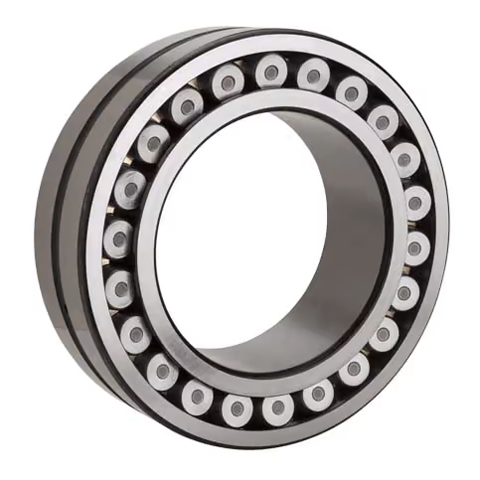
NTN NTN Spherical Roller Bearing , 22234EMD1
Item # d D B r Static Load Rating Dynamic Load Rating 22234EMD1 6.6929 in 170.000 mm 12.2047 in 310.000 mm 3.3858 in 86.000 mm 0.1575 in 4.000 mm 360000 lbf 1610000 N 1610.00 kN 315000 lbf 1400000 N 1400.00 kN 1. Design features and characteristics Spherical roller bearings consist of an outer ring having a continuous spherical raceway and two rows of barrel-shaped rollers guided by an inner ring with two raceways. (Refer to Fig. 1) This bearing has self-aligning properties, and therefore is suited for use where misalignment between the inner and outer rings occurs from housing installation error or shaft bending. Spherical roller bearings have a large capacity for radial loads, axial loads in either direction, and combined loads. They are also suited for applications where vibration and shock loads are encountered. When spherical roller bearings are used with a vertical shaft or under a large axial load, the load on the rollers of the row that is not subject to the axial load becomes small, and the resulting skidding on the rollers may result in wear. If the ratio of the axial load to the radial load exceeds the factor e in the dimension table (Fa/Fr > e), consult NTN Engineering.In addition to spherical roller bearings with cylindrical bores, spherical roller bearings with tapered bores are also available. Bearings with tapered bores are specified by the suffix “K” at the end of the spherical roller bearing part number. The standard taper ratio is 1:12 for bearings with a “K” suffix; for bearings in series 240 and 241, the suffix “K30” indicates the taper ratio for a bearing is 1:30. Most tapered bore bearings incorporate the use of adapters and withdrawal sleeves for shaft mounting.
$757.88
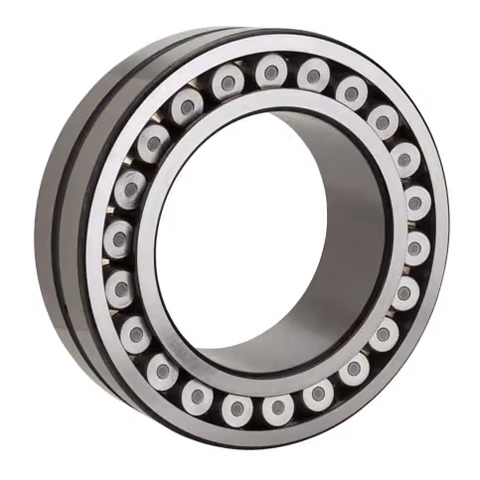
NTN NTN Spherical Roller Bearing , 22236EMD1
Item # d D B r Static Load Rating Dynamic Load Rating 22236EMD1 7.0866 in 180.000 mm 12.5984 in 320.000 mm 3.3858 in 86.000 mm 0.1575 in 4.000 mm 375000 lbf 1660000 N 1660.00 kN 325000 lbf 1450000 N 1450.00 kN 1. Design features and characteristics Spherical roller bearings consist of an outer ring having a continuous spherical raceway and two rows of barrel-shaped rollers guided by an inner ring with two raceways. (Refer to Fig. 1) This bearing has self-aligning properties, and therefore is suited for use where misalignment between the inner and outer rings occurs from housing installation error or shaft bending. Spherical roller bearings have a large capacity for radial loads, axial loads in either direction, and combined loads. They are also suited for applications where vibration and shock loads are encountered. When spherical roller bearings are used with a vertical shaft or under a large axial load, the load on the rollers of the row that is not subject to the axial load becomes small, and the resulting skidding on the rollers may result in wear. If the ratio of the axial load to the radial load exceeds the factor e in the dimension table (Fa/Fr > e), consult NTN Engineering.In addition to spherical roller bearings with cylindrical bores, spherical roller bearings with tapered bores are also available. Bearings with tapered bores are specified by the suffix “K” at the end of the spherical roller bearing part number. The standard taper ratio is 1:12 for bearings with a “K” suffix; for bearings in series 240 and 241, the suffix “K30” indicates the taper ratio for a bearing is 1:30. Most tapered bore bearings incorporate the use of adapters and withdrawal sleeves for shaft mounting.
$863.82
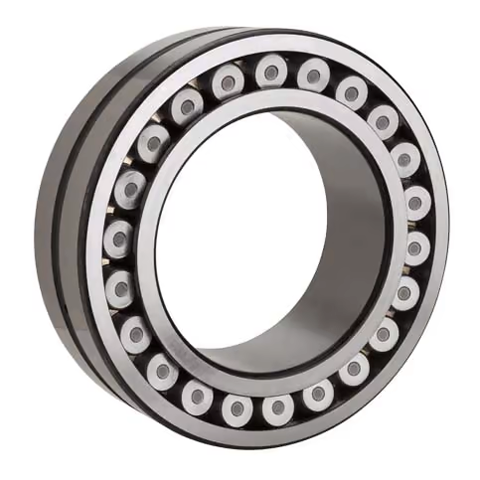
NTN NTN Spherical Roller Bearing , 22238EMD1
Item # d D B r Static Load Rating Dynamic Load Rating 22238EMD1 7.4803 in 190.000 mm 13.3858 in 340.000 mm 3.6220 in 92.000 mm 0.1575 in 4.000 mm 420000 lbf 1870000 N 1870.00 kN 365000 lbf 1620000 N 1620.00 kN 1. Design features and characteristics Spherical roller bearings consist of an outer ring having a continuous spherical raceway and two rows of barrel-shaped rollers guided by an inner ring with two raceways. (Refer to Fig. 1) This bearing has self-aligning properties, and therefore is suited for use where misalignment between the inner and outer rings occurs from housing installation error or shaft bending. Spherical roller bearings have a large capacity for radial loads, axial loads in either direction, and combined loads. They are also suited for applications where vibration and shock loads are encountered. When spherical roller bearings are used with a vertical shaft or under a large axial load, the load on the rollers of the row that is not subject to the axial load becomes small, and the resulting skidding on the rollers may result in wear. If the ratio of the axial load to the radial load exceeds the factor e in the dimension table (Fa/Fr > e), consult NTN Engineering.In addition to spherical roller bearings with cylindrical bores, spherical roller bearings with tapered bores are also available. Bearings with tapered bores are specified by the suffix “K” at the end of the spherical roller bearing part number. The standard taper ratio is 1:12 for bearings with a “K” suffix; for bearings in series 240 and 241, the suffix “K30” indicates the taper ratio for a bearing is 1:30. Most tapered bore bearings incorporate the use of adapters and withdrawal sleeves for shaft mounting.
$1,127.03
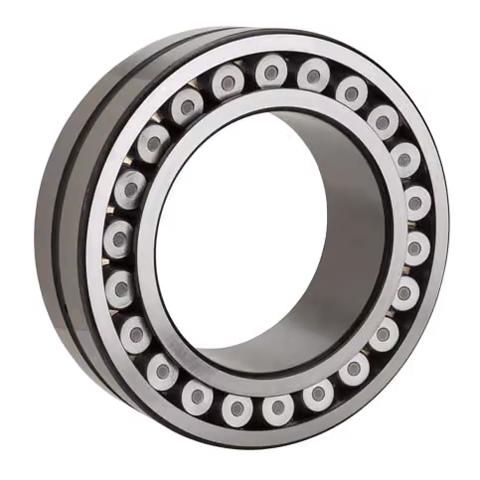
NTN NTN Spherical Roller Bearing , 22244EMD1
Item # d D B r Static Load Rating Dynamic Load Rating 22244EMD1 8.6614 in 220.000 mm 15.7480 in 400.000 mm 4.2520 in 108.000 mm 0.1575 in 4.000 mm 605000 lbf 2690000 N 2690.00 kN 495000 lbf 2210000 N 2210.00 kN 1. Design features and characteristics Spherical roller bearings consist of an outer ring having a continuous spherical raceway and two rows of barrel-shaped rollers guided by an inner ring with two raceways. (Refer to Fig. 1) This bearing has self-aligning properties, and therefore is suited for use where misalignment between the inner and outer rings occurs from housing installation error or shaft bending. Spherical roller bearings have a large capacity for radial loads, axial loads in either direction, and combined loads. They are also suited for applications where vibration and shock loads are encountered. When spherical roller bearings are used with a vertical shaft or under a large axial load, the load on the rollers of the row that is not subject to the axial load becomes small, and the resulting skidding on the rollers may result in wear. If the ratio of the axial load to the radial load exceeds the factor e in the dimension table (Fa/Fr > e), consult NTN Engineering.In addition to spherical roller bearings with cylindrical bores, spherical roller bearings with tapered bores are also available. Bearings with tapered bores are specified by the suffix “K” at the end of the spherical roller bearing part number. The standard taper ratio is 1:12 for bearings with a “K” suffix; for bearings in series 240 and 241, the suffix “K30” indicates the taper ratio for a bearing is 1:30. Most tapered bore bearings incorporate the use of adapters and withdrawal sleeves for shaft mounting.
$1,707.05
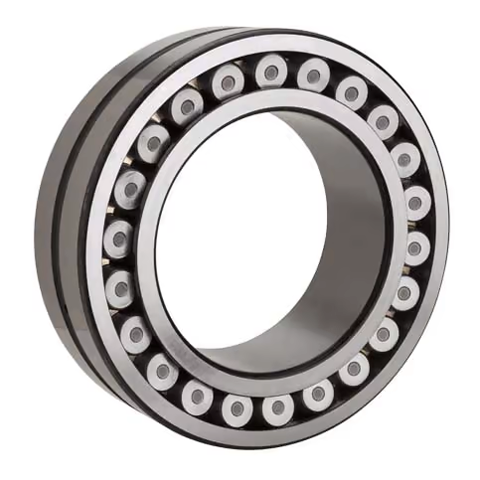
NTN NTN Spherical Roller Bearing , 22248B
Item # d D B r Static Load Rating Dynamic Load Rating 22248B 9.4488 in 240.000 mm 17.3228 in 440.000 mm 4.7244 in 120.000 mm 0.1575 in 4.000 mm 695000 lbf 3100000 N 3100.00 kN 435000 lbf 1940000 N 1940.00 kN 1. Design features and characteristics Spherical roller bearings consist of an outer ring having a continuous spherical raceway and two rows of barrel-shaped rollers guided by an inner ring with two raceways. (Refer to Fig. 1) This bearing has self-aligning properties, and therefore is suited for use where misalignment between the inner and outer rings occurs from housing installation error or shaft bending. Spherical roller bearings have a large capacity for radial loads, axial loads in either direction, and combined loads. They are also suited for applications where vibration and shock loads are encountered. When spherical roller bearings are used with a vertical shaft or under a large axial load, the load on the rollers of the row that is not subject to the axial load becomes small, and the resulting skidding on the rollers may result in wear. If the ratio of the axial load to the radial load exceeds the factor e in the dimension table (Fa/Fr > e), consult NTN Engineering.In addition to spherical roller bearings with cylindrical bores, spherical roller bearings with tapered bores are also available. Bearings with tapered bores are specified by the suffix “K” at the end of the spherical roller bearing part number. The standard taper ratio is 1:12 for bearings with a “K” suffix; for bearings in series 240 and 241, the suffix “K30” indicates the taper ratio for a bearing is 1:30. Most tapered bore bearings incorporate the use of adapters and withdrawal sleeves for shaft mounting.
$2,577.35
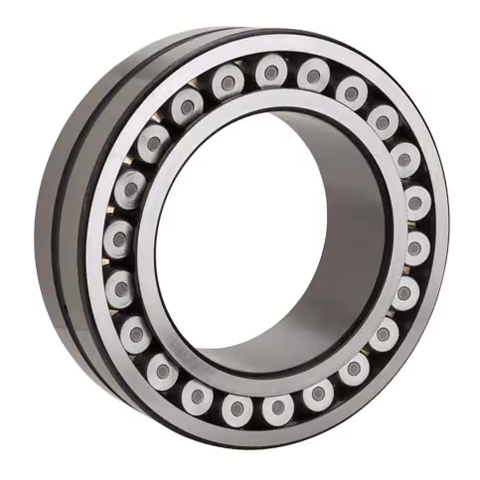
NTN NTN Spherical Roller Bearing , 22252B
Item # d D B r Static Load Rating Dynamic Load Rating 22252B 10.2362 in 260.000 mm 18.8976 in 480.000 mm 5.1181 in 130.000 mm 0.1969 in 5.000 mm 810000 lbf 3600000 N 3600.00 kN 500000 lbf 2230000 N 2230.00 kN 1. Design features and characteristics Spherical roller bearings consist of an outer ring having a continuous spherical raceway and two rows of barrel-shaped rollers guided by an inner ring with two raceways. (Refer to Fig. 1) This bearing has self-aligning properties, and therefore is suited for use where misalignment between the inner and outer rings occurs from housing installation error or shaft bending. Spherical roller bearings have a large capacity for radial loads, axial loads in either direction, and combined loads. They are also suited for applications where vibration and shock loads are encountered. When spherical roller bearings are used with a vertical shaft or under a large axial load, the load on the rollers of the row that is not subject to the axial load becomes small, and the resulting skidding on the rollers may result in wear. If the ratio of the axial load to the radial load exceeds the factor e in the dimension table (Fa/Fr > e), consult NTN Engineering.In addition to spherical roller bearings with cylindrical bores, spherical roller bearings with tapered bores are also available. Bearings with tapered bores are specified by the suffix “K” at the end of the spherical roller bearing part number. The standard taper ratio is 1:12 for bearings with a “K” suffix; for bearings in series 240 and 241, the suffix “K30” indicates the taper ratio for a bearing is 1:30. Most tapered bore bearings incorporate the use of adapters and withdrawal sleeves for shaft mounting.
$3,477.32
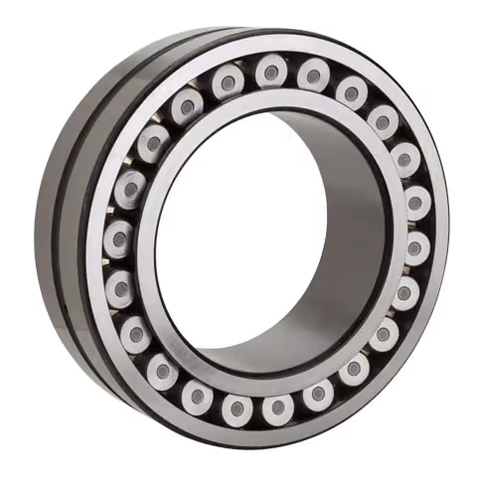
NTN NTN Spherical Roller Bearing , 22256B
Item # d D B r Static Load Rating Dynamic Load Rating 22256B 11.0236 in 280.000 mm 19.6850 in 500.000 mm 5.1181 in 130.000 mm 0.1969 in 5.000 mm 855000 lbf 3800000 N 3800.00 kN 520000 lbf 2310000 N 2310.00 kN 1. Design features and characteristics Spherical roller bearings consist of an outer ring having a continuous spherical raceway and two rows of barrel-shaped rollers guided by an inner ring with two raceways. (Refer to Fig. 1) This bearing has self-aligning properties, and therefore is suited for use where misalignment between the inner and outer rings occurs from housing installation error or shaft bending. Spherical roller bearings have a large capacity for radial loads, axial loads in either direction, and combined loads. They are also suited for applications where vibration and shock loads are encountered. When spherical roller bearings are used with a vertical shaft or under a large axial load, the load on the rollers of the row that is not subject to the axial load becomes small, and the resulting skidding on the rollers may result in wear. If the ratio of the axial load to the radial load exceeds the factor e in the dimension table (Fa/Fr > e), consult NTN Engineering.In addition to spherical roller bearings with cylindrical bores, spherical roller bearings with tapered bores are also available. Bearings with tapered bores are specified by the suffix “K” at the end of the spherical roller bearing part number. The standard taper ratio is 1:12 for bearings with a “K” suffix; for bearings in series 240 and 241, the suffix “K30” indicates the taper ratio for a bearing is 1:30. Most tapered bore bearings incorporate the use of adapters and withdrawal sleeves for shaft mounting.
$4,238.66
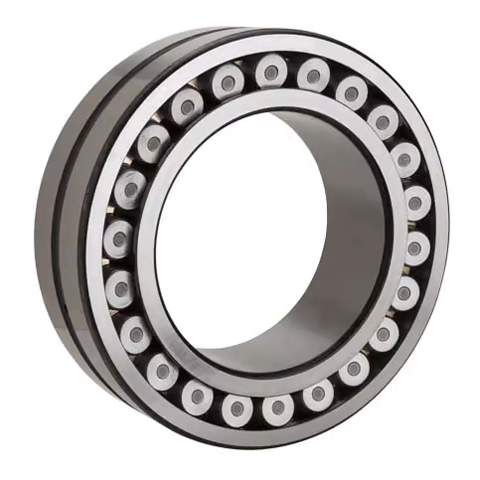
NTN NTN Spherical Roller Bearing , 22308EAD1
Item # d D B r Static Load Rating Dynamic Load Rating 22308EAD1 1.5748 in 40.000 mm 3.5433 in 90.000 mm 1.2992 in 33.000 mm 0.0591 in 1.500 mm 34000 lbf 152000 N 152.00 kN 38000 lbf 169000 N 169.00 kN 1. Design features and characteristics Spherical roller bearings consist of an outer ring having a continuous spherical raceway and two rows of barrel-shaped rollers guided by an inner ring with two raceways. (Refer to Fig. 1) This bearing has self-aligning properties, and therefore is suited for use where misalignment between the inner and outer rings occurs from housing installation error or shaft bending. Spherical roller bearings have a large capacity for radial loads, axial loads in either direction, and combined loads. They are also suited for applications where vibration and shock loads are encountered. When spherical roller bearings are used with a vertical shaft or under a large axial load, the load on the rollers of the row that is not subject to the axial load becomes small, and the resulting skidding on the rollers may result in wear. If the ratio of the axial load to the radial load exceeds the factor e in the dimension table (Fa/Fr > e), consult NTN Engineering.In addition to spherical roller bearings with cylindrical bores, spherical roller bearings with tapered bores are also available. Bearings with tapered bores are specified by the suffix “K” at the end of the spherical roller bearing part number. The standard taper ratio is 1:12 for bearings with a “K” suffix; for bearings in series 240 and 241, the suffix “K30” indicates the taper ratio for a bearing is 1:30. Most tapered bore bearings incorporate the use of adapters and withdrawal sleeves for shaft mounting.
$79.60
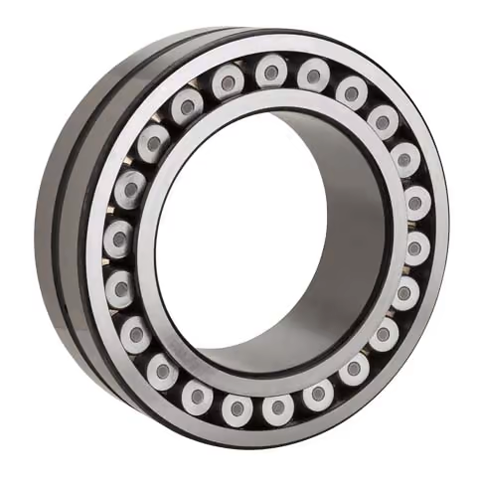
NTN NTN Spherical Roller Bearing , 22309EAD1
Item # d D B r Static Load Rating Dynamic Load Rating 22309EAD1 1.7717 in 45.000 mm 3.9370 in 100.000 mm 1.4173 in 36.000 mm 0.0591 in 1.500 mm 42000 lbf 187000 N 187.00 kN 46500 lbf 206000 N 206.00 kN 1. Design features and characteristics Spherical roller bearings consist of an outer ring having a continuous spherical raceway and two rows of barrel-shaped rollers guided by an inner ring with two raceways. (Refer to Fig. 1) This bearing has self-aligning properties, and therefore is suited for use where misalignment between the inner and outer rings occurs from housing installation error or shaft bending. Spherical roller bearings have a large capacity for radial loads, axial loads in either direction, and combined loads. They are also suited for applications where vibration and shock loads are encountered. When spherical roller bearings are used with a vertical shaft or under a large axial load, the load on the rollers of the row that is not subject to the axial load becomes small, and the resulting skidding on the rollers may result in wear. If the ratio of the axial load to the radial load exceeds the factor e in the dimension table (Fa/Fr > e), consult NTN Engineering.In addition to spherical roller bearings with cylindrical bores, spherical roller bearings with tapered bores are also available. Bearings with tapered bores are specified by the suffix “K” at the end of the spherical roller bearing part number. The standard taper ratio is 1:12 for bearings with a “K” suffix; for bearings in series 240 and 241, the suffix “K30” indicates the taper ratio for a bearing is 1:30. Most tapered bore bearings incorporate the use of adapters and withdrawal sleeves for shaft mounting.
$88.66
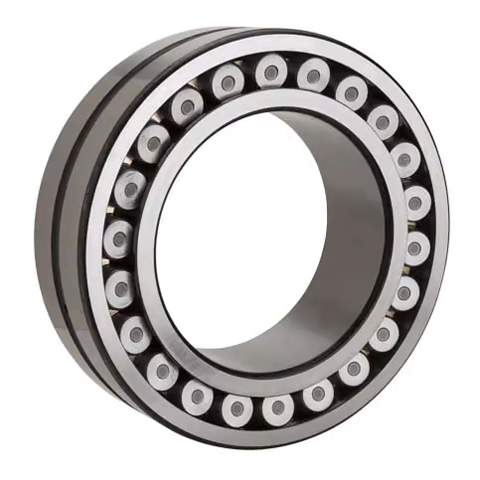
NTN NTN Spherical Roller Bearing , 22311EAD1
Item # d D B r Static Load Rating Dynamic Load Rating 22311EAD1 2.1654 in 55.000 mm 4.7244 in 120.000 mm 1.6929 in 43.000 mm 0.0787 in 2.000 mm 61500 lbf 274000 N 274.00 kN 66500 lbf 296000 N 296.00 kN 1. Design features and characteristics Spherical roller bearings consist of an outer ring having a continuous spherical raceway and two rows of barrel-shaped rollers guided by an inner ring with two raceways. (Refer to Fig. 1) This bearing has self-aligning properties, and therefore is suited for use where misalignment between the inner and outer rings occurs from housing installation error or shaft bending. Spherical roller bearings have a large capacity for radial loads, axial loads in either direction, and combined loads. They are also suited for applications where vibration and shock loads are encountered. When spherical roller bearings are used with a vertical shaft or under a large axial load, the load on the rollers of the row that is not subject to the axial load becomes small, and the resulting skidding on the rollers may result in wear. If the ratio of the axial load to the radial load exceeds the factor e in the dimension table (Fa/Fr > e), consult NTN Engineering.In addition to spherical roller bearings with cylindrical bores, spherical roller bearings with tapered bores are also available. Bearings with tapered bores are specified by the suffix “K” at the end of the spherical roller bearing part number. The standard taper ratio is 1:12 for bearings with a “K” suffix; for bearings in series 240 and 241, the suffix “K30” indicates the taper ratio for a bearing is 1:30. Most tapered bore bearings incorporate the use of adapters and withdrawal sleeves for shaft mounting.
$110.40


