Products
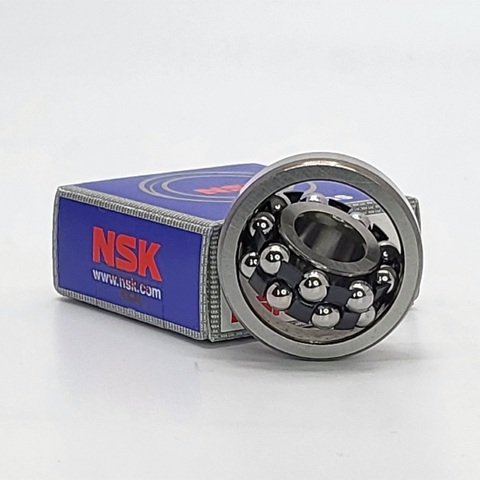
NSK NSK Self-Aligning Ball Bearings, Cylindrical Bore Bearings 2220 ,D=100
NSK Self-Aligning Ball Bearings, Cylindrical Bore Bearings 2220 ,D=100 Bearing Numbers Boundary Dimensions (mm) Basic Load Ratings (kN) Limiting Speeds (min-1) Constant e Axial Load Factors Mass (kg) approx. d D B r min. Cr C0r Grease Oil Y2 Y3 Y0 2220 100 180 46 2.1 94.5 38.5 3200 3800 0.27 3.7 2.4 2.5 4.51 DESIGN, TYPES, AND FEATURESThe outer ring of a self-aligning ball bearing has a spherical raceway and its center of curvature coincides with that of the bearing; therefore, the axis of the inner ring, balls and cage can deflect to some extent around the bearing center. This type is recommended when the alignment of the shaft and housing is difficult and when the shaft may bend. Since the contact angle is small, axial load capacity is low. Pressed-steel cages are usually used. PROTRUSION AMOUNT Some self-aligning ball bearings have balls that protrude from the side face as shown below. This protrusion amount b1 is listed in the following table. PERMISSIBLE MISALIGNMENT The permissible misalignment of self-aligning ball bearings is approximately 0.07 to 0.12 radian (4° to 7°) under normal loads. However, depending on the surrounding structure, such an angle may not be possible. Take care in the design of the bearing surroundings.
$331.71
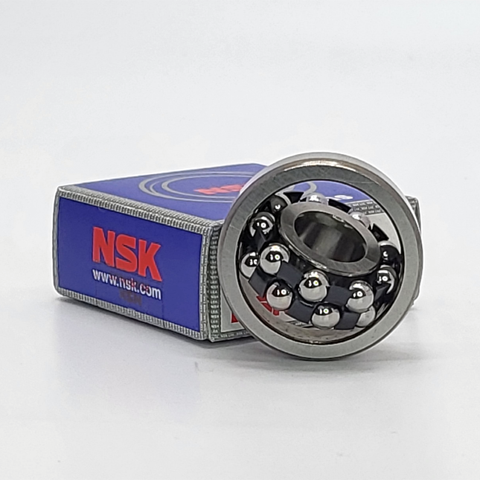
NSK NSK Self-Aligning Ball Bearings, Cylindrical Bore Bearings 2300 ,D=10
NSK Self-Aligning Ball Bearings, Cylindrical Bore Bearings 2300 ,D=10 Bearing Numbers Boundary Dimensions (mm) Basic Load Ratings (kN) Limiting Speeds (min-1) Constant e Axial Load Factors Mass (kg) approx. d D B r min. Cr C0r Grease Oil Y2 Y3 Y0 2300 10 35 17 0.6 9.2 2.01 18000 22000 0.71 1.4 0.89 0.93 0.077 DESIGN, TYPES, AND FEATURESThe outer ring of a self-aligning ball bearing has a spherical raceway and its center of curvature coincides with that of the bearing; therefore, the axis of the inner ring, balls and cage can deflect to some extent around the bearing center. This type is recommended when the alignment of the shaft and housing is difficult and when the shaft may bend. Since the contact angle is small, axial load capacity is low. Pressed-steel cages are usually used. PROTRUSION AMOUNT Some self-aligning ball bearings have balls that protrude from the side face as shown below. This protrusion amount b1 is listed in the following table. PERMISSIBLE MISALIGNMENT The permissible misalignment of self-aligning ball bearings is approximately 0.07 to 0.12 radian (4° to 7°) under normal loads. However, depending on the surrounding structure, such an angle may not be possible. Take care in the design of the bearing surroundings.
$18.40
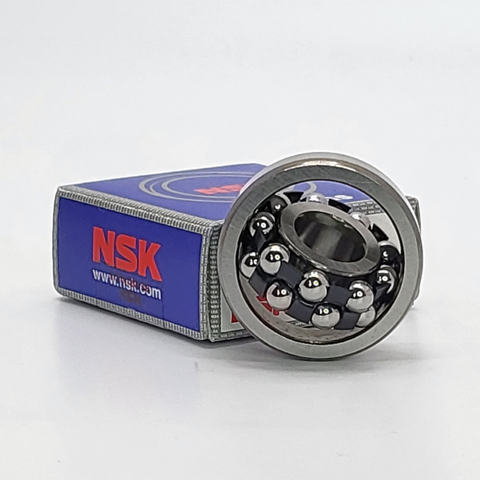
NSK NSK Self-Aligning Ball Bearings, Cylindrical Bore Bearings 2301 ,D=12
NSK Self-Aligning Ball Bearings, Cylindrical Bore Bearings 2301 ,D=12 Bearing Numbers Boundary Dimensions (mm) Basic Load Ratings (kN) Limiting Speeds (min-1) Constant e Axial Load Factors Mass (kg) approx. d D B r min. Cr C0r Grease Oil Y2 Y3 Y0 2301 12 37 17 1 12.1 2.73 17000 22000 0.6 1.6 1.1 1.1 0.082 DESIGN, TYPES, AND FEATURESThe outer ring of a self-aligning ball bearing has a spherical raceway and its center of curvature coincides with that of the bearing; therefore, the axis of the inner ring, balls and cage can deflect to some extent around the bearing center. This type is recommended when the alignment of the shaft and housing is difficult and when the shaft may bend. Since the contact angle is small, axial load capacity is low. Pressed-steel cages are usually used. PROTRUSION AMOUNT Some self-aligning ball bearings have balls that protrude from the side face as shown below. This protrusion amount b1 is listed in the following table. PERMISSIBLE MISALIGNMENT The permissible misalignment of self-aligning ball bearings is approximately 0.07 to 0.12 radian (4° to 7°) under normal loads. However, depending on the surrounding structure, such an angle may not be possible. Take care in the design of the bearing surroundings.
$17.06
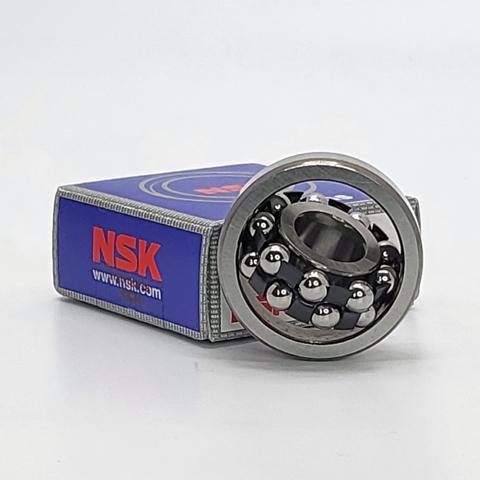
NSK NSK Self-Aligning Ball Bearings, Cylindrical Bore Bearings 2302 ,D=15
NSK Self-Aligning Ball Bearings, Cylindrical Bore Bearings 2302 ,D=15 Bearing Numbers Boundary Dimensions (mm) Basic Load Ratings (kN) Limiting Speeds (min-1) Constant e Axial Load Factors Mass (kg) approx. d D B r min. Cr C0r Grease Oil Y2 Y3 Y0 2302 15 42 17 1 12.3 2.91 14000 18000 0.51 1.9 1.2 1.3 0.108 DESIGN, TYPES, AND FEATURESThe outer ring of a self-aligning ball bearing has a spherical raceway and its center of curvature coincides with that of the bearing; therefore, the axis of the inner ring, balls and cage can deflect to some extent around the bearing center. This type is recommended when the alignment of the shaft and housing is difficult and when the shaft may bend. Since the contact angle is small, axial load capacity is low. Pressed-steel cages are usually used. PROTRUSION AMOUNT Some self-aligning ball bearings have balls that protrude from the side face as shown below. This protrusion amount b1 is listed in the following table. PERMISSIBLE MISALIGNMENT The permissible misalignment of self-aligning ball bearings is approximately 0.07 to 0.12 radian (4° to 7°) under normal loads. However, depending on the surrounding structure, such an angle may not be possible. Take care in the design of the bearing surroundings.
$17.76
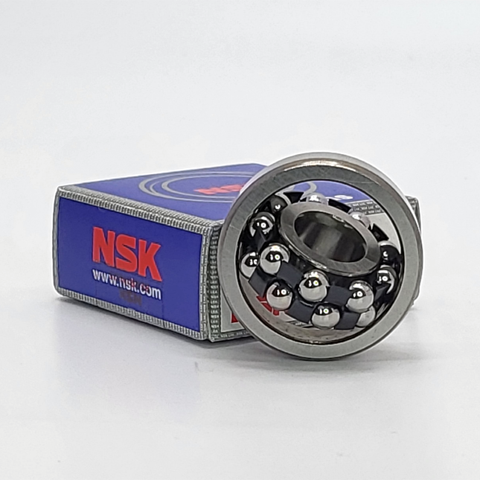
NSK NSK Self-Aligning Ball Bearings, Cylindrical Bore Bearings 2303 ,D=17
NSK Self-Aligning Ball Bearings, Cylindrical Bore Bearings 2303 ,D=17 Bearing Numbers Boundary Dimensions (mm) Basic Load Ratings (kN) Limiting Speeds (min-1) Constant e Axial Load Factors Mass (kg) approx. d D B r min. Cr C0r Grease Oil Y2 Y3 Y0 2303 17 47 19 1 14.7 3.55 13000 16000 0.51 1.9 1.2 1.3 0.15 DESIGN, TYPES, AND FEATURESThe outer ring of a self-aligning ball bearing has a spherical raceway and its center of curvature coincides with that of the bearing; therefore, the axis of the inner ring, balls and cage can deflect to some extent around the bearing center. This type is recommended when the alignment of the shaft and housing is difficult and when the shaft may bend. Since the contact angle is small, axial load capacity is low. Pressed-steel cages are usually used. PROTRUSION AMOUNT Some self-aligning ball bearings have balls that protrude from the side face as shown below. This protrusion amount b1 is listed in the following table. PERMISSIBLE MISALIGNMENT The permissible misalignment of self-aligning ball bearings is approximately 0.07 to 0.12 radian (4° to 7°) under normal loads. However, depending on the surrounding structure, such an angle may not be possible. Take care in the design of the bearing surroundings.
$19.80
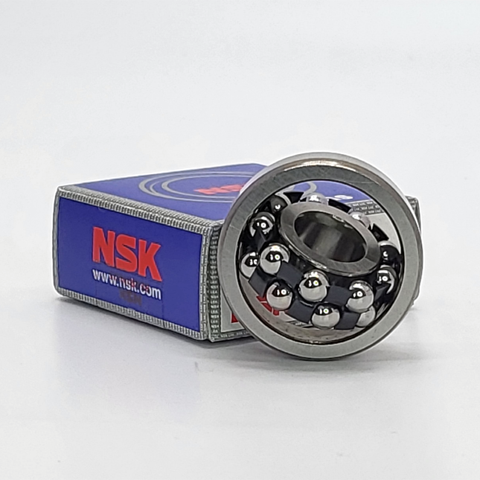
NSK NSK Self-Aligning Ball Bearings, Cylindrical Bore Bearings 2304 ,D=20
NSK Self-Aligning Ball Bearings, Cylindrical Bore Bearings 2304 ,D=20 Bearing Numbers Boundary Dimensions (mm) Basic Load Ratings (kN) Limiting Speeds (min-1) Constant e Axial Load Factors Mass (kg) approx. d D B r min. Cr C0r Grease Oil Y2 Y3 Y0 2304 20 52 21 1.1 18.5 4.7 11000 14000 0.5 1.9 1.2 1.3 0.193 DESIGN, TYPES, AND FEATURESThe outer ring of a self-aligning ball bearing has a spherical raceway and its center of curvature coincides with that of the bearing; therefore, the axis of the inner ring, balls and cage can deflect to some extent around the bearing center. This type is recommended when the alignment of the shaft and housing is difficult and when the shaft may bend. Since the contact angle is small, axial load capacity is low. Pressed-steel cages are usually used. PROTRUSION AMOUNT Some self-aligning ball bearings have balls that protrude from the side face as shown below. This protrusion amount b1 is listed in the following table. PERMISSIBLE MISALIGNMENT The permissible misalignment of self-aligning ball bearings is approximately 0.07 to 0.12 radian (4° to 7°) under normal loads. However, depending on the surrounding structure, such an angle may not be possible. Take care in the design of the bearing surroundings.
$23.78
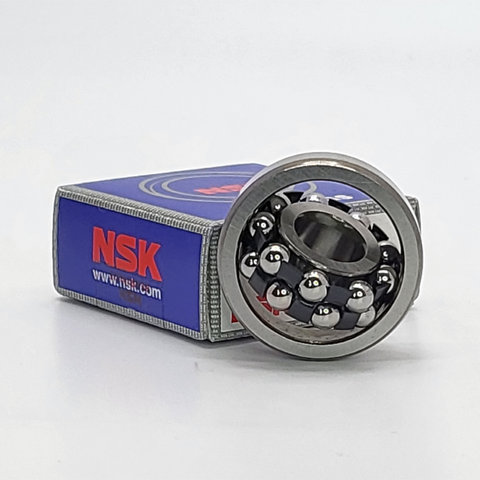
NSK NSK Self-Aligning Ball Bearings, Cylindrical Bore Bearings 2305 ,D=25
NSK Self-Aligning Ball Bearings, Cylindrical Bore Bearings 2305 ,D=25 Bearing Numbers Boundary Dimensions (mm) Basic Load Ratings (kN) Limiting Speeds (min-1) Constant e Axial Load Factors Mass (kg) approx. d D B r min. Cr C0r Grease Oil Y2 Y3 Y0 2305 25 62 24 1.1 24.9 6.6 9500 12000 0.46 2.1 1.4 1.4 0.319 DESIGN, TYPES, AND FEATURESThe outer ring of a self-aligning ball bearing has a spherical raceway and its center of curvature coincides with that of the bearing; therefore, the axis of the inner ring, balls and cage can deflect to some extent around the bearing center. This type is recommended when the alignment of the shaft and housing is difficult and when the shaft may bend. Since the contact angle is small, axial load capacity is low. Pressed-steel cages are usually used. PROTRUSION AMOUNT Some self-aligning ball bearings have balls that protrude from the side face as shown below. This protrusion amount b1 is listed in the following table. PERMISSIBLE MISALIGNMENT The permissible misalignment of self-aligning ball bearings is approximately 0.07 to 0.12 radian (4° to 7°) under normal loads. However, depending on the surrounding structure, such an angle may not be possible. Take care in the design of the bearing surroundings.
$32.07
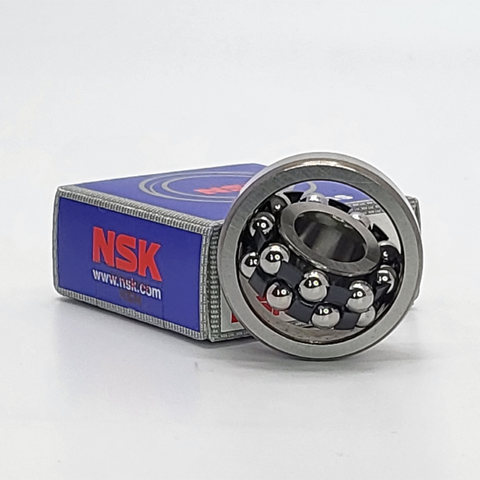
NSK NSK Self-Aligning Ball Bearings, Cylindrical Bore Bearings 2306 ,D=30
NSK Self-Aligning Ball Bearings, Cylindrical Bore Bearings 2306 ,D=30 Bearing Numbers Boundary Dimensions (mm) Basic Load Ratings (kN) Limiting Speeds (min-1) Constant e Axial Load Factors Mass (kg) approx. d D B r min. Cr C0r Grease Oil Y2 Y3 Y0 2306 30 72 27 1.1 32 8.75 8000 10000 0.44 2.2 1.4 1.5 0.48 DESIGN, TYPES, AND FEATURESThe outer ring of a self-aligning ball bearing has a spherical raceway and its center of curvature coincides with that of the bearing; therefore, the axis of the inner ring, balls and cage can deflect to some extent around the bearing center. This type is recommended when the alignment of the shaft and housing is difficult and when the shaft may bend. Since the contact angle is small, axial load capacity is low. Pressed-steel cages are usually used. PROTRUSION AMOUNT Some self-aligning ball bearings have balls that protrude from the side face as shown below. This protrusion amount b1 is listed in the following table. PERMISSIBLE MISALIGNMENT The permissible misalignment of self-aligning ball bearings is approximately 0.07 to 0.12 radian (4° to 7°) under normal loads. However, depending on the surrounding structure, such an angle may not be possible. Take care in the design of the bearing surroundings.
$38.82
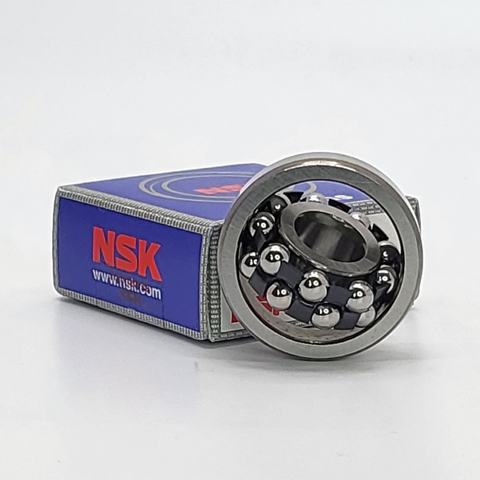
NSK NSK Self-Aligning Ball Bearings, Cylindrical Bore Bearings 2307 ,D=35
NSK Self-Aligning Ball Bearings, Cylindrical Bore Bearings 2307 ,D=35 Bearing Numbers Boundary Dimensions (mm) Basic Load Ratings (kN) Limiting Speeds (min-1) Constant e Axial Load Factors Mass (kg) approx. d D B r min. Cr C0r Grease Oil Y2 Y3 Y0 2307 35 80 31 1.5 40 11.3 7100 9000 0.46 2.1 1.4 1.4 0.642 DESIGN, TYPES, AND FEATURESThe outer ring of a self-aligning ball bearing has a spherical raceway and its center of curvature coincides with that of the bearing; therefore, the axis of the inner ring, balls and cage can deflect to some extent around the bearing center. This type is recommended when the alignment of the shaft and housing is difficult and when the shaft may bend. Since the contact angle is small, axial load capacity is low. Pressed-steel cages are usually used. PROTRUSION AMOUNT Some self-aligning ball bearings have balls that protrude from the side face as shown below. This protrusion amount b1 is listed in the following table. PERMISSIBLE MISALIGNMENT The permissible misalignment of self-aligning ball bearings is approximately 0.07 to 0.12 radian (4° to 7°) under normal loads. However, depending on the surrounding structure, such an angle may not be possible. Take care in the design of the bearing surroundings.
$50.10
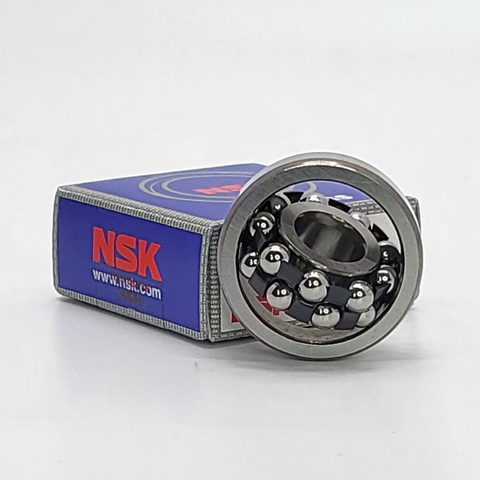
NSK NSK Self-Aligning Ball Bearings, Cylindrical Bore Bearings 2308 ,D=40
NSK Self-Aligning Ball Bearings, Cylindrical Bore Bearings 2308 ,D=40 Bearing Numbers Boundary Dimensions (mm) Basic Load Ratings (kN) Limiting Speeds (min-1) Constant e Axial Load Factors Mass (kg) approx. d D B r min. Cr C0r Grease Oil Y2 Y3 Y0 2308 40 90 33 1.5 45.5 13.5 6300 8000 0.43 2.3 1.5 1.5 0.889 DESIGN, TYPES, AND FEATURESThe outer ring of a self-aligning ball bearing has a spherical raceway and its center of curvature coincides with that of the bearing; therefore, the axis of the inner ring, balls and cage can deflect to some extent around the bearing center. This type is recommended when the alignment of the shaft and housing is difficult and when the shaft may bend. Since the contact angle is small, axial load capacity is low. Pressed-steel cages are usually used. PROTRUSION AMOUNT Some self-aligning ball bearings have balls that protrude from the side face as shown below. This protrusion amount b1 is listed in the following table. PERMISSIBLE MISALIGNMENT The permissible misalignment of self-aligning ball bearings is approximately 0.07 to 0.12 radian (4° to 7°) under normal loads. However, depending on the surrounding structure, such an angle may not be possible. Take care in the design of the bearing surroundings.
$58.27
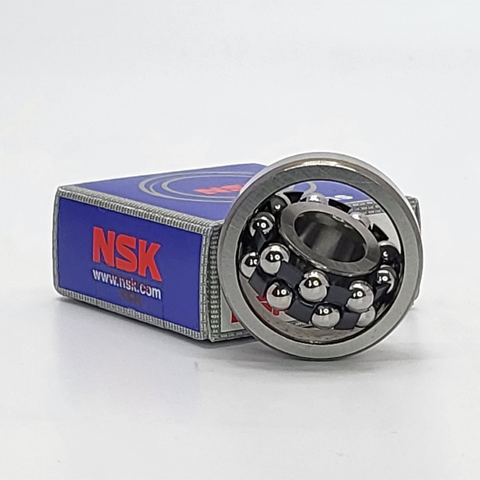
NSK NSK Self-Aligning Ball Bearings, Cylindrical Bore Bearings 2309 ,D=45
NSK Self-Aligning Ball Bearings, Cylindrical Bore Bearings 2309 ,D=45 Bearing Numbers Boundary Dimensions (mm) Basic Load Ratings (kN) Limiting Speeds (min-1) Constant e Axial Load Factors Mass (kg) approx. d D B r min. Cr C0r Grease Oil Y2 Y3 Y0 2309 45 100 36 1.5 55 16.7 5600 7100 0.41 2.4 1.5 1.6 1.2 DESIGN, TYPES, AND FEATURESThe outer ring of a self-aligning ball bearing has a spherical raceway and its center of curvature coincides with that of the bearing; therefore, the axis of the inner ring, balls and cage can deflect to some extent around the bearing center. This type is recommended when the alignment of the shaft and housing is difficult and when the shaft may bend. Since the contact angle is small, axial load capacity is low. Pressed-steel cages are usually used. PROTRUSION AMOUNT Some self-aligning ball bearings have balls that protrude from the side face as shown below. This protrusion amount b1 is listed in the following table. PERMISSIBLE MISALIGNMENT The permissible misalignment of self-aligning ball bearings is approximately 0.07 to 0.12 radian (4° to 7°) under normal loads. However, depending on the surrounding structure, such an angle may not be possible. Take care in the design of the bearing surroundings.
$75.66
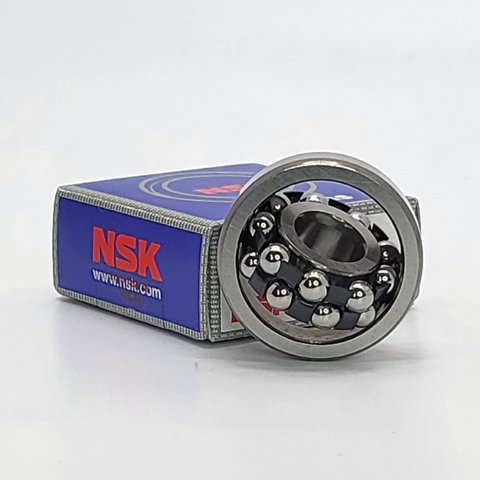
NSK NSK Self-Aligning Ball Bearings, Cylindrical Bore Bearings 2310 ,D=50
NSK Self-Aligning Ball Bearings, Cylindrical Bore Bearings 2310 ,D=50 Bearing Numbers Boundary Dimensions (mm) Basic Load Ratings (kN) Limiting Speeds (min-1) Constant e Axial Load Factors Mass (kg) approx. d D B r min. Cr C0r Grease Oil Y2 Y3 Y0 2310 50 110 40 2 65 20.2 5000 6300 0.42 2.3 1.5 1.6 1.58 DESIGN, TYPES, AND FEATURESThe outer ring of a self-aligning ball bearing has a spherical raceway and its center of curvature coincides with that of the bearing; therefore, the axis of the inner ring, balls and cage can deflect to some extent around the bearing center. This type is recommended when the alignment of the shaft and housing is difficult and when the shaft may bend. Since the contact angle is small, axial load capacity is low. Pressed-steel cages are usually used. PROTRUSION AMOUNT Some self-aligning ball bearings have balls that protrude from the side face as shown below. This protrusion amount b1 is listed in the following table. PERMISSIBLE MISALIGNMENT The permissible misalignment of self-aligning ball bearings is approximately 0.07 to 0.12 radian (4° to 7°) under normal loads. However, depending on the surrounding structure, such an angle may not be possible. Take care in the design of the bearing surroundings.
$89.18
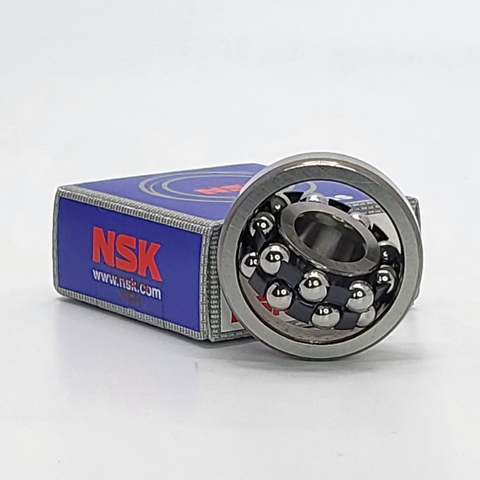
NSK NSK Self-Aligning Ball Bearings, Cylindrical Bore Bearings 2311 ,D=55
NSK Self-Aligning Ball Bearings, Cylindrical Bore Bearings 2311 ,D=55 Bearing Numbers Boundary Dimensions (mm) Basic Load Ratings (kN) Limiting Speeds (min-1) Constant e Axial Load Factors Mass (kg) approx. d D B r min. Cr C0r Grease Oil Y2 Y3 Y0 2311 55 120 43 2 76.5 24 4800 6000 0.41 2.4 1.5 1.6 2.03 DESIGN, TYPES, AND FEATURESThe outer ring of a self-aligning ball bearing has a spherical raceway and its center of curvature coincides with that of the bearing; therefore, the axis of the inner ring, balls and cage can deflect to some extent around the bearing center. This type is recommended when the alignment of the shaft and housing is difficult and when the shaft may bend. Since the contact angle is small, axial load capacity is low. Pressed-steel cages are usually used. PROTRUSION AMOUNT Some self-aligning ball bearings have balls that protrude from the side face as shown below. This protrusion amount b1 is listed in the following table. PERMISSIBLE MISALIGNMENT The permissible misalignment of self-aligning ball bearings is approximately 0.07 to 0.12 radian (4° to 7°) under normal loads. However, depending on the surrounding structure, such an angle may not be possible. Take care in the design of the bearing surroundings.
$122.16
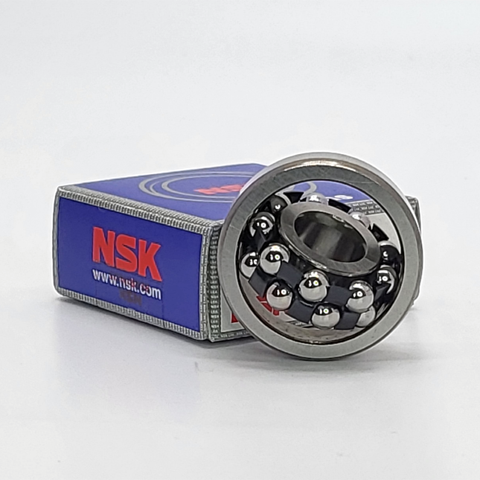
NSK NSK Self-Aligning Ball Bearings, Cylindrical Bore Bearings 2312 ,D=60
NSK Self-Aligning Ball Bearings, Cylindrical Bore Bearings 2312 ,D=60 Bearing Numbers Boundary Dimensions (mm) Basic Load Ratings (kN) Limiting Speeds (min-1) Constant e Axial Load Factors Mass (kg) approx. d D B r min. Cr C0r Grease Oil Y2 Y3 Y0 2312 60 130 46 2.1 88.5 28.3 4300 5300 0.4 2.4 1.6 1.6 2.49 DESIGN, TYPES, AND FEATURESThe outer ring of a self-aligning ball bearing has a spherical raceway and its center of curvature coincides with that of the bearing; therefore, the axis of the inner ring, balls and cage can deflect to some extent around the bearing center. This type is recommended when the alignment of the shaft and housing is difficult and when the shaft may bend. Since the contact angle is small, axial load capacity is low. Pressed-steel cages are usually used. PROTRUSION AMOUNT Some self-aligning ball bearings have balls that protrude from the side face as shown below. This protrusion amount b1 is listed in the following table. PERMISSIBLE MISALIGNMENT The permissible misalignment of self-aligning ball bearings is approximately 0.07 to 0.12 radian (4° to 7°) under normal loads. However, depending on the surrounding structure, such an angle may not be possible. Take care in the design of the bearing surroundings.
$148.72
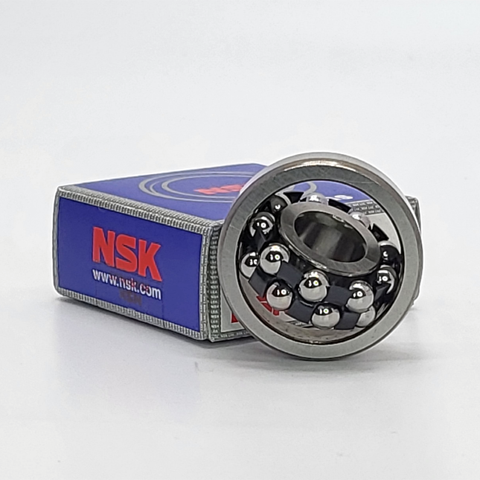
NSK NSK Self-Aligning Ball Bearings, Cylindrical Bore Bearings 2313 ,D=65
NSK Self-Aligning Ball Bearings, Cylindrical Bore Bearings 2313 ,D=65 Bearing Numbers Boundary Dimensions (mm) Basic Load Ratings (kN) Limiting Speeds (min-1) Constant e Axial Load Factors Mass (kg) approx. d D B r min. Cr C0r Grease Oil Y2 Y3 Y0 2313 65 140 48 2.1 97 32.5 3800 4800 0.39 2.5 1.6 1.7 3.11 DESIGN, TYPES, AND FEATURESThe outer ring of a self-aligning ball bearing has a spherical raceway and its center of curvature coincides with that of the bearing; therefore, the axis of the inner ring, balls and cage can deflect to some extent around the bearing center. This type is recommended when the alignment of the shaft and housing is difficult and when the shaft may bend. Since the contact angle is small, axial load capacity is low. Pressed-steel cages are usually used. PROTRUSION AMOUNT Some self-aligning ball bearings have balls that protrude from the side face as shown below. This protrusion amount b1 is listed in the following table. PERMISSIBLE MISALIGNMENT The permissible misalignment of self-aligning ball bearings is approximately 0.07 to 0.12 radian (4° to 7°) under normal loads. However, depending on the surrounding structure, such an angle may not be possible. Take care in the design of the bearing surroundings.
$182.95
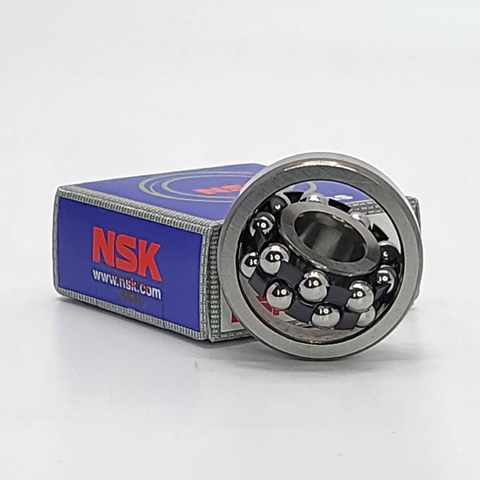
NSK NSK Self-Aligning Ball Bearings, Cylindrical Bore Bearings 2314 ,D=70
NSK Self-Aligning Ball Bearings, Cylindrical Bore Bearings 2314 ,D=70 Bearing Numbers Boundary Dimensions (mm) Basic Load Ratings (kN) Limiting Speeds (min-1) Constant e Axial Load Factors Mass (kg) approx. d D B r min. Cr C0r Grease Oil Y2 Y3 Y0 2314 70 150 51 2.1 111 37.5 3600 4500 0.38 2.6 1.7 1.8 3.8 DESIGN, TYPES, AND FEATURESThe outer ring of a self-aligning ball bearing has a spherical raceway and its center of curvature coincides with that of the bearing; therefore, the axis of the inner ring, balls and cage can deflect to some extent around the bearing center. This type is recommended when the alignment of the shaft and housing is difficult and when the shaft may bend. Since the contact angle is small, axial load capacity is low. Pressed-steel cages are usually used. PROTRUSION AMOUNT Some self-aligning ball bearings have balls that protrude from the side face as shown below. This protrusion amount b1 is listed in the following table. PERMISSIBLE MISALIGNMENT The permissible misalignment of self-aligning ball bearings is approximately 0.07 to 0.12 radian (4° to 7°) under normal loads. However, depending on the surrounding structure, such an angle may not be possible. Take care in the design of the bearing surroundings.
$267.05
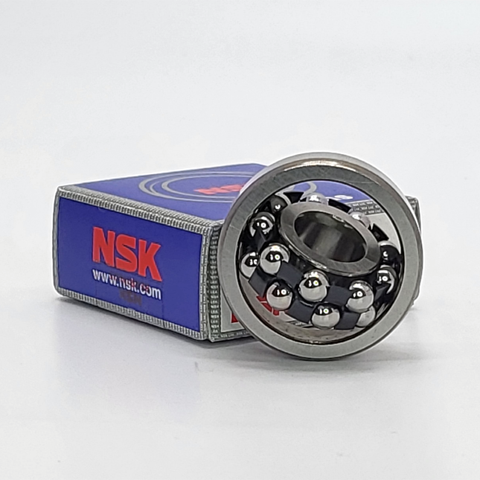
NSK NSK Self-Aligning Ball Bearings, Cylindrical Bore Bearings 2315 ,D=75
NSK Self-Aligning Ball Bearings, Cylindrical Bore Bearings 2315 ,D=75 Bearing Numbers Boundary Dimensions (mm) Basic Load Ratings (kN) Limiting Speeds (min-1) Constant e Axial Load Factors Mass (kg) approx. d D B r min. Cr C0r Grease Oil Y2 Y3 Y0 2315 75 160 55 2.1 125 43 3400 4300 0.38 2.5 1.6 1.7 4.67 DESIGN, TYPES, AND FEATURESThe outer ring of a self-aligning ball bearing has a spherical raceway and its center of curvature coincides with that of the bearing; therefore, the axis of the inner ring, balls and cage can deflect to some extent around the bearing center. This type is recommended when the alignment of the shaft and housing is difficult and when the shaft may bend. Since the contact angle is small, axial load capacity is low. Pressed-steel cages are usually used. PROTRUSION AMOUNT Some self-aligning ball bearings have balls that protrude from the side face as shown below. This protrusion amount b1 is listed in the following table. PERMISSIBLE MISALIGNMENT The permissible misalignment of self-aligning ball bearings is approximately 0.07 to 0.12 radian (4° to 7°) under normal loads. However, depending on the surrounding structure, such an angle may not be possible. Take care in the design of the bearing surroundings.
$351.81
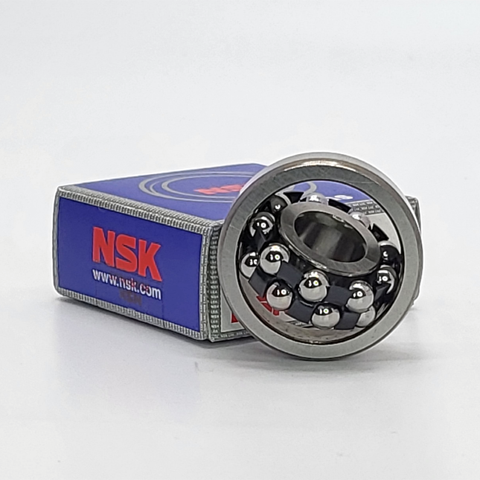
NSK NSK Self-Aligning Ball Bearings, Cylindrical Bore Bearings 2316 ,D=80
NSK Self-Aligning Ball Bearings, Cylindrical Bore Bearings 2316 ,D=80 Bearing Numbers Boundary Dimensions (mm) Basic Load Ratings (kN) Limiting Speeds (min-1) Constant e Axial Load Factors Mass (kg) approx. d D B r min. Cr C0r Grease Oil Y2 Y3 Y0 2316 80 170 58 2.1 130 45 3200 4000 0.39 2.5 1.6 1.7 5.44 DESIGN, TYPES, AND FEATURESThe outer ring of a self-aligning ball bearing has a spherical raceway and its center of curvature coincides with that of the bearing; therefore, the axis of the inner ring, balls and cage can deflect to some extent around the bearing center. This type is recommended when the alignment of the shaft and housing is difficult and when the shaft may bend. Since the contact angle is small, axial load capacity is low. Pressed-steel cages are usually used. PROTRUSION AMOUNT Some self-aligning ball bearings have balls that protrude from the side face as shown below. This protrusion amount b1 is listed in the following table. PERMISSIBLE MISALIGNMENT The permissible misalignment of self-aligning ball bearings is approximately 0.07 to 0.12 radian (4° to 7°) under normal loads. However, depending on the surrounding structure, such an angle may not be possible. Take care in the design of the bearing surroundings.
$359.49
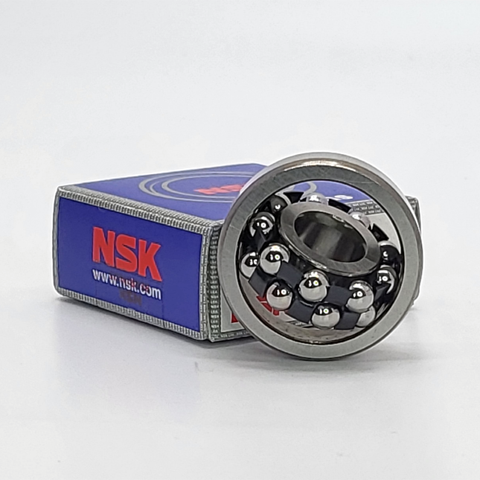
NSK NSK Self-Aligning Ball Bearings, Cylindrical Bore Bearings 2317 ,D=85
NSK Self-Aligning Ball Bearings, Cylindrical Bore Bearings 2317 ,D=85 Bearing Numbers Boundary Dimensions (mm) Basic Load Ratings (kN) Limiting Speeds (min-1) Constant e Axial Load Factors Mass (kg) approx. d D B r min. Cr C0r Grease Oil Y2 Y3 Y0 2317 85 180 60 3 142 51.5 3000 3800 0.37 2.6 1.7 1.8 6.43 DESIGN, TYPES, AND FEATURESThe outer ring of a self-aligning ball bearing has a spherical raceway and its center of curvature coincides with that of the bearing; therefore, the axis of the inner ring, balls and cage can deflect to some extent around the bearing center. This type is recommended when the alignment of the shaft and housing is difficult and when the shaft may bend. Since the contact angle is small, axial load capacity is low. Pressed-steel cages are usually used. PROTRUSION AMOUNT Some self-aligning ball bearings have balls that protrude from the side face as shown below. This protrusion amount b1 is listed in the following table. PERMISSIBLE MISALIGNMENT The permissible misalignment of self-aligning ball bearings is approximately 0.07 to 0.12 radian (4° to 7°) under normal loads. However, depending on the surrounding structure, such an angle may not be possible. Take care in the design of the bearing surroundings.
$516.90
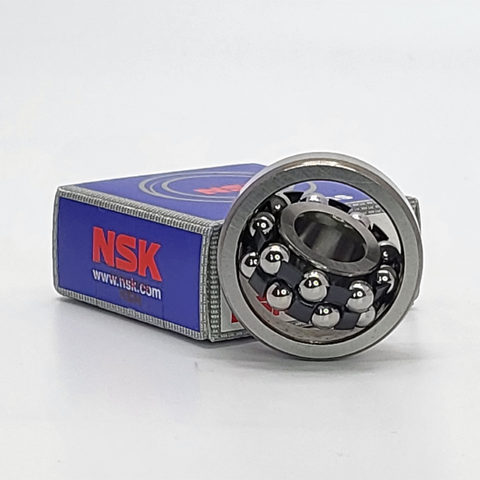
NSK NSK Self-Aligning Ball Bearings, Cylindrical Bore Bearings 2318 ,D=90
NSK Self-Aligning Ball Bearings, Cylindrical Bore Bearings 2318 ,D=90 Bearing Numbers Boundary Dimensions (mm) Basic Load Ratings (kN) Limiting Speeds (min-1) Constant e Axial Load Factors Mass (kg) approx. d D B r min. Cr C0r Grease Oil Y2 Y3 Y0 2318 90 190 64 3 154 57.5 2800 3600 0.38 2.6 1.7 1.7 7.62 DESIGN, TYPES, AND FEATURESThe outer ring of a self-aligning ball bearing has a spherical raceway and its center of curvature coincides with that of the bearing; therefore, the axis of the inner ring, balls and cage can deflect to some extent around the bearing center. This type is recommended when the alignment of the shaft and housing is difficult and when the shaft may bend. Since the contact angle is small, axial load capacity is low. Pressed-steel cages are usually used. PROTRUSION AMOUNT Some self-aligning ball bearings have balls that protrude from the side face as shown below. This protrusion amount b1 is listed in the following table. PERMISSIBLE MISALIGNMENT The permissible misalignment of self-aligning ball bearings is approximately 0.07 to 0.12 radian (4° to 7°) under normal loads. However, depending on the surrounding structure, such an angle may not be possible. Take care in the design of the bearing surroundings.
$707.79
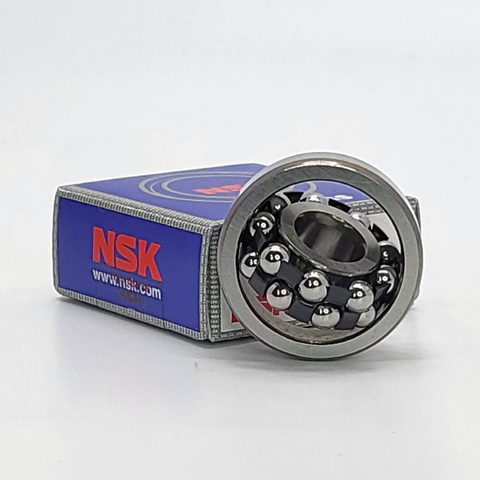
NSK NSK Self-Aligning Ball Bearings, Cylindrical Bore Bearings 2319 ,D=95
NSK Self-Aligning Ball Bearings, Cylindrical Bore Bearings 2319 ,D=95 Bearing Numbers Boundary Dimensions (mm) Basic Load Ratings (kN) Limiting Speeds (min-1) Constant e Axial Load Factors Mass (kg) approx. d D B r min. Cr C0r Grease Oil Y2 Y3 Y0 2319 95 200 67 3 161 64.5 2800 3400 0.38 2.6 1.7 1.8 8.86 DESIGN, TYPES, AND FEATURESThe outer ring of a self-aligning ball bearing has a spherical raceway and its center of curvature coincides with that of the bearing; therefore, the axis of the inner ring, balls and cage can deflect to some extent around the bearing center. This type is recommended when the alignment of the shaft and housing is difficult and when the shaft may bend. Since the contact angle is small, axial load capacity is low. Pressed-steel cages are usually used. PROTRUSION AMOUNT Some self-aligning ball bearings have balls that protrude from the side face as shown below. This protrusion amount b1 is listed in the following table. PERMISSIBLE MISALIGNMENT The permissible misalignment of self-aligning ball bearings is approximately 0.07 to 0.12 radian (4° to 7°) under normal loads. However, depending on the surrounding structure, such an angle may not be possible. Take care in the design of the bearing surroundings.
$844.63
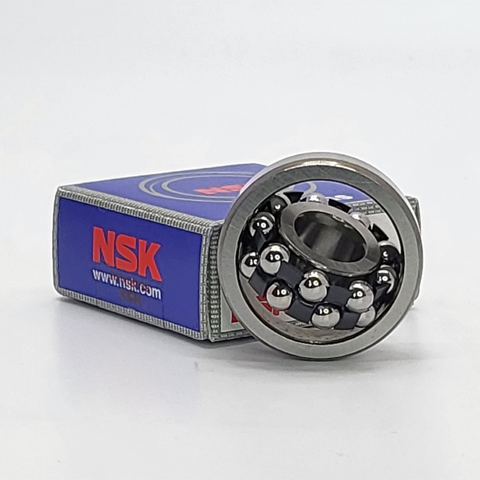
NSK NSK Self-Aligning Ball Bearings, Cylindrical Bore Bearings 2320 ,D=100
NSK Self-Aligning Ball Bearings, Cylindrical Bore Bearings 2320 ,D=100 Bearing Numbers Boundary Dimensions (mm) Basic Load Ratings (kN) Limiting Speeds (min-1) Constant e Axial Load Factors Mass (kg) approx. d D B r min. Cr C0r Grease Oil Y2 Y3 Y0 2320 100 215 73 3 187 79 2400 3200 0.38 2.6 1.7 1.8 11.4 DESIGN, TYPES, AND FEATURESThe outer ring of a self-aligning ball bearing has a spherical raceway and its center of curvature coincides with that of the bearing; therefore, the axis of the inner ring, balls and cage can deflect to some extent around the bearing center. This type is recommended when the alignment of the shaft and housing is difficult and when the shaft may bend. Since the contact angle is small, axial load capacity is low. Pressed-steel cages are usually used. PROTRUSION AMOUNT Some self-aligning ball bearings have balls that protrude from the side face as shown below. This protrusion amount b1 is listed in the following table. PERMISSIBLE MISALIGNMENT The permissible misalignment of self-aligning ball bearings is approximately 0.07 to 0.12 radian (4° to 7°) under normal loads. However, depending on the surrounding structure, such an angle may not be possible. Take care in the design of the bearing surroundings.
$1,124.48

NSK NSK Single-Direction Thrust Ball Bearings With Flat Seat , 51116 ,D=80
NSK Single-Direction Thrust Ball Bearings With Flat Seat , 51116 ,D=80 Bearing Numbers Boundary Dimensions (mm) Basic Load Ratings (kN) Limiting Speeds (min-1) Mass (kg) approx. d D T T3 T4 r min. Ca C0a Grease Oil 51116 80 105 19 1 45 141 2200 3400 0.417 DESIGN, TYPES, AND FEATURES THRUST BALL BEARINGS Thrust ball bearings are classified into those with flat seats or aligning seats, depending on the shape of the outer ring seat (housing washer). They can sustain axial loads but no radial loads. Available Series of thrust ball bearings available are shown in Table 1. For single-direction thrust ball bearings, pressed-steel cages and machined- brass cages are usually used as shown in Table 2. The cages in double- direction thrust ball bearings are the same as those in single-direction thrust ball bearings of the same Diameter Series. The basic load ratings listed in the bearing tables are based on the standard cage type shown in Table 2. If the type of cage is different for bearings with the same number, the number of balls may vary; in such cases, the load rating will differ from that listed in the bearing tables THRUST CYLINDRICAL ROLLER BEARINGS These are thrust bearings containing cylindrical rollers. They can sustain only axial loads, but they are suitable for heavy loads and have high axial rigidity. The cages are machined brass. THRUST SPHERICAL ROLLER BEARINGS These are thrust bearings containing convex rollers. They have a self- aligning capability and are free of any influence of mounting error or shaft deflection. Besides the original type, the E type with pressed cages for high load capacity is also available. Their bearing numbers are suffixed by E. For horizontal shaft or high speed application, machined brass cages are recommended. For details, contact NSK. Since there are several places where lubrication is difficult, such as the area between the roller heads and inner ring rib, the sliding surfaces between cage and guide sleeve, etc., oil lubrication should be used even at low speed. The cages in the original type are machined brass. DIMENSIONS RELATED TO MOUNTING The dimensions related to mounting of thrust spherical roller bearings are listed in the Bearing Table. If the bearing load is heavy, it is necessary to design the shaft shoulder with ample strength in order to provide sufficient support for the shaft washer. PERMISSIBLE MISALIGNMENT The permissible misalignment of thrust spherical roller bearings varies depending on the size, but it is approximately 0.018 to 0.036 radian (1° to 2°) with average loads. MINIMUM AXIAL LOAD It is necessary to apply some axial load to thrust bearings to prevent slippage between the rolling elements and raceways.
$45.21

NSK NSK Single-Direction Thrust Ball Bearings With Flat Seat , 51117 ,D=85
NSK Single-Direction Thrust Ball Bearings With Flat Seat , 51117 ,D=85 Bearing Numbers Boundary Dimensions (mm) Basic Load Ratings (kN) Limiting Speeds (min-1) Mass (kg) approx. d D T T3 T4 r min. Ca C0a Grease Oil 51117 85 110 19 1 46.5 150 2200 3200 0.44 DESIGN, TYPES, AND FEATURES THRUST BALL BEARINGS Thrust ball bearings are classified into those with flat seats or aligning seats, depending on the shape of the outer ring seat (housing washer). They can sustain axial loads but no radial loads. Available Series of thrust ball bearings available are shown in Table 1. For single-direction thrust ball bearings, pressed-steel cages and machined- brass cages are usually used as shown in Table 2. The cages in double- direction thrust ball bearings are the same as those in single-direction thrust ball bearings of the same Diameter Series. The basic load ratings listed in the bearing tables are based on the standard cage type shown in Table 2. If the type of cage is different for bearings with the same number, the number of balls may vary; in such cases, the load rating will differ from that listed in the bearing tables THRUST CYLINDRICAL ROLLER BEARINGS These are thrust bearings containing cylindrical rollers. They can sustain only axial loads, but they are suitable for heavy loads and have high axial rigidity. The cages are machined brass. THRUST SPHERICAL ROLLER BEARINGS These are thrust bearings containing convex rollers. They have a self- aligning capability and are free of any influence of mounting error or shaft deflection. Besides the original type, the E type with pressed cages for high load capacity is also available. Their bearing numbers are suffixed by E. For horizontal shaft or high speed application, machined brass cages are recommended. For details, contact NSK. Since there are several places where lubrication is difficult, such as the area between the roller heads and inner ring rib, the sliding surfaces between cage and guide sleeve, etc., oil lubrication should be used even at low speed. The cages in the original type are machined brass. DIMENSIONS RELATED TO MOUNTING The dimensions related to mounting of thrust spherical roller bearings are listed in the Bearing Table. If the bearing load is heavy, it is necessary to design the shaft shoulder with ample strength in order to provide sufficient support for the shaft washer. PERMISSIBLE MISALIGNMENT The permissible misalignment of thrust spherical roller bearings varies depending on the size, but it is approximately 0.018 to 0.036 radian (1° to 2°) with average loads. MINIMUM AXIAL LOAD It is necessary to apply some axial load to thrust bearings to prevent slippage between the rolling elements and raceways.
$48.82

NSK NSK Single-Direction Thrust Ball Bearings With Flat Seat , 51118 ,D=90
NSK Single-Direction Thrust Ball Bearings With Flat Seat , 51118 ,D=90 Bearing Numbers Boundary Dimensions (mm) Basic Load Ratings (kN) Limiting Speeds (min-1) Mass (kg) approx. d D T T3 T4 r min. Ca C0a Grease Oil 51118 90 120 22 1 60 190 1900 3000 0.646 DESIGN, TYPES, AND FEATURES THRUST BALL BEARINGS Thrust ball bearings are classified into those with flat seats or aligning seats, depending on the shape of the outer ring seat (housing washer). They can sustain axial loads but no radial loads. Available Series of thrust ball bearings available are shown in Table 1. For single-direction thrust ball bearings, pressed-steel cages and machined- brass cages are usually used as shown in Table 2. The cages in double- direction thrust ball bearings are the same as those in single-direction thrust ball bearings of the same Diameter Series. The basic load ratings listed in the bearing tables are based on the standard cage type shown in Table 2. If the type of cage is different for bearings with the same number, the number of balls may vary; in such cases, the load rating will differ from that listed in the bearing tables THRUST CYLINDRICAL ROLLER BEARINGS These are thrust bearings containing cylindrical rollers. They can sustain only axial loads, but they are suitable for heavy loads and have high axial rigidity. The cages are machined brass. THRUST SPHERICAL ROLLER BEARINGS These are thrust bearings containing convex rollers. They have a self- aligning capability and are free of any influence of mounting error or shaft deflection. Besides the original type, the E type with pressed cages for high load capacity is also available. Their bearing numbers are suffixed by E. For horizontal shaft or high speed application, machined brass cages are recommended. For details, contact NSK. Since there are several places where lubrication is difficult, such as the area between the roller heads and inner ring rib, the sliding surfaces between cage and guide sleeve, etc., oil lubrication should be used even at low speed. The cages in the original type are machined brass. DIMENSIONS RELATED TO MOUNTING The dimensions related to mounting of thrust spherical roller bearings are listed in the Bearing Table. If the bearing load is heavy, it is necessary to design the shaft shoulder with ample strength in order to provide sufficient support for the shaft washer. PERMISSIBLE MISALIGNMENT The permissible misalignment of thrust spherical roller bearings varies depending on the size, but it is approximately 0.018 to 0.036 radian (1° to 2°) with average loads. MINIMUM AXIAL LOAD It is necessary to apply some axial load to thrust bearings to prevent slippage between the rolling elements and raceways.
$54.34

NSK NSK Single-Direction Thrust Ball Bearings With Flat Seat , 51120 ,D=100
NSK Single-Direction Thrust Ball Bearings With Flat Seat , 51120 ,D=100 Bearing Numbers Boundary Dimensions (mm) Basic Load Ratings (kN) Limiting Speeds (min-1) Mass (kg) approx. d D T T3 T4 r min. Ca C0a Grease Oil 51120 100 135 25 1 86 268 1700 2600 0.96 DESIGN, TYPES, AND FEATURES THRUST BALL BEARINGS Thrust ball bearings are classified into those with flat seats or aligning seats, depending on the shape of the outer ring seat (housing washer). They can sustain axial loads but no radial loads. Available Series of thrust ball bearings available are shown in Table 1. For single-direction thrust ball bearings, pressed-steel cages and machined- brass cages are usually used as shown in Table 2. The cages in double- direction thrust ball bearings are the same as those in single-direction thrust ball bearings of the same Diameter Series. The basic load ratings listed in the bearing tables are based on the standard cage type shown in Table 2. If the type of cage is different for bearings with the same number, the number of balls may vary; in such cases, the load rating will differ from that listed in the bearing tables THRUST CYLINDRICAL ROLLER BEARINGS These are thrust bearings containing cylindrical rollers. They can sustain only axial loads, but they are suitable for heavy loads and have high axial rigidity. The cages are machined brass. THRUST SPHERICAL ROLLER BEARINGS These are thrust bearings containing convex rollers. They have a self- aligning capability and are free of any influence of mounting error or shaft deflection. Besides the original type, the E type with pressed cages for high load capacity is also available. Their bearing numbers are suffixed by E. For horizontal shaft or high speed application, machined brass cages are recommended. For details, contact NSK. Since there are several places where lubrication is difficult, such as the area between the roller heads and inner ring rib, the sliding surfaces between cage and guide sleeve, etc., oil lubrication should be used even at low speed. The cages in the original type are machined brass. DIMENSIONS RELATED TO MOUNTING The dimensions related to mounting of thrust spherical roller bearings are listed in the Bearing Table. If the bearing load is heavy, it is necessary to design the shaft shoulder with ample strength in order to provide sufficient support for the shaft washer. PERMISSIBLE MISALIGNMENT The permissible misalignment of thrust spherical roller bearings varies depending on the size, but it is approximately 0.018 to 0.036 radian (1° to 2°) with average loads. MINIMUM AXIAL LOAD It is necessary to apply some axial load to thrust bearings to prevent slippage between the rolling elements and raceways.
$93.82

NSK NSK Single-Direction Thrust Ball Bearings With Flat Seat , 51122 ,D=110
NSK Single-Direction Thrust Ball Bearings With Flat Seat , 51122 ,D=110 Bearing Numbers Boundary Dimensions (mm) Basic Load Ratings (kN) Limiting Speeds (min-1) Mass (kg) approx. d D T T3 T4 r min. Ca C0a Grease Oil 51122 110 145 25 1 88 288 1700 2400 1.04 DESIGN, TYPES, AND FEATURES THRUST BALL BEARINGS Thrust ball bearings are classified into those with flat seats or aligning seats, depending on the shape of the outer ring seat (housing washer). They can sustain axial loads but no radial loads. Available Series of thrust ball bearings available are shown in Table 1. For single-direction thrust ball bearings, pressed-steel cages and machined- brass cages are usually used as shown in Table 2. The cages in double- direction thrust ball bearings are the same as those in single-direction thrust ball bearings of the same Diameter Series. The basic load ratings listed in the bearing tables are based on the standard cage type shown in Table 2. If the type of cage is different for bearings with the same number, the number of balls may vary; in such cases, the load rating will differ from that listed in the bearing tables THRUST CYLINDRICAL ROLLER BEARINGS These are thrust bearings containing cylindrical rollers. They can sustain only axial loads, but they are suitable for heavy loads and have high axial rigidity. The cages are machined brass. THRUST SPHERICAL ROLLER BEARINGS These are thrust bearings containing convex rollers. They have a self- aligning capability and are free of any influence of mounting error or shaft deflection. Besides the original type, the E type with pressed cages for high load capacity is also available. Their bearing numbers are suffixed by E. For horizontal shaft or high speed application, machined brass cages are recommended. For details, contact NSK. Since there are several places where lubrication is difficult, such as the area between the roller heads and inner ring rib, the sliding surfaces between cage and guide sleeve, etc., oil lubrication should be used even at low speed. The cages in the original type are machined brass. DIMENSIONS RELATED TO MOUNTING The dimensions related to mounting of thrust spherical roller bearings are listed in the Bearing Table. If the bearing load is heavy, it is necessary to design the shaft shoulder with ample strength in order to provide sufficient support for the shaft washer. PERMISSIBLE MISALIGNMENT The permissible misalignment of thrust spherical roller bearings varies depending on the size, but it is approximately 0.018 to 0.036 radian (1° to 2°) with average loads. MINIMUM AXIAL LOAD It is necessary to apply some axial load to thrust bearings to prevent slippage between the rolling elements and raceways.
$138.98

NSK NSK Single-Direction Thrust Ball Bearings With Flat Seat , 51124 ,D=120
NSK Single-Direction Thrust Ball Bearings With Flat Seat , 51124 ,D=120 Bearing Numbers Boundary Dimensions (mm) Basic Load Ratings (kN) Limiting Speeds (min-1) Mass (kg) approx. d D T T3 T4 r min. Ca C0a Grease Oil 51124 120 155 25 1 90 310 1600 2400 1.12 DESIGN, TYPES, AND FEATURES THRUST BALL BEARINGS Thrust ball bearings are classified into those with flat seats or aligning seats, depending on the shape of the outer ring seat (housing washer). They can sustain axial loads but no radial loads. Available Series of thrust ball bearings available are shown in Table 1. For single-direction thrust ball bearings, pressed-steel cages and machined- brass cages are usually used as shown in Table 2. The cages in double- direction thrust ball bearings are the same as those in single-direction thrust ball bearings of the same Diameter Series. The basic load ratings listed in the bearing tables are based on the standard cage type shown in Table 2. If the type of cage is different for bearings with the same number, the number of balls may vary; in such cases, the load rating will differ from that listed in the bearing tables THRUST CYLINDRICAL ROLLER BEARINGS These are thrust bearings containing cylindrical rollers. They can sustain only axial loads, but they are suitable for heavy loads and have high axial rigidity. The cages are machined brass. THRUST SPHERICAL ROLLER BEARINGS These are thrust bearings containing convex rollers. They have a self- aligning capability and are free of any influence of mounting error or shaft deflection. Besides the original type, the E type with pressed cages for high load capacity is also available. Their bearing numbers are suffixed by E. For horizontal shaft or high speed application, machined brass cages are recommended. For details, contact NSK. Since there are several places where lubrication is difficult, such as the area between the roller heads and inner ring rib, the sliding surfaces between cage and guide sleeve, etc., oil lubrication should be used even at low speed. The cages in the original type are machined brass. DIMENSIONS RELATED TO MOUNTING The dimensions related to mounting of thrust spherical roller bearings are listed in the Bearing Table. If the bearing load is heavy, it is necessary to design the shaft shoulder with ample strength in order to provide sufficient support for the shaft washer. PERMISSIBLE MISALIGNMENT The permissible misalignment of thrust spherical roller bearings varies depending on the size, but it is approximately 0.018 to 0.036 radian (1° to 2°) with average loads. MINIMUM AXIAL LOAD It is necessary to apply some axial load to thrust bearings to prevent slippage between the rolling elements and raceways.
$178.68

NSK NSK Single-Direction Thrust Ball Bearings With Flat Seat , 51126 ,D=130
NSK Single-Direction Thrust Ball Bearings With Flat Seat , 51126 ,D=130 Bearing Numbers Boundary Dimensions (mm) Basic Load Ratings (kN) Limiting Speeds (min-1) Mass (kg) approx. d D T T3 T4 r min. Ca C0a Grease Oil 51126 130 170 30 1 105 350 1400 2000 1.68 DESIGN, TYPES, AND FEATURES THRUST BALL BEARINGS Thrust ball bearings are classified into those with flat seats or aligning seats, depending on the shape of the outer ring seat (housing washer). They can sustain axial loads but no radial loads. Available Series of thrust ball bearings available are shown in Table 1. For single-direction thrust ball bearings, pressed-steel cages and machined- brass cages are usually used as shown in Table 2. The cages in double- direction thrust ball bearings are the same as those in single-direction thrust ball bearings of the same Diameter Series. The basic load ratings listed in the bearing tables are based on the standard cage type shown in Table 2. If the type of cage is different for bearings with the same number, the number of balls may vary; in such cases, the load rating will differ from that listed in the bearing tables THRUST CYLINDRICAL ROLLER BEARINGS These are thrust bearings containing cylindrical rollers. They can sustain only axial loads, but they are suitable for heavy loads and have high axial rigidity. The cages are machined brass. THRUST SPHERICAL ROLLER BEARINGS These are thrust bearings containing convex rollers. They have a self- aligning capability and are free of any influence of mounting error or shaft deflection. Besides the original type, the E type with pressed cages for high load capacity is also available. Their bearing numbers are suffixed by E. For horizontal shaft or high speed application, machined brass cages are recommended. For details, contact NSK. Since there are several places where lubrication is difficult, such as the area between the roller heads and inner ring rib, the sliding surfaces between cage and guide sleeve, etc., oil lubrication should be used even at low speed. The cages in the original type are machined brass. DIMENSIONS RELATED TO MOUNTING The dimensions related to mounting of thrust spherical roller bearings are listed in the Bearing Table. If the bearing load is heavy, it is necessary to design the shaft shoulder with ample strength in order to provide sufficient support for the shaft washer. PERMISSIBLE MISALIGNMENT The permissible misalignment of thrust spherical roller bearings varies depending on the size, but it is approximately 0.018 to 0.036 radian (1° to 2°) with average loads. MINIMUM AXIAL LOAD It is necessary to apply some axial load to thrust bearings to prevent slippage between the rolling elements and raceways.
$246.66

NSK NSK Single-Direction Thrust Ball Bearings With Flat Seat , 51128X ,D=140
NSK Single-Direction Thrust Ball Bearings With Flat Seat , 51128X ,D=140 Bearing Numbers Boundary Dimensions (mm) Basic Load Ratings (kN) Limiting Speeds (min-1) Mass (kg) approx. d D T T3 T4 r min. Ca C0a Grease Oil 51128X 140 180 31 1 107 375 1300 2000 1.83 DESIGN, TYPES, AND FEATURES THRUST BALL BEARINGS Thrust ball bearings are classified into those with flat seats or aligning seats, depending on the shape of the outer ring seat (housing washer). They can sustain axial loads but no radial loads. Available Series of thrust ball bearings available are shown in Table 1. For single-direction thrust ball bearings, pressed-steel cages and machined- brass cages are usually used as shown in Table 2. The cages in double- direction thrust ball bearings are the same as those in single-direction thrust ball bearings of the same Diameter Series. The basic load ratings listed in the bearing tables are based on the standard cage type shown in Table 2. If the type of cage is different for bearings with the same number, the number of balls may vary; in such cases, the load rating will differ from that listed in the bearing tables THRUST CYLINDRICAL ROLLER BEARINGS These are thrust bearings containing cylindrical rollers. They can sustain only axial loads, but they are suitable for heavy loads and have high axial rigidity. The cages are machined brass. THRUST SPHERICAL ROLLER BEARINGS These are thrust bearings containing convex rollers. They have a self- aligning capability and are free of any influence of mounting error or shaft deflection. Besides the original type, the E type with pressed cages for high load capacity is also available. Their bearing numbers are suffixed by E. For horizontal shaft or high speed application, machined brass cages are recommended. For details, contact NSK. Since there are several places where lubrication is difficult, such as the area between the roller heads and inner ring rib, the sliding surfaces between cage and guide sleeve, etc., oil lubrication should be used even at low speed. The cages in the original type are machined brass. DIMENSIONS RELATED TO MOUNTING The dimensions related to mounting of thrust spherical roller bearings are listed in the Bearing Table. If the bearing load is heavy, it is necessary to design the shaft shoulder with ample strength in order to provide sufficient support for the shaft washer. PERMISSIBLE MISALIGNMENT The permissible misalignment of thrust spherical roller bearings varies depending on the size, but it is approximately 0.018 to 0.036 radian (1° to 2°) with average loads. MINIMUM AXIAL LOAD It is necessary to apply some axial load to thrust bearings to prevent slippage between the rolling elements and raceways.
$290.25

NSK NSK Single-Direction Thrust Ball Bearings With Flat Seat , 51130X ,D=150
NSK Single-Direction Thrust Ball Bearings With Flat Seat , 51130X ,D=150 Bearing Numbers Boundary Dimensions (mm) Basic Load Ratings (kN) Limiting Speeds (min-1) Mass (kg) approx. d D T T3 T4 r min. Ca C0a Grease Oil 51130X 150 190 31 1 110 400 1300 1900 1.95 DESIGN, TYPES, AND FEATURES THRUST BALL BEARINGS Thrust ball bearings are classified into those with flat seats or aligning seats, depending on the shape of the outer ring seat (housing washer). They can sustain axial loads but no radial loads. Available Series of thrust ball bearings available are shown in Table 1. For single-direction thrust ball bearings, pressed-steel cages and machined- brass cages are usually used as shown in Table 2. The cages in double- direction thrust ball bearings are the same as those in single-direction thrust ball bearings of the same Diameter Series. The basic load ratings listed in the bearing tables are based on the standard cage type shown in Table 2. If the type of cage is different for bearings with the same number, the number of balls may vary; in such cases, the load rating will differ from that listed in the bearing tables THRUST CYLINDRICAL ROLLER BEARINGS These are thrust bearings containing cylindrical rollers. They can sustain only axial loads, but they are suitable for heavy loads and have high axial rigidity. The cages are machined brass. THRUST SPHERICAL ROLLER BEARINGS These are thrust bearings containing convex rollers. They have a self- aligning capability and are free of any influence of mounting error or shaft deflection. Besides the original type, the E type with pressed cages for high load capacity is also available. Their bearing numbers are suffixed by E. For horizontal shaft or high speed application, machined brass cages are recommended. For details, contact NSK. Since there are several places where lubrication is difficult, such as the area between the roller heads and inner ring rib, the sliding surfaces between cage and guide sleeve, etc., oil lubrication should be used even at low speed. The cages in the original type are machined brass. DIMENSIONS RELATED TO MOUNTING The dimensions related to mounting of thrust spherical roller bearings are listed in the Bearing Table. If the bearing load is heavy, it is necessary to design the shaft shoulder with ample strength in order to provide sufficient support for the shaft washer. PERMISSIBLE MISALIGNMENT The permissible misalignment of thrust spherical roller bearings varies depending on the size, but it is approximately 0.018 to 0.036 radian (1° to 2°) with average loads. MINIMUM AXIAL LOAD It is necessary to apply some axial load to thrust bearings to prevent slippage between the rolling elements and raceways.
$316.50

NSK NSK Single-Direction Thrust Ball Bearings With Flat Seat , 51132X ,D=160
NSK Single-Direction Thrust Ball Bearings With Flat Seat , 51132X ,D=160 Bearing Numbers Boundary Dimensions (mm) Basic Load Ratings (kN) Limiting Speeds (min-1) Mass (kg) approx. d D T T3 T4 r min. Ca C0a Grease Oil 51132X 160 200 31 1 113 425 1200 1900 2.07 DESIGN, TYPES, AND FEATURES THRUST BALL BEARINGS Thrust ball bearings are classified into those with flat seats or aligning seats, depending on the shape of the outer ring seat (housing washer). They can sustain axial loads but no radial loads. Available Series of thrust ball bearings available are shown in Table 1. For single-direction thrust ball bearings, pressed-steel cages and machined- brass cages are usually used as shown in Table 2. The cages in double- direction thrust ball bearings are the same as those in single-direction thrust ball bearings of the same Diameter Series. The basic load ratings listed in the bearing tables are based on the standard cage type shown in Table 2. If the type of cage is different for bearings with the same number, the number of balls may vary; in such cases, the load rating will differ from that listed in the bearing tables THRUST CYLINDRICAL ROLLER BEARINGS These are thrust bearings containing cylindrical rollers. They can sustain only axial loads, but they are suitable for heavy loads and have high axial rigidity. The cages are machined brass. THRUST SPHERICAL ROLLER BEARINGS These are thrust bearings containing convex rollers. They have a self- aligning capability and are free of any influence of mounting error or shaft deflection. Besides the original type, the E type with pressed cages for high load capacity is also available. Their bearing numbers are suffixed by E. For horizontal shaft or high speed application, machined brass cages are recommended. For details, contact NSK. Since there are several places where lubrication is difficult, such as the area between the roller heads and inner ring rib, the sliding surfaces between cage and guide sleeve, etc., oil lubrication should be used even at low speed. The cages in the original type are machined brass. DIMENSIONS RELATED TO MOUNTING The dimensions related to mounting of thrust spherical roller bearings are listed in the Bearing Table. If the bearing load is heavy, it is necessary to design the shaft shoulder with ample strength in order to provide sufficient support for the shaft washer. PERMISSIBLE MISALIGNMENT The permissible misalignment of thrust spherical roller bearings varies depending on the size, but it is approximately 0.018 to 0.036 radian (1° to 2°) with average loads. MINIMUM AXIAL LOAD It is necessary to apply some axial load to thrust bearings to prevent slippage between the rolling elements and raceways.
$371.58

NSK NSK Single-Direction Thrust Ball Bearings With Flat Seat , 51134X ,D=170
NSK Single-Direction Thrust Ball Bearings With Flat Seat , 51134X ,D=170 Bearing Numbers Boundary Dimensions (mm) Basic Load Ratings (kN) Limiting Speeds (min-1) Mass (kg) approx. d D T T3 T4 r min. Ca C0a Grease Oil 51134X 170 215 34 1.1 135 510 1100 1700 2.72 DESIGN, TYPES, AND FEATURES THRUST BALL BEARINGS Thrust ball bearings are classified into those with flat seats or aligning seats, depending on the shape of the outer ring seat (housing washer). They can sustain axial loads but no radial loads. Available Series of thrust ball bearings available are shown in Table 1. For single-direction thrust ball bearings, pressed-steel cages and machined- brass cages are usually used as shown in Table 2. The cages in double- direction thrust ball bearings are the same as those in single-direction thrust ball bearings of the same Diameter Series. The basic load ratings listed in the bearing tables are based on the standard cage type shown in Table 2. If the type of cage is different for bearings with the same number, the number of balls may vary; in such cases, the load rating will differ from that listed in the bearing tables THRUST CYLINDRICAL ROLLER BEARINGS These are thrust bearings containing cylindrical rollers. They can sustain only axial loads, but they are suitable for heavy loads and have high axial rigidity. The cages are machined brass. THRUST SPHERICAL ROLLER BEARINGS These are thrust bearings containing convex rollers. They have a self- aligning capability and are free of any influence of mounting error or shaft deflection. Besides the original type, the E type with pressed cages for high load capacity is also available. Their bearing numbers are suffixed by E. For horizontal shaft or high speed application, machined brass cages are recommended. For details, contact NSK. Since there are several places where lubrication is difficult, such as the area between the roller heads and inner ring rib, the sliding surfaces between cage and guide sleeve, etc., oil lubrication should be used even at low speed. The cages in the original type are machined brass. DIMENSIONS RELATED TO MOUNTING The dimensions related to mounting of thrust spherical roller bearings are listed in the Bearing Table. If the bearing load is heavy, it is necessary to design the shaft shoulder with ample strength in order to provide sufficient support for the shaft washer. PERMISSIBLE MISALIGNMENT The permissible misalignment of thrust spherical roller bearings varies depending on the size, but it is approximately 0.018 to 0.036 radian (1° to 2°) with average loads. MINIMUM AXIAL LOAD It is necessary to apply some axial load to thrust bearings to prevent slippage between the rolling elements and raceways.
$459.63

NSK NSK Single-Direction Thrust Ball Bearings With Flat Seat , 51136X ,D=180
NSK Single-Direction Thrust Ball Bearings With Flat Seat , 51136X ,D=180 Bearing Numbers Boundary Dimensions (mm) Basic Load Ratings (kN) Limiting Speeds (min-1) Mass (kg) approx. d D T T3 T4 r min. Ca C0a Grease Oil 51136X 180 225 34 1.1 136 530 1100 1700 2.79 DESIGN, TYPES, AND FEATURES THRUST BALL BEARINGS Thrust ball bearings are classified into those with flat seats or aligning seats, depending on the shape of the outer ring seat (housing washer). They can sustain axial loads but no radial loads. Available Series of thrust ball bearings available are shown in Table 1. For single-direction thrust ball bearings, pressed-steel cages and machined- brass cages are usually used as shown in Table 2. The cages in double- direction thrust ball bearings are the same as those in single-direction thrust ball bearings of the same Diameter Series. The basic load ratings listed in the bearing tables are based on the standard cage type shown in Table 2. If the type of cage is different for bearings with the same number, the number of balls may vary; in such cases, the load rating will differ from that listed in the bearing tables THRUST CYLINDRICAL ROLLER BEARINGS These are thrust bearings containing cylindrical rollers. They can sustain only axial loads, but they are suitable for heavy loads and have high axial rigidity. The cages are machined brass. THRUST SPHERICAL ROLLER BEARINGS These are thrust bearings containing convex rollers. They have a self- aligning capability and are free of any influence of mounting error or shaft deflection. Besides the original type, the E type with pressed cages for high load capacity is also available. Their bearing numbers are suffixed by E. For horizontal shaft or high speed application, machined brass cages are recommended. For details, contact NSK. Since there are several places where lubrication is difficult, such as the area between the roller heads and inner ring rib, the sliding surfaces between cage and guide sleeve, etc., oil lubrication should be used even at low speed. The cages in the original type are machined brass. DIMENSIONS RELATED TO MOUNTING The dimensions related to mounting of thrust spherical roller bearings are listed in the Bearing Table. If the bearing load is heavy, it is necessary to design the shaft shoulder with ample strength in order to provide sufficient support for the shaft washer. PERMISSIBLE MISALIGNMENT The permissible misalignment of thrust spherical roller bearings varies depending on the size, but it is approximately 0.018 to 0.036 radian (1° to 2°) with average loads. MINIMUM AXIAL LOAD It is necessary to apply some axial load to thrust bearings to prevent slippage between the rolling elements and raceways.
$475.33

NSK NSK Single-Direction Thrust Ball Bearings With Flat Seat , 51138X ,D=190
NSK Single-Direction Thrust Ball Bearings With Flat Seat , 51138X ,D=190 Bearing Numbers Boundary Dimensions (mm) Basic Load Ratings (kN) Limiting Speeds (min-1) Mass (kg) approx. d D T T3 T4 r min. Ca C0a Grease Oil 51138X 190 240 37 1.1 172 655 1000 1600 3.6 DESIGN, TYPES, AND FEATURES THRUST BALL BEARINGS Thrust ball bearings are classified into those with flat seats or aligning seats, depending on the shape of the outer ring seat (housing washer). They can sustain axial loads but no radial loads. Available Series of thrust ball bearings available are shown in Table 1. For single-direction thrust ball bearings, pressed-steel cages and machined- brass cages are usually used as shown in Table 2. The cages in double- direction thrust ball bearings are the same as those in single-direction thrust ball bearings of the same Diameter Series. The basic load ratings listed in the bearing tables are based on the standard cage type shown in Table 2. If the type of cage is different for bearings with the same number, the number of balls may vary; in such cases, the load rating will differ from that listed in the bearing tables THRUST CYLINDRICAL ROLLER BEARINGS These are thrust bearings containing cylindrical rollers. They can sustain only axial loads, but they are suitable for heavy loads and have high axial rigidity. The cages are machined brass. THRUST SPHERICAL ROLLER BEARINGS These are thrust bearings containing convex rollers. They have a self- aligning capability and are free of any influence of mounting error or shaft deflection. Besides the original type, the E type with pressed cages for high load capacity is also available. Their bearing numbers are suffixed by E. For horizontal shaft or high speed application, machined brass cages are recommended. For details, contact NSK. Since there are several places where lubrication is difficult, such as the area between the roller heads and inner ring rib, the sliding surfaces between cage and guide sleeve, etc., oil lubrication should be used even at low speed. The cages in the original type are machined brass. DIMENSIONS RELATED TO MOUNTING The dimensions related to mounting of thrust spherical roller bearings are listed in the Bearing Table. If the bearing load is heavy, it is necessary to design the shaft shoulder with ample strength in order to provide sufficient support for the shaft washer. PERMISSIBLE MISALIGNMENT The permissible misalignment of thrust spherical roller bearings varies depending on the size, but it is approximately 0.018 to 0.036 radian (1° to 2°) with average loads. MINIMUM AXIAL LOAD It is necessary to apply some axial load to thrust bearings to prevent slippage between the rolling elements and raceways.
$573.49

NSK NSK Single-Direction Thrust Ball Bearings With Flat Seat , 51140X ,D=200
NSK Single-Direction Thrust Ball Bearings With Flat Seat , 51140X ,D=200 Bearing Numbers Boundary Dimensions (mm) Basic Load Ratings (kN) Limiting Speeds (min-1) Mass (kg) approx. d D T T3 T4 r min. Ca C0a Grease Oil 51140X 200 250 37 1.1 173 675 1000 1500 3.75 DESIGN, TYPES, AND FEATURES THRUST BALL BEARINGS Thrust ball bearings are classified into those with flat seats or aligning seats, depending on the shape of the outer ring seat (housing washer). They can sustain axial loads but no radial loads. Available Series of thrust ball bearings available are shown in Table 1. For single-direction thrust ball bearings, pressed-steel cages and machined- brass cages are usually used as shown in Table 2. The cages in double- direction thrust ball bearings are the same as those in single-direction thrust ball bearings of the same Diameter Series. The basic load ratings listed in the bearing tables are based on the standard cage type shown in Table 2. If the type of cage is different for bearings with the same number, the number of balls may vary; in such cases, the load rating will differ from that listed in the bearing tables THRUST CYLINDRICAL ROLLER BEARINGS These are thrust bearings containing cylindrical rollers. They can sustain only axial loads, but they are suitable for heavy loads and have high axial rigidity. The cages are machined brass. THRUST SPHERICAL ROLLER BEARINGS These are thrust bearings containing convex rollers. They have a self- aligning capability and are free of any influence of mounting error or shaft deflection. Besides the original type, the E type with pressed cages for high load capacity is also available. Their bearing numbers are suffixed by E. For horizontal shaft or high speed application, machined brass cages are recommended. For details, contact NSK. Since there are several places where lubrication is difficult, such as the area between the roller heads and inner ring rib, the sliding surfaces between cage and guide sleeve, etc., oil lubrication should be used even at low speed. The cages in the original type are machined brass. DIMENSIONS RELATED TO MOUNTING The dimensions related to mounting of thrust spherical roller bearings are listed in the Bearing Table. If the bearing load is heavy, it is necessary to design the shaft shoulder with ample strength in order to provide sufficient support for the shaft washer. PERMISSIBLE MISALIGNMENT The permissible misalignment of thrust spherical roller bearings varies depending on the size, but it is approximately 0.018 to 0.036 radian (1° to 2°) with average loads. MINIMUM AXIAL LOAD It is necessary to apply some axial load to thrust bearings to prevent slippage between the rolling elements and raceways.
$610.76

NSK NSK Single-Direction Thrust Ball Bearings With Flat Seat , 51144X ,D=220
NSK Single-Direction Thrust Ball Bearings With Flat Seat , 51144X ,D=220 Bearing Numbers Boundary Dimensions (mm) Basic Load Ratings (kN) Limiting Speeds (min-1) Mass (kg) approx. d D T T3 T4 r min. Ca C0a Grease Oil 51144X 220 270 37 1.1 179 740 950 1500 4.09 DESIGN, TYPES, AND FEATURES THRUST BALL BEARINGS Thrust ball bearings are classified into those with flat seats or aligning seats, depending on the shape of the outer ring seat (housing washer). They can sustain axial loads but no radial loads. Available Series of thrust ball bearings available are shown in Table 1. For single-direction thrust ball bearings, pressed-steel cages and machined- brass cages are usually used as shown in Table 2. The cages in double- direction thrust ball bearings are the same as those in single-direction thrust ball bearings of the same Diameter Series. The basic load ratings listed in the bearing tables are based on the standard cage type shown in Table 2. If the type of cage is different for bearings with the same number, the number of balls may vary; in such cases, the load rating will differ from that listed in the bearing tables THRUST CYLINDRICAL ROLLER BEARINGS These are thrust bearings containing cylindrical rollers. They can sustain only axial loads, but they are suitable for heavy loads and have high axial rigidity. The cages are machined brass. THRUST SPHERICAL ROLLER BEARINGS These are thrust bearings containing convex rollers. They have a self- aligning capability and are free of any influence of mounting error or shaft deflection. Besides the original type, the E type with pressed cages for high load capacity is also available. Their bearing numbers are suffixed by E. For horizontal shaft or high speed application, machined brass cages are recommended. For details, contact NSK. Since there are several places where lubrication is difficult, such as the area between the roller heads and inner ring rib, the sliding surfaces between cage and guide sleeve, etc., oil lubrication should be used even at low speed. The cages in the original type are machined brass. DIMENSIONS RELATED TO MOUNTING The dimensions related to mounting of thrust spherical roller bearings are listed in the Bearing Table. If the bearing load is heavy, it is necessary to design the shaft shoulder with ample strength in order to provide sufficient support for the shaft washer. PERMISSIBLE MISALIGNMENT The permissible misalignment of thrust spherical roller bearings varies depending on the size, but it is approximately 0.018 to 0.036 radian (1° to 2°) with average loads. MINIMUM AXIAL LOAD It is necessary to apply some axial load to thrust bearings to prevent slippage between the rolling elements and raceways.
$760.34

NSK NSK Single-Direction Thrust Ball Bearings With Flat Seat , 51148X ,D=240
NSK Single-Direction Thrust Ball Bearings With Flat Seat , 51148X ,D=240 Bearing Numbers Boundary Dimensions (mm) Basic Load Ratings (kN) Limiting Speeds (min-1) Mass (kg) approx. d D T T3 T4 r min. Ca C0a Grease Oil 51148X 240 300 45 1.5 229 935 850 1200 6.55 DESIGN, TYPES, AND FEATURES THRUST BALL BEARINGS Thrust ball bearings are classified into those with flat seats or aligning seats, depending on the shape of the outer ring seat (housing washer). They can sustain axial loads but no radial loads. Available Series of thrust ball bearings available are shown in Table 1. For single-direction thrust ball bearings, pressed-steel cages and machined- brass cages are usually used as shown in Table 2. The cages in double- direction thrust ball bearings are the same as those in single-direction thrust ball bearings of the same Diameter Series. The basic load ratings listed in the bearing tables are based on the standard cage type shown in Table 2. If the type of cage is different for bearings with the same number, the number of balls may vary; in such cases, the load rating will differ from that listed in the bearing tables THRUST CYLINDRICAL ROLLER BEARINGS These are thrust bearings containing cylindrical rollers. They can sustain only axial loads, but they are suitable for heavy loads and have high axial rigidity. The cages are machined brass. THRUST SPHERICAL ROLLER BEARINGS These are thrust bearings containing convex rollers. They have a self- aligning capability and are free of any influence of mounting error or shaft deflection. Besides the original type, the E type with pressed cages for high load capacity is also available. Their bearing numbers are suffixed by E. For horizontal shaft or high speed application, machined brass cages are recommended. For details, contact NSK. Since there are several places where lubrication is difficult, such as the area between the roller heads and inner ring rib, the sliding surfaces between cage and guide sleeve, etc., oil lubrication should be used even at low speed. The cages in the original type are machined brass. DIMENSIONS RELATED TO MOUNTING The dimensions related to mounting of thrust spherical roller bearings are listed in the Bearing Table. If the bearing load is heavy, it is necessary to design the shaft shoulder with ample strength in order to provide sufficient support for the shaft washer. PERMISSIBLE MISALIGNMENT The permissible misalignment of thrust spherical roller bearings varies depending on the size, but it is approximately 0.018 to 0.036 radian (1° to 2°) with average loads. MINIMUM AXIAL LOAD It is necessary to apply some axial load to thrust bearings to prevent slippage between the rolling elements and raceways.
$1,052.53

NSK NSK Single-Direction Thrust Ball Bearings With Flat Seat , 51152X ,D=260
NSK Single-Direction Thrust Ball Bearings With Flat Seat , 51152X ,D=260 Bearing Numbers Boundary Dimensions (mm) Basic Load Ratings (kN) Limiting Speeds (min-1) Mass (kg) approx. d D T T3 T4 r min. Ca C0a Grease Oil 51152X 260 320 45 1.5 233 990 800 1200 7.01 DESIGN, TYPES, AND FEATURES THRUST BALL BEARINGS Thrust ball bearings are classified into those with flat seats or aligning seats, depending on the shape of the outer ring seat (housing washer). They can sustain axial loads but no radial loads. Available Series of thrust ball bearings available are shown in Table 1. For single-direction thrust ball bearings, pressed-steel cages and machined- brass cages are usually used as shown in Table 2. The cages in double- direction thrust ball bearings are the same as those in single-direction thrust ball bearings of the same Diameter Series. The basic load ratings listed in the bearing tables are based on the standard cage type shown in Table 2. If the type of cage is different for bearings with the same number, the number of balls may vary; in such cases, the load rating will differ from that listed in the bearing tables THRUST CYLINDRICAL ROLLER BEARINGS These are thrust bearings containing cylindrical rollers. They can sustain only axial loads, but they are suitable for heavy loads and have high axial rigidity. The cages are machined brass. THRUST SPHERICAL ROLLER BEARINGS These are thrust bearings containing convex rollers. They have a self- aligning capability and are free of any influence of mounting error or shaft deflection. Besides the original type, the E type with pressed cages for high load capacity is also available. Their bearing numbers are suffixed by E. For horizontal shaft or high speed application, machined brass cages are recommended. For details, contact NSK. Since there are several places where lubrication is difficult, such as the area between the roller heads and inner ring rib, the sliding surfaces between cage and guide sleeve, etc., oil lubrication should be used even at low speed. The cages in the original type are machined brass. DIMENSIONS RELATED TO MOUNTING The dimensions related to mounting of thrust spherical roller bearings are listed in the Bearing Table. If the bearing load is heavy, it is necessary to design the shaft shoulder with ample strength in order to provide sufficient support for the shaft washer. PERMISSIBLE MISALIGNMENT The permissible misalignment of thrust spherical roller bearings varies depending on the size, but it is approximately 0.018 to 0.036 radian (1° to 2°) with average loads. MINIMUM AXIAL LOAD It is necessary to apply some axial load to thrust bearings to prevent slippage between the rolling elements and raceways.
$1,244.63

NSK NSK Single-Direction Thrust Ball Bearings With Flat Seat , 51200 ,D=10
NSK Single-Direction Thrust Ball Bearings With Flat Seat , 51200 ,D=10 Bearing Numbers Boundary Dimensions (mm) Basic Load Ratings (kN) Limiting Speeds (min-1) Mass (kg) approx. d D T T3 T4 r min. Ca C0a Grease Oil 51200 10 26 11 0.6 12.8 17.1 6000 9000 0.028 DESIGN, TYPES, AND FEATURES THRUST BALL BEARINGS Thrust ball bearings are classified into those with flat seats or aligning seats, depending on the shape of the outer ring seat (housing washer). They can sustain axial loads but no radial loads. Available Series of thrust ball bearings available are shown in Table 1. For single-direction thrust ball bearings, pressed-steel cages and machined- brass cages are usually used as shown in Table 2. The cages in double- direction thrust ball bearings are the same as those in single-direction thrust ball bearings of the same Diameter Series. The basic load ratings listed in the bearing tables are based on the standard cage type shown in Table 2. If the type of cage is different for bearings with the same number, the number of balls may vary; in such cases, the load rating will differ from that listed in the bearing tables THRUST CYLINDRICAL ROLLER BEARINGS These are thrust bearings containing cylindrical rollers. They can sustain only axial loads, but they are suitable for heavy loads and have high axial rigidity. The cages are machined brass. THRUST SPHERICAL ROLLER BEARINGS These are thrust bearings containing convex rollers. They have a self- aligning capability and are free of any influence of mounting error or shaft deflection. Besides the original type, the E type with pressed cages for high load capacity is also available. Their bearing numbers are suffixed by E. For horizontal shaft or high speed application, machined brass cages are recommended. For details, contact NSK. Since there are several places where lubrication is difficult, such as the area between the roller heads and inner ring rib, the sliding surfaces between cage and guide sleeve, etc., oil lubrication should be used even at low speed. The cages in the original type are machined brass. DIMENSIONS RELATED TO MOUNTING The dimensions related to mounting of thrust spherical roller bearings are listed in the Bearing Table. If the bearing load is heavy, it is necessary to design the shaft shoulder with ample strength in order to provide sufficient support for the shaft washer. PERMISSIBLE MISALIGNMENT The permissible misalignment of thrust spherical roller bearings varies depending on the size, but it is approximately 0.018 to 0.036 radian (1° to 2°) with average loads. MINIMUM AXIAL LOAD It is necessary to apply some axial load to thrust bearings to prevent slippage between the rolling elements and raceways.
$8.83

NSK NSK Single-Direction Thrust Ball Bearings With Flat Seat , 51201 ,D=12
NSK Single-Direction Thrust Ball Bearings With Flat Seat , 51201 ,D=12 Bearing Numbers Boundary Dimensions (mm) Basic Load Ratings (kN) Limiting Speeds (min-1) Mass (kg) approx. d D T T3 T4 r min. Ca C0a Grease Oil 51201 12 28 11 0.6 13.3 19 5600 8500 0.031 DESIGN, TYPES, AND FEATURES THRUST BALL BEARINGS Thrust ball bearings are classified into those with flat seats or aligning seats, depending on the shape of the outer ring seat (housing washer). They can sustain axial loads but no radial loads. Available Series of thrust ball bearings available are shown in Table 1. For single-direction thrust ball bearings, pressed-steel cages and machined- brass cages are usually used as shown in Table 2. The cages in double- direction thrust ball bearings are the same as those in single-direction thrust ball bearings of the same Diameter Series. The basic load ratings listed in the bearing tables are based on the standard cage type shown in Table 2. If the type of cage is different for bearings with the same number, the number of balls may vary; in such cases, the load rating will differ from that listed in the bearing tables THRUST CYLINDRICAL ROLLER BEARINGS These are thrust bearings containing cylindrical rollers. They can sustain only axial loads, but they are suitable for heavy loads and have high axial rigidity. The cages are machined brass. THRUST SPHERICAL ROLLER BEARINGS These are thrust bearings containing convex rollers. They have a self- aligning capability and are free of any influence of mounting error or shaft deflection. Besides the original type, the E type with pressed cages for high load capacity is also available. Their bearing numbers are suffixed by E. For horizontal shaft or high speed application, machined brass cages are recommended. For details, contact NSK. Since there are several places where lubrication is difficult, such as the area between the roller heads and inner ring rib, the sliding surfaces between cage and guide sleeve, etc., oil lubrication should be used even at low speed. The cages in the original type are machined brass. DIMENSIONS RELATED TO MOUNTING The dimensions related to mounting of thrust spherical roller bearings are listed in the Bearing Table. If the bearing load is heavy, it is necessary to design the shaft shoulder with ample strength in order to provide sufficient support for the shaft washer. PERMISSIBLE MISALIGNMENT The permissible misalignment of thrust spherical roller bearings varies depending on the size, but it is approximately 0.018 to 0.036 radian (1° to 2°) with average loads. MINIMUM AXIAL LOAD It is necessary to apply some axial load to thrust bearings to prevent slippage between the rolling elements and raceways.
$8.81

NSK NSK Single-Direction Thrust Ball Bearings With Flat Seat , 51202 ,D=15
NSK Single-Direction Thrust Ball Bearings With Flat Seat , 51202 ,D=15 Bearing Numbers Boundary Dimensions (mm) Basic Load Ratings (kN) Limiting Speeds (min-1) Mass (kg) approx. d D T T3 T4 r min. Ca C0a Grease Oil 51202 15 32 12 0.6 16.7 24.8 5000 7500 0.043 DESIGN, TYPES, AND FEATURES THRUST BALL BEARINGS Thrust ball bearings are classified into those with flat seats or aligning seats, depending on the shape of the outer ring seat (housing washer). They can sustain axial loads but no radial loads. Available Series of thrust ball bearings available are shown in Table 1. For single-direction thrust ball bearings, pressed-steel cages and machined- brass cages are usually used as shown in Table 2. The cages in double- direction thrust ball bearings are the same as those in single-direction thrust ball bearings of the same Diameter Series. The basic load ratings listed in the bearing tables are based on the standard cage type shown in Table 2. If the type of cage is different for bearings with the same number, the number of balls may vary; in such cases, the load rating will differ from that listed in the bearing tables THRUST CYLINDRICAL ROLLER BEARINGS These are thrust bearings containing cylindrical rollers. They can sustain only axial loads, but they are suitable for heavy loads and have high axial rigidity. The cages are machined brass. THRUST SPHERICAL ROLLER BEARINGS These are thrust bearings containing convex rollers. They have a self- aligning capability and are free of any influence of mounting error or shaft deflection. Besides the original type, the E type with pressed cages for high load capacity is also available. Their bearing numbers are suffixed by E. For horizontal shaft or high speed application, machined brass cages are recommended. For details, contact NSK. Since there are several places where lubrication is difficult, such as the area between the roller heads and inner ring rib, the sliding surfaces between cage and guide sleeve, etc., oil lubrication should be used even at low speed. The cages in the original type are machined brass. DIMENSIONS RELATED TO MOUNTING The dimensions related to mounting of thrust spherical roller bearings are listed in the Bearing Table. If the bearing load is heavy, it is necessary to design the shaft shoulder with ample strength in order to provide sufficient support for the shaft washer. PERMISSIBLE MISALIGNMENT The permissible misalignment of thrust spherical roller bearings varies depending on the size, but it is approximately 0.018 to 0.036 radian (1° to 2°) with average loads. MINIMUM AXIAL LOAD It is necessary to apply some axial load to thrust bearings to prevent slippage between the rolling elements and raceways.
$9.32

NSK NSK Single-Direction Thrust Ball Bearings With Flat Seat , 51203 ,D=17
NSK Single-Direction Thrust Ball Bearings With Flat Seat , 51203 ,D=17 Bearing Numbers Boundary Dimensions (mm) Basic Load Ratings (kN) Limiting Speeds (min-1) Mass (kg) approx. d D T T3 T4 r min. Ca C0a Grease Oil 51203 17 35 12 0.6 17.3 27.3 4800 7500 0.05 DESIGN, TYPES, AND FEATURES THRUST BALL BEARINGS Thrust ball bearings are classified into those with flat seats or aligning seats, depending on the shape of the outer ring seat (housing washer). They can sustain axial loads but no radial loads. Available Series of thrust ball bearings available are shown in Table 1. For single-direction thrust ball bearings, pressed-steel cages and machined- brass cages are usually used as shown in Table 2. The cages in double- direction thrust ball bearings are the same as those in single-direction thrust ball bearings of the same Diameter Series. The basic load ratings listed in the bearing tables are based on the standard cage type shown in Table 2. If the type of cage is different for bearings with the same number, the number of balls may vary; in such cases, the load rating will differ from that listed in the bearing tables THRUST CYLINDRICAL ROLLER BEARINGS These are thrust bearings containing cylindrical rollers. They can sustain only axial loads, but they are suitable for heavy loads and have high axial rigidity. The cages are machined brass. THRUST SPHERICAL ROLLER BEARINGS These are thrust bearings containing convex rollers. They have a self- aligning capability and are free of any influence of mounting error or shaft deflection. Besides the original type, the E type with pressed cages for high load capacity is also available. Their bearing numbers are suffixed by E. For horizontal shaft or high speed application, machined brass cages are recommended. For details, contact NSK. Since there are several places where lubrication is difficult, such as the area between the roller heads and inner ring rib, the sliding surfaces between cage and guide sleeve, etc., oil lubrication should be used even at low speed. The cages in the original type are machined brass. DIMENSIONS RELATED TO MOUNTING The dimensions related to mounting of thrust spherical roller bearings are listed in the Bearing Table. If the bearing load is heavy, it is necessary to design the shaft shoulder with ample strength in order to provide sufficient support for the shaft washer. PERMISSIBLE MISALIGNMENT The permissible misalignment of thrust spherical roller bearings varies depending on the size, but it is approximately 0.018 to 0.036 radian (1° to 2°) with average loads. MINIMUM AXIAL LOAD It is necessary to apply some axial load to thrust bearings to prevent slippage between the rolling elements and raceways.
$9.86

NSK NSK Single-Direction Thrust Ball Bearings With Flat Seat , 51204 ,D=20
NSK Single-Direction Thrust Ball Bearings With Flat Seat , 51204 ,D=20 Bearing Numbers Boundary Dimensions (mm) Basic Load Ratings (kN) Limiting Speeds (min-1) Mass (kg) approx. d D T T3 T4 r min. Ca C0a Grease Oil 51204 20 40 14 0.6 22.5 37.5 4300 6300 0.077 DESIGN, TYPES, AND FEATURES THRUST BALL BEARINGS Thrust ball bearings are classified into those with flat seats or aligning seats, depending on the shape of the outer ring seat (housing washer). They can sustain axial loads but no radial loads. Available Series of thrust ball bearings available are shown in Table 1. For single-direction thrust ball bearings, pressed-steel cages and machined- brass cages are usually used as shown in Table 2. The cages in double- direction thrust ball bearings are the same as those in single-direction thrust ball bearings of the same Diameter Series. The basic load ratings listed in the bearing tables are based on the standard cage type shown in Table 2. If the type of cage is different for bearings with the same number, the number of balls may vary; in such cases, the load rating will differ from that listed in the bearing tables THRUST CYLINDRICAL ROLLER BEARINGS These are thrust bearings containing cylindrical rollers. They can sustain only axial loads, but they are suitable for heavy loads and have high axial rigidity. The cages are machined brass. THRUST SPHERICAL ROLLER BEARINGS These are thrust bearings containing convex rollers. They have a self- aligning capability and are free of any influence of mounting error or shaft deflection. Besides the original type, the E type with pressed cages for high load capacity is also available. Their bearing numbers are suffixed by E. For horizontal shaft or high speed application, machined brass cages are recommended. For details, contact NSK. Since there are several places where lubrication is difficult, such as the area between the roller heads and inner ring rib, the sliding surfaces between cage and guide sleeve, etc., oil lubrication should be used even at low speed. The cages in the original type are machined brass. DIMENSIONS RELATED TO MOUNTING The dimensions related to mounting of thrust spherical roller bearings are listed in the Bearing Table. If the bearing load is heavy, it is necessary to design the shaft shoulder with ample strength in order to provide sufficient support for the shaft washer. PERMISSIBLE MISALIGNMENT The permissible misalignment of thrust spherical roller bearings varies depending on the size, but it is approximately 0.018 to 0.036 radian (1° to 2°) with average loads. MINIMUM AXIAL LOAD It is necessary to apply some axial load to thrust bearings to prevent slippage between the rolling elements and raceways.
$10.43

NSK NSK Single-Direction Thrust Ball Bearings With Flat Seat , 51205 ,D=25
NSK Single-Direction Thrust Ball Bearings With Flat Seat , 51205 ,D=25 Bearing Numbers Boundary Dimensions (mm) Basic Load Ratings (kN) Limiting Speeds (min-1) Mass (kg) approx. d D T T3 T4 r min. Ca C0a Grease Oil 51205 25 47 15 0.6 28 50.5 3800 5600 0.111 DESIGN, TYPES, AND FEATURES THRUST BALL BEARINGS Thrust ball bearings are classified into those with flat seats or aligning seats, depending on the shape of the outer ring seat (housing washer). They can sustain axial loads but no radial loads. Available Series of thrust ball bearings available are shown in Table 1. For single-direction thrust ball bearings, pressed-steel cages and machined- brass cages are usually used as shown in Table 2. The cages in double- direction thrust ball bearings are the same as those in single-direction thrust ball bearings of the same Diameter Series. The basic load ratings listed in the bearing tables are based on the standard cage type shown in Table 2. If the type of cage is different for bearings with the same number, the number of balls may vary; in such cases, the load rating will differ from that listed in the bearing tables THRUST CYLINDRICAL ROLLER BEARINGS These are thrust bearings containing cylindrical rollers. They can sustain only axial loads, but they are suitable for heavy loads and have high axial rigidity. The cages are machined brass. THRUST SPHERICAL ROLLER BEARINGS These are thrust bearings containing convex rollers. They have a self- aligning capability and are free of any influence of mounting error or shaft deflection. Besides the original type, the E type with pressed cages for high load capacity is also available. Their bearing numbers are suffixed by E. For horizontal shaft or high speed application, machined brass cages are recommended. For details, contact NSK. Since there are several places where lubrication is difficult, such as the area between the roller heads and inner ring rib, the sliding surfaces between cage and guide sleeve, etc., oil lubrication should be used even at low speed. The cages in the original type are machined brass. DIMENSIONS RELATED TO MOUNTING The dimensions related to mounting of thrust spherical roller bearings are listed in the Bearing Table. If the bearing load is heavy, it is necessary to design the shaft shoulder with ample strength in order to provide sufficient support for the shaft washer. PERMISSIBLE MISALIGNMENT The permissible misalignment of thrust spherical roller bearings varies depending on the size, but it is approximately 0.018 to 0.036 radian (1° to 2°) with average loads. MINIMUM AXIAL LOAD It is necessary to apply some axial load to thrust bearings to prevent slippage between the rolling elements and raceways.
$11.82

NSK NSK Single-Direction Thrust Ball Bearings With Flat Seat , 51206 ,D=30
NSK Single-Direction Thrust Ball Bearings With Flat Seat , 51206 ,D=30 Bearing Numbers Boundary Dimensions (mm) Basic Load Ratings (kN) Limiting Speeds (min-1) Mass (kg) approx. d D T T3 T4 r min. Ca C0a Grease Oil 51206 30 52 16 0.6 29.5 58 3400 5300 0.137 DESIGN, TYPES, AND FEATURES THRUST BALL BEARINGS Thrust ball bearings are classified into those with flat seats or aligning seats, depending on the shape of the outer ring seat (housing washer). They can sustain axial loads but no radial loads. Available Series of thrust ball bearings available are shown in Table 1. For single-direction thrust ball bearings, pressed-steel cages and machined- brass cages are usually used as shown in Table 2. The cages in double- direction thrust ball bearings are the same as those in single-direction thrust ball bearings of the same Diameter Series. The basic load ratings listed in the bearing tables are based on the standard cage type shown in Table 2. If the type of cage is different for bearings with the same number, the number of balls may vary; in such cases, the load rating will differ from that listed in the bearing tables THRUST CYLINDRICAL ROLLER BEARINGS These are thrust bearings containing cylindrical rollers. They can sustain only axial loads, but they are suitable for heavy loads and have high axial rigidity. The cages are machined brass. THRUST SPHERICAL ROLLER BEARINGS These are thrust bearings containing convex rollers. They have a self- aligning capability and are free of any influence of mounting error or shaft deflection. Besides the original type, the E type with pressed cages for high load capacity is also available. Their bearing numbers are suffixed by E. For horizontal shaft or high speed application, machined brass cages are recommended. For details, contact NSK. Since there are several places where lubrication is difficult, such as the area between the roller heads and inner ring rib, the sliding surfaces between cage and guide sleeve, etc., oil lubrication should be used even at low speed. The cages in the original type are machined brass. DIMENSIONS RELATED TO MOUNTING The dimensions related to mounting of thrust spherical roller bearings are listed in the Bearing Table. If the bearing load is heavy, it is necessary to design the shaft shoulder with ample strength in order to provide sufficient support for the shaft washer. PERMISSIBLE MISALIGNMENT The permissible misalignment of thrust spherical roller bearings varies depending on the size, but it is approximately 0.018 to 0.036 radian (1° to 2°) with average loads. MINIMUM AXIAL LOAD It is necessary to apply some axial load to thrust bearings to prevent slippage between the rolling elements and raceways.
$14.98

NSK NSK Single-Direction Thrust Ball Bearings With Flat Seat , 51207 ,D=35
NSK Single-Direction Thrust Ball Bearings With Flat Seat , 51207 ,D=35 Bearing Numbers Boundary Dimensions (mm) Basic Load Ratings (kN) Limiting Speeds (min-1) Mass (kg) approx. d D T T3 T4 r min. Ca C0a Grease Oil 51207 35 62 18 1 39.5 78 3000 4500 0.21 DESIGN, TYPES, AND FEATURES THRUST BALL BEARINGS Thrust ball bearings are classified into those with flat seats or aligning seats, depending on the shape of the outer ring seat (housing washer). They can sustain axial loads but no radial loads. Available Series of thrust ball bearings available are shown in Table 1. For single-direction thrust ball bearings, pressed-steel cages and machined- brass cages are usually used as shown in Table 2. The cages in double- direction thrust ball bearings are the same as those in single-direction thrust ball bearings of the same Diameter Series. The basic load ratings listed in the bearing tables are based on the standard cage type shown in Table 2. If the type of cage is different for bearings with the same number, the number of balls may vary; in such cases, the load rating will differ from that listed in the bearing tables THRUST CYLINDRICAL ROLLER BEARINGS These are thrust bearings containing cylindrical rollers. They can sustain only axial loads, but they are suitable for heavy loads and have high axial rigidity. The cages are machined brass. THRUST SPHERICAL ROLLER BEARINGS These are thrust bearings containing convex rollers. They have a self- aligning capability and are free of any influence of mounting error or shaft deflection. Besides the original type, the E type with pressed cages for high load capacity is also available. Their bearing numbers are suffixed by E. For horizontal shaft or high speed application, machined brass cages are recommended. For details, contact NSK. Since there are several places where lubrication is difficult, such as the area between the roller heads and inner ring rib, the sliding surfaces between cage and guide sleeve, etc., oil lubrication should be used even at low speed. The cages in the original type are machined brass. DIMENSIONS RELATED TO MOUNTING The dimensions related to mounting of thrust spherical roller bearings are listed in the Bearing Table. If the bearing load is heavy, it is necessary to design the shaft shoulder with ample strength in order to provide sufficient support for the shaft washer. PERMISSIBLE MISALIGNMENT The permissible misalignment of thrust spherical roller bearings varies depending on the size, but it is approximately 0.018 to 0.036 radian (1° to 2°) with average loads. MINIMUM AXIAL LOAD It is necessary to apply some axial load to thrust bearings to prevent slippage between the rolling elements and raceways.
$19.43

NSK NSK Single-Direction Thrust Ball Bearings With Flat Seat , 51208 ,D=40
NSK Single-Direction Thrust Ball Bearings With Flat Seat , 51208 ,D=40 Bearing Numbers Boundary Dimensions (mm) Basic Load Ratings (kN) Limiting Speeds (min-1) Mass (kg) approx. d D T T3 T4 r min. Ca C0a Grease Oil 51208 40 68 19 1 47.5 98.5 2800 4300 0.27 DESIGN, TYPES, AND FEATURES THRUST BALL BEARINGS Thrust ball bearings are classified into those with flat seats or aligning seats, depending on the shape of the outer ring seat (housing washer). They can sustain axial loads but no radial loads. Available Series of thrust ball bearings available are shown in Table 1. For single-direction thrust ball bearings, pressed-steel cages and machined- brass cages are usually used as shown in Table 2. The cages in double- direction thrust ball bearings are the same as those in single-direction thrust ball bearings of the same Diameter Series. The basic load ratings listed in the bearing tables are based on the standard cage type shown in Table 2. If the type of cage is different for bearings with the same number, the number of balls may vary; in such cases, the load rating will differ from that listed in the bearing tables THRUST CYLINDRICAL ROLLER BEARINGS These are thrust bearings containing cylindrical rollers. They can sustain only axial loads, but they are suitable for heavy loads and have high axial rigidity. The cages are machined brass. THRUST SPHERICAL ROLLER BEARINGS These are thrust bearings containing convex rollers. They have a self- aligning capability and are free of any influence of mounting error or shaft deflection. Besides the original type, the E type with pressed cages for high load capacity is also available. Their bearing numbers are suffixed by E. For horizontal shaft or high speed application, machined brass cages are recommended. For details, contact NSK. Since there are several places where lubrication is difficult, such as the area between the roller heads and inner ring rib, the sliding surfaces between cage and guide sleeve, etc., oil lubrication should be used even at low speed. The cages in the original type are machined brass. DIMENSIONS RELATED TO MOUNTING The dimensions related to mounting of thrust spherical roller bearings are listed in the Bearing Table. If the bearing load is heavy, it is necessary to design the shaft shoulder with ample strength in order to provide sufficient support for the shaft washer. PERMISSIBLE MISALIGNMENT The permissible misalignment of thrust spherical roller bearings varies depending on the size, but it is approximately 0.018 to 0.036 radian (1° to 2°) with average loads. MINIMUM AXIAL LOAD It is necessary to apply some axial load to thrust bearings to prevent slippage between the rolling elements and raceways.
$22.22


