Products
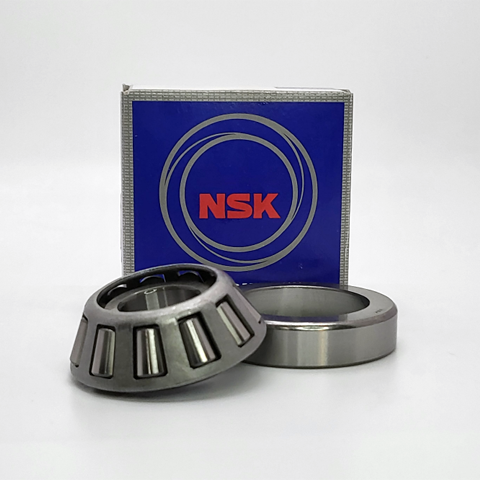
NSK NSK Tapered Roller Bearings, Single-Row Metric Design HR32208J ,D=40
NSK Tapered Roller Bearings, Single-Row Metric Design HR32208J ,D=40 Bearing Numbers Boundary Dimensions (mm) Basic Load Ratings (kN) Limiting Speeds (min-1) ISO355 Dimensions Series approx. Constant e Axial Load Factors Mass (kg) approx. d D T B C Cone r min. Cup r min. Cr C0r Grease Oil Y1 Y0 HR32208J 40 80 24.75 23 19 1.5 1.5 77 90.5 4800 6300 3DC 0.38 1.6 0.88 0.548 DESIGN, TYPES, AND FEATURES Tapered roller bearings are designed so the apices of the cones formed by the raceways of the inner and outer rings and the inner ring rollers all coincide at one point on the axis of the bearing. When a radial load is imposed, a component axial force occurs; therefore, it is necessary to use two bearings in opposition or some other multiple-bearing arrangement. For Metric Series medium-angle or steep-angle tapered roller bearings, the respective contact angle designation C or D is added after the bore number. For normal-angle tapered roller bearings, no contact angle designation is used. Medium-angle tapered roller bearings are primarily used for the pinion shafts of differential gears in automobiles. Some bearings with high load capacity (HR Series) contain a J suffix that indicates they conform to ISO specifications for outer ring back face raceway diameter, outer ring width, and contact angle. Therefore, the inner ring assembly and outer ring of bearings with a J suffix are internationally interchangeable. Some Metric Series tapered roller bearings specified by ISO 355 have different dimensions from past Series 3XX bearings. Some of these are listed in the bearing tables. These conform to ISO specifications for the small-end diameter of the inner ring and contact angle. The inner and outer ring assemblies are internationally interchangeable. The bearing designation structure, which has changed from the past, is listed below: Inch Series bearings also exist. Inner ring assemblies and outer rings are approximately formulated as follows (excluding four-row tapered roller bearings): Various arrangements of tapered roller bearings (excluding single-row bearings) are available. The cages of tapered roller bearings are usually made of pressed steel. Table 1 Design and Features of Tapered Roller Bearing Arrangements Design Arrangement Ex. Bearing Designation Features Back-to-back HR30210JDB+KLR10 Two standard bearings are combined. The bearing clearances are adjusted by inner ring spacers or outer ring spacers. The inner rings, outer rings, and spacers are marked with serial numbers and mating marks. Components with the same serial number can be assembled by referring to the matching indications. Face-to-face HR30210JDF+KR KBE Type 100KBE31+L The KBE type is a back-to-back arrangement of bearings with an integrated outer ring spacer. The KH type is a face-to-face arrangement in which the inner rings are integrated. Since the bearing clearance is adjusted using spacers, components must have the same serial number for assembly with reference to the matching indications. KH Type 110KH31+K
$33.94
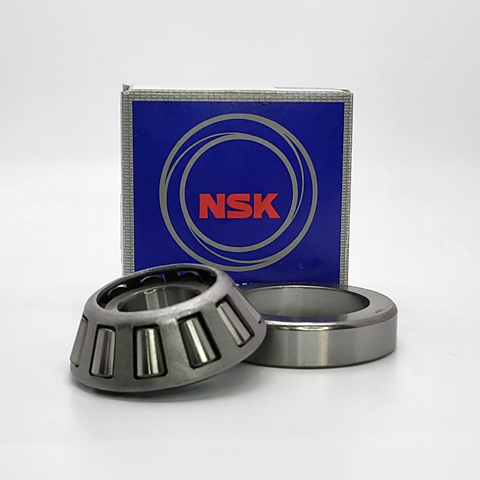
NSK NSK Tapered Roller Bearings, Single-Row Metric Design HR32209J ,D=45
NSK Tapered Roller Bearings, Single-Row Metric Design HR32209J ,D=45 Bearing Numbers Boundary Dimensions (mm) Basic Load Ratings (kN) Limiting Speeds (min-1) ISO355 Dimensions Series approx. Constant e Axial Load Factors Mass (kg) approx. d D T B C Cone r min. Cup r min. Cr C0r Grease Oil Y1 Y0 HR32209J 45 85 24.75 23 19 1.5 1.5 83 102 4300 6000 3DC 0.41 1.5 0.81 0.602 DESIGN, TYPES, AND FEATURES Tapered roller bearings are designed so the apices of the cones formed by the raceways of the inner and outer rings and the inner ring rollers all coincide at one point on the axis of the bearing. When a radial load is imposed, a component axial force occurs; therefore, it is necessary to use two bearings in opposition or some other multiple-bearing arrangement. For Metric Series medium-angle or steep-angle tapered roller bearings, the respective contact angle designation C or D is added after the bore number. For normal-angle tapered roller bearings, no contact angle designation is used. Medium-angle tapered roller bearings are primarily used for the pinion shafts of differential gears in automobiles. Some bearings with high load capacity (HR Series) contain a J suffix that indicates they conform to ISO specifications for outer ring back face raceway diameter, outer ring width, and contact angle. Therefore, the inner ring assembly and outer ring of bearings with a J suffix are internationally interchangeable. Some Metric Series tapered roller bearings specified by ISO 355 have different dimensions from past Series 3XX bearings. Some of these are listed in the bearing tables. These conform to ISO specifications for the small-end diameter of the inner ring and contact angle. The inner and outer ring assemblies are internationally interchangeable. The bearing designation structure, which has changed from the past, is listed below: Inch Series bearings also exist. Inner ring assemblies and outer rings are approximately formulated as follows (excluding four-row tapered roller bearings): Various arrangements of tapered roller bearings (excluding single-row bearings) are available. The cages of tapered roller bearings are usually made of pressed steel. Table 1 Design and Features of Tapered Roller Bearing Arrangements Design Arrangement Ex. Bearing Designation Features Back-to-back HR30210JDB+KLR10 Two standard bearings are combined. The bearing clearances are adjusted by inner ring spacers or outer ring spacers. The inner rings, outer rings, and spacers are marked with serial numbers and mating marks. Components with the same serial number can be assembled by referring to the matching indications. Face-to-face HR30210JDF+KR KBE Type 100KBE31+L The KBE type is a back-to-back arrangement of bearings with an integrated outer ring spacer. The KH type is a face-to-face arrangement in which the inner rings are integrated. Since the bearing clearance is adjusted using spacers, components must have the same serial number for assembly with reference to the matching indications. KH Type 110KH31+K
$37.99
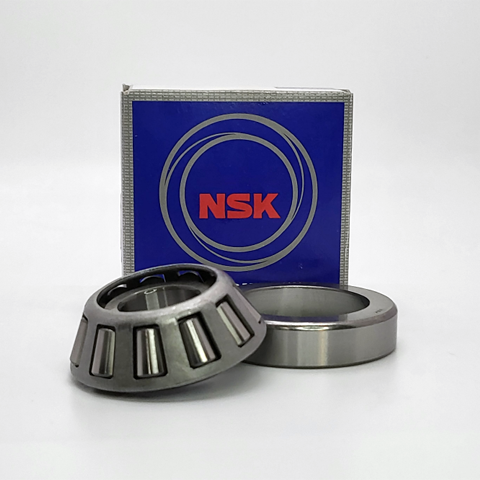
NSK NSK Tapered Roller Bearings, Single-Row Metric Design HR32210J ,D=50
NSK Tapered Roller Bearings, Single-Row Metric Design HR32210J ,D=50 Bearing Numbers Boundary Dimensions (mm) Basic Load Ratings (kN) Limiting Speeds (min-1) ISO355 Dimensions Series approx. Constant e Axial Load Factors Mass (kg) approx. d D T B C Cone r min. Cup r min. Cr C0r Grease Oil Y1 Y0 HR32210J 50 90 24.75 23 19 1.5 1.5 87.5 109 4000 5300 3DC 0.42 1.4 0.79 0.642 DESIGN, TYPES, AND FEATURES Tapered roller bearings are designed so the apices of the cones formed by the raceways of the inner and outer rings and the inner ring rollers all coincide at one point on the axis of the bearing. When a radial load is imposed, a component axial force occurs; therefore, it is necessary to use two bearings in opposition or some other multiple-bearing arrangement. For Metric Series medium-angle or steep-angle tapered roller bearings, the respective contact angle designation C or D is added after the bore number. For normal-angle tapered roller bearings, no contact angle designation is used. Medium-angle tapered roller bearings are primarily used for the pinion shafts of differential gears in automobiles. Some bearings with high load capacity (HR Series) contain a J suffix that indicates they conform to ISO specifications for outer ring back face raceway diameter, outer ring width, and contact angle. Therefore, the inner ring assembly and outer ring of bearings with a J suffix are internationally interchangeable. Some Metric Series tapered roller bearings specified by ISO 355 have different dimensions from past Series 3XX bearings. Some of these are listed in the bearing tables. These conform to ISO specifications for the small-end diameter of the inner ring and contact angle. The inner and outer ring assemblies are internationally interchangeable. The bearing designation structure, which has changed from the past, is listed below: Inch Series bearings also exist. Inner ring assemblies and outer rings are approximately formulated as follows (excluding four-row tapered roller bearings): Various arrangements of tapered roller bearings (excluding single-row bearings) are available. The cages of tapered roller bearings are usually made of pressed steel. Table 1 Design and Features of Tapered Roller Bearing Arrangements Design Arrangement Ex. Bearing Designation Features Back-to-back HR30210JDB+KLR10 Two standard bearings are combined. The bearing clearances are adjusted by inner ring spacers or outer ring spacers. The inner rings, outer rings, and spacers are marked with serial numbers and mating marks. Components with the same serial number can be assembled by referring to the matching indications. Face-to-face HR30210JDF+KR KBE Type 100KBE31+L The KBE type is a back-to-back arrangement of bearings with an integrated outer ring spacer. The KH type is a face-to-face arrangement in which the inner rings are integrated. Since the bearing clearance is adjusted using spacers, components must have the same serial number for assembly with reference to the matching indications. KH Type 110KH31+K
$41.94
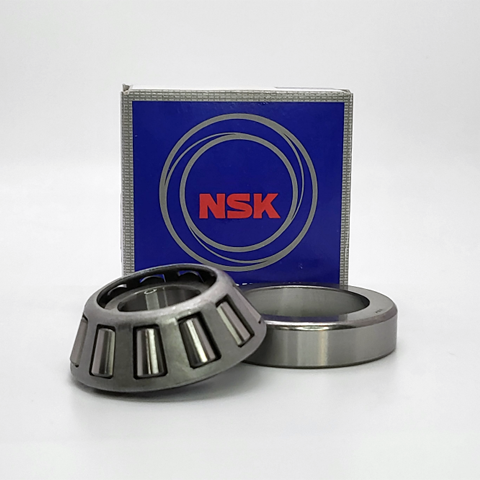
NSK NSK Tapered Roller Bearings, Single-Row Metric Design HR32211J ,D=55
NSK Tapered Roller Bearings, Single-Row Metric Design HR32211J ,D=55 Bearing Numbers Boundary Dimensions (mm) Basic Load Ratings (kN) Limiting Speeds (min-1) ISO355 Dimensions Series approx. Constant e Axial Load Factors Mass (kg) approx. d D T B C Cone r min. Cup r min. Cr C0r Grease Oil Y1 Y0 HR32211J 55 100 26.75 25 21 2 1.5 110 137 3600 5000 3DC 0.41 1.5 0.81 0.859 DESIGN, TYPES, AND FEATURES Tapered roller bearings are designed so the apices of the cones formed by the raceways of the inner and outer rings and the inner ring rollers all coincide at one point on the axis of the bearing. When a radial load is imposed, a component axial force occurs; therefore, it is necessary to use two bearings in opposition or some other multiple-bearing arrangement. For Metric Series medium-angle or steep-angle tapered roller bearings, the respective contact angle designation C or D is added after the bore number. For normal-angle tapered roller bearings, no contact angle designation is used. Medium-angle tapered roller bearings are primarily used for the pinion shafts of differential gears in automobiles. Some bearings with high load capacity (HR Series) contain a J suffix that indicates they conform to ISO specifications for outer ring back face raceway diameter, outer ring width, and contact angle. Therefore, the inner ring assembly and outer ring of bearings with a J suffix are internationally interchangeable. Some Metric Series tapered roller bearings specified by ISO 355 have different dimensions from past Series 3XX bearings. Some of these are listed in the bearing tables. These conform to ISO specifications for the small-end diameter of the inner ring and contact angle. The inner and outer ring assemblies are internationally interchangeable. The bearing designation structure, which has changed from the past, is listed below: Inch Series bearings also exist. Inner ring assemblies and outer rings are approximately formulated as follows (excluding four-row tapered roller bearings): Various arrangements of tapered roller bearings (excluding single-row bearings) are available. The cages of tapered roller bearings are usually made of pressed steel. Table 1 Design and Features of Tapered Roller Bearing Arrangements Design Arrangement Ex. Bearing Designation Features Back-to-back HR30210JDB+KLR10 Two standard bearings are combined. The bearing clearances are adjusted by inner ring spacers or outer ring spacers. The inner rings, outer rings, and spacers are marked with serial numbers and mating marks. Components with the same serial number can be assembled by referring to the matching indications. Face-to-face HR30210JDF+KR KBE Type 100KBE31+L The KBE type is a back-to-back arrangement of bearings with an integrated outer ring spacer. The KH type is a face-to-face arrangement in which the inner rings are integrated. Since the bearing clearance is adjusted using spacers, components must have the same serial number for assembly with reference to the matching indications. KH Type 110KH31+K
$54.20
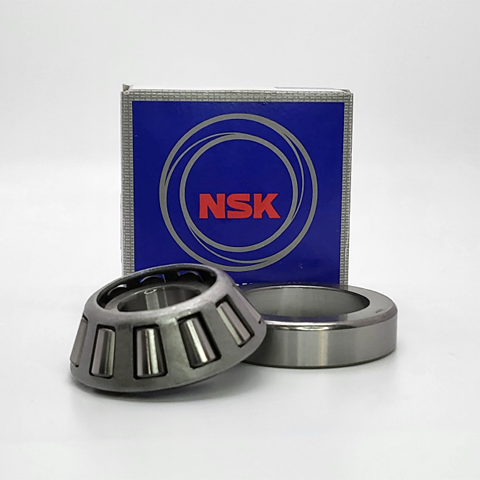
NSK NSK Tapered Roller Bearings, Single-Row Metric Design HR32212J ,D=60
NSK Tapered Roller Bearings, Single-Row Metric Design HR32212J ,D=60 Bearing Numbers Boundary Dimensions (mm) Basic Load Ratings (kN) Limiting Speeds (min-1) ISO355 Dimensions Series approx. Constant e Axial Load Factors Mass (kg) approx. d D T B C Cone r min. Cup r min. Cr C0r Grease Oil Y1 Y0 HR32212J 60 110 29.75 28 24 2 1.5 131 167 3400 4500 3EC 0.41 1.5 0.81 1.18 DESIGN, TYPES, AND FEATURES Tapered roller bearings are designed so the apices of the cones formed by the raceways of the inner and outer rings and the inner ring rollers all coincide at one point on the axis of the bearing. When a radial load is imposed, a component axial force occurs; therefore, it is necessary to use two bearings in opposition or some other multiple-bearing arrangement. For Metric Series medium-angle or steep-angle tapered roller bearings, the respective contact angle designation C or D is added after the bore number. For normal-angle tapered roller bearings, no contact angle designation is used. Medium-angle tapered roller bearings are primarily used for the pinion shafts of differential gears in automobiles. Some bearings with high load capacity (HR Series) contain a J suffix that indicates they conform to ISO specifications for outer ring back face raceway diameter, outer ring width, and contact angle. Therefore, the inner ring assembly and outer ring of bearings with a J suffix are internationally interchangeable. Some Metric Series tapered roller bearings specified by ISO 355 have different dimensions from past Series 3XX bearings. Some of these are listed in the bearing tables. These conform to ISO specifications for the small-end diameter of the inner ring and contact angle. The inner and outer ring assemblies are internationally interchangeable. The bearing designation structure, which has changed from the past, is listed below: Inch Series bearings also exist. Inner ring assemblies and outer rings are approximately formulated as follows (excluding four-row tapered roller bearings): Various arrangements of tapered roller bearings (excluding single-row bearings) are available. The cages of tapered roller bearings are usually made of pressed steel. Table 1 Design and Features of Tapered Roller Bearing Arrangements Design Arrangement Ex. Bearing Designation Features Back-to-back HR30210JDB+KLR10 Two standard bearings are combined. The bearing clearances are adjusted by inner ring spacers or outer ring spacers. The inner rings, outer rings, and spacers are marked with serial numbers and mating marks. Components with the same serial number can be assembled by referring to the matching indications. Face-to-face HR30210JDF+KR KBE Type 100KBE31+L The KBE type is a back-to-back arrangement of bearings with an integrated outer ring spacer. The KH type is a face-to-face arrangement in which the inner rings are integrated. Since the bearing clearance is adjusted using spacers, components must have the same serial number for assembly with reference to the matching indications. KH Type 110KH31+K
$64.72
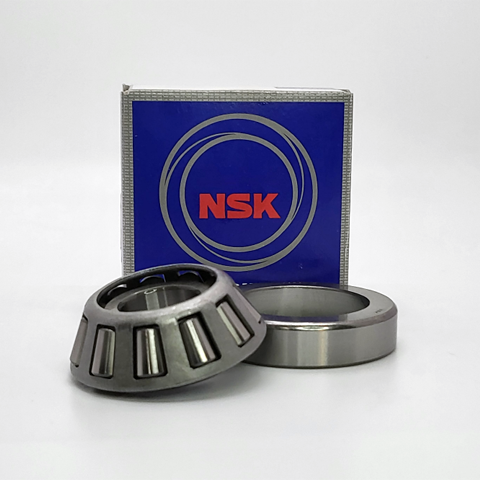
NSK NSK Tapered Roller Bearings, Single-Row Metric Design HR32213J ,D=65
NSK Tapered Roller Bearings, Single-Row Metric Design HR32213J ,D=65 Bearing Numbers Boundary Dimensions (mm) Basic Load Ratings (kN) Limiting Speeds (min-1) ISO355 Dimensions Series approx. Constant e Axial Load Factors Mass (kg) approx. d D T B C Cone r min. Cup r min. Cr C0r Grease Oil Y1 Y0 HR32213J 65 120 32.75 31 27 2 1.5 157 202 3000 4000 3EC 0.41 1.5 0.81 1.55 DESIGN, TYPES, AND FEATURES Tapered roller bearings are designed so the apices of the cones formed by the raceways of the inner and outer rings and the inner ring rollers all coincide at one point on the axis of the bearing. When a radial load is imposed, a component axial force occurs; therefore, it is necessary to use two bearings in opposition or some other multiple-bearing arrangement. For Metric Series medium-angle or steep-angle tapered roller bearings, the respective contact angle designation C or D is added after the bore number. For normal-angle tapered roller bearings, no contact angle designation is used. Medium-angle tapered roller bearings are primarily used for the pinion shafts of differential gears in automobiles. Some bearings with high load capacity (HR Series) contain a J suffix that indicates they conform to ISO specifications for outer ring back face raceway diameter, outer ring width, and contact angle. Therefore, the inner ring assembly and outer ring of bearings with a J suffix are internationally interchangeable. Some Metric Series tapered roller bearings specified by ISO 355 have different dimensions from past Series 3XX bearings. Some of these are listed in the bearing tables. These conform to ISO specifications for the small-end diameter of the inner ring and contact angle. The inner and outer ring assemblies are internationally interchangeable. The bearing designation structure, which has changed from the past, is listed below: Inch Series bearings also exist. Inner ring assemblies and outer rings are approximately formulated as follows (excluding four-row tapered roller bearings): Various arrangements of tapered roller bearings (excluding single-row bearings) are available. The cages of tapered roller bearings are usually made of pressed steel. Table 1 Design and Features of Tapered Roller Bearing Arrangements Design Arrangement Ex. Bearing Designation Features Back-to-back HR30210JDB+KLR10 Two standard bearings are combined. The bearing clearances are adjusted by inner ring spacers or outer ring spacers. The inner rings, outer rings, and spacers are marked with serial numbers and mating marks. Components with the same serial number can be assembled by referring to the matching indications. Face-to-face HR30210JDF+KR KBE Type 100KBE31+L The KBE type is a back-to-back arrangement of bearings with an integrated outer ring spacer. The KH type is a face-to-face arrangement in which the inner rings are integrated. Since the bearing clearance is adjusted using spacers, components must have the same serial number for assembly with reference to the matching indications. KH Type 110KH31+K
$79.49
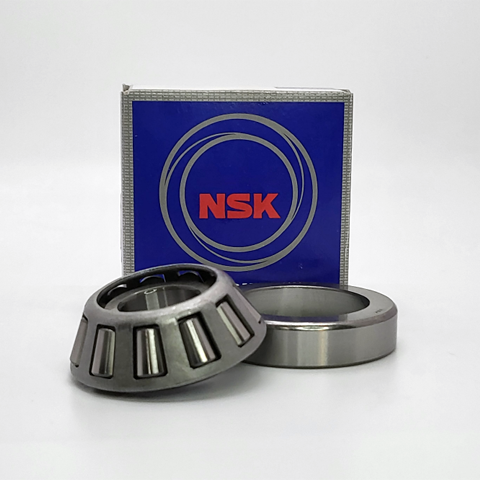
NSK NSK Tapered Roller Bearings, Single-Row Metric Design HR32214J ,D=70
NSK Tapered Roller Bearings, Single-Row Metric Design HR32214J ,D=70 Bearing Numbers Boundary Dimensions (mm) Basic Load Ratings (kN) Limiting Speeds (min-1) ISO355 Dimensions Series approx. Constant e Axial Load Factors Mass (kg) approx. d D T B C Cone r min. Cup r min. Cr C0r Grease Oil Y1 Y0 HR32214J 70 125 33.25 31 27 2 1.5 157 205 2800 4000 3EC 0.42 1.4 0.79 1.66 DESIGN, TYPES, AND FEATURES Tapered roller bearings are designed so the apices of the cones formed by the raceways of the inner and outer rings and the inner ring rollers all coincide at one point on the axis of the bearing. When a radial load is imposed, a component axial force occurs; therefore, it is necessary to use two bearings in opposition or some other multiple-bearing arrangement. For Metric Series medium-angle or steep-angle tapered roller bearings, the respective contact angle designation C or D is added after the bore number. For normal-angle tapered roller bearings, no contact angle designation is used. Medium-angle tapered roller bearings are primarily used for the pinion shafts of differential gears in automobiles. Some bearings with high load capacity (HR Series) contain a J suffix that indicates they conform to ISO specifications for outer ring back face raceway diameter, outer ring width, and contact angle. Therefore, the inner ring assembly and outer ring of bearings with a J suffix are internationally interchangeable. Some Metric Series tapered roller bearings specified by ISO 355 have different dimensions from past Series 3XX bearings. Some of these are listed in the bearing tables. These conform to ISO specifications for the small-end diameter of the inner ring and contact angle. The inner and outer ring assemblies are internationally interchangeable. The bearing designation structure, which has changed from the past, is listed below: Inch Series bearings also exist. Inner ring assemblies and outer rings are approximately formulated as follows (excluding four-row tapered roller bearings): Various arrangements of tapered roller bearings (excluding single-row bearings) are available. The cages of tapered roller bearings are usually made of pressed steel. Table 1 Design and Features of Tapered Roller Bearing Arrangements Design Arrangement Ex. Bearing Designation Features Back-to-back HR30210JDB+KLR10 Two standard bearings are combined. The bearing clearances are adjusted by inner ring spacers or outer ring spacers. The inner rings, outer rings, and spacers are marked with serial numbers and mating marks. Components with the same serial number can be assembled by referring to the matching indications. Face-to-face HR30210JDF+KR KBE Type 100KBE31+L The KBE type is a back-to-back arrangement of bearings with an integrated outer ring spacer. The KH type is a face-to-face arrangement in which the inner rings are integrated. Since the bearing clearance is adjusted using spacers, components must have the same serial number for assembly with reference to the matching indications. KH Type 110KH31+K
$94.74
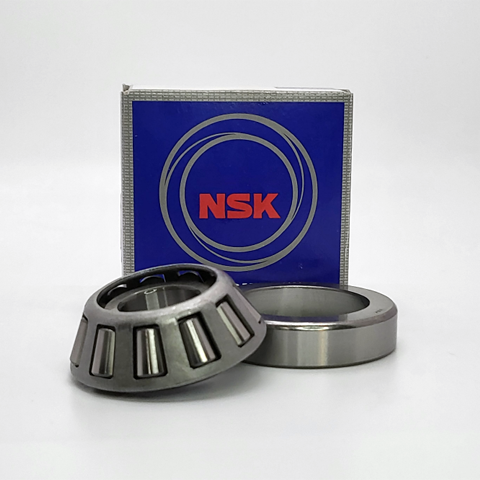
NSK NSK Tapered Roller Bearings, Single-Row Metric Design HR32215J ,D=75
NSK Tapered Roller Bearings, Single-Row Metric Design HR32215J ,D=75 Bearing Numbers Boundary Dimensions (mm) Basic Load Ratings (kN) Limiting Speeds (min-1) ISO355 Dimensions Series approx. Constant e Axial Load Factors Mass (kg) approx. d D T B C Cone r min. Cup r min. Cr C0r Grease Oil Y1 Y0 HR32215J 75 130 33.25 31 27 2 1.5 165 219 2800 3800 4DC 0.44 1.4 0.76 1.72 DESIGN, TYPES, AND FEATURES Tapered roller bearings are designed so the apices of the cones formed by the raceways of the inner and outer rings and the inner ring rollers all coincide at one point on the axis of the bearing. When a radial load is imposed, a component axial force occurs; therefore, it is necessary to use two bearings in opposition or some other multiple-bearing arrangement. For Metric Series medium-angle or steep-angle tapered roller bearings, the respective contact angle designation C or D is added after the bore number. For normal-angle tapered roller bearings, no contact angle designation is used. Medium-angle tapered roller bearings are primarily used for the pinion shafts of differential gears in automobiles. Some bearings with high load capacity (HR Series) contain a J suffix that indicates they conform to ISO specifications for outer ring back face raceway diameter, outer ring width, and contact angle. Therefore, the inner ring assembly and outer ring of bearings with a J suffix are internationally interchangeable. Some Metric Series tapered roller bearings specified by ISO 355 have different dimensions from past Series 3XX bearings. Some of these are listed in the bearing tables. These conform to ISO specifications for the small-end diameter of the inner ring and contact angle. The inner and outer ring assemblies are internationally interchangeable. The bearing designation structure, which has changed from the past, is listed below: Inch Series bearings also exist. Inner ring assemblies and outer rings are approximately formulated as follows (excluding four-row tapered roller bearings): Various arrangements of tapered roller bearings (excluding single-row bearings) are available. The cages of tapered roller bearings are usually made of pressed steel. Table 1 Design and Features of Tapered Roller Bearing Arrangements Design Arrangement Ex. Bearing Designation Features Back-to-back HR30210JDB+KLR10 Two standard bearings are combined. The bearing clearances are adjusted by inner ring spacers or outer ring spacers. The inner rings, outer rings, and spacers are marked with serial numbers and mating marks. Components with the same serial number can be assembled by referring to the matching indications. Face-to-face HR30210JDF+KR KBE Type 100KBE31+L The KBE type is a back-to-back arrangement of bearings with an integrated outer ring spacer. The KH type is a face-to-face arrangement in which the inner rings are integrated. Since the bearing clearance is adjusted using spacers, components must have the same serial number for assembly with reference to the matching indications. KH Type 110KH31+K
$81.01
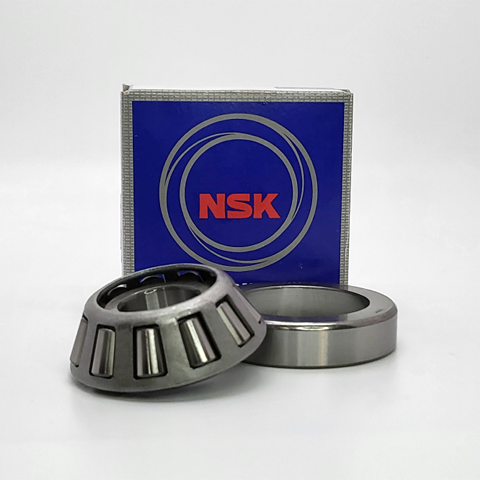
NSK NSK Tapered Roller Bearings, Single-Row Metric Design HR32216J ,D=80
NSK Tapered Roller Bearings, Single-Row Metric Design HR32216J ,D=80 Bearing Numbers Boundary Dimensions (mm) Basic Load Ratings (kN) Limiting Speeds (min-1) ISO355 Dimensions Series approx. Constant e Axial Load Factors Mass (kg) approx. d D T B C Cone r min. Cup r min. Cr C0r Grease Oil Y1 Y0 HR32216J 80 140 35.25 33 28 2.5 2 192 254 2600 3400 3EC 0.42 1.4 0.79 2.13 DESIGN, TYPES, AND FEATURES Tapered roller bearings are designed so the apices of the cones formed by the raceways of the inner and outer rings and the inner ring rollers all coincide at one point on the axis of the bearing. When a radial load is imposed, a component axial force occurs; therefore, it is necessary to use two bearings in opposition or some other multiple-bearing arrangement. For Metric Series medium-angle or steep-angle tapered roller bearings, the respective contact angle designation C or D is added after the bore number. For normal-angle tapered roller bearings, no contact angle designation is used. Medium-angle tapered roller bearings are primarily used for the pinion shafts of differential gears in automobiles. Some bearings with high load capacity (HR Series) contain a J suffix that indicates they conform to ISO specifications for outer ring back face raceway diameter, outer ring width, and contact angle. Therefore, the inner ring assembly and outer ring of bearings with a J suffix are internationally interchangeable. Some Metric Series tapered roller bearings specified by ISO 355 have different dimensions from past Series 3XX bearings. Some of these are listed in the bearing tables. These conform to ISO specifications for the small-end diameter of the inner ring and contact angle. The inner and outer ring assemblies are internationally interchangeable. The bearing designation structure, which has changed from the past, is listed below: Inch Series bearings also exist. Inner ring assemblies and outer rings are approximately formulated as follows (excluding four-row tapered roller bearings): Various arrangements of tapered roller bearings (excluding single-row bearings) are available. The cages of tapered roller bearings are usually made of pressed steel. Table 1 Design and Features of Tapered Roller Bearing Arrangements Design Arrangement Ex. Bearing Designation Features Back-to-back HR30210JDB+KLR10 Two standard bearings are combined. The bearing clearances are adjusted by inner ring spacers or outer ring spacers. The inner rings, outer rings, and spacers are marked with serial numbers and mating marks. Components with the same serial number can be assembled by referring to the matching indications. Face-to-face HR30210JDF+KR KBE Type 100KBE31+L The KBE type is a back-to-back arrangement of bearings with an integrated outer ring spacer. The KH type is a face-to-face arrangement in which the inner rings are integrated. Since the bearing clearance is adjusted using spacers, components must have the same serial number for assembly with reference to the matching indications. KH Type 110KH31+K
$94.22
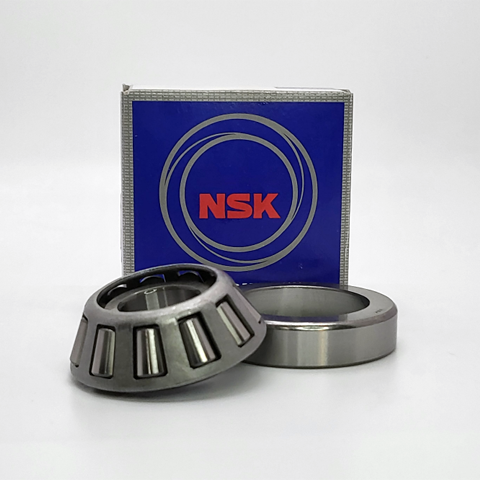
NSK NSK Tapered Roller Bearings, Single-Row Metric Design HR32217J ,D=85
NSK Tapered Roller Bearings, Single-Row Metric Design HR32217J ,D=85 Bearing Numbers Boundary Dimensions (mm) Basic Load Ratings (kN) Limiting Speeds (min-1) ISO355 Dimensions Series approx. Constant e Axial Load Factors Mass (kg) approx. d D T B C Cone r min. Cup r min. Cr C0r Grease Oil Y1 Y0 HR32217J 85 150 38.5 36 30 2.5 2 210 277 2200 3200 3EC 0.42 1.4 0.79 2.64 DESIGN, TYPES, AND FEATURES Tapered roller bearings are designed so the apices of the cones formed by the raceways of the inner and outer rings and the inner ring rollers all coincide at one point on the axis of the bearing. When a radial load is imposed, a component axial force occurs; therefore, it is necessary to use two bearings in opposition or some other multiple-bearing arrangement. For Metric Series medium-angle or steep-angle tapered roller bearings, the respective contact angle designation C or D is added after the bore number. For normal-angle tapered roller bearings, no contact angle designation is used. Medium-angle tapered roller bearings are primarily used for the pinion shafts of differential gears in automobiles. Some bearings with high load capacity (HR Series) contain a J suffix that indicates they conform to ISO specifications for outer ring back face raceway diameter, outer ring width, and contact angle. Therefore, the inner ring assembly and outer ring of bearings with a J suffix are internationally interchangeable. Some Metric Series tapered roller bearings specified by ISO 355 have different dimensions from past Series 3XX bearings. Some of these are listed in the bearing tables. These conform to ISO specifications for the small-end diameter of the inner ring and contact angle. The inner and outer ring assemblies are internationally interchangeable. The bearing designation structure, which has changed from the past, is listed below: Inch Series bearings also exist. Inner ring assemblies and outer rings are approximately formulated as follows (excluding four-row tapered roller bearings): Various arrangements of tapered roller bearings (excluding single-row bearings) are available. The cages of tapered roller bearings are usually made of pressed steel. Table 1 Design and Features of Tapered Roller Bearing Arrangements Design Arrangement Ex. Bearing Designation Features Back-to-back HR30210JDB+KLR10 Two standard bearings are combined. The bearing clearances are adjusted by inner ring spacers or outer ring spacers. The inner rings, outer rings, and spacers are marked with serial numbers and mating marks. Components with the same serial number can be assembled by referring to the matching indications. Face-to-face HR30210JDF+KR KBE Type 100KBE31+L The KBE type is a back-to-back arrangement of bearings with an integrated outer ring spacer. The KH type is a face-to-face arrangement in which the inner rings are integrated. Since the bearing clearance is adjusted using spacers, components must have the same serial number for assembly with reference to the matching indications. KH Type 110KH31+K
$118.02
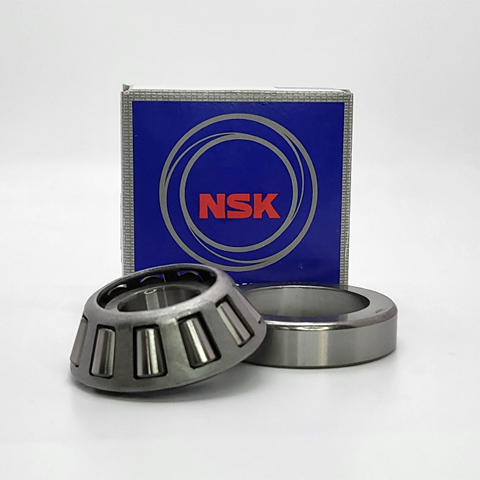
NSK NSK Tapered Roller Bearings, Single-Row Metric Design HR32218J ,D=90
NSK Tapered Roller Bearings, Single-Row Metric Design HR32218J ,D=90 Bearing Numbers Boundary Dimensions (mm) Basic Load Ratings (kN) Limiting Speeds (min-1) ISO355 Dimensions Series approx. Constant e Axial Load Factors Mass (kg) approx. d D T B C Cone r min. Cup r min. Cr C0r Grease Oil Y1 Y0 HR32218J 90 160 42.5 40 34 2.5 2 256 350 2200 3000 3FC 0.42 1.4 0.79 3.41 DESIGN, TYPES, AND FEATURES Tapered roller bearings are designed so the apices of the cones formed by the raceways of the inner and outer rings and the inner ring rollers all coincide at one point on the axis of the bearing. When a radial load is imposed, a component axial force occurs; therefore, it is necessary to use two bearings in opposition or some other multiple-bearing arrangement. For Metric Series medium-angle or steep-angle tapered roller bearings, the respective contact angle designation C or D is added after the bore number. For normal-angle tapered roller bearings, no contact angle designation is used. Medium-angle tapered roller bearings are primarily used for the pinion shafts of differential gears in automobiles. Some bearings with high load capacity (HR Series) contain a J suffix that indicates they conform to ISO specifications for outer ring back face raceway diameter, outer ring width, and contact angle. Therefore, the inner ring assembly and outer ring of bearings with a J suffix are internationally interchangeable. Some Metric Series tapered roller bearings specified by ISO 355 have different dimensions from past Series 3XX bearings. Some of these are listed in the bearing tables. These conform to ISO specifications for the small-end diameter of the inner ring and contact angle. The inner and outer ring assemblies are internationally interchangeable. The bearing designation structure, which has changed from the past, is listed below: Inch Series bearings also exist. Inner ring assemblies and outer rings are approximately formulated as follows (excluding four-row tapered roller bearings): Various arrangements of tapered roller bearings (excluding single-row bearings) are available. The cages of tapered roller bearings are usually made of pressed steel. Table 1 Design and Features of Tapered Roller Bearing Arrangements Design Arrangement Ex. Bearing Designation Features Back-to-back HR30210JDB+KLR10 Two standard bearings are combined. The bearing clearances are adjusted by inner ring spacers or outer ring spacers. The inner rings, outer rings, and spacers are marked with serial numbers and mating marks. Components with the same serial number can be assembled by referring to the matching indications. Face-to-face HR30210JDF+KR KBE Type 100KBE31+L The KBE type is a back-to-back arrangement of bearings with an integrated outer ring spacer. The KH type is a face-to-face arrangement in which the inner rings are integrated. Since the bearing clearance is adjusted using spacers, components must have the same serial number for assembly with reference to the matching indications. KH Type 110KH31+K
$150.64
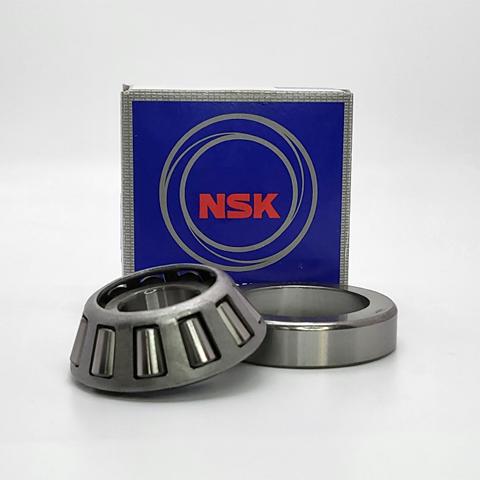
NSK NSK Tapered Roller Bearings, Single-Row Metric Design HR32219J ,D=95
NSK Tapered Roller Bearings, Single-Row Metric Design HR32219J ,D=95 Bearing Numbers Boundary Dimensions (mm) Basic Load Ratings (kN) Limiting Speeds (min-1) ISO355 Dimensions Series approx. Constant e Axial Load Factors Mass (kg) approx. d D T B C Cone r min. Cup r min. Cr C0r Grease Oil Y1 Y0 HR32219J 95 170 45.5 43 37 3 2.5 289 400 2200 2800 3FC 0.42 1.4 0.79 4.22 DESIGN, TYPES, AND FEATURES Tapered roller bearings are designed so the apices of the cones formed by the raceways of the inner and outer rings and the inner ring rollers all coincide at one point on the axis of the bearing. When a radial load is imposed, a component axial force occurs; therefore, it is necessary to use two bearings in opposition or some other multiple-bearing arrangement. For Metric Series medium-angle or steep-angle tapered roller bearings, the respective contact angle designation C or D is added after the bore number. For normal-angle tapered roller bearings, no contact angle designation is used. Medium-angle tapered roller bearings are primarily used for the pinion shafts of differential gears in automobiles. Some bearings with high load capacity (HR Series) contain a J suffix that indicates they conform to ISO specifications for outer ring back face raceway diameter, outer ring width, and contact angle. Therefore, the inner ring assembly and outer ring of bearings with a J suffix are internationally interchangeable. Some Metric Series tapered roller bearings specified by ISO 355 have different dimensions from past Series 3XX bearings. Some of these are listed in the bearing tables. These conform to ISO specifications for the small-end diameter of the inner ring and contact angle. The inner and outer ring assemblies are internationally interchangeable. The bearing designation structure, which has changed from the past, is listed below: Inch Series bearings also exist. Inner ring assemblies and outer rings are approximately formulated as follows (excluding four-row tapered roller bearings): Various arrangements of tapered roller bearings (excluding single-row bearings) are available. The cages of tapered roller bearings are usually made of pressed steel. Table 1 Design and Features of Tapered Roller Bearing Arrangements Design Arrangement Ex. Bearing Designation Features Back-to-back HR30210JDB+KLR10 Two standard bearings are combined. The bearing clearances are adjusted by inner ring spacers or outer ring spacers. The inner rings, outer rings, and spacers are marked with serial numbers and mating marks. Components with the same serial number can be assembled by referring to the matching indications. Face-to-face HR30210JDF+KR KBE Type 100KBE31+L The KBE type is a back-to-back arrangement of bearings with an integrated outer ring spacer. The KH type is a face-to-face arrangement in which the inner rings are integrated. Since the bearing clearance is adjusted using spacers, components must have the same serial number for assembly with reference to the matching indications. KH Type 110KH31+K
$187.09
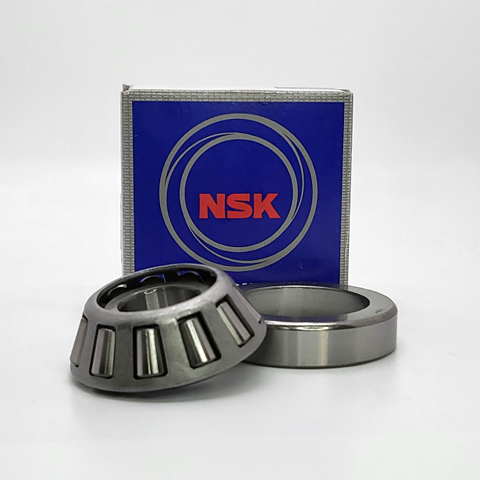
NSK NSK Tapered Roller Bearings, Single-Row Metric Design HR32220J ,D=100
NSK Tapered Roller Bearings, Single-Row Metric Design HR32220J ,D=100 Bearing Numbers Boundary Dimensions (mm) Basic Load Ratings (kN) Limiting Speeds (min-1) ISO355 Dimensions Series approx. Constant e Axial Load Factors Mass (kg) approx. d D T B C Cone r min. Cup r min. Cr C0r Grease Oil Y1 Y0 HR32220J 100 180 49 46 39 3 2.5 325 450 2000 2600 3FC 0.42 1.4 0.79 5.05 DESIGN, TYPES, AND FEATURES Tapered roller bearings are designed so the apices of the cones formed by the raceways of the inner and outer rings and the inner ring rollers all coincide at one point on the axis of the bearing. When a radial load is imposed, a component axial force occurs; therefore, it is necessary to use two bearings in opposition or some other multiple-bearing arrangement. For Metric Series medium-angle or steep-angle tapered roller bearings, the respective contact angle designation C or D is added after the bore number. For normal-angle tapered roller bearings, no contact angle designation is used. Medium-angle tapered roller bearings are primarily used for the pinion shafts of differential gears in automobiles. Some bearings with high load capacity (HR Series) contain a J suffix that indicates they conform to ISO specifications for outer ring back face raceway diameter, outer ring width, and contact angle. Therefore, the inner ring assembly and outer ring of bearings with a J suffix are internationally interchangeable. Some Metric Series tapered roller bearings specified by ISO 355 have different dimensions from past Series 3XX bearings. Some of these are listed in the bearing tables. These conform to ISO specifications for the small-end diameter of the inner ring and contact angle. The inner and outer ring assemblies are internationally interchangeable. The bearing designation structure, which has changed from the past, is listed below: Inch Series bearings also exist. Inner ring assemblies and outer rings are approximately formulated as follows (excluding four-row tapered roller bearings): Various arrangements of tapered roller bearings (excluding single-row bearings) are available. The cages of tapered roller bearings are usually made of pressed steel. Table 1 Design and Features of Tapered Roller Bearing Arrangements Design Arrangement Ex. Bearing Designation Features Back-to-back HR30210JDB+KLR10 Two standard bearings are combined. The bearing clearances are adjusted by inner ring spacers or outer ring spacers. The inner rings, outer rings, and spacers are marked with serial numbers and mating marks. Components with the same serial number can be assembled by referring to the matching indications. Face-to-face HR30210JDF+KR KBE Type 100KBE31+L The KBE type is a back-to-back arrangement of bearings with an integrated outer ring spacer. The KH type is a face-to-face arrangement in which the inner rings are integrated. Since the bearing clearance is adjusted using spacers, components must have the same serial number for assembly with reference to the matching indications. KH Type 110KH31+K
$235.77
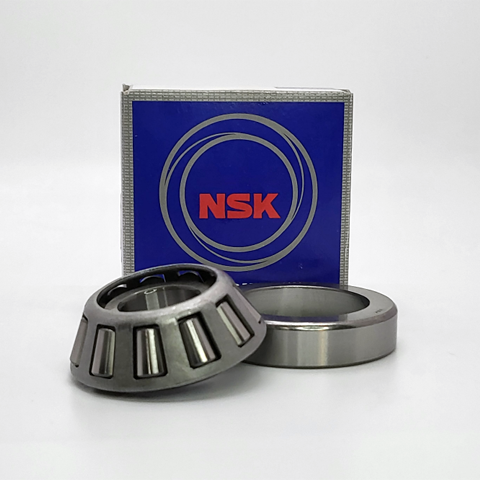
NSK NSK Tapered Roller Bearings, Single-Row Metric Design HR32221J ,D=105
NSK Tapered Roller Bearings, Single-Row Metric Design HR32221J ,D=105 Bearing Numbers Boundary Dimensions (mm) Basic Load Ratings (kN) Limiting Speeds (min-1) ISO355 Dimensions Series approx. Constant e Axial Load Factors Mass (kg) approx. d D T B C Cone r min. Cup r min. Cr C0r Grease Oil Y1 Y0 HR32221J 105 190 53 50 43 3 2.5 360 510 1900 2600 3FC 0.42 1.4 0.79 6.25 DESIGN, TYPES, AND FEATURES Tapered roller bearings are designed so the apices of the cones formed by the raceways of the inner and outer rings and the inner ring rollers all coincide at one point on the axis of the bearing. When a radial load is imposed, a component axial force occurs; therefore, it is necessary to use two bearings in opposition or some other multiple-bearing arrangement. For Metric Series medium-angle or steep-angle tapered roller bearings, the respective contact angle designation C or D is added after the bore number. For normal-angle tapered roller bearings, no contact angle designation is used. Medium-angle tapered roller bearings are primarily used for the pinion shafts of differential gears in automobiles. Some bearings with high load capacity (HR Series) contain a J suffix that indicates they conform to ISO specifications for outer ring back face raceway diameter, outer ring width, and contact angle. Therefore, the inner ring assembly and outer ring of bearings with a J suffix are internationally interchangeable. Some Metric Series tapered roller bearings specified by ISO 355 have different dimensions from past Series 3XX bearings. Some of these are listed in the bearing tables. These conform to ISO specifications for the small-end diameter of the inner ring and contact angle. The inner and outer ring assemblies are internationally interchangeable. The bearing designation structure, which has changed from the past, is listed below: Inch Series bearings also exist. Inner ring assemblies and outer rings are approximately formulated as follows (excluding four-row tapered roller bearings): Various arrangements of tapered roller bearings (excluding single-row bearings) are available. The cages of tapered roller bearings are usually made of pressed steel. Table 1 Design and Features of Tapered Roller Bearing Arrangements Design Arrangement Ex. Bearing Designation Features Back-to-back HR30210JDB+KLR10 Two standard bearings are combined. The bearing clearances are adjusted by inner ring spacers or outer ring spacers. The inner rings, outer rings, and spacers are marked with serial numbers and mating marks. Components with the same serial number can be assembled by referring to the matching indications. Face-to-face HR30210JDF+KR KBE Type 100KBE31+L The KBE type is a back-to-back arrangement of bearings with an integrated outer ring spacer. The KH type is a face-to-face arrangement in which the inner rings are integrated. Since the bearing clearance is adjusted using spacers, components must have the same serial number for assembly with reference to the matching indications. KH Type 110KH31+K
$355.54
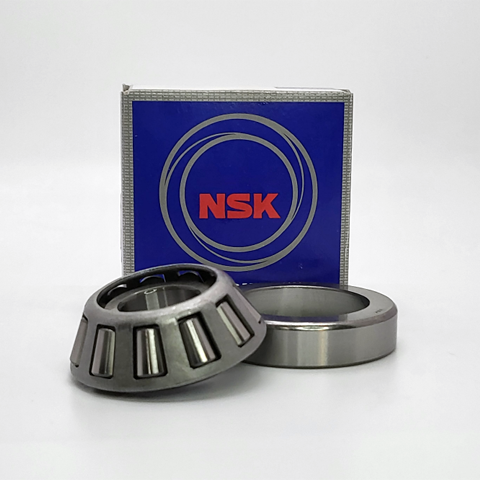
NSK NSK Tapered Roller Bearings, Single-Row Metric Design HR32222J ,D=110
NSK Tapered Roller Bearings, Single-Row Metric Design HR32222J ,D=110 Bearing Numbers Boundary Dimensions (mm) Basic Load Ratings (kN) Limiting Speeds (min-1) ISO355 Dimensions Series approx. Constant e Axial Load Factors Mass (kg) approx. d D T B C Cone r min. Cup r min. Cr C0r Grease Oil Y1 Y0 HR32222J 110 200 56 53 46 3 2.5 400 565 1800 2400 3FC 0.42 1.4 0.79 7.35 DESIGN, TYPES, AND FEATURES Tapered roller bearings are designed so the apices of the cones formed by the raceways of the inner and outer rings and the inner ring rollers all coincide at one point on the axis of the bearing. When a radial load is imposed, a component axial force occurs; therefore, it is necessary to use two bearings in opposition or some other multiple-bearing arrangement. For Metric Series medium-angle or steep-angle tapered roller bearings, the respective contact angle designation C or D is added after the bore number. For normal-angle tapered roller bearings, no contact angle designation is used. Medium-angle tapered roller bearings are primarily used for the pinion shafts of differential gears in automobiles. Some bearings with high load capacity (HR Series) contain a J suffix that indicates they conform to ISO specifications for outer ring back face raceway diameter, outer ring width, and contact angle. Therefore, the inner ring assembly and outer ring of bearings with a J suffix are internationally interchangeable. Some Metric Series tapered roller bearings specified by ISO 355 have different dimensions from past Series 3XX bearings. Some of these are listed in the bearing tables. These conform to ISO specifications for the small-end diameter of the inner ring and contact angle. The inner and outer ring assemblies are internationally interchangeable. The bearing designation structure, which has changed from the past, is listed below: Inch Series bearings also exist. Inner ring assemblies and outer rings are approximately formulated as follows (excluding four-row tapered roller bearings): Various arrangements of tapered roller bearings (excluding single-row bearings) are available. The cages of tapered roller bearings are usually made of pressed steel. Table 1 Design and Features of Tapered Roller Bearing Arrangements Design Arrangement Ex. Bearing Designation Features Back-to-back HR30210JDB+KLR10 Two standard bearings are combined. The bearing clearances are adjusted by inner ring spacers or outer ring spacers. The inner rings, outer rings, and spacers are marked with serial numbers and mating marks. Components with the same serial number can be assembled by referring to the matching indications. Face-to-face HR30210JDF+KR KBE Type 100KBE31+L The KBE type is a back-to-back arrangement of bearings with an integrated outer ring spacer. The KH type is a face-to-face arrangement in which the inner rings are integrated. Since the bearing clearance is adjusted using spacers, components must have the same serial number for assembly with reference to the matching indications. KH Type 110KH31+K
$417.24
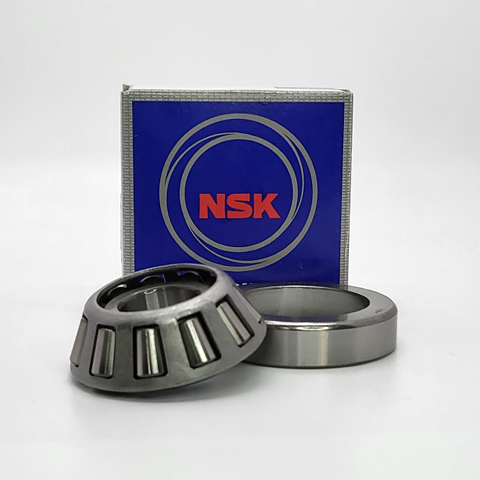
NSK NSK Tapered Roller Bearings, Single-Row Metric Design HR32224J ,D=120
NSK Tapered Roller Bearings, Single-Row Metric Design HR32224J ,D=120 Bearing Numbers Boundary Dimensions (mm) Basic Load Ratings (kN) Limiting Speeds (min-1) ISO355 Dimensions Series approx. Constant e Axial Load Factors Mass (kg) approx. d D T B C Cone r min. Cup r min. Cr C0r Grease Oil Y1 Y0 HR32224J 120 215 61.5 58 50 3 2.5 440 635 1600 2200 4FD 0.44 1.4 0.76 9 DESIGN, TYPES, AND FEATURES Tapered roller bearings are designed so the apices of the cones formed by the raceways of the inner and outer rings and the inner ring rollers all coincide at one point on the axis of the bearing. When a radial load is imposed, a component axial force occurs; therefore, it is necessary to use two bearings in opposition or some other multiple-bearing arrangement. For Metric Series medium-angle or steep-angle tapered roller bearings, the respective contact angle designation C or D is added after the bore number. For normal-angle tapered roller bearings, no contact angle designation is used. Medium-angle tapered roller bearings are primarily used for the pinion shafts of differential gears in automobiles. Some bearings with high load capacity (HR Series) contain a J suffix that indicates they conform to ISO specifications for outer ring back face raceway diameter, outer ring width, and contact angle. Therefore, the inner ring assembly and outer ring of bearings with a J suffix are internationally interchangeable. Some Metric Series tapered roller bearings specified by ISO 355 have different dimensions from past Series 3XX bearings. Some of these are listed in the bearing tables. These conform to ISO specifications for the small-end diameter of the inner ring and contact angle. The inner and outer ring assemblies are internationally interchangeable. The bearing designation structure, which has changed from the past, is listed below: Inch Series bearings also exist. Inner ring assemblies and outer rings are approximately formulated as follows (excluding four-row tapered roller bearings): Various arrangements of tapered roller bearings (excluding single-row bearings) are available. The cages of tapered roller bearings are usually made of pressed steel. Table 1 Design and Features of Tapered Roller Bearing Arrangements Design Arrangement Ex. Bearing Designation Features Back-to-back HR30210JDB+KLR10 Two standard bearings are combined. The bearing clearances are adjusted by inner ring spacers or outer ring spacers. The inner rings, outer rings, and spacers are marked with serial numbers and mating marks. Components with the same serial number can be assembled by referring to the matching indications. Face-to-face HR30210JDF+KR KBE Type 100KBE31+L The KBE type is a back-to-back arrangement of bearings with an integrated outer ring spacer. The KH type is a face-to-face arrangement in which the inner rings are integrated. Since the bearing clearance is adjusted using spacers, components must have the same serial number for assembly with reference to the matching indications. KH Type 110KH31+K
$629.23
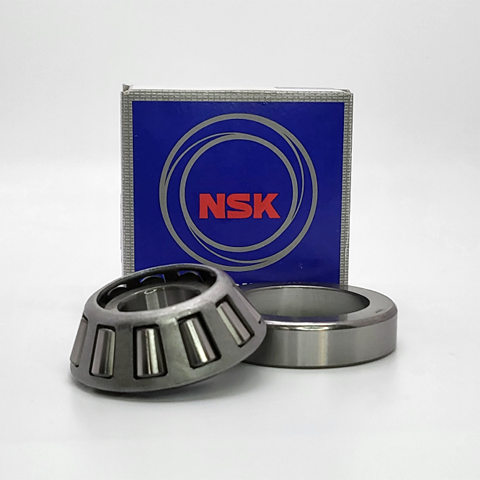
NSK NSK Tapered Roller Bearings, Single-Row Metric Design HR32226J ,D=130
NSK Tapered Roller Bearings, Single-Row Metric Design HR32226J ,D=130 Bearing Numbers Boundary Dimensions (mm) Basic Load Ratings (kN) Limiting Speeds (min-1) ISO355 Dimensions Series approx. Constant e Axial Load Factors Mass (kg) approx. d D T B C Cone r min. Cup r min. Cr C0r Grease Oil Y1 Y0 HR32226J 130 230 67.75 64 54 4 3 530 790 1500 2000 4FD 0.44 1.4 0.76 11.3 DESIGN, TYPES, AND FEATURES Tapered roller bearings are designed so the apices of the cones formed by the raceways of the inner and outer rings and the inner ring rollers all coincide at one point on the axis of the bearing. When a radial load is imposed, a component axial force occurs; therefore, it is necessary to use two bearings in opposition or some other multiple-bearing arrangement. For Metric Series medium-angle or steep-angle tapered roller bearings, the respective contact angle designation C or D is added after the bore number. For normal-angle tapered roller bearings, no contact angle designation is used. Medium-angle tapered roller bearings are primarily used for the pinion shafts of differential gears in automobiles. Some bearings with high load capacity (HR Series) contain a J suffix that indicates they conform to ISO specifications for outer ring back face raceway diameter, outer ring width, and contact angle. Therefore, the inner ring assembly and outer ring of bearings with a J suffix are internationally interchangeable. Some Metric Series tapered roller bearings specified by ISO 355 have different dimensions from past Series 3XX bearings. Some of these are listed in the bearing tables. These conform to ISO specifications for the small-end diameter of the inner ring and contact angle. The inner and outer ring assemblies are internationally interchangeable. The bearing designation structure, which has changed from the past, is listed below: Inch Series bearings also exist. Inner ring assemblies and outer rings are approximately formulated as follows (excluding four-row tapered roller bearings): Various arrangements of tapered roller bearings (excluding single-row bearings) are available. The cages of tapered roller bearings are usually made of pressed steel. Table 1 Design and Features of Tapered Roller Bearing Arrangements Design Arrangement Ex. Bearing Designation Features Back-to-back HR30210JDB+KLR10 Two standard bearings are combined. The bearing clearances are adjusted by inner ring spacers or outer ring spacers. The inner rings, outer rings, and spacers are marked with serial numbers and mating marks. Components with the same serial number can be assembled by referring to the matching indications. Face-to-face HR30210JDF+KR KBE Type 100KBE31+L The KBE type is a back-to-back arrangement of bearings with an integrated outer ring spacer. The KH type is a face-to-face arrangement in which the inner rings are integrated. Since the bearing clearance is adjusted using spacers, components must have the same serial number for assembly with reference to the matching indications. KH Type 110KH31+K
$909.82
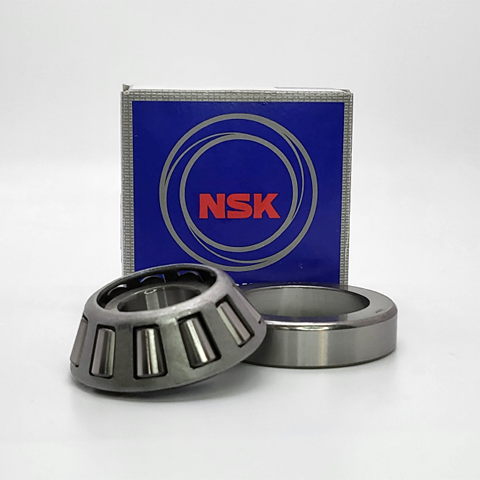
NSK NSK Tapered Roller Bearings, Single-Row Metric Design HR32228J ,D=140
NSK Tapered Roller Bearings, Single-Row Metric Design HR32228J ,D=140 Bearing Numbers Boundary Dimensions (mm) Basic Load Ratings (kN) Limiting Speeds (min-1) ISO355 Dimensions Series approx. Constant e Axial Load Factors Mass (kg) approx. d D T B C Cone r min. Cup r min. Cr C0r Grease Oil Y1 Y0 HR32228J 140 250 71.75 68 58 4 3 610 915 1400 1900 4FD 0.44 1.4 0.76 14.3 DESIGN, TYPES, AND FEATURES Tapered roller bearings are designed so the apices of the cones formed by the raceways of the inner and outer rings and the inner ring rollers all coincide at one point on the axis of the bearing. When a radial load is imposed, a component axial force occurs; therefore, it is necessary to use two bearings in opposition or some other multiple-bearing arrangement. For Metric Series medium-angle or steep-angle tapered roller bearings, the respective contact angle designation C or D is added after the bore number. For normal-angle tapered roller bearings, no contact angle designation is used. Medium-angle tapered roller bearings are primarily used for the pinion shafts of differential gears in automobiles. Some bearings with high load capacity (HR Series) contain a J suffix that indicates they conform to ISO specifications for outer ring back face raceway diameter, outer ring width, and contact angle. Therefore, the inner ring assembly and outer ring of bearings with a J suffix are internationally interchangeable. Some Metric Series tapered roller bearings specified by ISO 355 have different dimensions from past Series 3XX bearings. Some of these are listed in the bearing tables. These conform to ISO specifications for the small-end diameter of the inner ring and contact angle. The inner and outer ring assemblies are internationally interchangeable. The bearing designation structure, which has changed from the past, is listed below: Inch Series bearings also exist. Inner ring assemblies and outer rings are approximately formulated as follows (excluding four-row tapered roller bearings): Various arrangements of tapered roller bearings (excluding single-row bearings) are available. The cages of tapered roller bearings are usually made of pressed steel. Table 1 Design and Features of Tapered Roller Bearing Arrangements Design Arrangement Ex. Bearing Designation Features Back-to-back HR30210JDB+KLR10 Two standard bearings are combined. The bearing clearances are adjusted by inner ring spacers or outer ring spacers. The inner rings, outer rings, and spacers are marked with serial numbers and mating marks. Components with the same serial number can be assembled by referring to the matching indications. Face-to-face HR30210JDF+KR KBE Type 100KBE31+L The KBE type is a back-to-back arrangement of bearings with an integrated outer ring spacer. The KH type is a face-to-face arrangement in which the inner rings are integrated. Since the bearing clearance is adjusted using spacers, components must have the same serial number for assembly with reference to the matching indications. KH Type 110KH31+K
$1,089.58
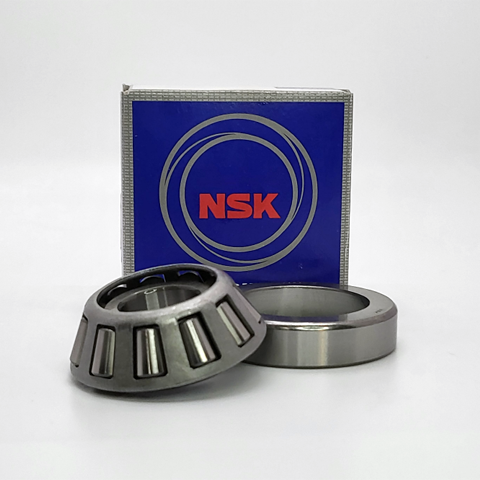
NSK NSK Tapered Roller Bearings, Single-Row Metric Design HR32230J ,D=150
NSK Tapered Roller Bearings, Single-Row Metric Design HR32230J ,D=150 Bearing Numbers Boundary Dimensions (mm) Basic Load Ratings (kN) Limiting Speeds (min-1) ISO355 Dimensions Series approx. Constant e Axial Load Factors Mass (kg) approx. d D T B C Cone r min. Cup r min. Cr C0r Grease Oil Y1 Y0 HR32230J 150 270 77 73 60 4 3 705 1080 1300 1800 4GD 0.44 1.4 0.76 17.8 DESIGN, TYPES, AND FEATURES Tapered roller bearings are designed so the apices of the cones formed by the raceways of the inner and outer rings and the inner ring rollers all coincide at one point on the axis of the bearing. When a radial load is imposed, a component axial force occurs; therefore, it is necessary to use two bearings in opposition or some other multiple-bearing arrangement. For Metric Series medium-angle or steep-angle tapered roller bearings, the respective contact angle designation C or D is added after the bore number. For normal-angle tapered roller bearings, no contact angle designation is used. Medium-angle tapered roller bearings are primarily used for the pinion shafts of differential gears in automobiles. Some bearings with high load capacity (HR Series) contain a J suffix that indicates they conform to ISO specifications for outer ring back face raceway diameter, outer ring width, and contact angle. Therefore, the inner ring assembly and outer ring of bearings with a J suffix are internationally interchangeable. Some Metric Series tapered roller bearings specified by ISO 355 have different dimensions from past Series 3XX bearings. Some of these are listed in the bearing tables. These conform to ISO specifications for the small-end diameter of the inner ring and contact angle. The inner and outer ring assemblies are internationally interchangeable. The bearing designation structure, which has changed from the past, is listed below: Inch Series bearings also exist. Inner ring assemblies and outer rings are approximately formulated as follows (excluding four-row tapered roller bearings): Various arrangements of tapered roller bearings (excluding single-row bearings) are available. The cages of tapered roller bearings are usually made of pressed steel. Table 1 Design and Features of Tapered Roller Bearing Arrangements Design Arrangement Ex. Bearing Designation Features Back-to-back HR30210JDB+KLR10 Two standard bearings are combined. The bearing clearances are adjusted by inner ring spacers or outer ring spacers. The inner rings, outer rings, and spacers are marked with serial numbers and mating marks. Components with the same serial number can be assembled by referring to the matching indications. Face-to-face HR30210JDF+KR KBE Type 100KBE31+L The KBE type is a back-to-back arrangement of bearings with an integrated outer ring spacer. The KH type is a face-to-face arrangement in which the inner rings are integrated. Since the bearing clearance is adjusted using spacers, components must have the same serial number for assembly with reference to the matching indications. KH Type 110KH31+K
$1,387.56
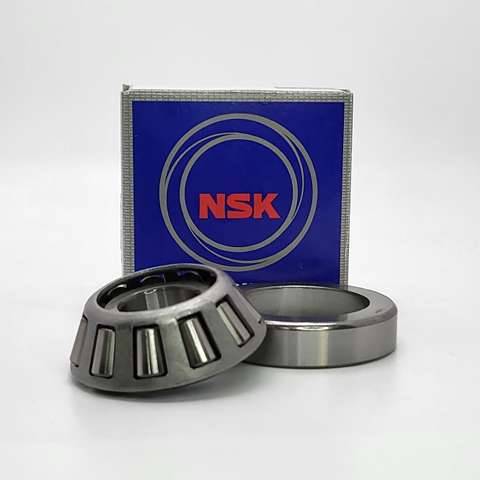
NSK NSK Tapered Roller Bearings, Single-Row Metric Design HR32232J ,D=160
NSK Tapered Roller Bearings, Single-Row Metric Design HR32232J ,D=160 Bearing Numbers Boundary Dimensions (mm) Basic Load Ratings (kN) Limiting Speeds (min-1) ISO355 Dimensions Series approx. Constant e Axial Load Factors Mass (kg) approx. d D T B C Cone r min. Cup r min. Cr C0r Grease Oil Y1 Y0 HR32232J 160 290 84 80 67 4 3 795 1120 1200 1600 4GD 0.44 1.4 0.76 22.7 DESIGN, TYPES, AND FEATURES Tapered roller bearings are designed so the apices of the cones formed by the raceways of the inner and outer rings and the inner ring rollers all coincide at one point on the axis of the bearing. When a radial load is imposed, a component axial force occurs; therefore, it is necessary to use two bearings in opposition or some other multiple-bearing arrangement. For Metric Series medium-angle or steep-angle tapered roller bearings, the respective contact angle designation C or D is added after the bore number. For normal-angle tapered roller bearings, no contact angle designation is used. Medium-angle tapered roller bearings are primarily used for the pinion shafts of differential gears in automobiles. Some bearings with high load capacity (HR Series) contain a J suffix that indicates they conform to ISO specifications for outer ring back face raceway diameter, outer ring width, and contact angle. Therefore, the inner ring assembly and outer ring of bearings with a J suffix are internationally interchangeable. Some Metric Series tapered roller bearings specified by ISO 355 have different dimensions from past Series 3XX bearings. Some of these are listed in the bearing tables. These conform to ISO specifications for the small-end diameter of the inner ring and contact angle. The inner and outer ring assemblies are internationally interchangeable. The bearing designation structure, which has changed from the past, is listed below: Inch Series bearings also exist. Inner ring assemblies and outer rings are approximately formulated as follows (excluding four-row tapered roller bearings): Various arrangements of tapered roller bearings (excluding single-row bearings) are available. The cages of tapered roller bearings are usually made of pressed steel. Table 1 Design and Features of Tapered Roller Bearing Arrangements Design Arrangement Ex. Bearing Designation Features Back-to-back HR30210JDB+KLR10 Two standard bearings are combined. The bearing clearances are adjusted by inner ring spacers or outer ring spacers. The inner rings, outer rings, and spacers are marked with serial numbers and mating marks. Components with the same serial number can be assembled by referring to the matching indications. Face-to-face HR30210JDF+KR KBE Type 100KBE31+L The KBE type is a back-to-back arrangement of bearings with an integrated outer ring spacer. The KH type is a face-to-face arrangement in which the inner rings are integrated. Since the bearing clearance is adjusted using spacers, components must have the same serial number for assembly with reference to the matching indications. KH Type 110KH31+K
$1,402.82
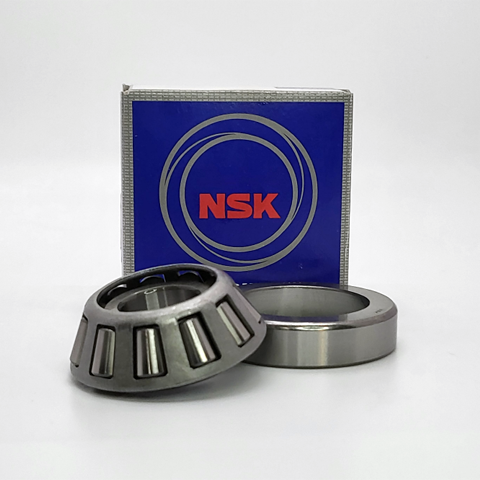
NSK NSK Tapered Roller Bearings, Single-Row Metric Design HR32234J ,D=170
NSK Tapered Roller Bearings, Single-Row Metric Design HR32234J ,D=170 Bearing Numbers Boundary Dimensions (mm) Basic Load Ratings (kN) Limiting Speeds (min-1) ISO355 Dimensions Series approx. Constant e Axial Load Factors Mass (kg) approx. d D T B C Cone r min. Cup r min. Cr C0r Grease Oil Y1 Y0 HR32234J 170 310 91 86 71 5 4 930 1450 1100 1500 4GD 0.44 1.4 0.76 28 DESIGN, TYPES, AND FEATURES Tapered roller bearings are designed so the apices of the cones formed by the raceways of the inner and outer rings and the inner ring rollers all coincide at one point on the axis of the bearing. When a radial load is imposed, a component axial force occurs; therefore, it is necessary to use two bearings in opposition or some other multiple-bearing arrangement. For Metric Series medium-angle or steep-angle tapered roller bearings, the respective contact angle designation C or D is added after the bore number. For normal-angle tapered roller bearings, no contact angle designation is used. Medium-angle tapered roller bearings are primarily used for the pinion shafts of differential gears in automobiles. Some bearings with high load capacity (HR Series) contain a J suffix that indicates they conform to ISO specifications for outer ring back face raceway diameter, outer ring width, and contact angle. Therefore, the inner ring assembly and outer ring of bearings with a J suffix are internationally interchangeable. Some Metric Series tapered roller bearings specified by ISO 355 have different dimensions from past Series 3XX bearings. Some of these are listed in the bearing tables. These conform to ISO specifications for the small-end diameter of the inner ring and contact angle. The inner and outer ring assemblies are internationally interchangeable. The bearing designation structure, which has changed from the past, is listed below: Inch Series bearings also exist. Inner ring assemblies and outer rings are approximately formulated as follows (excluding four-row tapered roller bearings): Various arrangements of tapered roller bearings (excluding single-row bearings) are available. The cages of tapered roller bearings are usually made of pressed steel. Table 1 Design and Features of Tapered Roller Bearing Arrangements Design Arrangement Ex. Bearing Designation Features Back-to-back HR30210JDB+KLR10 Two standard bearings are combined. The bearing clearances are adjusted by inner ring spacers or outer ring spacers. The inner rings, outer rings, and spacers are marked with serial numbers and mating marks. Components with the same serial number can be assembled by referring to the matching indications. Face-to-face HR30210JDF+KR KBE Type 100KBE31+L The KBE type is a back-to-back arrangement of bearings with an integrated outer ring spacer. The KH type is a face-to-face arrangement in which the inner rings are integrated. Since the bearing clearance is adjusted using spacers, components must have the same serial number for assembly with reference to the matching indications. KH Type 110KH31+K
$1,610.57
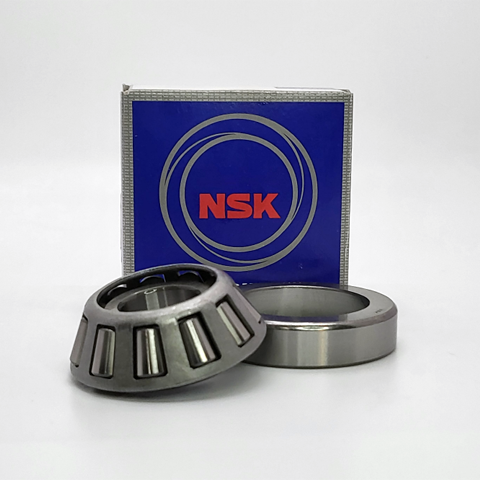
NSK NSK Tapered Roller Bearings, Single-Row Metric Design HR32236J ,D=180
NSK Tapered Roller Bearings, Single-Row Metric Design HR32236J ,D=180 Bearing Numbers Boundary Dimensions (mm) Basic Load Ratings (kN) Limiting Speeds (min-1) ISO355 Dimensions Series approx. Constant e Axial Load Factors Mass (kg) approx. d D T B C Cone r min. Cup r min. Cr C0r Grease Oil Y1 Y0 HR32236J 180 320 91 86 71 5 4 960 1540 1100 1400 4GD 0.45 1.3 0.73 29.8 DESIGN, TYPES, AND FEATURES Tapered roller bearings are designed so the apices of the cones formed by the raceways of the inner and outer rings and the inner ring rollers all coincide at one point on the axis of the bearing. When a radial load is imposed, a component axial force occurs; therefore, it is necessary to use two bearings in opposition or some other multiple-bearing arrangement. For Metric Series medium-angle or steep-angle tapered roller bearings, the respective contact angle designation C or D is added after the bore number. For normal-angle tapered roller bearings, no contact angle designation is used. Medium-angle tapered roller bearings are primarily used for the pinion shafts of differential gears in automobiles. Some bearings with high load capacity (HR Series) contain a J suffix that indicates they conform to ISO specifications for outer ring back face raceway diameter, outer ring width, and contact angle. Therefore, the inner ring assembly and outer ring of bearings with a J suffix are internationally interchangeable. Some Metric Series tapered roller bearings specified by ISO 355 have different dimensions from past Series 3XX bearings. Some of these are listed in the bearing tables. These conform to ISO specifications for the small-end diameter of the inner ring and contact angle. The inner and outer ring assemblies are internationally interchangeable. The bearing designation structure, which has changed from the past, is listed below: Inch Series bearings also exist. Inner ring assemblies and outer rings are approximately formulated as follows (excluding four-row tapered roller bearings): Various arrangements of tapered roller bearings (excluding single-row bearings) are available. The cages of tapered roller bearings are usually made of pressed steel. Table 1 Design and Features of Tapered Roller Bearing Arrangements Design Arrangement Ex. Bearing Designation Features Back-to-back HR30210JDB+KLR10 Two standard bearings are combined. The bearing clearances are adjusted by inner ring spacers or outer ring spacers. The inner rings, outer rings, and spacers are marked with serial numbers and mating marks. Components with the same serial number can be assembled by referring to the matching indications. Face-to-face HR30210JDF+KR KBE Type 100KBE31+L The KBE type is a back-to-back arrangement of bearings with an integrated outer ring spacer. The KH type is a face-to-face arrangement in which the inner rings are integrated. Since the bearing clearance is adjusted using spacers, components must have the same serial number for assembly with reference to the matching indications. KH Type 110KH31+K
$1,828.96
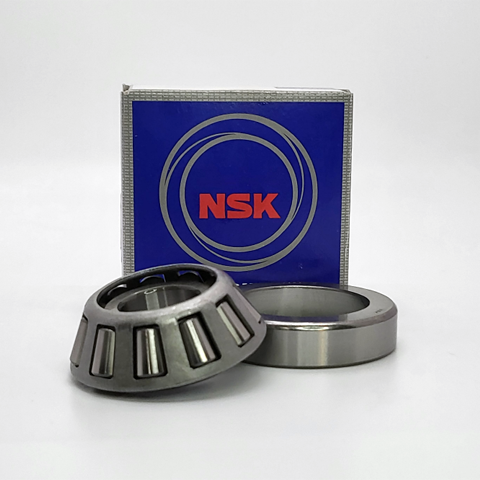
NSK NSK Tapered Roller Bearings, Single-Row Metric Design HR32240J ,D=200
NSK Tapered Roller Bearings, Single-Row Metric Design HR32240J ,D=200 Bearing Numbers Boundary Dimensions (mm) Basic Load Ratings (kN) Limiting Speeds (min-1) ISO355 Dimensions Series approx. Constant e Axial Load Factors Mass (kg) approx. d D T B C Cone r min. Cup r min. Cr C0r Grease Oil Y1 Y0 HR32240J 200 360 104 98 82 5 4 1210 1920 950 1300 3GD 0.41 1.5 0.81 42.6 DESIGN, TYPES, AND FEATURES Tapered roller bearings are designed so the apices of the cones formed by the raceways of the inner and outer rings and the inner ring rollers all coincide at one point on the axis of the bearing. When a radial load is imposed, a component axial force occurs; therefore, it is necessary to use two bearings in opposition or some other multiple-bearing arrangement. For Metric Series medium-angle or steep-angle tapered roller bearings, the respective contact angle designation C or D is added after the bore number. For normal-angle tapered roller bearings, no contact angle designation is used. Medium-angle tapered roller bearings are primarily used for the pinion shafts of differential gears in automobiles. Some bearings with high load capacity (HR Series) contain a J suffix that indicates they conform to ISO specifications for outer ring back face raceway diameter, outer ring width, and contact angle. Therefore, the inner ring assembly and outer ring of bearings with a J suffix are internationally interchangeable. Some Metric Series tapered roller bearings specified by ISO 355 have different dimensions from past Series 3XX bearings. Some of these are listed in the bearing tables. These conform to ISO specifications for the small-end diameter of the inner ring and contact angle. The inner and outer ring assemblies are internationally interchangeable. The bearing designation structure, which has changed from the past, is listed below: Inch Series bearings also exist. Inner ring assemblies and outer rings are approximately formulated as follows (excluding four-row tapered roller bearings): Various arrangements of tapered roller bearings (excluding single-row bearings) are available. The cages of tapered roller bearings are usually made of pressed steel. Table 1 Design and Features of Tapered Roller Bearing Arrangements Design Arrangement Ex. Bearing Designation Features Back-to-back HR30210JDB+KLR10 Two standard bearings are combined. The bearing clearances are adjusted by inner ring spacers or outer ring spacers. The inner rings, outer rings, and spacers are marked with serial numbers and mating marks. Components with the same serial number can be assembled by referring to the matching indications. Face-to-face HR30210JDF+KR KBE Type 100KBE31+L The KBE type is a back-to-back arrangement of bearings with an integrated outer ring spacer. The KH type is a face-to-face arrangement in which the inner rings are integrated. Since the bearing clearance is adjusted using spacers, components must have the same serial number for assembly with reference to the matching indications. KH Type 110KH31+K
$3,073.78
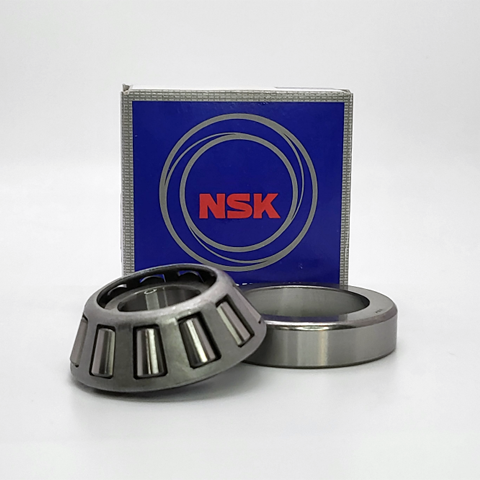
NSK NSK Tapered Roller Bearings, Single-Row Metric Design HR32304J ,D=20
NSK Tapered Roller Bearings, Single-Row Metric Design HR32304J ,D=20 Bearing Numbers Boundary Dimensions (mm) Basic Load Ratings (kN) Limiting Speeds (min-1) ISO355 Dimensions Series approx. Constant e Axial Load Factors Mass (kg) approx. d D T B C Cone r min. Cup r min. Cr C0r Grease Oil Y1 Y0 HR32304J 20 52 22.25 21 18 1.5 1.5 45.5 47.5 8000 11000 2FD 0.3 2 1.1 0.241 DESIGN, TYPES, AND FEATURES Tapered roller bearings are designed so the apices of the cones formed by the raceways of the inner and outer rings and the inner ring rollers all coincide at one point on the axis of the bearing. When a radial load is imposed, a component axial force occurs; therefore, it is necessary to use two bearings in opposition or some other multiple-bearing arrangement. For Metric Series medium-angle or steep-angle tapered roller bearings, the respective contact angle designation C or D is added after the bore number. For normal-angle tapered roller bearings, no contact angle designation is used. Medium-angle tapered roller bearings are primarily used for the pinion shafts of differential gears in automobiles. Some bearings with high load capacity (HR Series) contain a J suffix that indicates they conform to ISO specifications for outer ring back face raceway diameter, outer ring width, and contact angle. Therefore, the inner ring assembly and outer ring of bearings with a J suffix are internationally interchangeable. Some Metric Series tapered roller bearings specified by ISO 355 have different dimensions from past Series 3XX bearings. Some of these are listed in the bearing tables. These conform to ISO specifications for the small-end diameter of the inner ring and contact angle. The inner and outer ring assemblies are internationally interchangeable. The bearing designation structure, which has changed from the past, is listed below: Inch Series bearings also exist. Inner ring assemblies and outer rings are approximately formulated as follows (excluding four-row tapered roller bearings): Various arrangements of tapered roller bearings (excluding single-row bearings) are available. The cages of tapered roller bearings are usually made of pressed steel. Table 1 Design and Features of Tapered Roller Bearing Arrangements Design Arrangement Ex. Bearing Designation Features Back-to-back HR30210JDB+KLR10 Two standard bearings are combined. The bearing clearances are adjusted by inner ring spacers or outer ring spacers. The inner rings, outer rings, and spacers are marked with serial numbers and mating marks. Components with the same serial number can be assembled by referring to the matching indications. Face-to-face HR30210JDF+KR KBE Type 100KBE31+L The KBE type is a back-to-back arrangement of bearings with an integrated outer ring spacer. The KH type is a face-to-face arrangement in which the inner rings are integrated. Since the bearing clearance is adjusted using spacers, components must have the same serial number for assembly with reference to the matching indications. KH Type 110KH31+K
$31.70
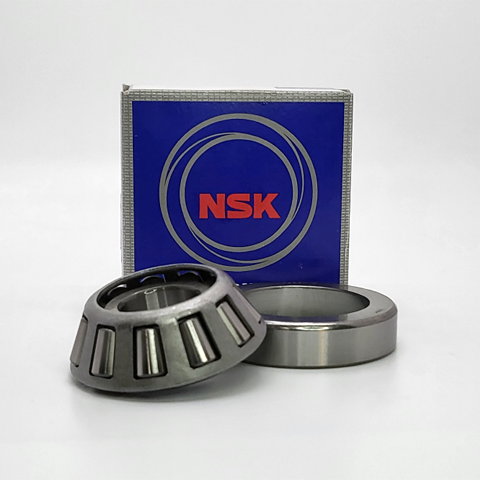
NSK NSK Tapered Roller Bearings, Single-Row Metric Design HR32305J ,D=25
NSK Tapered Roller Bearings, Single-Row Metric Design HR32305J ,D=25 Bearing Numbers Boundary Dimensions (mm) Basic Load Ratings (kN) Limiting Speeds (min-1) ISO355 Dimensions Series approx. Constant e Axial Load Factors Mass (kg) approx. d D T B C Cone r min. Cup r min. Cr C0r Grease Oil Y1 Y0 HR32305J 25 62 25.25 24 20 1.5 1.5 62.5 66 6300 8500 2FD 0.3 2 1.1 0.376 DESIGN, TYPES, AND FEATURES Tapered roller bearings are designed so the apices of the cones formed by the raceways of the inner and outer rings and the inner ring rollers all coincide at one point on the axis of the bearing. When a radial load is imposed, a component axial force occurs; therefore, it is necessary to use two bearings in opposition or some other multiple-bearing arrangement. For Metric Series medium-angle or steep-angle tapered roller bearings, the respective contact angle designation C or D is added after the bore number. For normal-angle tapered roller bearings, no contact angle designation is used. Medium-angle tapered roller bearings are primarily used for the pinion shafts of differential gears in automobiles. Some bearings with high load capacity (HR Series) contain a J suffix that indicates they conform to ISO specifications for outer ring back face raceway diameter, outer ring width, and contact angle. Therefore, the inner ring assembly and outer ring of bearings with a J suffix are internationally interchangeable. Some Metric Series tapered roller bearings specified by ISO 355 have different dimensions from past Series 3XX bearings. Some of these are listed in the bearing tables. These conform to ISO specifications for the small-end diameter of the inner ring and contact angle. The inner and outer ring assemblies are internationally interchangeable. The bearing designation structure, which has changed from the past, is listed below: Inch Series bearings also exist. Inner ring assemblies and outer rings are approximately formulated as follows (excluding four-row tapered roller bearings): Various arrangements of tapered roller bearings (excluding single-row bearings) are available. The cages of tapered roller bearings are usually made of pressed steel. Table 1 Design and Features of Tapered Roller Bearing Arrangements Design Arrangement Ex. Bearing Designation Features Back-to-back HR30210JDB+KLR10 Two standard bearings are combined. The bearing clearances are adjusted by inner ring spacers or outer ring spacers. The inner rings, outer rings, and spacers are marked with serial numbers and mating marks. Components with the same serial number can be assembled by referring to the matching indications. Face-to-face HR30210JDF+KR KBE Type 100KBE31+L The KBE type is a back-to-back arrangement of bearings with an integrated outer ring spacer. The KH type is a face-to-face arrangement in which the inner rings are integrated. Since the bearing clearance is adjusted using spacers, components must have the same serial number for assembly with reference to the matching indications. KH Type 110KH31+K
$35.30
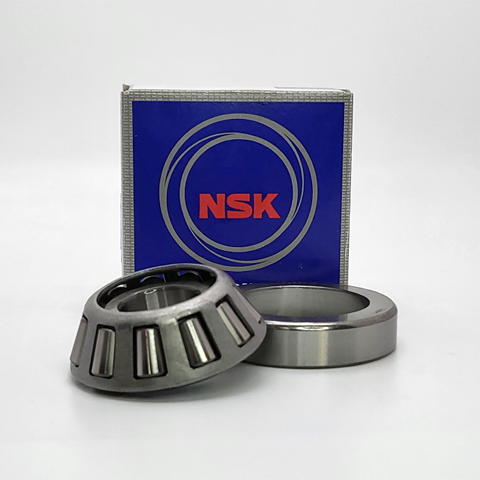
NSK NSK Tapered Roller Bearings, Single-Row Metric Design HR32306J ,D=30
NSK Tapered Roller Bearings, Single-Row Metric Design HR32306J ,D=30 Bearing Numbers Boundary Dimensions (mm) Basic Load Ratings (kN) Limiting Speeds (min-1) ISO355 Dimensions Series approx. Constant e Axial Load Factors Mass (kg) approx. d D T B C Cone r min. Cup r min. Cr C0r Grease Oil Y1 Y0 HR32306J 30 72 28.75 27 23 1.5 1.5 80 88.5 5600 7500 2FD 0.32 1.9 1.1 0.57 DESIGN, TYPES, AND FEATURES Tapered roller bearings are designed so the apices of the cones formed by the raceways of the inner and outer rings and the inner ring rollers all coincide at one point on the axis of the bearing. When a radial load is imposed, a component axial force occurs; therefore, it is necessary to use two bearings in opposition or some other multiple-bearing arrangement. For Metric Series medium-angle or steep-angle tapered roller bearings, the respective contact angle designation C or D is added after the bore number. For normal-angle tapered roller bearings, no contact angle designation is used. Medium-angle tapered roller bearings are primarily used for the pinion shafts of differential gears in automobiles. Some bearings with high load capacity (HR Series) contain a J suffix that indicates they conform to ISO specifications for outer ring back face raceway diameter, outer ring width, and contact angle. Therefore, the inner ring assembly and outer ring of bearings with a J suffix are internationally interchangeable. Some Metric Series tapered roller bearings specified by ISO 355 have different dimensions from past Series 3XX bearings. Some of these are listed in the bearing tables. These conform to ISO specifications for the small-end diameter of the inner ring and contact angle. The inner and outer ring assemblies are internationally interchangeable. The bearing designation structure, which has changed from the past, is listed below: Inch Series bearings also exist. Inner ring assemblies and outer rings are approximately formulated as follows (excluding four-row tapered roller bearings): Various arrangements of tapered roller bearings (excluding single-row bearings) are available. The cages of tapered roller bearings are usually made of pressed steel. Table 1 Design and Features of Tapered Roller Bearing Arrangements Design Arrangement Ex. Bearing Designation Features Back-to-back HR30210JDB+KLR10 Two standard bearings are combined. The bearing clearances are adjusted by inner ring spacers or outer ring spacers. The inner rings, outer rings, and spacers are marked with serial numbers and mating marks. Components with the same serial number can be assembled by referring to the matching indications. Face-to-face HR30210JDF+KR KBE Type 100KBE31+L The KBE type is a back-to-back arrangement of bearings with an integrated outer ring spacer. The KH type is a face-to-face arrangement in which the inner rings are integrated. Since the bearing clearance is adjusted using spacers, components must have the same serial number for assembly with reference to the matching indications. KH Type 110KH31+K
$42.12
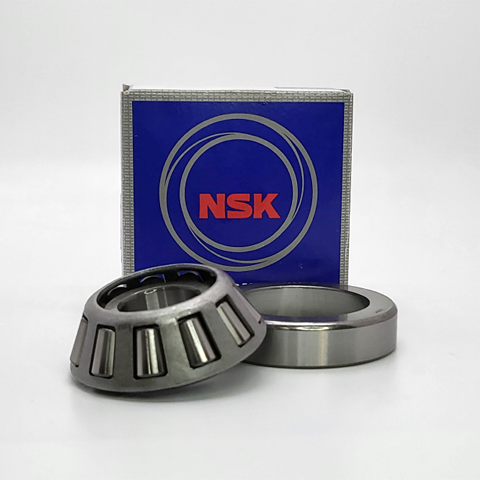
NSK NSK Tapered Roller Bearings, Single-Row Metric Design HR32307J ,D=35
NSK Tapered Roller Bearings, Single-Row Metric Design HR32307J ,D=35 Bearing Numbers Boundary Dimensions (mm) Basic Load Ratings (kN) Limiting Speeds (min-1) ISO355 Dimensions Series approx. Constant e Axial Load Factors Mass (kg) approx. d D T B C Cone r min. Cup r min. Cr C0r Grease Oil Y1 Y0 HR32307J 35 80 32.75 31 25 2 1.5 99 111 5000 6700 2FE 0.32 1.9 1.1 0.765 DESIGN, TYPES, AND FEATURES Tapered roller bearings are designed so the apices of the cones formed by the raceways of the inner and outer rings and the inner ring rollers all coincide at one point on the axis of the bearing. When a radial load is imposed, a component axial force occurs; therefore, it is necessary to use two bearings in opposition or some other multiple-bearing arrangement. For Metric Series medium-angle or steep-angle tapered roller bearings, the respective contact angle designation C or D is added after the bore number. For normal-angle tapered roller bearings, no contact angle designation is used. Medium-angle tapered roller bearings are primarily used for the pinion shafts of differential gears in automobiles. Some bearings with high load capacity (HR Series) contain a J suffix that indicates they conform to ISO specifications for outer ring back face raceway diameter, outer ring width, and contact angle. Therefore, the inner ring assembly and outer ring of bearings with a J suffix are internationally interchangeable. Some Metric Series tapered roller bearings specified by ISO 355 have different dimensions from past Series 3XX bearings. Some of these are listed in the bearing tables. These conform to ISO specifications for the small-end diameter of the inner ring and contact angle. The inner and outer ring assemblies are internationally interchangeable. The bearing designation structure, which has changed from the past, is listed below: Inch Series bearings also exist. Inner ring assemblies and outer rings are approximately formulated as follows (excluding four-row tapered roller bearings): Various arrangements of tapered roller bearings (excluding single-row bearings) are available. The cages of tapered roller bearings are usually made of pressed steel. Table 1 Design and Features of Tapered Roller Bearing Arrangements Design Arrangement Ex. Bearing Designation Features Back-to-back HR30210JDB+KLR10 Two standard bearings are combined. The bearing clearances are adjusted by inner ring spacers or outer ring spacers. The inner rings, outer rings, and spacers are marked with serial numbers and mating marks. Components with the same serial number can be assembled by referring to the matching indications. Face-to-face HR30210JDF+KR KBE Type 100KBE31+L The KBE type is a back-to-back arrangement of bearings with an integrated outer ring spacer. The KH type is a face-to-face arrangement in which the inner rings are integrated. Since the bearing clearance is adjusted using spacers, components must have the same serial number for assembly with reference to the matching indications. KH Type 110KH31+K
$46.06
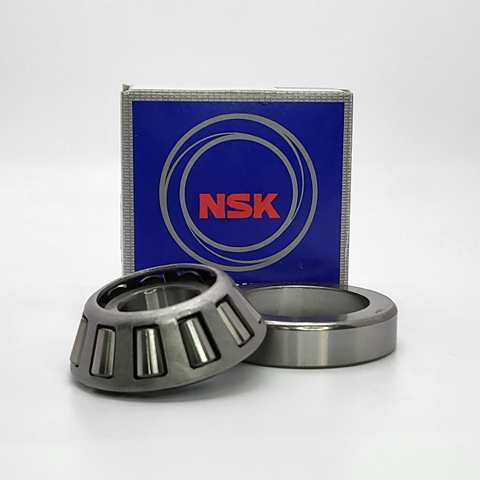
NSK NSK Tapered Roller Bearings, Single-Row Metric Design HR32308J ,D=40
NSK Tapered Roller Bearings, Single-Row Metric Design HR32308J ,D=40 Bearing Numbers Boundary Dimensions (mm) Basic Load Ratings (kN) Limiting Speeds (min-1) ISO355 Dimensions Series approx. Constant e Axial Load Factors Mass (kg) approx. d D T B C Cone r min. Cup r min. Cr C0r Grease Oil Y1 Y0 HR32308J 40 90 35.25 33 27 2 1.5 120 145 4300 6000 2FD 0.35 1.7 0.96 1.05 DESIGN, TYPES, AND FEATURES Tapered roller bearings are designed so the apices of the cones formed by the raceways of the inner and outer rings and the inner ring rollers all coincide at one point on the axis of the bearing. When a radial load is imposed, a component axial force occurs; therefore, it is necessary to use two bearings in opposition or some other multiple-bearing arrangement. For Metric Series medium-angle or steep-angle tapered roller bearings, the respective contact angle designation C or D is added after the bore number. For normal-angle tapered roller bearings, no contact angle designation is used. Medium-angle tapered roller bearings are primarily used for the pinion shafts of differential gears in automobiles. Some bearings with high load capacity (HR Series) contain a J suffix that indicates they conform to ISO specifications for outer ring back face raceway diameter, outer ring width, and contact angle. Therefore, the inner ring assembly and outer ring of bearings with a J suffix are internationally interchangeable. Some Metric Series tapered roller bearings specified by ISO 355 have different dimensions from past Series 3XX bearings. Some of these are listed in the bearing tables. These conform to ISO specifications for the small-end diameter of the inner ring and contact angle. The inner and outer ring assemblies are internationally interchangeable. The bearing designation structure, which has changed from the past, is listed below: Inch Series bearings also exist. Inner ring assemblies and outer rings are approximately formulated as follows (excluding four-row tapered roller bearings): Various arrangements of tapered roller bearings (excluding single-row bearings) are available. The cages of tapered roller bearings are usually made of pressed steel. Table 1 Design and Features of Tapered Roller Bearing Arrangements Design Arrangement Ex. Bearing Designation Features Back-to-back HR30210JDB+KLR10 Two standard bearings are combined. The bearing clearances are adjusted by inner ring spacers or outer ring spacers. The inner rings, outer rings, and spacers are marked with serial numbers and mating marks. Components with the same serial number can be assembled by referring to the matching indications. Face-to-face HR30210JDF+KR KBE Type 100KBE31+L The KBE type is a back-to-back arrangement of bearings with an integrated outer ring spacer. The KH type is a face-to-face arrangement in which the inner rings are integrated. Since the bearing clearance is adjusted using spacers, components must have the same serial number for assembly with reference to the matching indications. KH Type 110KH31+K
$56.74
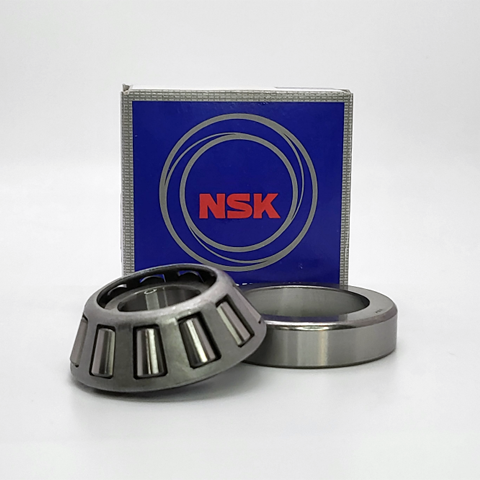
NSK NSK Tapered Roller Bearings, Single-Row Metric Design HR32309J ,D=45
NSK Tapered Roller Bearings, Single-Row Metric Design HR32309J ,D=45 Bearing Numbers Boundary Dimensions (mm) Basic Load Ratings (kN) Limiting Speeds (min-1) ISO355 Dimensions Series approx. Constant e Axial Load Factors Mass (kg) approx. d D T B C Cone r min. Cup r min. Cr C0r Grease Oil Y1 Y0 HR32309J 45 100 38.25 36 30 2 1.5 144 177 3800 5300 2FD 0.35 1.7 0.96 1.42 DESIGN, TYPES, AND FEATURES Tapered roller bearings are designed so the apices of the cones formed by the raceways of the inner and outer rings and the inner ring rollers all coincide at one point on the axis of the bearing. When a radial load is imposed, a component axial force occurs; therefore, it is necessary to use two bearings in opposition or some other multiple-bearing arrangement. For Metric Series medium-angle or steep-angle tapered roller bearings, the respective contact angle designation C or D is added after the bore number. For normal-angle tapered roller bearings, no contact angle designation is used. Medium-angle tapered roller bearings are primarily used for the pinion shafts of differential gears in automobiles. Some bearings with high load capacity (HR Series) contain a J suffix that indicates they conform to ISO specifications for outer ring back face raceway diameter, outer ring width, and contact angle. Therefore, the inner ring assembly and outer ring of bearings with a J suffix are internationally interchangeable. Some Metric Series tapered roller bearings specified by ISO 355 have different dimensions from past Series 3XX bearings. Some of these are listed in the bearing tables. These conform to ISO specifications for the small-end diameter of the inner ring and contact angle. The inner and outer ring assemblies are internationally interchangeable. The bearing designation structure, which has changed from the past, is listed below: Inch Series bearings also exist. Inner ring assemblies and outer rings are approximately formulated as follows (excluding four-row tapered roller bearings): Various arrangements of tapered roller bearings (excluding single-row bearings) are available. The cages of tapered roller bearings are usually made of pressed steel. Table 1 Design and Features of Tapered Roller Bearing Arrangements Design Arrangement Ex. Bearing Designation Features Back-to-back HR30210JDB+KLR10 Two standard bearings are combined. The bearing clearances are adjusted by inner ring spacers or outer ring spacers. The inner rings, outer rings, and spacers are marked with serial numbers and mating marks. Components with the same serial number can be assembled by referring to the matching indications. Face-to-face HR30210JDF+KR KBE Type 100KBE31+L The KBE type is a back-to-back arrangement of bearings with an integrated outer ring spacer. The KH type is a face-to-face arrangement in which the inner rings are integrated. Since the bearing clearance is adjusted using spacers, components must have the same serial number for assembly with reference to the matching indications. KH Type 110KH31+K
$68.03
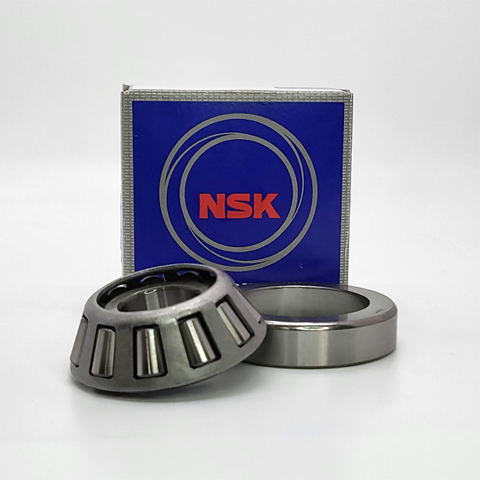
NSK NSK Tapered Roller Bearings, Single-Row Metric Design HR32311J ,D=55
NSK Tapered Roller Bearings, Single-Row Metric Design HR32311J ,D=55 Bearing Numbers Boundary Dimensions (mm) Basic Load Ratings (kN) Limiting Speeds (min-1) ISO355 Dimensions Series approx. Constant e Axial Load Factors Mass (kg) approx. d D T B C Cone r min. Cup r min. Cr C0r Grease Oil Y1 Y0 HR32311J 55 120 45.5 43 35 2.5 2 204 258 3200 4300 2FD 0.35 1.7 0.96 2.39 DESIGN, TYPES, AND FEATURES Tapered roller bearings are designed so the apices of the cones formed by the raceways of the inner and outer rings and the inner ring rollers all coincide at one point on the axis of the bearing. When a radial load is imposed, a component axial force occurs; therefore, it is necessary to use two bearings in opposition or some other multiple-bearing arrangement. For Metric Series medium-angle or steep-angle tapered roller bearings, the respective contact angle designation C or D is added after the bore number. For normal-angle tapered roller bearings, no contact angle designation is used. Medium-angle tapered roller bearings are primarily used for the pinion shafts of differential gears in automobiles. Some bearings with high load capacity (HR Series) contain a J suffix that indicates they conform to ISO specifications for outer ring back face raceway diameter, outer ring width, and contact angle. Therefore, the inner ring assembly and outer ring of bearings with a J suffix are internationally interchangeable. Some Metric Series tapered roller bearings specified by ISO 355 have different dimensions from past Series 3XX bearings. Some of these are listed in the bearing tables. These conform to ISO specifications for the small-end diameter of the inner ring and contact angle. The inner and outer ring assemblies are internationally interchangeable. The bearing designation structure, which has changed from the past, is listed below: Inch Series bearings also exist. Inner ring assemblies and outer rings are approximately formulated as follows (excluding four-row tapered roller bearings): Various arrangements of tapered roller bearings (excluding single-row bearings) are available. The cages of tapered roller bearings are usually made of pressed steel. Table 1 Design and Features of Tapered Roller Bearing Arrangements Design Arrangement Ex. Bearing Designation Features Back-to-back HR30210JDB+KLR10 Two standard bearings are combined. The bearing clearances are adjusted by inner ring spacers or outer ring spacers. The inner rings, outer rings, and spacers are marked with serial numbers and mating marks. Components with the same serial number can be assembled by referring to the matching indications. Face-to-face HR30210JDF+KR KBE Type 100KBE31+L The KBE type is a back-to-back arrangement of bearings with an integrated outer ring spacer. The KH type is a face-to-face arrangement in which the inner rings are integrated. Since the bearing clearance is adjusted using spacers, components must have the same serial number for assembly with reference to the matching indications. KH Type 110KH31+K
$112.00
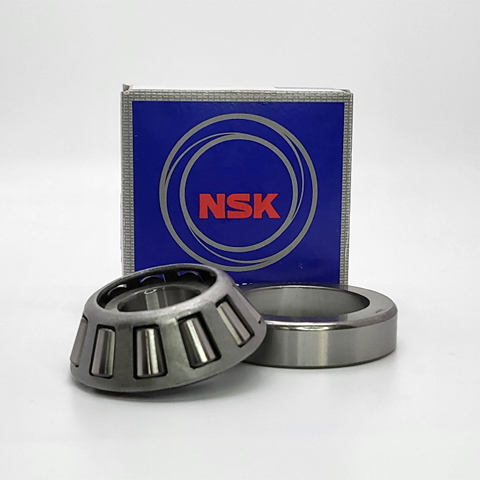
NSK NSK Tapered Roller Bearings, Single-Row Metric Design HR32312J ,D=60
NSK Tapered Roller Bearings, Single-Row Metric Design HR32312J ,D=60 Bearing Numbers Boundary Dimensions (mm) Basic Load Ratings (kN) Limiting Speeds (min-1) ISO355 Dimensions Series approx. Constant e Axial Load Factors Mass (kg) approx. d D T B C Cone r min. Cup r min. Cr C0r Grease Oil Y1 Y0 HR32312J 60 130 48.5 46 37 3 2.5 233 295 3000 4000 2FD 0.35 1.7 0.96 2.96 DESIGN, TYPES, AND FEATURES Tapered roller bearings are designed so the apices of the cones formed by the raceways of the inner and outer rings and the inner ring rollers all coincide at one point on the axis of the bearing. When a radial load is imposed, a component axial force occurs; therefore, it is necessary to use two bearings in opposition or some other multiple-bearing arrangement. For Metric Series medium-angle or steep-angle tapered roller bearings, the respective contact angle designation C or D is added after the bore number. For normal-angle tapered roller bearings, no contact angle designation is used. Medium-angle tapered roller bearings are primarily used for the pinion shafts of differential gears in automobiles. Some bearings with high load capacity (HR Series) contain a J suffix that indicates they conform to ISO specifications for outer ring back face raceway diameter, outer ring width, and contact angle. Therefore, the inner ring assembly and outer ring of bearings with a J suffix are internationally interchangeable. Some Metric Series tapered roller bearings specified by ISO 355 have different dimensions from past Series 3XX bearings. Some of these are listed in the bearing tables. These conform to ISO specifications for the small-end diameter of the inner ring and contact angle. The inner and outer ring assemblies are internationally interchangeable. The bearing designation structure, which has changed from the past, is listed below: Inch Series bearings also exist. Inner ring assemblies and outer rings are approximately formulated as follows (excluding four-row tapered roller bearings): Various arrangements of tapered roller bearings (excluding single-row bearings) are available. The cages of tapered roller bearings are usually made of pressed steel. Table 1 Design and Features of Tapered Roller Bearing Arrangements Design Arrangement Ex. Bearing Designation Features Back-to-back HR30210JDB+KLR10 Two standard bearings are combined. The bearing clearances are adjusted by inner ring spacers or outer ring spacers. The inner rings, outer rings, and spacers are marked with serial numbers and mating marks. Components with the same serial number can be assembled by referring to the matching indications. Face-to-face HR30210JDF+KR KBE Type 100KBE31+L The KBE type is a back-to-back arrangement of bearings with an integrated outer ring spacer. The KH type is a face-to-face arrangement in which the inner rings are integrated. Since the bearing clearance is adjusted using spacers, components must have the same serial number for assembly with reference to the matching indications. KH Type 110KH31+K
$139.98
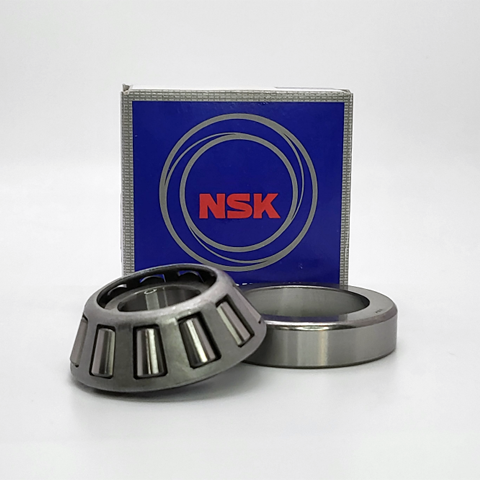
NSK NSK Tapered Roller Bearings, Single-Row Metric Design HR32313J ,D=65
NSK Tapered Roller Bearings, Single-Row Metric Design HR32313J ,D=65 Bearing Numbers Boundary Dimensions (mm) Basic Load Ratings (kN) Limiting Speeds (min-1) ISO355 Dimensions Series approx. Constant e Axial Load Factors Mass (kg) approx. d D T B C Cone r min. Cup r min. Cr C0r Grease Oil Y1 Y0 HR32313J 65 140 51 48 39 3 2.5 267 340 2800 3800 2GD 0.35 1.7 0.96 3.6 DESIGN, TYPES, AND FEATURES Tapered roller bearings are designed so the apices of the cones formed by the raceways of the inner and outer rings and the inner ring rollers all coincide at one point on the axis of the bearing. When a radial load is imposed, a component axial force occurs; therefore, it is necessary to use two bearings in opposition or some other multiple-bearing arrangement. For Metric Series medium-angle or steep-angle tapered roller bearings, the respective contact angle designation C or D is added after the bore number. For normal-angle tapered roller bearings, no contact angle designation is used. Medium-angle tapered roller bearings are primarily used for the pinion shafts of differential gears in automobiles. Some bearings with high load capacity (HR Series) contain a J suffix that indicates they conform to ISO specifications for outer ring back face raceway diameter, outer ring width, and contact angle. Therefore, the inner ring assembly and outer ring of bearings with a J suffix are internationally interchangeable. Some Metric Series tapered roller bearings specified by ISO 355 have different dimensions from past Series 3XX bearings. Some of these are listed in the bearing tables. These conform to ISO specifications for the small-end diameter of the inner ring and contact angle. The inner and outer ring assemblies are internationally interchangeable. The bearing designation structure, which has changed from the past, is listed below: Inch Series bearings also exist. Inner ring assemblies and outer rings are approximately formulated as follows (excluding four-row tapered roller bearings): Various arrangements of tapered roller bearings (excluding single-row bearings) are available. The cages of tapered roller bearings are usually made of pressed steel. Table 1 Design and Features of Tapered Roller Bearing Arrangements Design Arrangement Ex. Bearing Designation Features Back-to-back HR30210JDB+KLR10 Two standard bearings are combined. The bearing clearances are adjusted by inner ring spacers or outer ring spacers. The inner rings, outer rings, and spacers are marked with serial numbers and mating marks. Components with the same serial number can be assembled by referring to the matching indications. Face-to-face HR30210JDF+KR KBE Type 100KBE31+L The KBE type is a back-to-back arrangement of bearings with an integrated outer ring spacer. The KH type is a face-to-face arrangement in which the inner rings are integrated. Since the bearing clearance is adjusted using spacers, components must have the same serial number for assembly with reference to the matching indications. KH Type 110KH31+K
$179.23
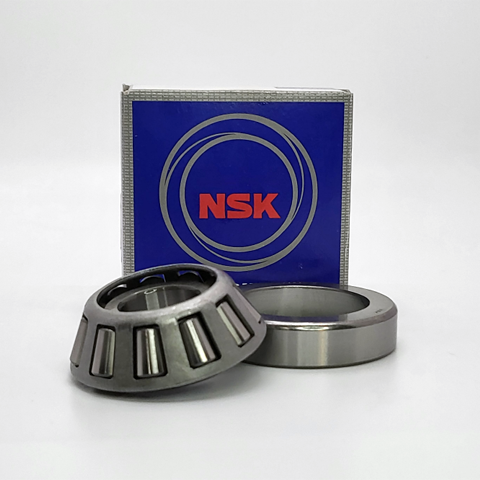
NSK NSK Tapered Roller Bearings, Single-Row Metric Design HR32314J ,D=70
NSK Tapered Roller Bearings, Single-Row Metric Design HR32314J ,D=70 Bearing Numbers Boundary Dimensions (mm) Basic Load Ratings (kN) Limiting Speeds (min-1) ISO355 Dimensions Series approx. Constant e Axial Load Factors Mass (kg) approx. d D T B C Cone r min. Cup r min. Cr C0r Grease Oil Y1 Y0 HR32314J 70 150 54 51 42 3 2.5 300 390 2600 3400 2GD 0.35 1.7 0.96 4.35 DESIGN, TYPES, AND FEATURES Tapered roller bearings are designed so the apices of the cones formed by the raceways of the inner and outer rings and the inner ring rollers all coincide at one point on the axis of the bearing. When a radial load is imposed, a component axial force occurs; therefore, it is necessary to use two bearings in opposition or some other multiple-bearing arrangement. For Metric Series medium-angle or steep-angle tapered roller bearings, the respective contact angle designation C or D is added after the bore number. For normal-angle tapered roller bearings, no contact angle designation is used. Medium-angle tapered roller bearings are primarily used for the pinion shafts of differential gears in automobiles. Some bearings with high load capacity (HR Series) contain a J suffix that indicates they conform to ISO specifications for outer ring back face raceway diameter, outer ring width, and contact angle. Therefore, the inner ring assembly and outer ring of bearings with a J suffix are internationally interchangeable. Some Metric Series tapered roller bearings specified by ISO 355 have different dimensions from past Series 3XX bearings. Some of these are listed in the bearing tables. These conform to ISO specifications for the small-end diameter of the inner ring and contact angle. The inner and outer ring assemblies are internationally interchangeable. The bearing designation structure, which has changed from the past, is listed below: Inch Series bearings also exist. Inner ring assemblies and outer rings are approximately formulated as follows (excluding four-row tapered roller bearings): Various arrangements of tapered roller bearings (excluding single-row bearings) are available. The cages of tapered roller bearings are usually made of pressed steel. Table 1 Design and Features of Tapered Roller Bearing Arrangements Design Arrangement Ex. Bearing Designation Features Back-to-back HR30210JDB+KLR10 Two standard bearings are combined. The bearing clearances are adjusted by inner ring spacers or outer ring spacers. The inner rings, outer rings, and spacers are marked with serial numbers and mating marks. Components with the same serial number can be assembled by referring to the matching indications. Face-to-face HR30210JDF+KR KBE Type 100KBE31+L The KBE type is a back-to-back arrangement of bearings with an integrated outer ring spacer. The KH type is a face-to-face arrangement in which the inner rings are integrated. Since the bearing clearance is adjusted using spacers, components must have the same serial number for assembly with reference to the matching indications. KH Type 110KH31+K
$231.38
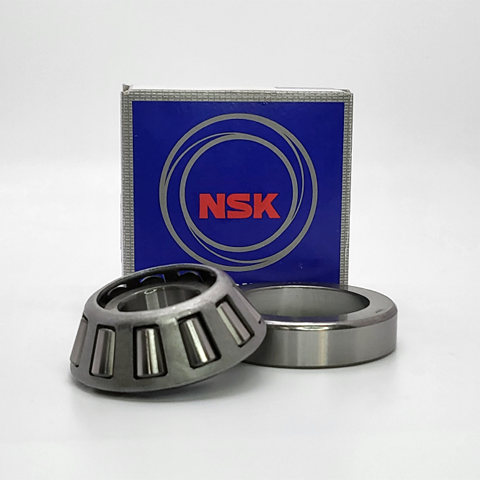
NSK NSK Tapered Roller Bearings, Single-Row Metric Design HR32315J ,D=75
NSK Tapered Roller Bearings, Single-Row Metric Design HR32315J ,D=75 Bearing Numbers Boundary Dimensions (mm) Basic Load Ratings (kN) Limiting Speeds (min-1) ISO355 Dimensions Series approx. Constant e Axial Load Factors Mass (kg) approx. d D T B C Cone r min. Cup r min. Cr C0r Grease Oil Y1 Y0 HR32315J 75 160 58 55 45 3 2.5 340 445 2400 3200 2GD 0.35 1.7 0.96 5.31 DESIGN, TYPES, AND FEATURES Tapered roller bearings are designed so the apices of the cones formed by the raceways of the inner and outer rings and the inner ring rollers all coincide at one point on the axis of the bearing. When a radial load is imposed, a component axial force occurs; therefore, it is necessary to use two bearings in opposition or some other multiple-bearing arrangement. For Metric Series medium-angle or steep-angle tapered roller bearings, the respective contact angle designation C or D is added after the bore number. For normal-angle tapered roller bearings, no contact angle designation is used. Medium-angle tapered roller bearings are primarily used for the pinion shafts of differential gears in automobiles. Some bearings with high load capacity (HR Series) contain a J suffix that indicates they conform to ISO specifications for outer ring back face raceway diameter, outer ring width, and contact angle. Therefore, the inner ring assembly and outer ring of bearings with a J suffix are internationally interchangeable. Some Metric Series tapered roller bearings specified by ISO 355 have different dimensions from past Series 3XX bearings. Some of these are listed in the bearing tables. These conform to ISO specifications for the small-end diameter of the inner ring and contact angle. The inner and outer ring assemblies are internationally interchangeable. The bearing designation structure, which has changed from the past, is listed below: Inch Series bearings also exist. Inner ring assemblies and outer rings are approximately formulated as follows (excluding four-row tapered roller bearings): Various arrangements of tapered roller bearings (excluding single-row bearings) are available. The cages of tapered roller bearings are usually made of pressed steel. Table 1 Design and Features of Tapered Roller Bearing Arrangements Design Arrangement Ex. Bearing Designation Features Back-to-back HR30210JDB+KLR10 Two standard bearings are combined. The bearing clearances are adjusted by inner ring spacers or outer ring spacers. The inner rings, outer rings, and spacers are marked with serial numbers and mating marks. Components with the same serial number can be assembled by referring to the matching indications. Face-to-face HR30210JDF+KR KBE Type 100KBE31+L The KBE type is a back-to-back arrangement of bearings with an integrated outer ring spacer. The KH type is a face-to-face arrangement in which the inner rings are integrated. Since the bearing clearance is adjusted using spacers, components must have the same serial number for assembly with reference to the matching indications. KH Type 110KH31+K
$241.16
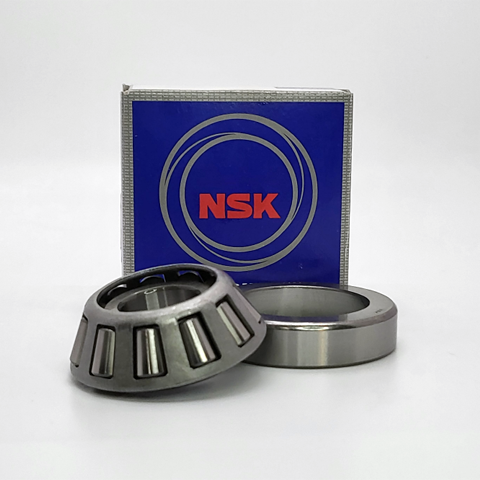
NSK NSK Tapered Roller Bearings, Single-Row Metric Design HR32316J ,D=80
NSK Tapered Roller Bearings, Single-Row Metric Design HR32316J ,D=80 Bearing Numbers Boundary Dimensions (mm) Basic Load Ratings (kN) Limiting Speeds (min-1) ISO355 Dimensions Series approx. Constant e Axial Load Factors Mass (kg) approx. d D T B C Cone r min. Cup r min. Cr C0r Grease Oil Y1 Y0 HR32316J 80 170 61.5 58 48 3 2.5 385 505 2200 3000 2GD 0.35 1.7 0.96 6.35 DESIGN, TYPES, AND FEATURES Tapered roller bearings are designed so the apices of the cones formed by the raceways of the inner and outer rings and the inner ring rollers all coincide at one point on the axis of the bearing. When a radial load is imposed, a component axial force occurs; therefore, it is necessary to use two bearings in opposition or some other multiple-bearing arrangement. For Metric Series medium-angle or steep-angle tapered roller bearings, the respective contact angle designation C or D is added after the bore number. For normal-angle tapered roller bearings, no contact angle designation is used. Medium-angle tapered roller bearings are primarily used for the pinion shafts of differential gears in automobiles. Some bearings with high load capacity (HR Series) contain a J suffix that indicates they conform to ISO specifications for outer ring back face raceway diameter, outer ring width, and contact angle. Therefore, the inner ring assembly and outer ring of bearings with a J suffix are internationally interchangeable. Some Metric Series tapered roller bearings specified by ISO 355 have different dimensions from past Series 3XX bearings. Some of these are listed in the bearing tables. These conform to ISO specifications for the small-end diameter of the inner ring and contact angle. The inner and outer ring assemblies are internationally interchangeable. The bearing designation structure, which has changed from the past, is listed below: Inch Series bearings also exist. Inner ring assemblies and outer rings are approximately formulated as follows (excluding four-row tapered roller bearings): Various arrangements of tapered roller bearings (excluding single-row bearings) are available. The cages of tapered roller bearings are usually made of pressed steel. Table 1 Design and Features of Tapered Roller Bearing Arrangements Design Arrangement Ex. Bearing Designation Features Back-to-back HR30210JDB+KLR10 Two standard bearings are combined. The bearing clearances are adjusted by inner ring spacers or outer ring spacers. The inner rings, outer rings, and spacers are marked with serial numbers and mating marks. Components with the same serial number can be assembled by referring to the matching indications. Face-to-face HR30210JDF+KR KBE Type 100KBE31+L The KBE type is a back-to-back arrangement of bearings with an integrated outer ring spacer. The KH type is a face-to-face arrangement in which the inner rings are integrated. Since the bearing clearance is adjusted using spacers, components must have the same serial number for assembly with reference to the matching indications. KH Type 110KH31+K
$287.28
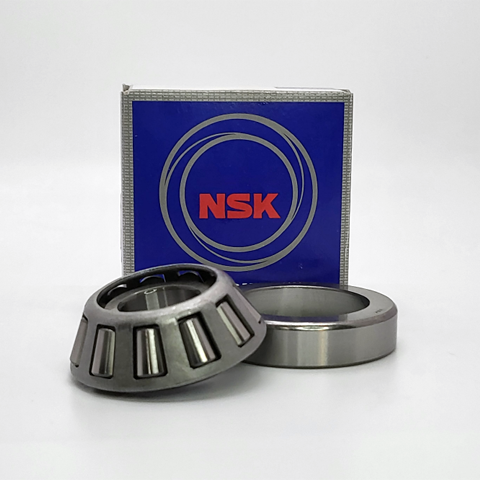
NSK NSK Tapered Roller Bearings, Single-Row Metric Design HR32317J ,D=85
NSK Tapered Roller Bearings, Single-Row Metric Design HR32317J ,D=85 Bearing Numbers Boundary Dimensions (mm) Basic Load Ratings (kN) Limiting Speeds (min-1) ISO355 Dimensions Series approx. Constant e Axial Load Factors Mass (kg) approx. d D T B C Cone r min. Cup r min. Cr C0r Grease Oil Y1 Y0 HR32317J 85 180 63.5 60 49 4 3 410 535 2000 2800 2GD 0.35 1.7 0.96 7.31 DESIGN, TYPES, AND FEATURES Tapered roller bearings are designed so the apices of the cones formed by the raceways of the inner and outer rings and the inner ring rollers all coincide at one point on the axis of the bearing. When a radial load is imposed, a component axial force occurs; therefore, it is necessary to use two bearings in opposition or some other multiple-bearing arrangement. For Metric Series medium-angle or steep-angle tapered roller bearings, the respective contact angle designation C or D is added after the bore number. For normal-angle tapered roller bearings, no contact angle designation is used. Medium-angle tapered roller bearings are primarily used for the pinion shafts of differential gears in automobiles. Some bearings with high load capacity (HR Series) contain a J suffix that indicates they conform to ISO specifications for outer ring back face raceway diameter, outer ring width, and contact angle. Therefore, the inner ring assembly and outer ring of bearings with a J suffix are internationally interchangeable. Some Metric Series tapered roller bearings specified by ISO 355 have different dimensions from past Series 3XX bearings. Some of these are listed in the bearing tables. These conform to ISO specifications for the small-end diameter of the inner ring and contact angle. The inner and outer ring assemblies are internationally interchangeable. The bearing designation structure, which has changed from the past, is listed below: Inch Series bearings also exist. Inner ring assemblies and outer rings are approximately formulated as follows (excluding four-row tapered roller bearings): Various arrangements of tapered roller bearings (excluding single-row bearings) are available. The cages of tapered roller bearings are usually made of pressed steel. Table 1 Design and Features of Tapered Roller Bearing Arrangements Design Arrangement Ex. Bearing Designation Features Back-to-back HR30210JDB+KLR10 Two standard bearings are combined. The bearing clearances are adjusted by inner ring spacers or outer ring spacers. The inner rings, outer rings, and spacers are marked with serial numbers and mating marks. Components with the same serial number can be assembled by referring to the matching indications. Face-to-face HR30210JDF+KR KBE Type 100KBE31+L The KBE type is a back-to-back arrangement of bearings with an integrated outer ring spacer. The KH type is a face-to-face arrangement in which the inner rings are integrated. Since the bearing clearance is adjusted using spacers, components must have the same serial number for assembly with reference to the matching indications. KH Type 110KH31+K
$394.76
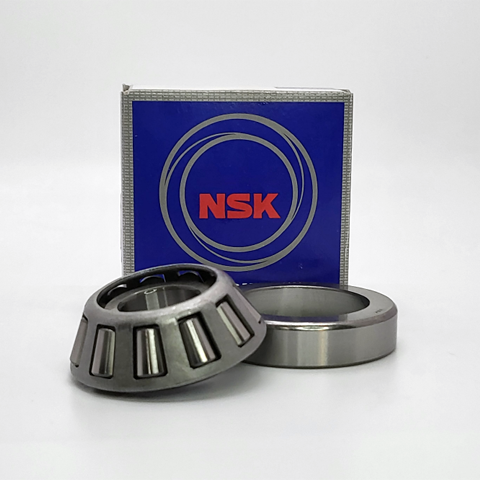
NSK NSK Tapered Roller Bearings, Single-Row Metric Design HR32318J ,D=90
NSK Tapered Roller Bearings, Single-Row Metric Design HR32318J ,D=90 Bearing Numbers Boundary Dimensions (mm) Basic Load Ratings (kN) Limiting Speeds (min-1) ISO355 Dimensions Series approx. Constant e Axial Load Factors Mass (kg) approx. d D T B C Cone r min. Cup r min. Cr C0r Grease Oil Y1 Y0 HR32318J 90 190 67.5 64 53 4 3 450 590 2000 2600 2GD 0.35 1.7 0.96 8.6 DESIGN, TYPES, AND FEATURES Tapered roller bearings are designed so the apices of the cones formed by the raceways of the inner and outer rings and the inner ring rollers all coincide at one point on the axis of the bearing. When a radial load is imposed, a component axial force occurs; therefore, it is necessary to use two bearings in opposition or some other multiple-bearing arrangement. For Metric Series medium-angle or steep-angle tapered roller bearings, the respective contact angle designation C or D is added after the bore number. For normal-angle tapered roller bearings, no contact angle designation is used. Medium-angle tapered roller bearings are primarily used for the pinion shafts of differential gears in automobiles. Some bearings with high load capacity (HR Series) contain a J suffix that indicates they conform to ISO specifications for outer ring back face raceway diameter, outer ring width, and contact angle. Therefore, the inner ring assembly and outer ring of bearings with a J suffix are internationally interchangeable. Some Metric Series tapered roller bearings specified by ISO 355 have different dimensions from past Series 3XX bearings. Some of these are listed in the bearing tables. These conform to ISO specifications for the small-end diameter of the inner ring and contact angle. The inner and outer ring assemblies are internationally interchangeable. The bearing designation structure, which has changed from the past, is listed below: Inch Series bearings also exist. Inner ring assemblies and outer rings are approximately formulated as follows (excluding four-row tapered roller bearings): Various arrangements of tapered roller bearings (excluding single-row bearings) are available. The cages of tapered roller bearings are usually made of pressed steel. Table 1 Design and Features of Tapered Roller Bearing Arrangements Design Arrangement Ex. Bearing Designation Features Back-to-back HR30210JDB+KLR10 Two standard bearings are combined. The bearing clearances are adjusted by inner ring spacers or outer ring spacers. The inner rings, outer rings, and spacers are marked with serial numbers and mating marks. Components with the same serial number can be assembled by referring to the matching indications. Face-to-face HR30210JDF+KR KBE Type 100KBE31+L The KBE type is a back-to-back arrangement of bearings with an integrated outer ring spacer. The KH type is a face-to-face arrangement in which the inner rings are integrated. Since the bearing clearance is adjusted using spacers, components must have the same serial number for assembly with reference to the matching indications. KH Type 110KH31+K
$542.78
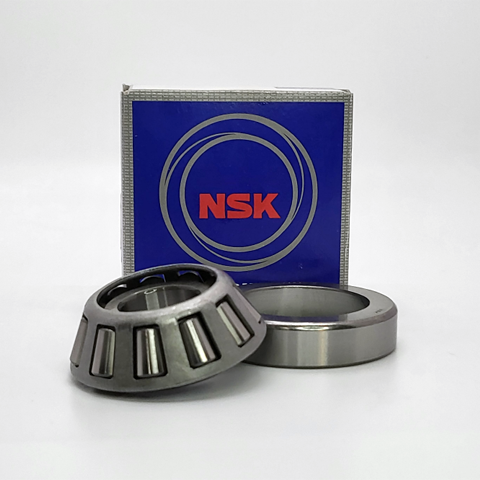
NSK NSK Tapered Roller Bearings, Single-Row Metric Design HR32319J ,D=95
NSK Tapered Roller Bearings, Single-Row Metric Design HR32319J ,D=95 Bearing Numbers Boundary Dimensions (mm) Basic Load Ratings (kN) Limiting Speeds (min-1) ISO355 Dimensions Series approx. Constant e Axial Load Factors Mass (kg) approx. d D T B C Cone r min. Cup r min. Cr C0r Grease Oil Y1 Y0 HR32319J 95 200 71.5 67 55 4 3 525 710 1900 2600 2GD 0.35 1.7 0.96 10.4 DESIGN, TYPES, AND FEATURES Tapered roller bearings are designed so the apices of the cones formed by the raceways of the inner and outer rings and the inner ring rollers all coincide at one point on the axis of the bearing. When a radial load is imposed, a component axial force occurs; therefore, it is necessary to use two bearings in opposition or some other multiple-bearing arrangement. For Metric Series medium-angle or steep-angle tapered roller bearings, the respective contact angle designation C or D is added after the bore number. For normal-angle tapered roller bearings, no contact angle designation is used. Medium-angle tapered roller bearings are primarily used for the pinion shafts of differential gears in automobiles. Some bearings with high load capacity (HR Series) contain a J suffix that indicates they conform to ISO specifications for outer ring back face raceway diameter, outer ring width, and contact angle. Therefore, the inner ring assembly and outer ring of bearings with a J suffix are internationally interchangeable. Some Metric Series tapered roller bearings specified by ISO 355 have different dimensions from past Series 3XX bearings. Some of these are listed in the bearing tables. These conform to ISO specifications for the small-end diameter of the inner ring and contact angle. The inner and outer ring assemblies are internationally interchangeable. The bearing designation structure, which has changed from the past, is listed below: Inch Series bearings also exist. Inner ring assemblies and outer rings are approximately formulated as follows (excluding four-row tapered roller bearings): Various arrangements of tapered roller bearings (excluding single-row bearings) are available. The cages of tapered roller bearings are usually made of pressed steel. Table 1 Design and Features of Tapered Roller Bearing Arrangements Design Arrangement Ex. Bearing Designation Features Back-to-back HR30210JDB+KLR10 Two standard bearings are combined. The bearing clearances are adjusted by inner ring spacers or outer ring spacers. The inner rings, outer rings, and spacers are marked with serial numbers and mating marks. Components with the same serial number can be assembled by referring to the matching indications. Face-to-face HR30210JDF+KR KBE Type 100KBE31+L The KBE type is a back-to-back arrangement of bearings with an integrated outer ring spacer. The KH type is a face-to-face arrangement in which the inner rings are integrated. Since the bearing clearance is adjusted using spacers, components must have the same serial number for assembly with reference to the matching indications. KH Type 110KH31+K
$660.36
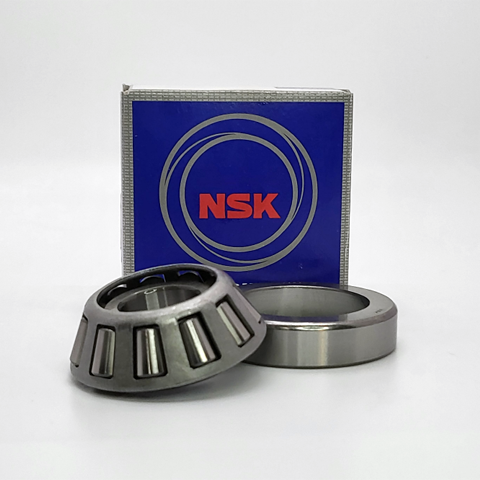
NSK NSK Tapered Roller Bearings, Single-Row Metric Design HR32320J ,D=100
NSK Tapered Roller Bearings, Single-Row Metric Design HR32320J ,D=100 Bearing Numbers Boundary Dimensions (mm) Basic Load Ratings (kN) Limiting Speeds (min-1) ISO355 Dimensions Series approx. Constant e Axial Load Factors Mass (kg) approx. d D T B C Cone r min. Cup r min. Cr C0r Grease Oil Y1 Y0 HR32320J 100 215 77.5 73 60 4 3 565 755 1700 2400 2GD 0.35 1.7 0.96 12.7 DESIGN, TYPES, AND FEATURES Tapered roller bearings are designed so the apices of the cones formed by the raceways of the inner and outer rings and the inner ring rollers all coincide at one point on the axis of the bearing. When a radial load is imposed, a component axial force occurs; therefore, it is necessary to use two bearings in opposition or some other multiple-bearing arrangement. For Metric Series medium-angle or steep-angle tapered roller bearings, the respective contact angle designation C or D is added after the bore number. For normal-angle tapered roller bearings, no contact angle designation is used. Medium-angle tapered roller bearings are primarily used for the pinion shafts of differential gears in automobiles. Some bearings with high load capacity (HR Series) contain a J suffix that indicates they conform to ISO specifications for outer ring back face raceway diameter, outer ring width, and contact angle. Therefore, the inner ring assembly and outer ring of bearings with a J suffix are internationally interchangeable. Some Metric Series tapered roller bearings specified by ISO 355 have different dimensions from past Series 3XX bearings. Some of these are listed in the bearing tables. These conform to ISO specifications for the small-end diameter of the inner ring and contact angle. The inner and outer ring assemblies are internationally interchangeable. The bearing designation structure, which has changed from the past, is listed below: Inch Series bearings also exist. Inner ring assemblies and outer rings are approximately formulated as follows (excluding four-row tapered roller bearings): Various arrangements of tapered roller bearings (excluding single-row bearings) are available. The cages of tapered roller bearings are usually made of pressed steel. Table 1 Design and Features of Tapered Roller Bearing Arrangements Design Arrangement Ex. Bearing Designation Features Back-to-back HR30210JDB+KLR10 Two standard bearings are combined. The bearing clearances are adjusted by inner ring spacers or outer ring spacers. The inner rings, outer rings, and spacers are marked with serial numbers and mating marks. Components with the same serial number can be assembled by referring to the matching indications. Face-to-face HR30210JDF+KR KBE Type 100KBE31+L The KBE type is a back-to-back arrangement of bearings with an integrated outer ring spacer. The KH type is a face-to-face arrangement in which the inner rings are integrated. Since the bearing clearance is adjusted using spacers, components must have the same serial number for assembly with reference to the matching indications. KH Type 110KH31+K
$841.72
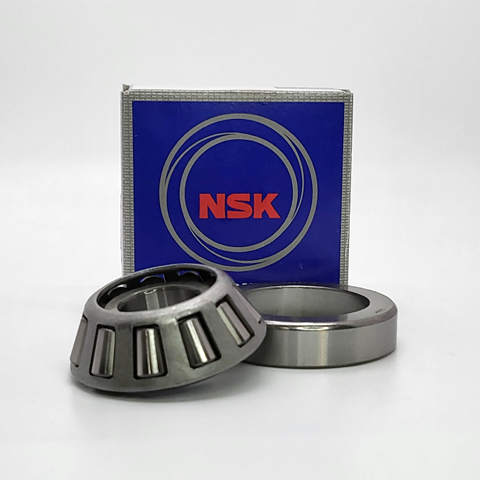
NSK NSK Tapered Roller Bearings, Single-Row Metric Design HR32321J ,D=105
NSK Tapered Roller Bearings, Single-Row Metric Design HR32321J ,D=105 Bearing Numbers Boundary Dimensions (mm) Basic Load Ratings (kN) Limiting Speeds (min-1) ISO355 Dimensions Series approx. Constant e Axial Load Factors Mass (kg) approx. d D T B C Cone r min. Cup r min. Cr C0r Grease Oil Y1 Y0 HR32321J 105 225 81.5 77 63 4 3 670 925 1700 2200 2GD 0.35 1.7 0.96 14.9 DESIGN, TYPES, AND FEATURES Tapered roller bearings are designed so the apices of the cones formed by the raceways of the inner and outer rings and the inner ring rollers all coincide at one point on the axis of the bearing. When a radial load is imposed, a component axial force occurs; therefore, it is necessary to use two bearings in opposition or some other multiple-bearing arrangement. For Metric Series medium-angle or steep-angle tapered roller bearings, the respective contact angle designation C or D is added after the bore number. For normal-angle tapered roller bearings, no contact angle designation is used. Medium-angle tapered roller bearings are primarily used for the pinion shafts of differential gears in automobiles. Some bearings with high load capacity (HR Series) contain a J suffix that indicates they conform to ISO specifications for outer ring back face raceway diameter, outer ring width, and contact angle. Therefore, the inner ring assembly and outer ring of bearings with a J suffix are internationally interchangeable. Some Metric Series tapered roller bearings specified by ISO 355 have different dimensions from past Series 3XX bearings. Some of these are listed in the bearing tables. These conform to ISO specifications for the small-end diameter of the inner ring and contact angle. The inner and outer ring assemblies are internationally interchangeable. The bearing designation structure, which has changed from the past, is listed below: Inch Series bearings also exist. Inner ring assemblies and outer rings are approximately formulated as follows (excluding four-row tapered roller bearings): Various arrangements of tapered roller bearings (excluding single-row bearings) are available. The cages of tapered roller bearings are usually made of pressed steel. Table 1 Design and Features of Tapered Roller Bearing Arrangements Design Arrangement Ex. Bearing Designation Features Back-to-back HR30210JDB+KLR10 Two standard bearings are combined. The bearing clearances are adjusted by inner ring spacers or outer ring spacers. The inner rings, outer rings, and spacers are marked with serial numbers and mating marks. Components with the same serial number can be assembled by referring to the matching indications. Face-to-face HR30210JDF+KR KBE Type 100KBE31+L The KBE type is a back-to-back arrangement of bearings with an integrated outer ring spacer. The KH type is a face-to-face arrangement in which the inner rings are integrated. Since the bearing clearance is adjusted using spacers, components must have the same serial number for assembly with reference to the matching indications. KH Type 110KH31+K
$1,164.01
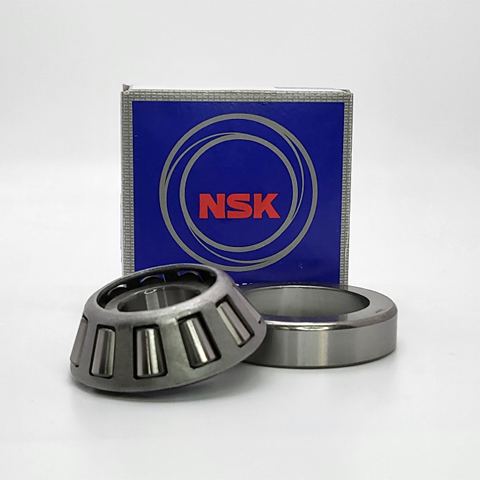
NSK NSK Tapered Roller Bearings, Single-Row Metric Design HR32322J ,D=110
NSK Tapered Roller Bearings, Single-Row Metric Design HR32322J ,D=110 Bearing Numbers Boundary Dimensions (mm) Basic Load Ratings (kN) Limiting Speeds (min-1) ISO355 Dimensions Series approx. Constant e Axial Load Factors Mass (kg) approx. d D T B C Cone r min. Cup r min. Cr C0r Grease Oil Y1 Y0 HR32322J 110 240 84.5 80 65 4 3 675 910 1500 2000 2GD 0.35 1.7 0.96 17.1 DESIGN, TYPES, AND FEATURES Tapered roller bearings are designed so the apices of the cones formed by the raceways of the inner and outer rings and the inner ring rollers all coincide at one point on the axis of the bearing. When a radial load is imposed, a component axial force occurs; therefore, it is necessary to use two bearings in opposition or some other multiple-bearing arrangement. For Metric Series medium-angle or steep-angle tapered roller bearings, the respective contact angle designation C or D is added after the bore number. For normal-angle tapered roller bearings, no contact angle designation is used. Medium-angle tapered roller bearings are primarily used for the pinion shafts of differential gears in automobiles. Some bearings with high load capacity (HR Series) contain a J suffix that indicates they conform to ISO specifications for outer ring back face raceway diameter, outer ring width, and contact angle. Therefore, the inner ring assembly and outer ring of bearings with a J suffix are internationally interchangeable. Some Metric Series tapered roller bearings specified by ISO 355 have different dimensions from past Series 3XX bearings. Some of these are listed in the bearing tables. These conform to ISO specifications for the small-end diameter of the inner ring and contact angle. The inner and outer ring assemblies are internationally interchangeable. The bearing designation structure, which has changed from the past, is listed below: Inch Series bearings also exist. Inner ring assemblies and outer rings are approximately formulated as follows (excluding four-row tapered roller bearings): Various arrangements of tapered roller bearings (excluding single-row bearings) are available. The cages of tapered roller bearings are usually made of pressed steel. Table 1 Design and Features of Tapered Roller Bearing Arrangements Design Arrangement Ex. Bearing Designation Features Back-to-back HR30210JDB+KLR10 Two standard bearings are combined. The bearing clearances are adjusted by inner ring spacers or outer ring spacers. The inner rings, outer rings, and spacers are marked with serial numbers and mating marks. Components with the same serial number can be assembled by referring to the matching indications. Face-to-face HR30210JDF+KR KBE Type 100KBE31+L The KBE type is a back-to-back arrangement of bearings with an integrated outer ring spacer. The KH type is a face-to-face arrangement in which the inner rings are integrated. Since the bearing clearance is adjusted using spacers, components must have the same serial number for assembly with reference to the matching indications. KH Type 110KH31+K
$1,108.91
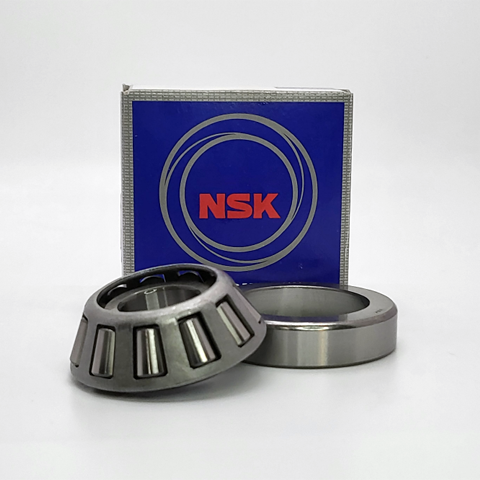
NSK NSK Tapered Roller Bearings, Single-Row Metric Design HR32324J ,D=120
NSK Tapered Roller Bearings, Single-Row Metric Design HR32324J ,D=120 Bearing Numbers Boundary Dimensions (mm) Basic Load Ratings (kN) Limiting Speeds (min-1) ISO355 Dimensions Series approx. Constant e Axial Load Factors Mass (kg) approx. d D T B C Cone r min. Cup r min. Cr C0r Grease Oil Y1 Y0 HR32324J 120 260 90.5 86 69 4 3 770 1060 1400 1900 2GD 0.35 1.7 0.96 21.8 DESIGN, TYPES, AND FEATURES Tapered roller bearings are designed so the apices of the cones formed by the raceways of the inner and outer rings and the inner ring rollers all coincide at one point on the axis of the bearing. When a radial load is imposed, a component axial force occurs; therefore, it is necessary to use two bearings in opposition or some other multiple-bearing arrangement. For Metric Series medium-angle or steep-angle tapered roller bearings, the respective contact angle designation C or D is added after the bore number. For normal-angle tapered roller bearings, no contact angle designation is used. Medium-angle tapered roller bearings are primarily used for the pinion shafts of differential gears in automobiles. Some bearings with high load capacity (HR Series) contain a J suffix that indicates they conform to ISO specifications for outer ring back face raceway diameter, outer ring width, and contact angle. Therefore, the inner ring assembly and outer ring of bearings with a J suffix are internationally interchangeable. Some Metric Series tapered roller bearings specified by ISO 355 have different dimensions from past Series 3XX bearings. Some of these are listed in the bearing tables. These conform to ISO specifications for the small-end diameter of the inner ring and contact angle. The inner and outer ring assemblies are internationally interchangeable. The bearing designation structure, which has changed from the past, is listed below: Inch Series bearings also exist. Inner ring assemblies and outer rings are approximately formulated as follows (excluding four-row tapered roller bearings): Various arrangements of tapered roller bearings (excluding single-row bearings) are available. The cages of tapered roller bearings are usually made of pressed steel. Table 1 Design and Features of Tapered Roller Bearing Arrangements Design Arrangement Ex. Bearing Designation Features Back-to-back HR30210JDB+KLR10 Two standard bearings are combined. The bearing clearances are adjusted by inner ring spacers or outer ring spacers. The inner rings, outer rings, and spacers are marked with serial numbers and mating marks. Components with the same serial number can be assembled by referring to the matching indications. Face-to-face HR30210JDF+KR KBE Type 100KBE31+L The KBE type is a back-to-back arrangement of bearings with an integrated outer ring spacer. The KH type is a face-to-face arrangement in which the inner rings are integrated. Since the bearing clearance is adjusted using spacers, components must have the same serial number for assembly with reference to the matching indications. KH Type 110KH31+K
$1,431.39
NT CUTTER NT CUTTER Basic Precision Knife "D-400/D-400P"
NT CUTTER Basic Precision Knife "D-400/D-400P" Most basic and popular design knife. Includes 5 blades for each BDA (45 degrees) and BDC (30 degrees) blades. Dia.9mm grip. Made from chemical resistant resin. Detailed data Item name Basic Precision Knife Item number D-400/D-400P Color Black Applicable holder/Spare blade BDA-200P, BDC-200P,BD-50P, BD-1800, BD-2000, BSB-03P, BSB-13P Number of blade included Precision 30 degree blade×5, Precision 45 degree blade×5 Accessories Cap, Spare blade case Packaging data Packing D-400:Paper boxD-400P:Blister pack Size(mm) D-400:35×165×17D-400P:50×190×16 Weight(g) D-400:31D-400P:37 JAN Code D-400:4904011012600D-400P:4904011010606 Unit QTY 200 (20×10)
$6.12
NT CUTTER NT CUTTER Circle Cutter "C-1500P"
NT CUTTER Circle Cutter "C-1500P" Light-Duty Circle Cutter to cut a circle from 1.8 – 17cm in diameter.Leaves no trace of center pin mark. Perfect for making crafts, models and other light-duty jobs. Useful center gauge to assist in finding the center point. CE-700P (extension beam) for larger circles (from 16-40cm in diameter) is sold separately. Detailed data Item name Circle Cutter Item number C-1500P Color White Applicable holder/Spare blade BDA-200P, BSB-03P Number of blade included Precision 45 degree blade×6(Equipped×1, Spare Blades×5) Accessories Blade protective cover, Center gauge Packaging data Packing Blister pack Size(mm) 130×191×59 Weight(g) 108 JAN Code 4904011011139 Unit QTY 10
$21.73
NT CUTTER NT CUTTER Circle Cutter "C-2500P"
NT CUTTER Circle Cutter "C-2500P" Heavy-Duty Circle Cutter to cut a circle from 3 to 16cm in diameter. Ideal for DIY projects and installation / repair jobs for roofing and flooring on carpet and thin veneer, etc. Also nice for making pipe holes and rounding corners in carpet and other uses in construction. CE-1000P (extension bar) for larger circles (from 15-23cm in diameter) is sold separately. Detailed data Item name Circle Cutter Item number C-2500P Color Red Applicable holder/Spare blade BC-400P, BC-1P Number of blade included Circle&Mat Board cutter blade×2(Inside poket) Packaging data Packing Blister pack Size(mm) 157×210×64 Weight(g) 209 JAN Code 4904011011153 Unit QTY 10
$37.75
NT CUTTER NT CUTTER Circle Cutter for plastic board "CP-1P"
NT CUTTER Circle Cutter for plastic board "CP-1P" Cuts thin plastic board up to 2mm thickness in a 5cm - 20cm diameter circle without leaving a pinhole in the center. With this tool, you can cut out lids, an opening for a pipe and use it in the design of hundreds of decorative objects. Detailed data Item name Circle Cutter for plastic board Item number CP-1P Color Red, Silver Applicable holder/Spare blade BM-2P Number of blade included Plastic cutting blade×1 Accessories Blade snapper Packaging data Packing Blister pack Size(mm) 92×230×50 Weight(g) 170 JAN Code 4904011012532 Unit QTY 10
$49.48
NT CUTTER NT CUTTER Compact Circle Cutter "C-400P"
NT CUTTER Compact Circle Cutter "C-400P" Light-Duty Circle Cutter to cut a circle from 2 – 15cm in diameter. Perfect for making crafts and other light-duty jobs. Detailed data Item name Compact Circle Cutter Item number C-400P Color Orange Applicable holder/Spare blade BDA-200P, BSB-03P Number of blade included Precision 45 degree blade×5 Accessories Blade protective cover Packaging data Packing Blister pack Size(mm) 50×190×20 Weight(g) 30 JAN Code 4904011011122 Unit QTY 100 (10×10)
$5.92
NT CUTTER NT CUTTER Compact Metal Circle Cutter "C-700GP"
NT CUTTER Compact Metal Circle Cutter "C-700GP" Light-Duty Circle Cutter to cut a circle from 1 – 14cm in diameter. Not only does it cuts circles, but also cuts parallel lines with blades attached to both legs. Can also be used as a divider with needles attached to both legs. Durable die-casting body. Detailed data Item name Compact Metal Circle Cutter Item number C-700GP Color Silver Applicable holder/Spare blade BDA-200P, BSB-03P Number of blade included Precision 45 degree blade×6, Needles×2 Accessories Spare blade case Packaging data Packing Transparent bag Size(mm) 60×215×13 Weight(g) 73 JAN Code 4904011011191 Unit QTY 100 (10×10)
$10.19
