Products
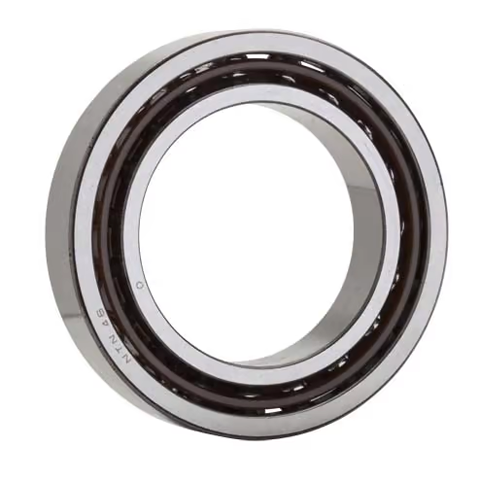
NTN NTN Angular Contact Bearing ,7000
Item # d D B r Static Load Rating Dynamic Load Rating 7000 0.3937 in 10.000 mm 1.0236 in 26.000 mm 0.3150 in 8.000 mm 0.0118 in 0.300 mm 465 lbf 2070 N 2.07 kN 1050 lbf 4650 N 4.65 kN 1. Design features and characteristics 1.1 Angular contact ball bearing Angular contact ball bearings are non-separable bearings with a defined contact angle in the radial direction relative to the straight line that runs through the point where each ball makes contact with the inner and outer rings (see Fig. 1). Table 1 provides information on contact angles and their designated codes. In addition to radial loads, angular contact ball bearings can accommodate single direction axial loads. Since an axial load is generated from a radial force, these bearings are generally used in pairs. Table 2 shows general angular contact ball bearing characteristics, Table 3 shows information on using duplex (side by side) angular contact ball bearings, and Table 4 shows information on multiple-row angular contact ball bearings. For bearings with a contact angle of 15° and bearing tolerance JIS Class 5 or higher, see special catalog “Precision rolling bearings (CAT. No. 2260/E)”. 1.2 Four-point angular contact ball bearings Four-point angular contact ball bearings have a contact angle of 30° and a split inner ring. As shown in Fig. 2, when the inner and outer rings receive a radial load, the ball contacts the inner and outer rings at four points. This construction enables a single bearing to accommodate axial loads from either direction, and when under a simple axial load or heavy axial load, the bearing relies on two contact points like ordinary bearings. 1.3 Double row angular contact ball bearings The structure of double row angular contact ball bearings is designed by arranging two single row angular contact bearings back-to-back in duplex (DB) to form a single bearing with a contact angle of 25°.These bearings are capable of accommodating radial loads, axial loads in either direction, and have a high capacity for moment loads.As shown in Fig. 4, sealed and shielded type double row angular contact ball bearings are also available. Standard loads vary from those of open type bearings.
$9.21
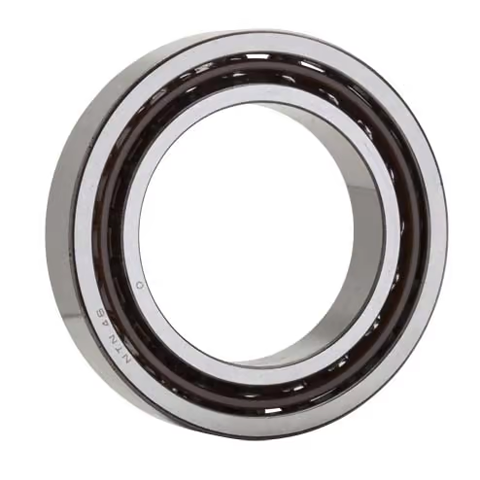
NTN NTN Angular Contact Bearing ,7001
Item # d D B r Static Load Rating Dynamic Load Rating 7001 0.4724 in 12.000 mm 1.1024 in 28.000 mm 0.3150 in 8.000 mm 0.0118 in 0.300 mm 555 lbf 2460 N 2.46 kN 1140 lbf 5050 N 5.05 kN 1. Design features and characteristics 1.1 Angular contact ball bearing Angular contact ball bearings are non-separable bearings with a defined contact angle in the radial direction relative to the straight line that runs through the point where each ball makes contact with the inner and outer rings (see Fig. 1). Table 1 provides information on contact angles and their designated codes. In addition to radial loads, angular contact ball bearings can accommodate single direction axial loads. Since an axial load is generated from a radial force, these bearings are generally used in pairs. Table 2 shows general angular contact ball bearing characteristics, Table 3 shows information on using duplex (side by side) angular contact ball bearings, and Table 4 shows information on multiple-row angular contact ball bearings. For bearings with a contact angle of 15° and bearing tolerance JIS Class 5 or higher, see special catalog “Precision rolling bearings (CAT. No. 2260/E)”. 1.2 Four-point angular contact ball bearings Four-point angular contact ball bearings have a contact angle of 30° and a split inner ring. As shown in Fig. 2, when the inner and outer rings receive a radial load, the ball contacts the inner and outer rings at four points. This construction enables a single bearing to accommodate axial loads from either direction, and when under a simple axial load or heavy axial load, the bearing relies on two contact points like ordinary bearings. 1.3 Double row angular contact ball bearings The structure of double row angular contact ball bearings is designed by arranging two single row angular contact bearings back-to-back in duplex (DB) to form a single bearing with a contact angle of 25°.These bearings are capable of accommodating radial loads, axial loads in either direction, and have a high capacity for moment loads.As shown in Fig. 4, sealed and shielded type double row angular contact ball bearings are also available. Standard loads vary from those of open type bearings.
$9.74
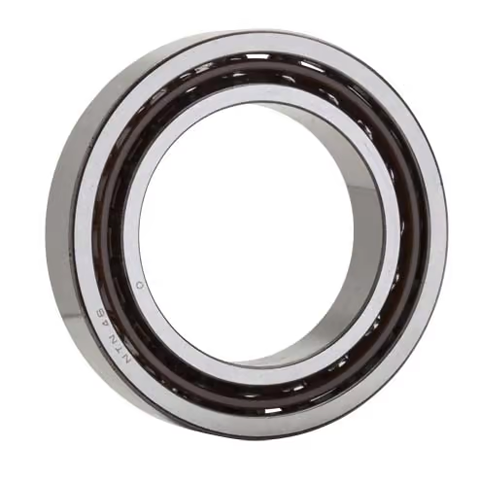
NTN NTN Angular Contact Bearing ,7002
Item # d D B r Static Load Rating Dynamic Load Rating 7002 0.5906 in 15.000 mm 1.2598 in 32.000 mm 0.3543 in 9.000 mm 0.0118 in 0.300 mm 710 lbf 3150 N 3.15 kN 1300 lbf 5800 N 5.80 kN 1. Design features and characteristics 1.1 Angular contact ball bearing Angular contact ball bearings are non-separable bearings with a defined contact angle in the radial direction relative to the straight line that runs through the point where each ball makes contact with the inner and outer rings (see Fig. 1). Table 1 provides information on contact angles and their designated codes. In addition to radial loads, angular contact ball bearings can accommodate single direction axial loads. Since an axial load is generated from a radial force, these bearings are generally used in pairs. Table 2 shows general angular contact ball bearing characteristics, Table 3 shows information on using duplex (side by side) angular contact ball bearings, and Table 4 shows information on multiple-row angular contact ball bearings. For bearings with a contact angle of 15° and bearing tolerance JIS Class 5 or higher, see special catalog “Precision rolling bearings (CAT. No. 2260/E)”. 1.2 Four-point angular contact ball bearings Four-point angular contact ball bearings have a contact angle of 30° and a split inner ring. As shown in Fig. 2, when the inner and outer rings receive a radial load, the ball contacts the inner and outer rings at four points. This construction enables a single bearing to accommodate axial loads from either direction, and when under a simple axial load or heavy axial load, the bearing relies on two contact points like ordinary bearings. 1.3 Double row angular contact ball bearings The structure of double row angular contact ball bearings is designed by arranging two single row angular contact bearings back-to-back in duplex (DB) to form a single bearing with a contact angle of 25°.These bearings are capable of accommodating radial loads, axial loads in either direction, and have a high capacity for moment loads.As shown in Fig. 4, sealed and shielded type double row angular contact ball bearings are also available. Standard loads vary from those of open type bearings.
$10.27
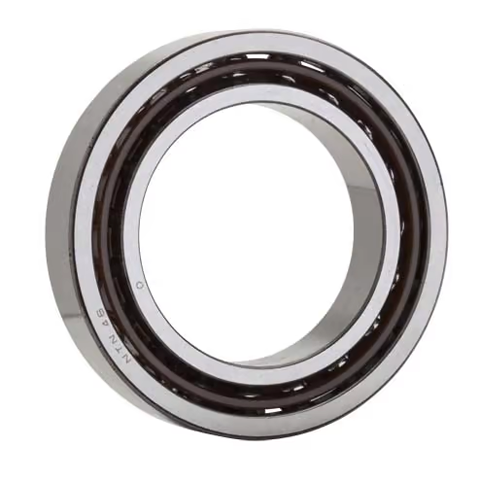
NTN NTN Angular Contact Bearing ,7003
Item # d D B r Static Load Rating Dynamic Load Rating 7003 0.6693 in 17.000 mm 1.3780 in 35.000 mm 0.3937 in 10.000 mm 0.0118 in 0.300 mm 865 lbf 3850 N 3.85 kN 1610 lbf 7150 N 7.15 kN 1. Design features and characteristics 1.1 Angular contact ball bearing Angular contact ball bearings are non-separable bearings with a defined contact angle in the radial direction relative to the straight line that runs through the point where each ball makes contact with the inner and outer rings (see Fig. 1). Table 1 provides information on contact angles and their designated codes. In addition to radial loads, angular contact ball bearings can accommodate single direction axial loads. Since an axial load is generated from a radial force, these bearings are generally used in pairs. Table 2 shows general angular contact ball bearing characteristics, Table 3 shows information on using duplex (side by side) angular contact ball bearings, and Table 4 shows information on multiple-row angular contact ball bearings. For bearings with a contact angle of 15° and bearing tolerance JIS Class 5 or higher, see special catalog “Precision rolling bearings (CAT. No. 2260/E)”. 1.2 Four-point angular contact ball bearings Four-point angular contact ball bearings have a contact angle of 30° and a split inner ring. As shown in Fig. 2, when the inner and outer rings receive a radial load, the ball contacts the inner and outer rings at four points. This construction enables a single bearing to accommodate axial loads from either direction, and when under a simple axial load or heavy axial load, the bearing relies on two contact points like ordinary bearings. 1.3 Double row angular contact ball bearings The structure of double row angular contact ball bearings is designed by arranging two single row angular contact bearings back-to-back in duplex (DB) to form a single bearing with a contact angle of 25°.These bearings are capable of accommodating radial loads, axial loads in either direction, and have a high capacity for moment loads.As shown in Fig. 4, sealed and shielded type double row angular contact ball bearings are also available. Standard loads vary from those of open type bearings.
$10.65
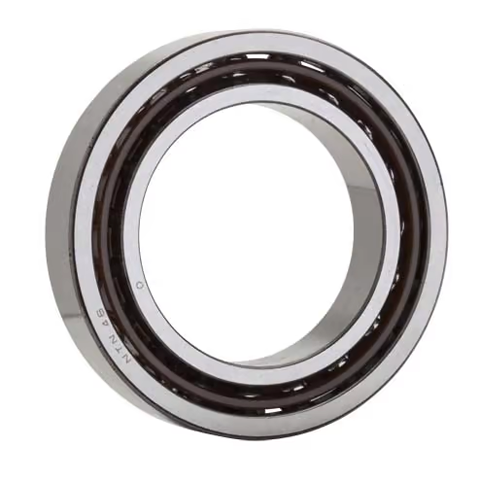
NTN NTN Angular Contact Bearing ,7004
Item # d D B r Static Load Rating Dynamic Load Rating 7004 0.7874 in 20.000 mm 1.6535 in 42.000 mm 0.4724 in 12.000 mm 0.0236 in 0.600 mm 1260 lbf 5600 N 5.60 kN 2180 lbf 9700 N 9.70 kN 1. Design features and characteristics 1.1 Angular contact ball bearing Angular contact ball bearings are non-separable bearings with a defined contact angle in the radial direction relative to the straight line that runs through the point where each ball makes contact with the inner and outer rings (see Fig. 1). Table 1 provides information on contact angles and their designated codes. In addition to radial loads, angular contact ball bearings can accommodate single direction axial loads. Since an axial load is generated from a radial force, these bearings are generally used in pairs. Table 2 shows general angular contact ball bearing characteristics, Table 3 shows information on using duplex (side by side) angular contact ball bearings, and Table 4 shows information on multiple-row angular contact ball bearings. For bearings with a contact angle of 15° and bearing tolerance JIS Class 5 or higher, see special catalog “Precision rolling bearings (CAT. No. 2260/E)”. 1.2 Four-point angular contact ball bearings Four-point angular contact ball bearings have a contact angle of 30° and a split inner ring. As shown in Fig. 2, when the inner and outer rings receive a radial load, the ball contacts the inner and outer rings at four points. This construction enables a single bearing to accommodate axial loads from either direction, and when under a simple axial load or heavy axial load, the bearing relies on two contact points like ordinary bearings. 1.3 Double row angular contact ball bearings The structure of double row angular contact ball bearings is designed by arranging two single row angular contact bearings back-to-back in duplex (DB) to form a single bearing with a contact angle of 25°.These bearings are capable of accommodating radial loads, axial loads in either direction, and have a high capacity for moment loads.As shown in Fig. 4, sealed and shielded type double row angular contact ball bearings are also available. Standard loads vary from those of open type bearings.
$11.18
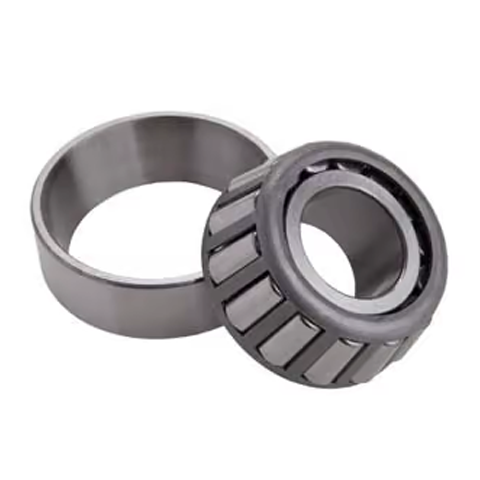
NTN NTN Tapered Roller Bearing Set - Metric Series, 30202
NTN 4T-30209 Single Row Tapered Roller Bearing (Inside Dia - 45mm, Outside Dia - 85mm) SPECIFICATIONS Type of Product : Single Row Tapered Roller Bearing Inside Diameter (d) (mm) : 45 Outside Diameter D (mm) : 85 Width Dia mm : 19 Model No : 4T-30209 1. Types, design features, and characteristics Tapered roller bearings are designed so the tapered vertex of the raceway surfaces of the inner and outer rings and rollers converge at one point on the centerline of the bearing (see Fig. 1).The tapered rollers are guided by the compound force of the inner and outer raceway surfaces which keep the rollers pressed up against the large rib on the inner ring.A large variety of these bearings, including single, double, and four row arrangements, are available in both metric and inch series. Each type and associated characteristics are shown in Table 1. For four-row tapered roller bearings, see section “C. Special application bearings.” Table 1 Tapered roller bearing types and characteristics Type Characteristics Single row taperedroller bearings (1) There are both metric and inch series adhering to the standards shown in the following table. Dimension series *Dimension series previously not covered by 3XX are regulated under JIS B 1512; dimensions previously missing from 3XX will henceforth use the bearing number. (2) In addition to the standard design, there are also medium contact angle and large contact angle types, denoted by the contact angle codes at the end of the part numbers (C and D, respectively). (3) Subunits Tapered roller bearings can be disassembled into parts: the inner ring, rollers, and cage (collectively known as the “CONE”) and the outer ring (known as the “CUP”). These are the bearing’s “subunits”. Subunit dimensions are standardized under ISO or ABMA standards, and unified subunits are interchangeable within each dimensional standard. However, high precision grade bearings are generally not interchangeable, and these subunits must be used by assembling only subunits with identical manufacturing numbers.Aside from any cautionary notes that may appear, the single row tapered roller bearings listed in the dimension tables have subunits standardized for both metric and inch systems (including J series). (Refer to Fig. 2) Single row taperedroller bearings (4) These bearings are constructed to have a high capacity for radial loads, axial loads, and combined loads. The larger the contact angle, the greater the axial load capacity. When a pure radial load is applied to a tapered roller bearing, an induced load in the axial direction is also generated, so these bearings are generally used in pairs.(5) Single row tapered roller bearings are separable, so both the inner and outer rings can be used with tight fits. (6) Tapered roller bearings are also manufactured with flanges attached to the outer rings. For more details, contact NTN Engineering. (Refer to Fig. 3) Duplex tapered roller bearings (1) When two single-row tapered roller bearings are to be used in combination, the bearing clearance and preload are adjusted by the inner ring spacer or the outer ring spacer (see Fig. 4).(2) A product number and a combination code are indicated on inner rings, outer rings, and spacers. Parts displaying the same number and code must be used in combination.(3) See A-96 Table 8.14 for the axial internal clearance. Double row taperedroller bearings (1) Back-to-back arrangement (using double row outer rings) and face-to-face arrangement (using double row inner rings) are both available. The assemblies have been adjusted so that each type's internal clearance values are fixed. Only parts with identical manufacturing numbers can be used and they must be assembled according to their code numbers. (Refer to Fig. 5)(2) See A-96 Table 8.14 for the axial internal clearance of double-row and duplex bearings. 2. Standard cage type In general, pressed cages (see Fig. 6) are used in tapered roller bearings. For large sized bearings, machined or pin type cages may also be used, while resin cages may also be used for smaller sized bearings. 3. Allowable misalignment In order to avoid edge loading and potential for premature failure, the maximum allowable misalignment based on bearing series can be found below.The allowable misalignment of combined bearings is influenced by the load center position, so please consult NTN Engineering.• Single row (standard) …………… 1/ 2 000• Single row (ULTAGE) …………… 1/ 600 4. Precautions If bearing load is light during operation, or if the ratio of axial to radial load for duplex and double row bearings exceeds the value of e, slipping may develop between the rollers and raceway surface, sometimes resulting in smearing. The mass of rollers and cages particularly tends to be large for large tapered roller bearings. For additional details, please contact NTN Engineering.In tapered roller bearings, the cage may protrude beyond the inner and/or outer ring side faces. Care should be taken when designing the housing and shaft to ensure contact with the cage does not occur.
$20.77
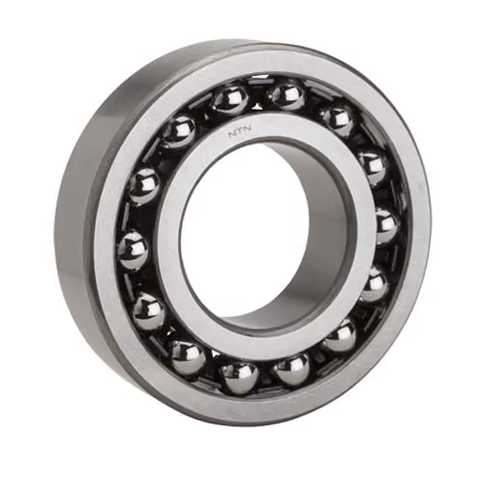
NTN NTN 1200 Self-Aligning Ball Bearing - Straight Bore, 10 mm ID, 30 mm OD, 9 mm Width, Open
NTN 1200 Self-Aligning Ball Bearing - Straight Bore, 10 mm ID, 30 mm OD, 9 mm Width, Open, CN SPECIFICATIONS Bore Type Cylindrical Bore Diameter 0.3937 in, 10.000 mm Outside Diameter 1.1811 in, 30.000 mm Overall Width 9.000 mm, 0.3543 in Closure Type Open Cage Type Fiber Glass Reinforced Internal Clearance CN Operating Temperature Range -40 to 250 ºF Seal Material None Dynamic Load Capacity 1250 lbf Seal Type None Static Load Capacity 268 lbf Precision Rating Class 0 Maximum RPM 28000 rpm Bearing Material High Carbon Chrome Steel Cage Material Nylon Finish/Coating Uncoated Harmonization Code 8482.10.5060 Outer Ring Width 0.3543 in; 9.000 mm Inner Ring Width 9.000 mm, 0.3543 in Fillet Radius 0.600 mm, 0.0236 in Series 12 Manufacturer UPC Number 4547359512946 Weight 0.071 lb 1. Design features and characteristics The outer ring raceway of self-aligning ball bearings forms a spherical surface whose center is common to the bearing center. The inner ring of the bearing has two raceways.The balls, cage, and inner ring of these bearings are capable of shifting in order to compensate for a certain degree of misalignment with the outer rings. As a result, the bearing is able to align itself and compensate for shaft / housing finishing unevenness, bearing fitting error, and other sources of misalignment as shown in Fig. 1.Since axial load capacity is limited, self- aligning ball bearing are not suitable for applications with heavy axial loads. It is recommended to use an adapter on a self-aligning ball bearing with a tapered bore inner diameter for ease of installation and disassembly. These bearings and adapters are often used on drive shaft applications. 2. Standard cage type All bearing series are equipped with a pressed cage, except 2321S and 2322S, which are equipped with a machined cage.Self-Aligning Ball BearingsIt is recommended to use an adapter on a self-aligning ball bearing with a tapered bore inner diameter for ease of installation and disassembly. These bearings and adapters are often used on drive shaft applications. Table 1 Standard cage types of spherical ball bearings 3. Ball protrusion Bearings with part numbers listed in Table 2 below have balls which protrude slightly from the bearing face as illustrated in Fig. 2. The total width dimensions are shown in Table 2. 4. Allowable misalignment angle The allowable misalignment angle can be determined by the following function. This degree of allowable misalignment may be limited by the design of mating components around the bearing.Normal load ....................... 1/15 5. Precautions for using self-aligning ball bearings Self-aligning ball bearings are unable to support large axial loads and therefore axial loading shall be limited.Please consider using self-aligning roller bearings when a large axial load is to be applied.
$6.22
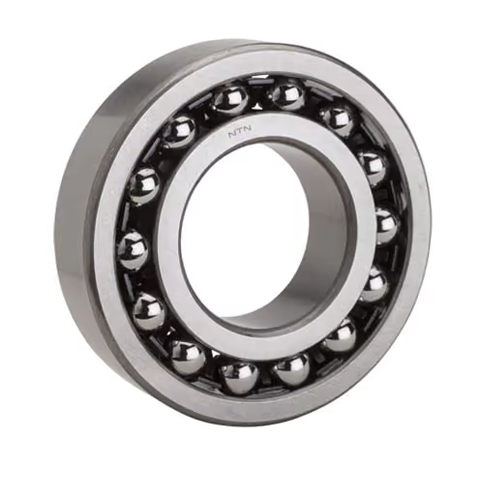
NTN NTN 1201 Self-Aligning Ball Bearing - Straight Bore, 12 mm ID, 32 mm OD, 10 mm Width, Open,
NTN 1201 Self-Aligning Ball Bearing - Straight Bore, 12 mm ID, 32 mm OD, 10 mm Width, Open, CN SPECIFICATIONS Bore Type Cylindrical Bore Diameter 0.4724 in, 12.000 mm Outside Diameter 1.2598 in, 32.000 mm Overall Width 0.3937 in, 10.000 mm Closure Type Open Cage Type Fiber Glass Reinforced Internal Clearance CN Operating Temperature Range -40 to 250 ºF Seal Material None Dynamic Load Capacity 1280 lbf Seal Type None Static Load Capacity 286 lbf Precision Rating Class 0 Maximum RPM 26000 rpm Bearing Material High Carbon Chrome Steel Cage Material Nylon Finish/Coating Uncoated Harmonization Code 8482.10.5060 Outer Ring Width 0.3937 in; 10.000 mm Inner Ring Width 0.3937 in, 10.000 mm Fillet Radius 0.600 mm, 0.0236 in Series 12 Manufacturer UPC Number 4547359512953 Weight 0.090 lb 1. Design features and characteristics The outer ring raceway of self-aligning ball bearings forms a spherical surface whose center is common to the bearing center. The inner ring of the bearing has two raceways.The balls, cage, and inner ring of these bearings are capable of shifting in order to compensate for a certain degree of misalignment with the outer rings. As a result, the bearing is able to align itself and compensate for shaft / housing finishing unevenness, bearing fitting error, and other sources of misalignment as shown in Fig. 1.Since axial load capacity is limited, self- aligning ball bearing are not suitable for applications with heavy axial loads. It is recommended to use an adapter on a self-aligning ball bearing with a tapered bore inner diameter for ease of installation and disassembly. These bearings and adapters are often used on drive shaft applications. 2. Standard cage type All bearing series are equipped with a pressed cage, except 2321S and 2322S, which are equipped with a machined cage.Self-Aligning Ball BearingsIt is recommended to use an adapter on a self-aligning ball bearing with a tapered bore inner diameter for ease of installation and disassembly. These bearings and adapters are often used on drive shaft applications. Table 1 Standard cage types of spherical ball bearings 3. Ball protrusion Bearings with part numbers listed in Table 2 below have balls which protrude slightly from the bearing face as illustrated in Fig. 2. The total width dimensions are shown in Table 2. 4. Allowable misalignment angle The allowable misalignment angle can be determined by the following function. This degree of allowable misalignment may be limited by the design of mating components around the bearing.Normal load ....................... 1/15 5. Precautions for using self-aligning ball bearings Self-aligning ball bearings are unable to support large axial loads and therefore axial loading shall be limited.Please consider using self-aligning roller bearings when a large axial load is to be applied.
$6.50
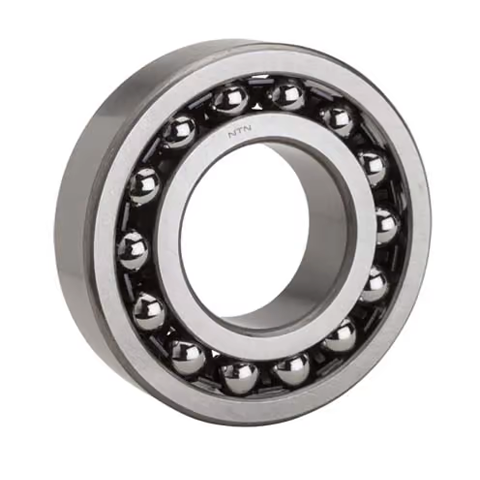
NTN NTN 1205 Self-Aligning Ball Bearing - Straight Bore, 25 mm ID, 52 mm OD, 15 mm Width, Open
NTN 1205 Self-Aligning Ball Bearing - Straight Bore, 25 mm ID, 52 mm OD, 15 mm Width, Open, CN SPECIFICATIONS Bore Type Cylindrical Bore Diameter 0.9843 in, 25.000 mm Outside Diameter 52.000 mm, 2.0472 in Overall Width 15.000 mm, 0.5906 in Closure Type Open Cage Type Fiber Glass Reinforced Internal Clearance CN Operating Temperature Range -40 to 250 ºF Seal Material None Dynamic Load Capacity 2740 lbf Seal Type None Static Load Capacity 740 lbf Precision Rating Class 0 Maximum RPM 14000 rpm Bearing Material High Carbon Chrome Steel Cage Material Nylon Finish/Coating Uncoated Harmonization Code 8482.10.5060 Outer Ring Width 0.5906 in; 15.000 mm Inner Ring Width 15.000 mm, 0.5906 in Fillet Radius 1.000 mm, 0.0394 in Series 12 Manufacturer UPC Number 4547359254822 Weight 0.291 lb 1. Design features and characteristics The outer ring raceway of self-aligning ball bearings forms a spherical surface whose center is common to the bearing center. The inner ring of the bearing has two raceways.The balls, cage, and inner ring of these bearings are capable of shifting in order to compensate for a certain degree of misalignment with the outer rings. As a result, the bearing is able to align itself and compensate for shaft / housing finishing unevenness, bearing fitting error, and other sources of misalignment as shown in Fig. 1.Since axial load capacity is limited, self- aligning ball bearing are not suitable for applications with heavy axial loads. It is recommended to use an adapter on a self-aligning ball bearing with a tapered bore inner diameter for ease of installation and disassembly. These bearings and adapters are often used on drive shaft applications. 2. Standard cage type All bearing series are equipped with a pressed cage, except 2321S and 2322S, which are equipped with a machined cage.Self-Aligning Ball BearingsIt is recommended to use an adapter on a self-aligning ball bearing with a tapered bore inner diameter for ease of installation and disassembly. These bearings and adapters are often used on drive shaft applications. Table 1 Standard cage types of spherical ball bearings 3. Ball protrusion Bearings with part numbers listed in Table 2 below have balls which protrude slightly from the bearing face as illustrated in Fig. 2. The total width dimensions are shown in Table 2. 4. Allowable misalignment angle The allowable misalignment angle can be determined by the following function. This degree of allowable misalignment may be limited by the design of mating components around the bearing.Normal load ....................... 1/15 5. Precautions for using self-aligning ball bearings Self-aligning ball bearings are unable to support large axial loads and therefore axial loading shall be limited.Please consider using self-aligning roller bearings when a large axial load is to be applied.
$10.00
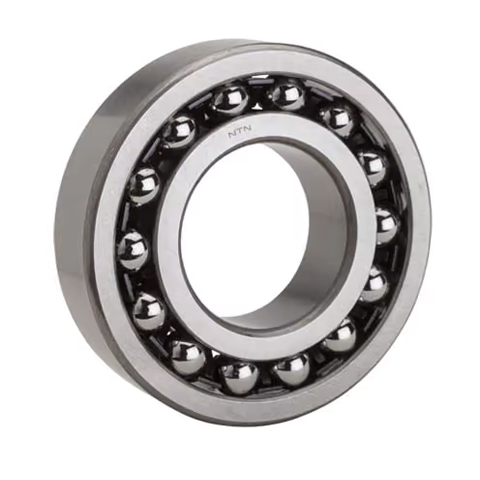
NTN NTN 1205K Self-Aligning Ball Bearing - Taper 1:12, 25 mm
NTN 1205K Self-Aligning Ball Bearing - Taper 1:12, 25 mm ID, 52 mm OD, 15 mm Width, Open, CN SPECIFICATIONS Bore Type Tapered Bore Diameter 0.9843 in, 25.000 mm Outside Diameter 52.000 mm, 2.0472 in Overall Width 15.000 mm, 0.5906 in Closure Type Open Cage Type Fiber Glass Reinforced Internal Clearance CN Operating Temperature Range -40 to 250 ºF Seal Material None Dynamic Load Capacity 2740 lbf Seal Type None Static Load Capacity 740 lbf Precision Rating Class 0 Maximum RPM 14000 rpm Bearing Material High Carbon Chrome Steel Cage Material Nylon Finish/Coating Uncoated Harmonization Code 8482.10.5060 Outer Ring Width 0.5906 in; 15.000 mm Inner Ring Width 15.000 mm, 0.5906 in Fillet Radius 1.000 mm, 0.0394 in Manufacturer UPC Number 4547359254877 Weight 0.289 lb 1. Design features and characteristics The outer ring raceway of self-aligning ball bearings forms a spherical surface whose center is common to the bearing center. The inner ring of the bearing has two raceways.The balls, cage, and inner ring of these bearings are capable of shifting in order to compensate for a certain degree of misalignment with the outer rings. As a result, the bearing is able to align itself and compensate for shaft / housing finishing unevenness, bearing fitting error, and other sources of misalignment as shown in Fig. 1.Since axial load capacity is limited, self- aligning ball bearing are not suitable for applications with heavy axial loads. It is recommended to use an adapter on a self-aligning ball bearing with a tapered bore inner diameter for ease of installation and disassembly. These bearings and adapters are often used on drive shaft applications. 2. Standard cage type All bearing series are equipped with a pressed cage, except 2321S and 2322S, which are equipped with a machined cage.Self-Aligning Ball BearingsIt is recommended to use an adapter on a self-aligning ball bearing with a tapered bore inner diameter for ease of installation and disassembly. These bearings and adapters are often used on drive shaft applications. Table 1 Standard cage types of spherical ball bearings 3. Ball protrusion Bearings with part numbers listed in Table 2 below have balls which protrude slightly from the bearing face as illustrated in Fig. 2. The total width dimensions are shown in Table 2. 4. Allowable misalignment angle The allowable misalignment angle can be determined by the following function. This degree of allowable misalignment may be limited by the design of mating components around the bearing.Normal load ....................... 1/15 5. Precautions for using self-aligning ball bearings Self-aligning ball bearings are unable to support large axial loads and therefore axial loading shall be limited.Please consider using self-aligning roller bearings when a large axial load is to be applied.
$11.30
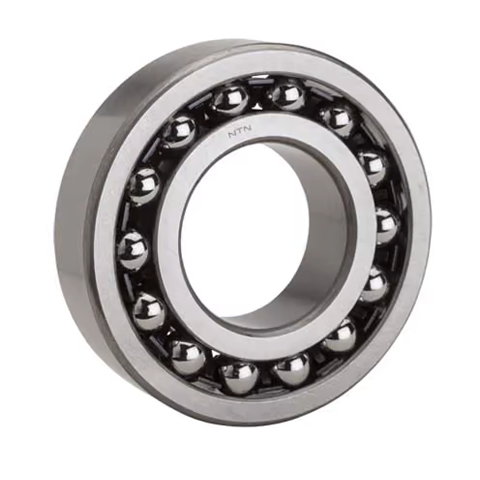
NTN NTN 1206K Self-Aligning Ball Bearing - Taper 1:12, 30 mm
NTN 1206K Self-Aligning Ball Bearing - Taper 1:12, 30 mm ID, 62 mm OD, 16 mm Width, Open, CN SPECIFICATIONS Bore Type Tapered Bore Diameter 1.1811 in, 30.000 mm Outside Diameter 62.000 mm, 2.4409 in Overall Width 16.000 mm, 0.6299 in Closure Type Open Cage Type Fiber Glass Reinforced Internal Clearance CN Operating Temperature Range -40 to 250 ºF Seal Material None Dynamic Load Capacity 3550 lbf Seal Type None Static Load Capacity 1050 lbf Precision Rating Class 0 Maximum RPM 12000 rpm Bearing Material High Carbon Chrome Steel Cage Material Nylon Finish/Coating Uncoated Harmonization Code 8482.10.5060 Outer Ring Width 0.6299 in; 16.000 mm Inner Ring Width 16.000 mm, 0.6299 in Fillet Radius 1.000 mm, 0.0394 in Manufacturer UPC Number 4547359254945 Weight 0.474 lb 1. Design features and characteristics The outer ring raceway of self-aligning ball bearings forms a spherical surface whose center is common to the bearing center. The inner ring of the bearing has two raceways.The balls, cage, and inner ring of these bearings are capable of shifting in order to compensate for a certain degree of misalignment with the outer rings. As a result, the bearing is able to align itself and compensate for shaft / housing finishing unevenness, bearing fitting error, and other sources of misalignment as shown in Fig. 1.Since axial load capacity is limited, self- aligning ball bearing are not suitable for applications with heavy axial loads. It is recommended to use an adapter on a self-aligning ball bearing with a tapered bore inner diameter for ease of installation and disassembly. These bearings and adapters are often used on drive shaft applications. 2. Standard cage type All bearing series are equipped with a pressed cage, except 2321S and 2322S, which are equipped with a machined cage.Self-Aligning Ball BearingsIt is recommended to use an adapter on a self-aligning ball bearing with a tapered bore inner diameter for ease of installation and disassembly. These bearings and adapters are often used on drive shaft applications. Table 1 Standard cage types of spherical ball bearings 3. Ball protrusion Bearings with part numbers listed in Table 2 below have balls which protrude slightly from the bearing face as illustrated in Fig. 2. The total width dimensions are shown in Table 2. 4. Allowable misalignment angle The allowable misalignment angle can be determined by the following function. This degree of allowable misalignment may be limited by the design of mating components around the bearing.Normal load ....................... 1/15 5. Precautions for using self-aligning ball bearings Self-aligning ball bearings are unable to support large axial loads and therefore axial loading shall be limited.Please consider using self-aligning roller bearings when a large axial load is to be applied.
$13.90
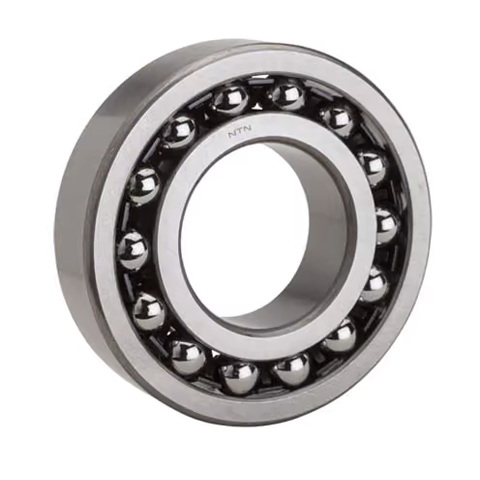
NTN NTN 1207K Self-Aligning Ball Bearing - Taper 1:12, 35 mm
NTN 1207K Self-Aligning Ball Bearing - Taper 1:12, 35 mm ID, 72 mm OD, 17 mm Width, Open, CN SPECIFICATIONS Bore Type Tapered Bore Diameter 35.000 mm, 1.3780 in Outside Diameter 72.000 mm, 2.8346 in Overall Width 17.000 mm, 0.6693 in Closure Type Open Cage Type Pressed Internal Clearance CN Operating Temperature Range -40 to 250 ºF Seal Material None Dynamic Load Capacity 3550 lbf Seal Type None Static Load Capacity 1150 lbf Precision Rating Class 0 Maximum RPM 10000 rpm Bearing Material High Carbon Chrome Steel Cage Material Steel Finish/Coating Uncoated Harmonization Code 8482.10.5060 Outer Ring Width 0.6693 in; 17.000 mm Inner Ring Width 17.000 mm, 0.6693 in Fillet Radius 1.100 mm, 0.0433 in Manufacturer UPC Number 4547359513172 Weight 0.694 lb 1. Design features and characteristics The outer ring raceway of self-aligning ball bearings forms a spherical surface whose center is common to the bearing center. The inner ring of the bearing has two raceways.The balls, cage, and inner ring of these bearings are capable of shifting in order to compensate for a certain degree of misalignment with the outer rings. As a result, the bearing is able to align itself and compensate for shaft / housing finishing unevenness, bearing fitting error, and other sources of misalignment as shown in Fig. 1.Since axial load capacity is limited, self- aligning ball bearing are not suitable for applications with heavy axial loads. It is recommended to use an adapter on a self-aligning ball bearing with a tapered bore inner diameter for ease of installation and disassembly. These bearings and adapters are often used on drive shaft applications. 2. Standard cage type All bearing series are equipped with a pressed cage, except 2321S and 2322S, which are equipped with a machined cage.Self-Aligning Ball BearingsIt is recommended to use an adapter on a self-aligning ball bearing with a tapered bore inner diameter for ease of installation and disassembly. These bearings and adapters are often used on drive shaft applications. Table 1 Standard cage types of spherical ball bearings 3. Ball protrusion Bearings with part numbers listed in Table 2 below have balls which protrude slightly from the bearing face as illustrated in Fig. 2. The total width dimensions are shown in Table 2. 4. Allowable misalignment angle The allowable misalignment angle can be determined by the following function. This degree of allowable misalignment may be limited by the design of mating components around the bearing.Normal load ....................... 1/15 5. Precautions for using self-aligning ball bearings Self-aligning ball bearings are unable to support large axial loads and therefore axial loading shall be limited.Please consider using self-aligning roller bearings when a large axial load is to be applied.
$15.75
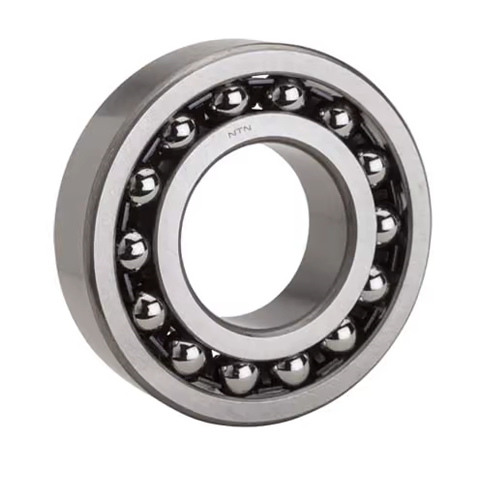
NTN NTN 1208K Self-Aligning Ball Bearing - Taper 1:12, 40 mm
NTN 1208K Self-Aligning Ball Bearing - Taper 1:12, 40 mm ID, 80 mm OD, 18 mm Width, Open, CN SPECIFICATIONS Bore Type Tapered Bore Diameter 1.5748 in, 40.000 mm Outside Diameter 3.1496 in, 80.000 mm Overall Width 18.000 mm, 0.7087 in Closure Type Open Cage Type Pressed Internal Clearance CN Operating Temperature Range -40 to 250 ºF Seal Material None Dynamic Load Capacity 4350 lbf Seal Type None Static Load Capacity 1460 lbf Precision Rating Class 0 Maximum RPM 9000 rpm Bearing Material High Carbon Chrome Steel Cage Material Steel Finish/Coating Uncoated Harmonization Code 8482.10.5060 Outer Ring Width 0.7087 in; 18.000 mm Inner Ring Width 18.000 mm, 0.7087 in Fillet Radius 1.100 mm, 0.0433 in Manufacturer UPC Number 4547359513271 Weight 0.899 lb 1. Design features and characteristics The outer ring raceway of self-aligning ball bearings forms a spherical surface whose center is common to the bearing center. The inner ring of the bearing has two raceways.The balls, cage, and inner ring of these bearings are capable of shifting in order to compensate for a certain degree of misalignment with the outer rings. As a result, the bearing is able to align itself and compensate for shaft / housing finishing unevenness, bearing fitting error, and other sources of misalignment as shown in Fig. 1.Since axial load capacity is limited, self- aligning ball bearing are not suitable for applications with heavy axial loads. It is recommended to use an adapter on a self-aligning ball bearing with a tapered bore inner diameter for ease of installation and disassembly. These bearings and adapters are often used on drive shaft applications. 2. Standard cage type All bearing series are equipped with a pressed cage, except 2321S and 2322S, which are equipped with a machined cage.Self-Aligning Ball BearingsIt is recommended to use an adapter on a self-aligning ball bearing with a tapered bore inner diameter for ease of installation and disassembly. These bearings and adapters are often used on drive shaft applications. Table 1 Standard cage types of spherical ball bearings 3. Ball protrusion Bearings with part numbers listed in Table 2 below have balls which protrude slightly from the bearing face as illustrated in Fig. 2. The total width dimensions are shown in Table 2. 4. Allowable misalignment angle The allowable misalignment angle can be determined by the following function. This degree of allowable misalignment may be limited by the design of mating components around the bearing.Normal load ....................... 1/15 5. Precautions for using self-aligning ball bearings Self-aligning ball bearings are unable to support large axial loads and therefore axial loading shall be limited.Please consider using self-aligning roller bearings when a large axial load is to be applied.
$19.77
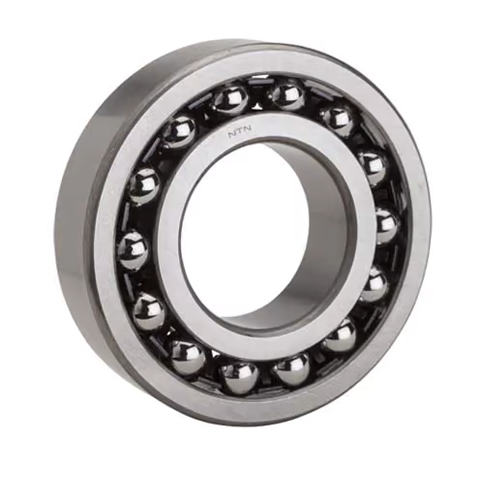
NTN NTN 1216 Self-Aligning Ball Bearing - Straight Bore, 80 mm ID, 140 mm OD, 26 mm Width, Open
NTN 1216 Self-Aligning Ball Bearing - Straight Bore, 80 mm ID, 140 mm OD, 26 mm Width, Open, CN SPECIFICATIONS Bore Type Cylindrical Bore Diameter 3.1496 in, 80.000 mm Outside Diameter 140.000 mm, 5.5118 in Overall Width 26.000 mm, 1.0236 in Closure Type Open Cage Type Pressed Internal Clearance CN Operating Temperature Range -40 to 250 ºF Seal Material None Dynamic Load Capacity 9000 lbf Seal Type None Static Load Capacity 3800 lbf Precision Rating Class 0 Maximum RPM 5000 rpm Bearing Material High Carbon Chrome Steel Cage Material Steel Finish/Coating Uncoated Harmonization Code 8482.10.5060 Outer Ring Width 1.0236 in; 26.000 mm Inner Ring Width 26.000 mm, 1.0236 in Fillet Radius 2.000 mm, 0.0787 in Manufacturer UPC Number 4547359255850 Weight 3.629 lb 1. Design features and characteristics The outer ring raceway of self-aligning ball bearings forms a spherical surface whose center is common to the bearing center. The inner ring of the bearing has two raceways.The balls, cage, and inner ring of these bearings are capable of shifting in order to compensate for a certain degree of misalignment with the outer rings. As a result, the bearing is able to align itself and compensate for shaft / housing finishing unevenness, bearing fitting error, and other sources of misalignment as shown in Fig. 1.Since axial load capacity is limited, self- aligning ball bearing are not suitable for applications with heavy axial loads. It is recommended to use an adapter on a self-aligning ball bearing with a tapered bore inner diameter for ease of installation and disassembly. These bearings and adapters are often used on drive shaft applications. 2. Standard cage type All bearing series are equipped with a pressed cage, except 2321S and 2322S, which are equipped with a machined cage.Self-Aligning Ball BearingsIt is recommended to use an adapter on a self-aligning ball bearing with a tapered bore inner diameter for ease of installation and disassembly. These bearings and adapters are often used on drive shaft applications. Table 1 Standard cage types of spherical ball bearings 3. Ball protrusion Bearings with part numbers listed in Table 2 below have balls which protrude slightly from the bearing face as illustrated in Fig. 2. The total width dimensions are shown in Table 2. 4. Allowable misalignment angle The allowable misalignment angle can be determined by the following function. This degree of allowable misalignment may be limited by the design of mating components around the bearing.Normal load ....................... 1/15 5. Precautions for using self-aligning ball bearings Self-aligning ball bearings are unable to support large axial loads and therefore axial loading shall be limited.Please consider using self-aligning roller bearings when a large axial load is to be applied.
$61.16
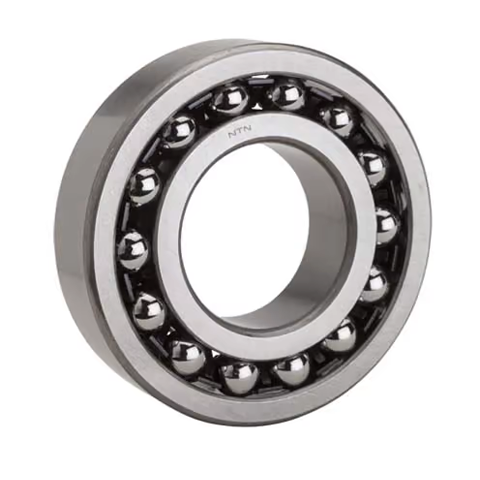
NTN NTN 1305K Self-Aligning Ball Bearing - 25 mm
NTN1305K Self Aligning Ball Bearings w/ Tapered Bore SPECIFICATIONS Bore Type Tapered Bore Diameter 25 mm, 0.9843 in Outside Diameter 62 mm, 2.4409 in Overall Width 17 mm, 0.6693 in Closure Type Open Cage Type Pressed Internal Clearance CN Operating Temperature Range -40 to 250 ºF Seal Material None Dynamic Load Capacity 4100 lbf Seal Type None Static Load Capacity 1120 lbf Precision Rating Class 0 Maximum RPM 13000 rpm Bearing Material High Carbon Chrome Steel Cage Material Steel Harmonization Code 8482.10.5060 Outer Ring Width 0.6693 in; 17.000 mm Inner Ring Width 17.000 mm, 0.6693 in Fillet Radius 1.100 mm, 0.0433 in Manufacturer UPC Number 4547359746303 Weight 0.553 lb 1. Design features and characteristics The outer ring raceway of self-aligning ball bearings forms a spherical surface whose center is common to the bearing center. The inner ring of the bearing has two raceways.The balls, cage, and inner ring of these bearings are capable of shifting in order to compensate for a certain degree of misalignment with the outer rings. As a result, the bearing is able to align itself and compensate for shaft / housing finishing unevenness, bearing fitting error, and other sources of misalignment as shown in Fig. 1.Since axial load capacity is limited, self- aligning ball bearing are not suitable for applications with heavy axial loads. It is recommended to use an adapter on a self-aligning ball bearing with a tapered bore inner diameter for ease of installation and disassembly. These bearings and adapters are often used on drive shaft applications. 2. Standard cage type All bearing series are equipped with a pressed cage, except 2321S and 2322S, which are equipped with a machined cage.Self-Aligning Ball BearingsIt is recommended to use an adapter on a self-aligning ball bearing with a tapered bore inner diameter for ease of installation and disassembly. These bearings and adapters are often used on drive shaft applications. Table 1 Standard cage types of spherical ball bearings 3. Ball protrusion Bearings with part numbers listed in Table 2 below have balls which protrude slightly from the bearing face as illustrated in Fig. 2. The total width dimensions are shown in Table 2. 4. Allowable misalignment angle The allowable misalignment angle can be determined by the following function. This degree of allowable misalignment may be limited by the design of mating components around the bearing.Normal load ....................... 1/15 5. Precautions for using self-aligning ball bearings Self-aligning ball bearings are unable to support large axial loads and therefore axial loading shall be limited.Please consider using self-aligning roller bearings when a large axial load is to be applied.
$15.41

NTN NTN 1310 Self-Aligning Ball Bearing - Straight Bore, 50 mm ID, 110 mm OD, 27 mm Width, Open
NTN 1310 Self-Aligning Ball Bearing - Straight Bore, 50 mm ID, 110 mm OD, 27 mm Width, Open, CN SPECIFICATIONS Bore Type Cylindrical Bore Diameter 1.9685 in, 50.000 mm Outside Diameter 110.000 mm, 4.3307 in Overall Width 27.000 mm, 1.0630 in Closure Type Open Cage Type Pressed Internal Clearance CN Operating Temperature Range -40 to 250 ºF Seal Material None Dynamic Load Capacity 9800 lbf Seal Type None Static Load Capacity 3150 lbf Precision Rating Class 0 Maximum RPM 6700 rpm Bearing Material High Carbon Chrome Steel Cage Material Steel Finish/Coating Uncoated Harmonization Code 8482.10.5060 Outer Ring Width 1.0630 in; 27.000 mm Inner Ring Width 27.000 mm, 1.0630 in Fillet Radius 2.000 mm, 0.0787 in Series 13 Manufacturer UPC Number 4547359256789 Weight 2.635 lb 1. Design features and characteristics The outer ring raceway of self-aligning ball bearings forms a spherical surface whose center is common to the bearing center. The inner ring of the bearing has two raceways.The balls, cage, and inner ring of these bearings are capable of shifting in order to compensate for a certain degree of misalignment with the outer rings. As a result, the bearing is able to align itself and compensate for shaft / housing finishing unevenness, bearing fitting error, and other sources of misalignment as shown in Fig. 1.Since axial load capacity is limited, self- aligning ball bearing are not suitable for applications with heavy axial loads. It is recommended to use an adapter on a self-aligning ball bearing with a tapered bore inner diameter for ease of installation and disassembly. These bearings and adapters are often used on drive shaft applications. 2. Standard cage type All bearing series are equipped with a pressed cage, except 2321S and 2322S, which are equipped with a machined cage.Self-Aligning Ball BearingsIt is recommended to use an adapter on a self-aligning ball bearing with a tapered bore inner diameter for ease of installation and disassembly. These bearings and adapters are often used on drive shaft applications. Table 1 Standard cage types of spherical ball bearings 3. Ball protrusion Bearings with part numbers listed in Table 2 below have balls which protrude slightly from the bearing face as illustrated in Fig. 2. The total width dimensions are shown in Table 2. 4. Allowable misalignment angle The allowable misalignment angle can be determined by the following function. This degree of allowable misalignment may be limited by the design of mating components around the bearing.Normal load ....................... 1/15 5. Precautions for using self-aligning ball bearings Self-aligning ball bearings are unable to support large axial loads and therefore axial loading shall be limited.Please consider using self-aligning roller bearings when a large axial load is to be applied.
$37.57

NTN NTN 1318K Self-Aligning Ball Bearing - Taper 1:12, 90 mm
NTN 1318K Self-Aligning Ball Bearing - Taper 1:12, 90 mm ID, 190 mm OD, 43 mm Width, Open, CN SPECIFICATIONS Bore Type Tapered Bore Diameter 90.000 mm, 3.5433 in Outside Diameter 190.000 mm, 7.4803 in Overall Width 43.000 mm, 1.6929 in Closure Type Open Cage Type Pressed Internal Clearance CN Operating Temperature Range -40 to 250 ºF Seal Material None Dynamic Load Capacity 26300 lbf Seal Type None Static Load Capacity 10000 lbf Precision Rating Class 0 Maximum RPM 3800 rpm Bearing Material High Carbon Chrome Steel Cage Material Steel Finish/Coating Uncoated Harmonization Code 8482.10.5060 Outer Ring Width 1.6929 in; 43.000 mm Inner Ring Width 43.000 mm, 1.6929 in Fillet Radius 0.1181 in, 3.000 mm Manufacturer UPC Number 4547359257373 Weight 12.474 lb 1. Design features and characteristics The outer ring raceway of self-aligning ball bearings forms a spherical surface whose center is common to the bearing center. The inner ring of the bearing has two raceways.The balls, cage, and inner ring of these bearings are capable of shifting in order to compensate for a certain degree of misalignment with the outer rings. As a result, the bearing is able to align itself and compensate for shaft / housing finishing unevenness, bearing fitting error, and other sources of misalignment as shown in Fig. 1.Since axial load capacity is limited, self- aligning ball bearing are not suitable for applications with heavy axial loads. It is recommended to use an adapter on a self-aligning ball bearing with a tapered bore inner diameter for ease of installation and disassembly. These bearings and adapters are often used on drive shaft applications. 2. Standard cage type All bearing series are equipped with a pressed cage, except 2321S and 2322S, which are equipped with a machined cage.Self-Aligning Ball BearingsIt is recommended to use an adapter on a self-aligning ball bearing with a tapered bore inner diameter for ease of installation and disassembly. These bearings and adapters are often used on drive shaft applications. Table 1 Standard cage types of spherical ball bearings 3. Ball protrusion Bearings with part numbers listed in Table 2 below have balls which protrude slightly from the bearing face as illustrated in Fig. 2. The total width dimensions are shown in Table 2. 4. Allowable misalignment angle The allowable misalignment angle can be determined by the following function. This degree of allowable misalignment may be limited by the design of mating components around the bearing.Normal load ....................... 1/15 5. Precautions for using self-aligning ball bearings Self-aligning ball bearings are unable to support large axial loads and therefore axial loading shall be limited.Please consider using self-aligning roller bearings when a large axial load is to be applied.
$225.77

NTN NTN 21308CD1C3 Spherical Roller Bearing - 40 mm
NTN 21308CD1C3 • Specification: Standard• Standard Size: Metric Series• Load Direction: Radial• Raceway Ring Shape: Self-Aligning Roller• Number Of Raceway Ring Rows: Double Row SPECIFICATIONS Raceway Ring Shape Self-aligning roller Load Direction Radial I.D. d(Ø) 40 O.D. D(Ø) 90 Width B(mm) 23 Inner/Outer Ring Material Steel Number Of Raceway Ring Rows Double Row Standard Size Metric System Specifications/Environment Standard Rolling Element Material Steel Outer Ring Type Flat Retainer Type Punching Basic Load Rating, Dynamic Rating(N) 88000 Bearing Ring With Oil Hole, Oil Groove Internal Clearance Symbol C3 Shaft Bore Config. Cylindrical Bore Type of momi removing - Symbol of Bearing Ring Shape - Revolution Frequency(rpm) 4900 Series C Shape JAN Code - Ordering Code - Mass(g) - RoHS 10 1. Design features and characteristics Spherical roller bearings consist of an outer ring having a continuous spherical raceway and two rows of barrel-shaped rollers guided by an inner ring with two raceways. (Refer to Fig. 1) This bearing has self-aligning properties, and therefore is suited for use where misalignment between the inner and outer rings occurs from housing installation error or shaft bending. Spherical roller bearings have a large capacity for radial loads, axial loads in either direction, and combined loads. They are also suited for applications where vibration and shock loads are encountered. When spherical roller bearings are used with a vertical shaft or under a large axial load, the load on the rollers of the row that is not subject to the axial load becomes small, and the resulting skidding on the rollers may result in wear. If the ratio of the axial load to the radial load exceeds the factor e in the dimension table (Fa/Fr > e), consult NTN Engineering.In addition to spherical roller bearings with cylindrical bores, spherical roller bearings with tapered bores are also available. Bearings with tapered bores are specified by the suffix “K” at the end of the spherical roller bearing part number. The standard taper ratio is 1:12 for bearings with a “K” suffix; for bearings in series 240 and 241, the suffix “K30” indicates the taper ratio for a bearing is 1:30. Most tapered bore bearings incorporate the use of adapters and withdrawal sleeves for shaft mounting.
$72.94

NTN NTN 21309CD1 Spherical Roller Bearing - 45 mm
NTN 21308CD1C3 • Specification: Standard• Standard Size: Metric Series• Load Direction: Radial• Raceway Ring Shape: Self-Aligning Roller• Number Of Raceway Ring Rows: Double Row SPECIFICATIONS Raceway Ring Shape Self-aligning roller Load Direction Radial I.D. d(Ø) 45 O.D. D(Ø) 100 Width B(mm) 25 Inner/Outer Ring Material Steel Number Of Raceway Ring Rows Double Row Standard Size Metric System Specifications/Environment Standard Rolling Element Material Steel Outer Ring Type Flat Retainer Type Punching Basic Load Rating, Dynamic Rating(N) 102000 Bearing Ring With Oil Hole, Oil Groove Internal Clearance Symbol No Shaft Bore Config. Cylindrical Bore Type of momi removing - Symbol of Bearing Ring Shape - Revolution Frequency(rpm) 4400 Series C Shape JAN Code - Ordering Code - Mass(g) - RoHS 10 1. Design features and characteristics Spherical roller bearings consist of an outer ring having a continuous spherical raceway and two rows of barrel-shaped rollers guided by an inner ring with two raceways. (Refer to Fig. 1) This bearing has self-aligning properties, and therefore is suited for use where misalignment between the inner and outer rings occurs from housing installation error or shaft bending. Spherical roller bearings have a large capacity for radial loads, axial loads in either direction, and combined loads. They are also suited for applications where vibration and shock loads are encountered. When spherical roller bearings are used with a vertical shaft or under a large axial load, the load on the rollers of the row that is not subject to the axial load becomes small, and the resulting skidding on the rollers may result in wear. If the ratio of the axial load to the radial load exceeds the factor e in the dimension table (Fa/Fr > e), consult NTN Engineering.In addition to spherical roller bearings with cylindrical bores, spherical roller bearings with tapered bores are also available. Bearings with tapered bores are specified by the suffix “K” at the end of the spherical roller bearing part number. The standard taper ratio is 1:12 for bearings with a “K” suffix; for bearings in series 240 and 241, the suffix “K30” indicates the taper ratio for a bearing is 1:30. Most tapered bore bearings incorporate the use of adapters and withdrawal sleeves for shaft mounting.
$79.63

NTN NTN 21310CKD1 Spherical Roller Bearing D= 50mm
NTN 21310CKD1 Spherical Roller Bearing D= 50mm • Features Type of Product : Spherical Roller Bearing Inside Diameter (d) (mm) : 50 Outside Diameter D (mm) : 110 Width Dia mm : 27 Model No : 21310CKD1 SPECIFICATIONS 1. Design features and characteristics Spherical roller bearings consist of an outer ring having a continuous spherical raceway and two rows of barrel-shaped rollers guided by an inner ring with two raceways. (Refer to Fig. 1) This bearing has self-aligning properties, and therefore is suited for use where misalignment between the inner and outer rings occurs from housing installation error or shaft bending. Spherical roller bearings have a large capacity for radial loads, axial loads in either direction, and combined loads. They are also suited for applications where vibration and shock loads are encountered. When spherical roller bearings are used with a vertical shaft or under a large axial load, the load on the rollers of the row that is not subject to the axial load becomes small, and the resulting skidding on the rollers may result in wear. If the ratio of the axial load to the radial load exceeds the factor e in the dimension table (Fa/Fr > e), consult NTN Engineering.In addition to spherical roller bearings with cylindrical bores, spherical roller bearings with tapered bores are also available. Bearings with tapered bores are specified by the suffix “K” at the end of the spherical roller bearing part number. The standard taper ratio is 1:12 for bearings with a “K” suffix; for bearings in series 240 and 241, the suffix “K30” indicates the taper ratio for a bearing is 1:30. Most tapered bore bearings incorporate the use of adapters and withdrawal sleeves for shaft mounting.
$86.03

NTN NTN 21310CKD1C3 Spherical Roller Bearing D= 50mm
NTN 21310CKD1C3 Spherical Roller Bearing D= 50mm Type of Product : Spherical Roller Bearing Inside Diameter (d) (mm) : 50 Outside Diameter D (mm) : 110 Width Dia mm : 27 Model No : 21310CKD1C3 SPECIFICATIONS Type of Product : Spherical Roller Bearing Inside Diameter (d) (mm) : 50 Outside Diameter D (mm) : 110 Width Dia mm : 27 1. Design features and characteristics Spherical roller bearings consist of an outer ring having a continuous spherical raceway and two rows of barrel-shaped rollers guided by an inner ring with two raceways. (Refer to Fig. 1) This bearing has self-aligning properties, and therefore is suited for use where misalignment between the inner and outer rings occurs from housing installation error or shaft bending. Spherical roller bearings have a large capacity for radial loads, axial loads in either direction, and combined loads. They are also suited for applications where vibration and shock loads are encountered. When spherical roller bearings are used with a vertical shaft or under a large axial load, the load on the rollers of the row that is not subject to the axial load becomes small, and the resulting skidding on the rollers may result in wear. If the ratio of the axial load to the radial load exceeds the factor e in the dimension table (Fa/Fr > e), consult NTN Engineering.In addition to spherical roller bearings with cylindrical bores, spherical roller bearings with tapered bores are also available. Bearings with tapered bores are specified by the suffix “K” at the end of the spherical roller bearing part number. The standard taper ratio is 1:12 for bearings with a “K” suffix; for bearings in series 240 and 241, the suffix “K30” indicates the taper ratio for a bearing is 1:30. Most tapered bore bearings incorporate the use of adapters and withdrawal sleeves for shaft mounting.
$86.03

NTN NTN 21312D1 Spherical Roller Bearing D= 60mm
NTN 21312D1 Spherical Roller Bearing D= 60mm A roller bearing with an inner ring featuring a two-row raceway groove, an outer ring featuring a spherical raceway surface, and barrel-shaped rolling elements.[Features]· The center of the outer ring raceway surface coincides with the centerline of the bearing. Self-aligning.· Can even be used when inner ring and outer ring tilting exists due to shaft deflection or housing mounting errors.[Applications]· Used for locations where shaft and housing alignment is difficult.· Shafts which deflect easily such as drive shafts.· When there are large axial loads.· Steel equipment, papermaking machinery, mining machinery, etc.· Ideal for bearing radial load, axial load in 2 directions, and combined radial and axial loads. SPECIFICATIONS Raceway Ring Shape Self-aligning roller Load Direction Radial Inner Dia. d(Ø) 60 Outer Dia. D(Ø) 130 Width B(mm) 31 Inner/Outer Ring Material Steel Number of Raceway Ring Rows Double Row Size Standards Metric System Specifications/Environment Standard Rolling Element Material Steel Outer Ring Type Flat Retainer Type Momi removing Basic Load Rating: Dynamic Load(N) 167000 Bearing Ring With Oil Hole, Oil Groove Internal Clearance Symbol NA Shaft Bore Config. Cylindrical Bore Type of momi removing - Symbol of Bearing Ring Shape - Revolution Frequency(rpm) 3400 Series Type 213 JAN code - Trusco code - Mass(g) - RoHS 10 1. Design features and characteristics Spherical roller bearings consist of an outer ring having a continuous spherical raceway and two rows of barrel-shaped rollers guided by an inner ring with two raceways. (Refer to Fig. 1) This bearing has self-aligning properties, and therefore is suited for use where misalignment between the inner and outer rings occurs from housing installation error or shaft bending. Spherical roller bearings have a large capacity for radial loads, axial loads in either direction, and combined loads. They are also suited for applications where vibration and shock loads are encountered. When spherical roller bearings are used with a vertical shaft or under a large axial load, the load on the rollers of the row that is not subject to the axial load becomes small, and the resulting skidding on the rollers may result in wear. If the ratio of the axial load to the radial load exceeds the factor e in the dimension table (Fa/Fr > e), consult NTN Engineering.In addition to spherical roller bearings with cylindrical bores, spherical roller bearings with tapered bores are also available. Bearings with tapered bores are specified by the suffix “K” at the end of the spherical roller bearing part number. The standard taper ratio is 1:12 for bearings with a “K” suffix; for bearings in series 240 and 241, the suffix “K30” indicates the taper ratio for a bearing is 1:30. Most tapered bore bearings incorporate the use of adapters and withdrawal sleeves for shaft mounting.
$100.57

NTN NTN 21312KD1C3 Spherical Roller Bearing D= 60mm
NTN 21312KD1C3 Spherical Roller Bearing D= 60mm A roller bearing with an inner ring featuring a two-row raceway groove, an outer ring featuring a spherical raceway surface, and barrel-shaped rolling elements.[Features]· The center of the outer ring raceway surface coincides with the centerline of the bearing. Self-aligning.· Can even be used when inner ring and outer ring tilting exists due to shaft deflection or housing mounting errors.[Applications]· Used for locations where shaft and housing alignment is difficult.· Shafts which deflect easily such as drive shafts.· When there are large axial loads.· Steel equipment, papermaking machinery, mining machinery, etc.· Ideal for bearing radial load, axial load in 2 directions, and combined radial and axial loads. SPECIFICATIONS Type of Product : Spherical Roller Bearing Inside Diameter (d) (mm) : 60 Outside Diameter D (mm) : 130 Width Dia mm : 31 Model No : 21312KD1C3 1. Design features and characteristics Spherical roller bearings consist of an outer ring having a continuous spherical raceway and two rows of barrel-shaped rollers guided by an inner ring with two raceways. (Refer to Fig. 1) This bearing has self-aligning properties, and therefore is suited for use where misalignment between the inner and outer rings occurs from housing installation error or shaft bending. Spherical roller bearings have a large capacity for radial loads, axial loads in either direction, and combined loads. They are also suited for applications where vibration and shock loads are encountered. When spherical roller bearings are used with a vertical shaft or under a large axial load, the load on the rollers of the row that is not subject to the axial load becomes small, and the resulting skidding on the rollers may result in wear. If the ratio of the axial load to the radial load exceeds the factor e in the dimension table (Fa/Fr > e), consult NTN Engineering.In addition to spherical roller bearings with cylindrical bores, spherical roller bearings with tapered bores are also available. Bearings with tapered bores are specified by the suffix “K” at the end of the spherical roller bearing part number. The standard taper ratio is 1:12 for bearings with a “K” suffix; for bearings in series 240 and 241, the suffix “K30” indicates the taper ratio for a bearing is 1:30. Most tapered bore bearings incorporate the use of adapters and withdrawal sleeves for shaft mounting.
$100.57

NTN NTN 21313D1C3 Spherical Roller Bearing D= 65mm
NTN 21313D1C3 Spherical Roller Bearing D= 65mm A roller bearing with an inner ring featuring a two-row raceway groove, an outer ring featuring a spherical raceway surface, and barrel-shaped rolling elements.[Features]· The center of the outer ring raceway surface coincides with the centerline of the bearing. Self-aligning.· Can even be used when inner ring and outer ring tilting exists due to shaft deflection or housing mounting errors.[Applications]· Used for locations where shaft and housing alignment is difficult.· Shafts which deflect easily such as drive shafts.· When there are large axial loads.· Steel equipment, papermaking machinery, mining machinery, etc.· Ideal for bearing radial load, axial load in 2 directions, and combined radial and axial loads. SPECIFICATIONS Type of Product : Spherical Roller Bearing Inside Diameter (d) (mm) : 65 Outside Diameter D (mm) : 140 Width Dia mm : 33 Model No : 21313D1C3 1. Design features and characteristics Spherical roller bearings consist of an outer ring having a continuous spherical raceway and two rows of barrel-shaped rollers guided by an inner ring with two raceways. (Refer to Fig. 1) This bearing has self-aligning properties, and therefore is suited for use where misalignment between the inner and outer rings occurs from housing installation error or shaft bending. Spherical roller bearings have a large capacity for radial loads, axial loads in either direction, and combined loads. They are also suited for applications where vibration and shock loads are encountered. When spherical roller bearings are used with a vertical shaft or under a large axial load, the load on the rollers of the row that is not subject to the axial load becomes small, and the resulting skidding on the rollers may result in wear. If the ratio of the axial load to the radial load exceeds the factor e in the dimension table (Fa/Fr > e), consult NTN Engineering.In addition to spherical roller bearings with cylindrical bores, spherical roller bearings with tapered bores are also available. Bearings with tapered bores are specified by the suffix “K” at the end of the spherical roller bearing part number. The standard taper ratio is 1:12 for bearings with a “K” suffix; for bearings in series 240 and 241, the suffix “K30” indicates the taper ratio for a bearing is 1:30. Most tapered bore bearings incorporate the use of adapters and withdrawal sleeves for shaft mounting.
$117.20

NTN NTN 21313KD1C3 Spherical Roller Bearing D= 65mm
NTN 21313KD1C3 Spherical Roller Bearing D= 65mm A roller bearing with an inner ring featuring a two-row raceway groove, an outer ring featuring a spherical raceway surface, and barrel-shaped rolling elements.[Features]· The center of the outer ring raceway surface coincides with the centerline of the bearing. Self-aligning.· Can even be used when inner ring and outer ring tilting exists due to shaft deflection or housing mounting errors.[Applications]· Used for locations where shaft and housing alignment is difficult.· Shafts which deflect easily such as drive shafts.· When there are large axial loads.· Steel equipment, papermaking machinery, mining machinery, etc.· Ideal for bearing radial load, axial load in 2 directions, and combined radial and axial loads. SPECIFICATIONS Type of Product : Spherical Roller Bearing Inside Diameter (d) (mm) : 65 Outside Diameter D (mm) : 140 Width Dia mm : 33 Model No : 21313KD1C3 1. Design features and characteristics Spherical roller bearings consist of an outer ring having a continuous spherical raceway and two rows of barrel-shaped rollers guided by an inner ring with two raceways. (Refer to Fig. 1) This bearing has self-aligning properties, and therefore is suited for use where misalignment between the inner and outer rings occurs from housing installation error or shaft bending. Spherical roller bearings have a large capacity for radial loads, axial loads in either direction, and combined loads. They are also suited for applications where vibration and shock loads are encountered. When spherical roller bearings are used with a vertical shaft or under a large axial load, the load on the rollers of the row that is not subject to the axial load becomes small, and the resulting skidding on the rollers may result in wear. If the ratio of the axial load to the radial load exceeds the factor e in the dimension table (Fa/Fr > e), consult NTN Engineering.In addition to spherical roller bearings with cylindrical bores, spherical roller bearings with tapered bores are also available. Bearings with tapered bores are specified by the suffix “K” at the end of the spherical roller bearing part number. The standard taper ratio is 1:12 for bearings with a “K” suffix; for bearings in series 240 and 241, the suffix “K30” indicates the taper ratio for a bearing is 1:30. Most tapered bore bearings incorporate the use of adapters and withdrawal sleeves for shaft mounting.
$117.20

NTN NTN 21314KD1 Spherical Roller Bearing D= 70mm
NTN 21314KD1 Spherical Roller Bearing D= 70mm A roller bearing with an inner ring featuring a two-row raceway groove, an outer ring featuring a spherical raceway surface, and barrel-shaped rolling elements.[Features]· The center of the outer ring raceway surface coincides with the centerline of the bearing. Self-aligning.· Can even be used when inner ring and outer ring tilting exists due to shaft deflection or housing mounting errors.[Applications]· Used for locations where shaft and housing alignment is difficult.· Shafts which deflect easily such as drive shafts.· When there are large axial loads.· Steel equipment, papermaking machinery, mining machinery, etc.· Ideal for bearing radial load, axial load in 2 directions, and combined radial and axial loads. SPECIFICATIONS Type of Product : Spherical Roller Bearing Inside Diameter (d) (mm) : 70 Outside Diameter D (mm) : 150 Width Dia mm : 35 Model No : 21314KD1 1. Design features and characteristics Spherical roller bearings consist of an outer ring having a continuous spherical raceway and two rows of barrel-shaped rollers guided by an inner ring with two raceways. (Refer to Fig. 1) This bearing has self-aligning properties, and therefore is suited for use where misalignment between the inner and outer rings occurs from housing installation error or shaft bending. Spherical roller bearings have a large capacity for radial loads, axial loads in either direction, and combined loads. They are also suited for applications where vibration and shock loads are encountered. When spherical roller bearings are used with a vertical shaft or under a large axial load, the load on the rollers of the row that is not subject to the axial load becomes small, and the resulting skidding on the rollers may result in wear. If the ratio of the axial load to the radial load exceeds the factor e in the dimension table (Fa/Fr > e), consult NTN Engineering.In addition to spherical roller bearings with cylindrical bores, spherical roller bearings with tapered bores are also available. Bearings with tapered bores are specified by the suffix “K” at the end of the spherical roller bearing part number. The standard taper ratio is 1:12 for bearings with a “K” suffix; for bearings in series 240 and 241, the suffix “K30” indicates the taper ratio for a bearing is 1:30. Most tapered bore bearings incorporate the use of adapters and withdrawal sleeves for shaft mounting.
$135.85

NTN NTN 21316D1C3 Spherical Roller Bearing D= 80mm
NTN 21316D1C3 Spherical Roller Bearing D= 80mm A roller bearing with an inner ring featuring a two-row raceway groove, an outer ring featuring a spherical raceway surface, and barrel-shaped rolling elements.[Features]· The center of the outer ring raceway surface coincides with the centerline of the bearing. Self-aligning.· Can even be used when inner ring and outer ring tilting exists due to shaft deflection or housing mounting errors.[Applications]· Used for locations where shaft and housing alignment is difficult.· Shafts which deflect easily such as drive shafts.· When there are large axial loads.· Steel equipment, papermaking machinery, mining machinery, etc.· Ideal for bearing radial load, axial load in 2 directions, and combined radial and axial loads. SPECIFICATIONS Type of Product : Spherical Roller Bearing Inside Diameter (d) (mm) : 80 Outside Diameter D (mm) : 170 Width Dia mm : 39 Model No : 21316D1C3 1. Design features and characteristics Spherical roller bearings consist of an outer ring having a continuous spherical raceway and two rows of barrel-shaped rollers guided by an inner ring with two raceways. (Refer to Fig. 1) This bearing has self-aligning properties, and therefore is suited for use where misalignment between the inner and outer rings occurs from housing installation error or shaft bending. Spherical roller bearings have a large capacity for radial loads, axial loads in either direction, and combined loads. They are also suited for applications where vibration and shock loads are encountered. When spherical roller bearings are used with a vertical shaft or under a large axial load, the load on the rollers of the row that is not subject to the axial load becomes small, and the resulting skidding on the rollers may result in wear. If the ratio of the axial load to the radial load exceeds the factor e in the dimension table (Fa/Fr > e), consult NTN Engineering.In addition to spherical roller bearings with cylindrical bores, spherical roller bearings with tapered bores are also available. Bearings with tapered bores are specified by the suffix “K” at the end of the spherical roller bearing part number. The standard taper ratio is 1:12 for bearings with a “K” suffix; for bearings in series 240 and 241, the suffix “K30” indicates the taper ratio for a bearing is 1:30. Most tapered bore bearings incorporate the use of adapters and withdrawal sleeves for shaft mounting.
$168.82

NTN NTN 21317D1C3 Spherical Roller Bearing D= 85mm
NTN 21317D1C3 Spherical Roller Bearing D= 85mm A roller bearing with an inner ring featuring a two-row raceway groove, an outer ring featuring a spherical raceway surface, and barrel-shaped rolling elements.[Features]· The center of the outer ring raceway surface coincides with the centerline of the bearing. Self-aligning.· Can even be used when inner ring and outer ring tilting exists due to shaft deflection or housing mounting errors.[Applications]· Used for locations where shaft and housing alignment is difficult.· Shafts which deflect easily such as drive shafts.· When there are large axial loads.· Steel equipment, papermaking machinery, mining machinery, etc.· Ideal for bearing radial load, axial load in 2 directions, and combined radial and axial loads. SPECIFICATIONS Type of Product : Spherical Roller Bearing Inside Diameter (d) (mm) : 85 Outside Diameter D (mm) : 180 Width Dia mm : 41 Model No : 21317D1C3 1. Design features and characteristics Spherical roller bearings consist of an outer ring having a continuous spherical raceway and two rows of barrel-shaped rollers guided by an inner ring with two raceways. (Refer to Fig. 1) This bearing has self-aligning properties, and therefore is suited for use where misalignment between the inner and outer rings occurs from housing installation error or shaft bending. Spherical roller bearings have a large capacity for radial loads, axial loads in either direction, and combined loads. They are also suited for applications where vibration and shock loads are encountered. When spherical roller bearings are used with a vertical shaft or under a large axial load, the load on the rollers of the row that is not subject to the axial load becomes small, and the resulting skidding on the rollers may result in wear. If the ratio of the axial load to the radial load exceeds the factor e in the dimension table (Fa/Fr > e), consult NTN Engineering.In addition to spherical roller bearings with cylindrical bores, spherical roller bearings with tapered bores are also available. Bearings with tapered bores are specified by the suffix “K” at the end of the spherical roller bearing part number. The standard taper ratio is 1:12 for bearings with a “K” suffix; for bearings in series 240 and 241, the suffix “K30” indicates the taper ratio for a bearing is 1:30. Most tapered bore bearings incorporate the use of adapters and withdrawal sleeves for shaft mounting.
$177.67

NTN NTN 21317KD1 Spherical Roller Bearing D= 85mm
NTN 21317KD1 Spherical Roller Bearing D= 85mm A roller bearing with an inner ring featuring a two-row raceway groove, an outer ring featuring a spherical raceway surface, and barrel-shaped rolling elements.[Features]· The center of the outer ring raceway surface coincides with the centerline of the bearing. Self-aligning.· Can even be used when inner ring and outer ring tilting exists due to shaft deflection or housing mounting errors.[Applications]· Used for locations where shaft and housing alignment is difficult.· Shafts which deflect easily such as drive shafts.· When there are large axial loads.· Steel equipment, papermaking machinery, mining machinery, etc.· Ideal for bearing radial load, axial load in 2 directions, and combined radial and axial loads. SPECIFICATIONS Type of Product : Spherical Roller Bearing Inside Diameter (d) (mm) : 85 Outside Diameter D (mm) : 180 Width Dia mm : 41 Model No : 21317KD1 1. Design features and characteristics Spherical roller bearings consist of an outer ring having a continuous spherical raceway and two rows of barrel-shaped rollers guided by an inner ring with two raceways. (Refer to Fig. 1) This bearing has self-aligning properties, and therefore is suited for use where misalignment between the inner and outer rings occurs from housing installation error or shaft bending. Spherical roller bearings have a large capacity for radial loads, axial loads in either direction, and combined loads. They are also suited for applications where vibration and shock loads are encountered. When spherical roller bearings are used with a vertical shaft or under a large axial load, the load on the rollers of the row that is not subject to the axial load becomes small, and the resulting skidding on the rollers may result in wear. If the ratio of the axial load to the radial load exceeds the factor e in the dimension table (Fa/Fr > e), consult NTN Engineering.In addition to spherical roller bearings with cylindrical bores, spherical roller bearings with tapered bores are also available. Bearings with tapered bores are specified by the suffix “K” at the end of the spherical roller bearing part number. The standard taper ratio is 1:12 for bearings with a “K” suffix; for bearings in series 240 and 241, the suffix “K30” indicates the taper ratio for a bearing is 1:30. Most tapered bore bearings incorporate the use of adapters and withdrawal sleeves for shaft mounting.
$177.67

NTN NTN 21317KD1C3 Spherical Roller Bearing D= 85mm
NTN 21317KD1C3 Spherical Roller Bearing D= 85mm A roller bearing with an inner ring featuring a two-row raceway groove, an outer ring featuring a spherical raceway surface, and barrel-shaped rolling elements.[Features]· The center of the outer ring raceway surface coincides with the centerline of the bearing. Self-aligning.· Can even be used when inner ring and outer ring tilting exists due to shaft deflection or housing mounting errors.[Applications]· Used for locations where shaft and housing alignment is difficult.· Shafts which deflect easily such as drive shafts.· When there are large axial loads.· Steel equipment, papermaking machinery, mining machinery, etc.· Ideal for bearing radial load, axial load in 2 directions, and combined radial and axial loads. SPECIFICATIONS ype of Product : Spherical Roller Bearing Inside Diameter (d) (mm) : 85 Outside Diameter D (mm) : 180 Width Dia mm : 41 Model No : 21317KD1C3 1. Design features and characteristics Spherical roller bearings consist of an outer ring having a continuous spherical raceway and two rows of barrel-shaped rollers guided by an inner ring with two raceways. (Refer to Fig. 1) This bearing has self-aligning properties, and therefore is suited for use where misalignment between the inner and outer rings occurs from housing installation error or shaft bending. Spherical roller bearings have a large capacity for radial loads, axial loads in either direction, and combined loads. They are also suited for applications where vibration and shock loads are encountered. When spherical roller bearings are used with a vertical shaft or under a large axial load, the load on the rollers of the row that is not subject to the axial load becomes small, and the resulting skidding on the rollers may result in wear. If the ratio of the axial load to the radial load exceeds the factor e in the dimension table (Fa/Fr > e), consult NTN Engineering.In addition to spherical roller bearings with cylindrical bores, spherical roller bearings with tapered bores are also available. Bearings with tapered bores are specified by the suffix “K” at the end of the spherical roller bearing part number. The standard taper ratio is 1:12 for bearings with a “K” suffix; for bearings in series 240 and 241, the suffix “K30” indicates the taper ratio for a bearing is 1:30. Most tapered bore bearings incorporate the use of adapters and withdrawal sleeves for shaft mounting.
$177.67

NTN NTN 2201 Self-Aligning Ball Bearing - Straight Bore, 12 mm ID, 32 mm OD, 14 mm Width, Open
NTN 2201 Self-Aligning Ball Bearing - Straight Bore, 12 mm ID, 32 mm OD, 14 mm Width, Open, CN SPECIFICATIONS Bore Type Cylindrical Bore Diameter 0.4724 in, 12.000 mm Outside Diameter 1.2598 in, 32.000 mm Overall Width 14.000 mm, 0.5512 in Closure Type Open Cage Type Pressed Internal Clearance CN Operating Temperature Range -40 to 250 ºF Seal Material None Dynamic Load Capacity 1740 lbf Seal Type None Static Load Capacity 390 lbf Precision Rating Class 0 Maximum RPM 26000 rpm Bearing Material High Carbon Chrome Steel Cage Material Steel Finish/Coating Uncoated Harmonization Code 8482.10.5060 Outer Ring Width 0.5512 in; 14.000 mm Inner Ring Width 14.000 mm, 0.5512 in Fillet Radius 0.600 mm, 0.0236 in Manufacturer UPC Number 4547359518634 Weight 0.115 lb 1. Design features and characteristics The outer ring raceway of self-aligning ball bearings forms a spherical surface whose center is common to the bearing center. The inner ring of the bearing has two raceways.The balls, cage, and inner ring of these bearings are capable of shifting in order to compensate for a certain degree of misalignment with the outer rings. As a result, the bearing is able to align itself and compensate for shaft / housing finishing unevenness, bearing fitting error, and other sources of misalignment as shown in Fig. 1.Since axial load capacity is limited, self- aligning ball bearing are not suitable for applications with heavy axial loads. It is recommended to use an adapter on a self-aligning ball bearing with a tapered bore inner diameter for ease of installation and disassembly. These bearings and adapters are often used on drive shaft applications. 2. Standard cage type All bearing series are equipped with a pressed cage, except 2321S and 2322S, which are equipped with a machined cage.Self-Aligning Ball BearingsIt is recommended to use an adapter on a self-aligning ball bearing with a tapered bore inner diameter for ease of installation and disassembly. These bearings and adapters are often used on drive shaft applications. Table 1 Standard cage types of spherical ball bearings 3. Ball protrusion Bearings with part numbers listed in Table 2 below have balls which protrude slightly from the bearing face as illustrated in Fig. 2. The total width dimensions are shown in Table 2. 4. Allowable misalignment angle The allowable misalignment angle can be determined by the following function. This degree of allowable misalignment may be limited by the design of mating components around the bearing.Normal load ....................... 1/15 5. Precautions for using self-aligning ball bearings Self-aligning ball bearings are unable to support large axial loads and therefore axial loading shall be limited.Please consider using self-aligning roller bearings when a large axial load is to be applied.
$8.05

NTN NTN 2205K Self-Aligning Ball Bearing w/ Tapered Bore D=25
NTN 2205K Self Aligning Ball Bearings w/ Tapered Bore SPECIFICATIONS Bore Type Tapered Bore Diameter 25 mm, 0.9843 in Outside Diameter 52 mm, 2.0472 in Overall Width 18 mm, 0.7087 in Closure Type Open Cage Type Pressed Internal Clearance CN Operating Temperature Range -40 to 250 ºF Seal Material None Dynamic Load Capacity 2790 lbf Seal Type None Static Load Capacity 775 lbf Precision Rating Class 0 Maximum RPM 14000 rpm Bearing Material High Carbon Chrome Steel Cage Material Steel Harmonization Code 8482.10.5060 Outer Ring Width 0.7087 in; 18.000 mm Inner Ring Width 18.000 mm, 0.7087 in Fillet Radius 1.000 mm, 0.0394 in Manufacturer UPC Number 4547359261622 Weight 0.335 lb 1. Design features and characteristics The outer ring raceway of self-aligning ball bearings forms a spherical surface whose center is common to the bearing center. The inner ring of the bearing has two raceways.The balls, cage, and inner ring of these bearings are capable of shifting in order to compensate for a certain degree of misalignment with the outer rings. As a result, the bearing is able to align itself and compensate for shaft / housing finishing unevenness, bearing fitting error, and other sources of misalignment as shown in Fig. 1.Since axial load capacity is limited, self- aligning ball bearing are not suitable for applications with heavy axial loads. It is recommended to use an adapter on a self-aligning ball bearing with a tapered bore inner diameter for ease of installation and disassembly. These bearings and adapters are often used on drive shaft applications. 2. Standard cage type All bearing series are equipped with a pressed cage, except 2321S and 2322S, which are equipped with a machined cage.Self-Aligning Ball BearingsIt is recommended to use an adapter on a self-aligning ball bearing with a tapered bore inner diameter for ease of installation and disassembly. These bearings and adapters are often used on drive shaft applications. Table 1 Standard cage types of spherical ball bearings 3. Ball protrusion Bearings with part numbers listed in Table 2 below have balls which protrude slightly from the bearing face as illustrated in Fig. 2. The total width dimensions are shown in Table 2. 4. Allowable misalignment angle The allowable misalignment angle can be determined by the following function. This degree of allowable misalignment may be limited by the design of mating components around the bearing.Normal load ....................... 1/15 5. Precautions for using self-aligning ball bearings Self-aligning ball bearings are unable to support large axial loads and therefore axial loading shall be limited.Please consider using self-aligning roller bearings when a large axial load is to be applied.
$12.65

NTN NTN 2208 Self-Aligning Ball Bearing - Straight Bore, 40 mm ID, 80 mm OD, 23 mm Width, Open
NTN 2208 Self-Aligning Ball Bearing - Straight Bore, 40 mm ID, 80 mm OD, 23 mm Width, Open, CN SPECIFICATIONS Bore Type Cylindrical Bore Diameter 1.5748 in, 40.000 mm Outside Diameter 3.1496 in, 80.000 mm Overall Width 23.000 mm, 0.9055 in Closure Type Open Cage Type Pressed Internal Clearance CN Operating Temperature Range -40 to 250 ºF Seal Material None Dynamic Load Capacity 5050 lbf Seal Type None Static Load Capacity 1650 lbf Precision Rating Class 0 Maximum RPM 9000 rpm Bearing Material High Carbon Chrome Steel Cage Material Steel Finish/Coating Uncoated Harmonization Code 8482.10.5060 Outer Ring Width 0.9055 in; 23.000 mm Inner Ring Width 23.000 mm, 0.9055 in Fillet Radius 1.100 mm, 0.0433 in Manufacturer UPC Number 4547359518696 Weight 1.087 lb 1. Design features and characteristics The outer ring raceway of self-aligning ball bearings forms a spherical surface whose center is common to the bearing center. The inner ring of the bearing has two raceways.The balls, cage, and inner ring of these bearings are capable of shifting in order to compensate for a certain degree of misalignment with the outer rings. As a result, the bearing is able to align itself and compensate for shaft / housing finishing unevenness, bearing fitting error, and other sources of misalignment as shown in Fig. 1.Since axial load capacity is limited, self- aligning ball bearing are not suitable for applications with heavy axial loads. It is recommended to use an adapter on a self-aligning ball bearing with a tapered bore inner diameter for ease of installation and disassembly. These bearings and adapters are often used on drive shaft applications. 2. Standard cage type All bearing series are equipped with a pressed cage, except 2321S and 2322S, which are equipped with a machined cage.Self-Aligning Ball BearingsIt is recommended to use an adapter on a self-aligning ball bearing with a tapered bore inner diameter for ease of installation and disassembly. These bearings and adapters are often used on drive shaft applications. Table 1 Standard cage types of spherical ball bearings 3. Ball protrusion Bearings with part numbers listed in Table 2 below have balls which protrude slightly from the bearing face as illustrated in Fig. 2. The total width dimensions are shown in Table 2. 4. Allowable misalignment angle The allowable misalignment angle can be determined by the following function. This degree of allowable misalignment may be limited by the design of mating components around the bearing.Normal load ....................... 1/15 5. Precautions for using self-aligning ball bearings Self-aligning ball bearings are unable to support large axial loads and therefore axial loading shall be limited.Please consider using self-aligning roller bearings when a large axial load is to be applied.
$18.89

NTN NTN 2209 Self-Aligning Ball Bearing - Straight Bore, 45 mm ID, 85 mm OD, 23 mm Width, Open
NTN 2209 Self-Aligning Ball Bearing - Straight Bore, 45 mm ID, 85 mm OD, 23 mm Width, Open, CN SPECIFICATIONS Bore Type Cylindrical Bore Diameter 1.7717 in, 45.000 mm Outside Diameter 3.3465 in, 85.000 mm Overall Width 23.000 mm, 0.9055 in Closure Type Open Cage Type Pressed Internal Clearance CN Operating Temperature Range -40 to 250 ºF Seal Material None Dynamic Load Capacity 5250 lbf Seal Type None Static Load Capacity 1830 lbf Precision Rating Class 0 Maximum RPM 8500 rpm Bearing Material High Carbon Chrome Steel Cage Material Steel Finish/Coating Uncoated Harmonization Code 8482.10.5060 Outer Ring Width 0.9055 in; 23.000 mm Inner Ring Width 23.000 mm, 0.9055 in Fillet Radius 1.100 mm, 0.0433 in Manufacturer UPC Number 4547359261790 Weight 1.193 lb 1. Design features and characteristics The outer ring raceway of self-aligning ball bearings forms a spherical surface whose center is common to the bearing center. The inner ring of the bearing has two raceways.The balls, cage, and inner ring of these bearings are capable of shifting in order to compensate for a certain degree of misalignment with the outer rings. As a result, the bearing is able to align itself and compensate for shaft / housing finishing unevenness, bearing fitting error, and other sources of misalignment as shown in Fig. 1.Since axial load capacity is limited, self- aligning ball bearing are not suitable for applications with heavy axial loads. It is recommended to use an adapter on a self-aligning ball bearing with a tapered bore inner diameter for ease of installation and disassembly. These bearings and adapters are often used on drive shaft applications. 2. Standard cage type All bearing series are equipped with a pressed cage, except 2321S and 2322S, which are equipped with a machined cage.Self-Aligning Ball BearingsIt is recommended to use an adapter on a self-aligning ball bearing with a tapered bore inner diameter for ease of installation and disassembly. These bearings and adapters are often used on drive shaft applications. Table 1 Standard cage types of spherical ball bearings 3. Ball protrusion Bearings with part numbers listed in Table 2 below have balls which protrude slightly from the bearing face as illustrated in Fig. 2. The total width dimensions are shown in Table 2. 4. Allowable misalignment angle The allowable misalignment angle can be determined by the following function. This degree of allowable misalignment may be limited by the design of mating components around the bearing.Normal load ....................... 1/15 5. Precautions for using self-aligning ball bearings Self-aligning ball bearings are unable to support large axial loads and therefore axial loading shall be limited.Please consider using self-aligning roller bearings when a large axial load is to be applied.
$23.55

NTN NTN 2210K Self-Aligning Ball Bearing w/ Tapered Bore D=50
NTN 2210K Self Aligning Ball Bearings w/ Tapered Bore SPECIFICATIONS Bore Type Tapered Bore Diameter 50 mm, 1.9685 in Outside Diameter 90 mm, 3.5433 in Overall Width 23 mm, 0.9055 in Closure Type Open Cage Type Pressed Internal Clearance CN Operating Temperature Range -40 to 250 ºF Seal Material None Dynamic Load Capacity 5250 lbf Seal Type None Static Load Capacity 1900 lbf Precision Rating Class 0 Maximum RPM 8000 rpm Bearing Material High Carbon Chrome Steel Cage Material Steel Harmonization Code 8482.10.5060 Outer Ring Width 0.9055 in; 23.000 mm Inner Ring Width 23.000 mm, 0.9055 in Fillet Radius 1.100 mm, 0.0433 in Manufacturer UPC Number 4547359261882 Weight 1.261 lb 1. Design features and characteristics The outer ring raceway of self-aligning ball bearings forms a spherical surface whose center is common to the bearing center. The inner ring of the bearing has two raceways.The balls, cage, and inner ring of these bearings are capable of shifting in order to compensate for a certain degree of misalignment with the outer rings. As a result, the bearing is able to align itself and compensate for shaft / housing finishing unevenness, bearing fitting error, and other sources of misalignment as shown in Fig. 1.Since axial load capacity is limited, self- aligning ball bearing are not suitable for applications with heavy axial loads. It is recommended to use an adapter on a self-aligning ball bearing with a tapered bore inner diameter for ease of installation and disassembly. These bearings and adapters are often used on drive shaft applications. 2. Standard cage type All bearing series are equipped with a pressed cage, except 2321S and 2322S, which are equipped with a machined cage.Self-Aligning Ball BearingsIt is recommended to use an adapter on a self-aligning ball bearing with a tapered bore inner diameter for ease of installation and disassembly. These bearings and adapters are often used on drive shaft applications. Table 1 Standard cage types of spherical ball bearings 3. Ball protrusion Bearings with part numbers listed in Table 2 below have balls which protrude slightly from the bearing face as illustrated in Fig. 2. The total width dimensions are shown in Table 2. 4. Allowable misalignment angle The allowable misalignment angle can be determined by the following function. This degree of allowable misalignment may be limited by the design of mating components around the bearing.Normal load ....................... 1/15 5. Precautions for using self-aligning ball bearings Self-aligning ball bearings are unable to support large axial loads and therefore axial loading shall be limited.Please consider using self-aligning roller bearings when a large axial load is to be applied.
$31.69

NTN NTN 2220 Self Aligning Ball Bearings - Cylindrical Bore
NTN 2220 Self Aligning Ball Bearings - Cylindrical Bore SPECIFICATIONS Bore Type Cylindrical Bore Diameter 100.000 mm, 3.9370 in Outside Diameter 180.000 mm, 7.0866 in Overall Width 1.8110 in, 46.000 mm Closure Type Open Cage Type Pressed Internal Clearance CN Operating Temperature Range -40 to 250 ºF Seal Material None Dynamic Load Capacity 21200 lbf Seal Type None Static Load Capacity 8650 lbf Precision Rating Class 0 Maximum RPM 3800 rpm Bearing Material High Carbon Chrome Steel Cage Material Steel Outer Ring Width 1.8110 in; 46.000 mm Inner Ring Width 1.8110 in, 46.000 mm Fillet Radius 0.0827 in, 2.100 mm Weight 10.249 lb 1. Design features and characteristics The outer ring raceway of self-aligning ball bearings forms a spherical surface whose center is common to the bearing center. The inner ring of the bearing has two raceways.The balls, cage, and inner ring of these bearings are capable of shifting in order to compensate for a certain degree of misalignment with the outer rings. As a result, the bearing is able to align itself and compensate for shaft / housing finishing unevenness, bearing fitting error, and other sources of misalignment as shown in Fig. 1.Since axial load capacity is limited, self- aligning ball bearing are not suitable for applications with heavy axial loads. It is recommended to use an adapter on a self-aligning ball bearing with a tapered bore inner diameter for ease of installation and disassembly. These bearings and adapters are often used on drive shaft applications. 2. Standard cage type All bearing series are equipped with a pressed cage, except 2321S and 2322S, which are equipped with a machined cage.Self-Aligning Ball BearingsIt is recommended to use an adapter on a self-aligning ball bearing with a tapered bore inner diameter for ease of installation and disassembly. These bearings and adapters are often used on drive shaft applications. Table 1 Standard cage types of spherical ball bearings 3. Ball protrusion Bearings with part numbers listed in Table 2 below have balls which protrude slightly from the bearing face as illustrated in Fig. 2. The total width dimensions are shown in Table 2. 4. Allowable misalignment angle The allowable misalignment angle can be determined by the following function. This degree of allowable misalignment may be limited by the design of mating components around the bearing.Normal load ....................... 1/15 5. Precautions for using self-aligning ball bearings Self-aligning ball bearings are unable to support large axial loads and therefore axial loading shall be limited.Please consider using self-aligning roller bearings when a large axial load is to be applied.
$189.30

NTN NTN 22207EAW33C3 Spherical Roller Bearing D= 35mm
NTN 22207EAW33C3 Spherical Roller Bearing - 35 mm ID, 72 mm OD, 23 mm Width, Round Bore, Open, C3 SPECIFICATIONS Bore Type Round Outer Ring Type Not Split Bore Diameter 35.000 mm, 1.3780 in Outside Diameter 72.000 mm, 2.8346 in Overall Width 23.000 mm, 0.9055 in Cage Type Pressed Closure Type Open Internal Clearance C3 Lubrication Hole Type Lubrication Groove & Holes Maximum Operating Temperature 400 ºF Dynamic Load Capacity 22500 lbf Static Load Capacity 20700 lbf Maximum RPM 9400 rpm Operating Temperature Range -40 to 400 ºF Cage Material Steel Bearing Material Through Hardened Steel Precision Rating Not Rated Finish/Coating Uncoated Outer Ring Width 0.9055 in; 23.000 mm Inner Ring Width 23.000 mm, 0.9055 in Fillet Radius 1.100 mm, 0.0433 in Series 222 1. Design features and characteristics Spherical roller bearings consist of an outer ring having a continuous spherical raceway and two rows of barrel-shaped rollers guided by an inner ring with two raceways. (Refer to Fig. 1) This bearing has self-aligning properties, and therefore is suited for use where misalignment between the inner and outer rings occurs from housing installation error or shaft bending. Spherical roller bearings have a large capacity for radial loads, axial loads in either direction, and combined loads. They are also suited for applications where vibration and shock loads are encountered. When spherical roller bearings are used with a vertical shaft or under a large axial load, the load on the rollers of the row that is not subject to the axial load becomes small, and the resulting skidding on the rollers may result in wear. If the ratio of the axial load to the radial load exceeds the factor e in the dimension table (Fa/Fr > e), consult NTN Engineering.In addition to spherical roller bearings with cylindrical bores, spherical roller bearings with tapered bores are also available. Bearings with tapered bores are specified by the suffix “K” at the end of the spherical roller bearing part number. The standard taper ratio is 1:12 for bearings with a “K” suffix; for bearings in series 240 and 241, the suffix “K30” indicates the taper ratio for a bearing is 1:30. Most tapered bore bearings incorporate the use of adapters and withdrawal sleeves for shaft mounting.
$58.59

NTN NTN 22208EAKD1 Spherical Roller Bearing D= 40mm
NTN 22208EAKD1 Spherical Roller Bearing (Inside Dia - 40mm, Outside Dia - 80mm) SPECIFICATIONS ype of Product : Spherical Roller Bearing Inside Diameter (d) (mm) : 40 Outside Diameter D (mm) : 80 Width Dia mm : 23 Model No : 22208EAKD1 1. Design features and characteristics Spherical roller bearings consist of an outer ring having a continuous spherical raceway and two rows of barrel-shaped rollers guided by an inner ring with two raceways. (Refer to Fig. 1) This bearing has self-aligning properties, and therefore is suited for use where misalignment between the inner and outer rings occurs from housing installation error or shaft bending. Spherical roller bearings have a large capacity for radial loads, axial loads in either direction, and combined loads. They are also suited for applications where vibration and shock loads are encountered. When spherical roller bearings are used with a vertical shaft or under a large axial load, the load on the rollers of the row that is not subject to the axial load becomes small, and the resulting skidding on the rollers may result in wear. If the ratio of the axial load to the radial load exceeds the factor e in the dimension table (Fa/Fr > e), consult NTN Engineering.In addition to spherical roller bearings with cylindrical bores, spherical roller bearings with tapered bores are also available. Bearings with tapered bores are specified by the suffix “K” at the end of the spherical roller bearing part number. The standard taper ratio is 1:12 for bearings with a “K” suffix; for bearings in series 240 and 241, the suffix “K30” indicates the taper ratio for a bearing is 1:30. Most tapered bore bearings incorporate the use of adapters and withdrawal sleeves for shaft mounting.
$60.49

NTN NTN 22208EAKD1C3 Spherical Roller Bearing D= 40mm
NTN 22208EAKD1C3 Spherical Roller Bearing (Inside Dia - 40mm, Outside Dia - 80mm) SPECIFICATIONS Type of Product : Spherical Roller Bearing Inside Diameter (d) (mm) : 40 Outside Diameter D (mm) : 80 Width Dia mm : 23 Model No : 22208EAKD1C3 1. Design features and characteristics Spherical roller bearings consist of an outer ring having a continuous spherical raceway and two rows of barrel-shaped rollers guided by an inner ring with two raceways. (Refer to Fig. 1) This bearing has self-aligning properties, and therefore is suited for use where misalignment between the inner and outer rings occurs from housing installation error or shaft bending. Spherical roller bearings have a large capacity for radial loads, axial loads in either direction, and combined loads. They are also suited for applications where vibration and shock loads are encountered. When spherical roller bearings are used with a vertical shaft or under a large axial load, the load on the rollers of the row that is not subject to the axial load becomes small, and the resulting skidding on the rollers may result in wear. If the ratio of the axial load to the radial load exceeds the factor e in the dimension table (Fa/Fr > e), consult NTN Engineering.In addition to spherical roller bearings with cylindrical bores, spherical roller bearings with tapered bores are also available. Bearings with tapered bores are specified by the suffix “K” at the end of the spherical roller bearing part number. The standard taper ratio is 1:12 for bearings with a “K” suffix; for bearings in series 240 and 241, the suffix “K30” indicates the taper ratio for a bearing is 1:30. Most tapered bore bearings incorporate the use of adapters and withdrawal sleeves for shaft mounting.
$60.49

NTN NTN 22209EAD1 Spherical Roller Bearing D= 45mm
NTN 22209EAD1 Spherical Roller Bearing (Inside Dia - 45mm, Outside Dia - 85mm) SPECIFICATIONS Type of Product : Spherical Roller Bearing Inside Diameter (d) (mm) : 45 Outside Diameter D (mm) : 85 Width Dia mm : 23 Model No : 22209EAD1 1. Design features and characteristics Spherical roller bearings consist of an outer ring having a continuous spherical raceway and two rows of barrel-shaped rollers guided by an inner ring with two raceways. (Refer to Fig. 1) This bearing has self-aligning properties, and therefore is suited for use where misalignment between the inner and outer rings occurs from housing installation error or shaft bending. Spherical roller bearings have a large capacity for radial loads, axial loads in either direction, and combined loads. They are also suited for applications where vibration and shock loads are encountered. When spherical roller bearings are used with a vertical shaft or under a large axial load, the load on the rollers of the row that is not subject to the axial load becomes small, and the resulting skidding on the rollers may result in wear. If the ratio of the axial load to the radial load exceeds the factor e in the dimension table (Fa/Fr > e), consult NTN Engineering.In addition to spherical roller bearings with cylindrical bores, spherical roller bearings with tapered bores are also available. Bearings with tapered bores are specified by the suffix “K” at the end of the spherical roller bearing part number. The standard taper ratio is 1:12 for bearings with a “K” suffix; for bearings in series 240 and 241, the suffix “K30” indicates the taper ratio for a bearing is 1:30. Most tapered bore bearings incorporate the use of adapters and withdrawal sleeves for shaft mounting.
$61.69

NTN NTN 22209EAD1C3 Spherical Roller Bearing D= 45mm
NTN 22209EAD1C3 Spherical Roller Bearing (Inside Dia - 45mm, Outside Dia - 85mm) SPECIFICATIONS Type of Product : Spherical Roller Bearing Inside Diameter (d) (mm) : 45 Outside Diameter D (mm) : 85 Width Dia mm : 23 Model No : 22209EAD1C3 1. Design features and characteristics Spherical roller bearings consist of an outer ring having a continuous spherical raceway and two rows of barrel-shaped rollers guided by an inner ring with two raceways. (Refer to Fig. 1) This bearing has self-aligning properties, and therefore is suited for use where misalignment between the inner and outer rings occurs from housing installation error or shaft bending. Spherical roller bearings have a large capacity for radial loads, axial loads in either direction, and combined loads. They are also suited for applications where vibration and shock loads are encountered. When spherical roller bearings are used with a vertical shaft or under a large axial load, the load on the rollers of the row that is not subject to the axial load becomes small, and the resulting skidding on the rollers may result in wear. If the ratio of the axial load to the radial load exceeds the factor e in the dimension table (Fa/Fr > e), consult NTN Engineering.In addition to spherical roller bearings with cylindrical bores, spherical roller bearings with tapered bores are also available. Bearings with tapered bores are specified by the suffix “K” at the end of the spherical roller bearing part number. The standard taper ratio is 1:12 for bearings with a “K” suffix; for bearings in series 240 and 241, the suffix “K30” indicates the taper ratio for a bearing is 1:30. Most tapered bore bearings incorporate the use of adapters and withdrawal sleeves for shaft mounting.
$61.69

NTN NTN 22210EAD1 Spherical Roller Bearing D= 50mm
NTN 22210EAD1 Spherical Roller Bearing (Inside Dia - 50mm, Outside Dia - 90mm) SPECIFICATIONS Type of Product : Spherical Roller Bearing Inside Diameter (d) (mm) : 50 Outside Diameter D (mm) : 90 Width Dia mm : 23 Model No : 22210EAD1 1. Design features and characteristics Spherical roller bearings consist of an outer ring having a continuous spherical raceway and two rows of barrel-shaped rollers guided by an inner ring with two raceways. (Refer to Fig. 1) This bearing has self-aligning properties, and therefore is suited for use where misalignment between the inner and outer rings occurs from housing installation error or shaft bending. Spherical roller bearings have a large capacity for radial loads, axial loads in either direction, and combined loads. They are also suited for applications where vibration and shock loads are encountered. When spherical roller bearings are used with a vertical shaft or under a large axial load, the load on the rollers of the row that is not subject to the axial load becomes small, and the resulting skidding on the rollers may result in wear. If the ratio of the axial load to the radial load exceeds the factor e in the dimension table (Fa/Fr > e), consult NTN Engineering.In addition to spherical roller bearings with cylindrical bores, spherical roller bearings with tapered bores are also available. Bearings with tapered bores are specified by the suffix “K” at the end of the spherical roller bearing part number. The standard taper ratio is 1:12 for bearings with a “K” suffix; for bearings in series 240 and 241, the suffix “K30” indicates the taper ratio for a bearing is 1:30. Most tapered bore bearings incorporate the use of adapters and withdrawal sleeves for shaft mounting.
$63.08

NTN NTN 22210EAD1C3 Spherical Roller Bearing D= 50mm
NTN 22210EAD1C3 Spherical Roller Bearing (Inside Dia - 50mm, Outside Dia - 90mm) SPECIFICATIONS Type of Product : Spherical Roller Bearing Inside Diameter (d) (mm) : 50 Outside Diameter D (mm) : 90 Width Dia mm : 23 Model No : 22210EAD1C3 1. Design features and characteristics Spherical roller bearings consist of an outer ring having a continuous spherical raceway and two rows of barrel-shaped rollers guided by an inner ring with two raceways. (Refer to Fig. 1) This bearing has self-aligning properties, and therefore is suited for use where misalignment between the inner and outer rings occurs from housing installation error or shaft bending. Spherical roller bearings have a large capacity for radial loads, axial loads in either direction, and combined loads. They are also suited for applications where vibration and shock loads are encountered. When spherical roller bearings are used with a vertical shaft or under a large axial load, the load on the rollers of the row that is not subject to the axial load becomes small, and the resulting skidding on the rollers may result in wear. If the ratio of the axial load to the radial load exceeds the factor e in the dimension table (Fa/Fr > e), consult NTN Engineering.In addition to spherical roller bearings with cylindrical bores, spherical roller bearings with tapered bores are also available. Bearings with tapered bores are specified by the suffix “K” at the end of the spherical roller bearing part number. The standard taper ratio is 1:12 for bearings with a “K” suffix; for bearings in series 240 and 241, the suffix “K30” indicates the taper ratio for a bearing is 1:30. Most tapered bore bearings incorporate the use of adapters and withdrawal sleeves for shaft mounting.
$63.08

NTN NTN 22210EAKD1C3 Spherical Roller Bearing D= 50mm
NTN 22210EAKD1C3 Spherical Roller Bearing (Inside Dia - 50mm, Outside Dia - 90mm) SPECIFICATIONS Type of Product : Spherical Roller Bearing Inside Diameter (d) (mm) : 50 Outside Diameter D (mm) : 90 Width Dia mm : 23 Model No : 22210EAKD1C3 1. Design features and characteristics Spherical roller bearings consist of an outer ring having a continuous spherical raceway and two rows of barrel-shaped rollers guided by an inner ring with two raceways. (Refer to Fig. 1) This bearing has self-aligning properties, and therefore is suited for use where misalignment between the inner and outer rings occurs from housing installation error or shaft bending. Spherical roller bearings have a large capacity for radial loads, axial loads in either direction, and combined loads. They are also suited for applications where vibration and shock loads are encountered. When spherical roller bearings are used with a vertical shaft or under a large axial load, the load on the rollers of the row that is not subject to the axial load becomes small, and the resulting skidding on the rollers may result in wear. If the ratio of the axial load to the radial load exceeds the factor e in the dimension table (Fa/Fr > e), consult NTN Engineering.In addition to spherical roller bearings with cylindrical bores, spherical roller bearings with tapered bores are also available. Bearings with tapered bores are specified by the suffix “K” at the end of the spherical roller bearing part number. The standard taper ratio is 1:12 for bearings with a “K” suffix; for bearings in series 240 and 241, the suffix “K30” indicates the taper ratio for a bearing is 1:30. Most tapered bore bearings incorporate the use of adapters and withdrawal sleeves for shaft mounting.
$63.08

NTN NTN 22211EAD1 Spherical Roller Bearing D= 55mm
NTN 22211EAD1 Spherical Roller Bearing (Inside Dia - 55mm, Outside Dia - 100mm) SPECIFICATIONS Type of Product : Spherical Roller Bearing Inside Diameter (d) (mm) : 55 Outside Diameter D (mm) : 100 Width Dia mm : 25 Model No : 22211EAD1 1. Design features and characteristics Spherical roller bearings consist of an outer ring having a continuous spherical raceway and two rows of barrel-shaped rollers guided by an inner ring with two raceways. (Refer to Fig. 1) This bearing has self-aligning properties, and therefore is suited for use where misalignment between the inner and outer rings occurs from housing installation error or shaft bending. Spherical roller bearings have a large capacity for radial loads, axial loads in either direction, and combined loads. They are also suited for applications where vibration and shock loads are encountered. When spherical roller bearings are used with a vertical shaft or under a large axial load, the load on the rollers of the row that is not subject to the axial load becomes small, and the resulting skidding on the rollers may result in wear. If the ratio of the axial load to the radial load exceeds the factor e in the dimension table (Fa/Fr > e), consult NTN Engineering.In addition to spherical roller bearings with cylindrical bores, spherical roller bearings with tapered bores are also available. Bearings with tapered bores are specified by the suffix “K” at the end of the spherical roller bearing part number. The standard taper ratio is 1:12 for bearings with a “K” suffix; for bearings in series 240 and 241, the suffix “K30” indicates the taper ratio for a bearing is 1:30. Most tapered bore bearings incorporate the use of adapters and withdrawal sleeves for shaft mounting.
$74.28

NTN NTN 22211EAD1C3 Spherical Roller Bearing D= 55mm
NTN 22211EAD1C3 Spherical Roller Bearing (Inside Dia - 55mm, Outside Dia - 100mm) SPECIFICATIONS Type of Product : Spherical Roller Bearing Inside Diameter (d) (mm) : 55 Outside Diameter D (mm) : 100 Width Dia mm : 25 Model No : 22211EAD1C3 1. Design features and characteristics Spherical roller bearings consist of an outer ring having a continuous spherical raceway and two rows of barrel-shaped rollers guided by an inner ring with two raceways. (Refer to Fig. 1) This bearing has self-aligning properties, and therefore is suited for use where misalignment between the inner and outer rings occurs from housing installation error or shaft bending. Spherical roller bearings have a large capacity for radial loads, axial loads in either direction, and combined loads. They are also suited for applications where vibration and shock loads are encountered. When spherical roller bearings are used with a vertical shaft or under a large axial load, the load on the rollers of the row that is not subject to the axial load becomes small, and the resulting skidding on the rollers may result in wear. If the ratio of the axial load to the radial load exceeds the factor e in the dimension table (Fa/Fr > e), consult NTN Engineering.In addition to spherical roller bearings with cylindrical bores, spherical roller bearings with tapered bores are also available. Bearings with tapered bores are specified by the suffix “K” at the end of the spherical roller bearing part number. The standard taper ratio is 1:12 for bearings with a “K” suffix; for bearings in series 240 and 241, the suffix “K30” indicates the taper ratio for a bearing is 1:30. Most tapered bore bearings incorporate the use of adapters and withdrawal sleeves for shaft mounting.
$74.28

NTN NTN 22211EAKD1C3 Spherical Roller Bearing D= 55mm
NTN 22211EAKD1C3 Spherical Roller Bearing (Inside Dia - 55mm, Outside Dia - 100mm) SPECIFICATIONS Type of Product : Spherical Roller Bearing Inside Diameter (d) (mm) : 55 Outside Diameter D (mm) : 100 Width Dia mm : 25 Model No : 22211EAKD1C3 1. Design features and characteristics Spherical roller bearings consist of an outer ring having a continuous spherical raceway and two rows of barrel-shaped rollers guided by an inner ring with two raceways. (Refer to Fig. 1) This bearing has self-aligning properties, and therefore is suited for use where misalignment between the inner and outer rings occurs from housing installation error or shaft bending. Spherical roller bearings have a large capacity for radial loads, axial loads in either direction, and combined loads. They are also suited for applications where vibration and shock loads are encountered. When spherical roller bearings are used with a vertical shaft or under a large axial load, the load on the rollers of the row that is not subject to the axial load becomes small, and the resulting skidding on the rollers may result in wear. If the ratio of the axial load to the radial load exceeds the factor e in the dimension table (Fa/Fr > e), consult NTN Engineering.In addition to spherical roller bearings with cylindrical bores, spherical roller bearings with tapered bores are also available. Bearings with tapered bores are specified by the suffix “K” at the end of the spherical roller bearing part number. The standard taper ratio is 1:12 for bearings with a “K” suffix; for bearings in series 240 and 241, the suffix “K30” indicates the taper ratio for a bearing is 1:30. Most tapered bore bearings incorporate the use of adapters and withdrawal sleeves for shaft mounting.
$74.28

NTN NTN 22213EAD1 Spherical Roller Bearing D= 65mm
NTN 22213EAD1 Spherical Roller Bearing (Inside Dia - 65mm, Outside Dia - 120mm) SPECIFICATIONS Type of Product : Spherical Roller Bearing Inside Diameter (d) (mm) : 65 Outside Diameter D (mm) : 120 Width Dia mm : 31 Model No : 22213EAD1 1. Design features and characteristics Spherical roller bearings consist of an outer ring having a continuous spherical raceway and two rows of barrel-shaped rollers guided by an inner ring with two raceways. (Refer to Fig. 1) This bearing has self-aligning properties, and therefore is suited for use where misalignment between the inner and outer rings occurs from housing installation error or shaft bending. Spherical roller bearings have a large capacity for radial loads, axial loads in either direction, and combined loads. They are also suited for applications where vibration and shock loads are encountered. When spherical roller bearings are used with a vertical shaft or under a large axial load, the load on the rollers of the row that is not subject to the axial load becomes small, and the resulting skidding on the rollers may result in wear. If the ratio of the axial load to the radial load exceeds the factor e in the dimension table (Fa/Fr > e), consult NTN Engineering.In addition to spherical roller bearings with cylindrical bores, spherical roller bearings with tapered bores are also available. Bearings with tapered bores are specified by the suffix “K” at the end of the spherical roller bearing part number. The standard taper ratio is 1:12 for bearings with a “K” suffix; for bearings in series 240 and 241, the suffix “K30” indicates the taper ratio for a bearing is 1:30. Most tapered bore bearings incorporate the use of adapters and withdrawal sleeves for shaft mounting.
$82.86


