NTN Angular Contact Ball Bearing

NTN NTN Angular Contact Ball Bearing , 7201
Item # d D B r Static Load Rating Dynamic Load Rating 7201 0.4724 in 12.000 mm 1.2598 in 32.000 mm 0.3937 in 10.000 mm 0.0236 in 0.600 mm 890 lbf 3950 N 3.95 kN 1710 lbf 7600 N 7.60 kN 1. Design features and characteristics 1.1 Angular contact ball bearing Angular contact ball bearings are non-separable bearings with a defined contact angle in the radial direction relative to the straight line that runs through the point where each ball makes contact with the inner and outer rings (see Fig. 1). Table 1 provides information on contact angles and their designated codes. In addition to radial loads, angular contact ball bearings can accommodate single direction axial loads. Since an axial load is generated from a radial force, these bearings are generally used in pairs. Table 2 shows general angular contact ball bearing characteristics, Table 3 shows information on using duplex (side by side) angular contact ball bearings, and Table 4 shows information on multiple-row angular contact ball bearings. For bearings with a contact angle of 15° and bearing tolerance JIS Class 5 or higher, see special catalog “Precision rolling bearings (CAT. No. 2260/E)”. 1.2 Four-point angular contact ball bearings Four-point angular contact ball bearings have a contact angle of 30° and a split inner ring. As shown in Fig. 2, when the inner and outer rings receive a radial load, the ball contacts the inner and outer rings at four points. This construction enables a single bearing to accommodate axial loads from either direction, and when under a simple axial load or heavy axial load, the bearing relies on two contact points like ordinary bearings. 1.3 Double row angular contact ball bearings The structure of double row angular contact ball bearings is designed by arranging two single row angular contact bearings back-to-back in duplex (DB) to form a single bearing with a contact angle of 25°.These bearings are capable of accommodating radial loads, axial loads in either direction, and have a high capacity for moment loads.As shown in Fig. 4, sealed and shielded type double row angular contact ball bearings are also available. Standard loads vary from those of open type bearings.
$8.84

NTN NTN Angular Contact Ball Bearing , 7034
Item # d D B r Static Load Rating Dynamic Load Rating 7034 6.6929 in 170.000 mm 10.2362 in 260.000 mm 1.6535 in 42.000 mm 0.0827 in 2.100 mm 48000 lbf 214000 N 214.00 kN 42000 lbf 186000 N 186.00 kN 1. Design features and characteristics 1.1 Angular contact ball bearing Angular contact ball bearings are non-separable bearings with a defined contact angle in the radial direction relative to the straight line that runs through the point where each ball makes contact with the inner and outer rings (see Fig. 1). Table 1 provides information on contact angles and their designated codes. In addition to radial loads, angular contact ball bearings can accommodate single direction axial loads. Since an axial load is generated from a radial force, these bearings are generally used in pairs. Table 2 shows general angular contact ball bearing characteristics, Table 3 shows information on using duplex (side by side) angular contact ball bearings, and Table 4 shows information on multiple-row angular contact ball bearings. For bearings with a contact angle of 15° and bearing tolerance JIS Class 5 or higher, see special catalog “Precision rolling bearings (CAT. No. 2260/E)”. 1.2 Four-point angular contact ball bearings Four-point angular contact ball bearings have a contact angle of 30° and a split inner ring. As shown in Fig. 2, when the inner and outer rings receive a radial load, the ball contacts the inner and outer rings at four points. This construction enables a single bearing to accommodate axial loads from either direction, and when under a simple axial load or heavy axial load, the bearing relies on two contact points like ordinary bearings. 1.3 Double row angular contact ball bearings The structure of double row angular contact ball bearings is designed by arranging two single row angular contact bearings back-to-back in duplex (DB) to form a single bearing with a contact angle of 25°.These bearings are capable of accommodating radial loads, axial loads in either direction, and have a high capacity for moment loads.As shown in Fig. 4, sealed and shielded type double row angular contact ball bearings are also available. Standard loads vary from those of open type bearings.
$780.71

NTN NTN Angular Contact Ball Bearing , 7032
Item # d D B r Static Load Rating Dynamic Load Rating 7032 6.2992 in 160.000 mm 9.4488 in 240.000 mm 1.4961 in 38.000 mm 0.0827 in 2.100 mm 39500 lbf 176000 N 176.00 kN 35000 lbf 155000 N 155.00 kN 1. Design features and characteristics 1.1 Angular contact ball bearing Angular contact ball bearings are non-separable bearings with a defined contact angle in the radial direction relative to the straight line that runs through the point where each ball makes contact with the inner and outer rings (see Fig. 1). Table 1 provides information on contact angles and their designated codes. In addition to radial loads, angular contact ball bearings can accommodate single direction axial loads. Since an axial load is generated from a radial force, these bearings are generally used in pairs. Table 2 shows general angular contact ball bearing characteristics, Table 3 shows information on using duplex (side by side) angular contact ball bearings, and Table 4 shows information on multiple-row angular contact ball bearings. For bearings with a contact angle of 15° and bearing tolerance JIS Class 5 or higher, see special catalog “Precision rolling bearings (CAT. No. 2260/E)”. 1.2 Four-point angular contact ball bearings Four-point angular contact ball bearings have a contact angle of 30° and a split inner ring. As shown in Fig. 2, when the inner and outer rings receive a radial load, the ball contacts the inner and outer rings at four points. This construction enables a single bearing to accommodate axial loads from either direction, and when under a simple axial load or heavy axial load, the bearing relies on two contact points like ordinary bearings. 1.3 Double row angular contact ball bearings The structure of double row angular contact ball bearings is designed by arranging two single row angular contact bearings back-to-back in duplex (DB) to form a single bearing with a contact angle of 25°.These bearings are capable of accommodating radial loads, axial loads in either direction, and have a high capacity for moment loads.As shown in Fig. 4, sealed and shielded type double row angular contact ball bearings are also available. Standard loads vary from those of open type bearings.
$594.59

NTN NTN Angular Contact Ball Bearing , 7030
Item # d D B r Static Load Rating Dynamic Load Rating 7030 5.9055 in 150.000 mm 8.8583 in 225.000 mm 1.3780 in 35.000 mm 0.0827 in 2.100 mm 34500 lbf 154000 N 154.00 kN 31000 lbf 137000 N 137.00 kN 1. Design features and characteristics 1.1 Angular contact ball bearing Angular contact ball bearings are non-separable bearings with a defined contact angle in the radial direction relative to the straight line that runs through the point where each ball makes contact with the inner and outer rings (see Fig. 1). Table 1 provides information on contact angles and their designated codes. In addition to radial loads, angular contact ball bearings can accommodate single direction axial loads. Since an axial load is generated from a radial force, these bearings are generally used in pairs. Table 2 shows general angular contact ball bearing characteristics, Table 3 shows information on using duplex (side by side) angular contact ball bearings, and Table 4 shows information on multiple-row angular contact ball bearings. For bearings with a contact angle of 15° and bearing tolerance JIS Class 5 or higher, see special catalog “Precision rolling bearings (CAT. No. 2260/E)”. 1.2 Four-point angular contact ball bearings Four-point angular contact ball bearings have a contact angle of 30° and a split inner ring. As shown in Fig. 2, when the inner and outer rings receive a radial load, the ball contacts the inner and outer rings at four points. This construction enables a single bearing to accommodate axial loads from either direction, and when under a simple axial load or heavy axial load, the bearing relies on two contact points like ordinary bearings. 1.3 Double row angular contact ball bearings The structure of double row angular contact ball bearings is designed by arranging two single row angular contact bearings back-to-back in duplex (DB) to form a single bearing with a contact angle of 25°.These bearings are capable of accommodating radial loads, axial loads in either direction, and have a high capacity for moment loads.As shown in Fig. 4, sealed and shielded type double row angular contact ball bearings are also available. Standard loads vary from those of open type bearings.
$531.92

NTN NTN Angular Contact Ball Bearing , 7026
Item # d D B r Static Load Rating Dynamic Load Rating 7026 5.1181 in 130.000 mm 7.8740 in 200.000 mm 1.2992 in 33.000 mm 0.0787 in 2.000 mm 28100 lbf 125000 N 125.00 kN 26300 lbf 117000 N 117.00 kN 1. Design features and characteristics 1.1 Angular contact ball bearing Angular contact ball bearings are non-separable bearings with a defined contact angle in the radial direction relative to the straight line that runs through the point where each ball makes contact with the inner and outer rings (see Fig. 1). Table 1 provides information on contact angles and their designated codes. In addition to radial loads, angular contact ball bearings can accommodate single direction axial loads. Since an axial load is generated from a radial force, these bearings are generally used in pairs. Table 2 shows general angular contact ball bearing characteristics, Table 3 shows information on using duplex (side by side) angular contact ball bearings, and Table 4 shows information on multiple-row angular contact ball bearings. For bearings with a contact angle of 15° and bearing tolerance JIS Class 5 or higher, see special catalog “Precision rolling bearings (CAT. No. 2260/E)”. 1.2 Four-point angular contact ball bearings Four-point angular contact ball bearings have a contact angle of 30° and a split inner ring. As shown in Fig. 2, when the inner and outer rings receive a radial load, the ball contacts the inner and outer rings at four points. This construction enables a single bearing to accommodate axial loads from either direction, and when under a simple axial load or heavy axial load, the bearing relies on two contact points like ordinary bearings. 1.3 Double row angular contact ball bearings The structure of double row angular contact ball bearings is designed by arranging two single row angular contact bearings back-to-back in duplex (DB) to form a single bearing with a contact angle of 25°.These bearings are capable of accommodating radial loads, axial loads in either direction, and have a high capacity for moment loads.As shown in Fig. 4, sealed and shielded type double row angular contact ball bearings are also available. Standard loads vary from those of open type bearings.
$362.82

NTN NTN Angular Contact Ball Bearing , 7022
Item # d D B r Static Load Rating Dynamic Load Rating 7022 4.3307 in 110.000 mm 6.6929 in 170.000 mm 1.1024 in 28.000 mm 0.0787 in 2.000 mm 20900 lbf 93000 N 93.00 kN 20700 lbf 92000 N 92.00 kN 1. Design features and characteristics 1.1 Angular contact ball bearing Angular contact ball bearings are non-separable bearings with a defined contact angle in the radial direction relative to the straight line that runs through the point where each ball makes contact with the inner and outer rings (see Fig. 1). Table 1 provides information on contact angles and their designated codes. In addition to radial loads, angular contact ball bearings can accommodate single direction axial loads. Since an axial load is generated from a radial force, these bearings are generally used in pairs. Table 2 shows general angular contact ball bearing characteristics, Table 3 shows information on using duplex (side by side) angular contact ball bearings, and Table 4 shows information on multiple-row angular contact ball bearings. For bearings with a contact angle of 15° and bearing tolerance JIS Class 5 or higher, see special catalog “Precision rolling bearings (CAT. No. 2260/E)”. 1.2 Four-point angular contact ball bearings Four-point angular contact ball bearings have a contact angle of 30° and a split inner ring. As shown in Fig. 2, when the inner and outer rings receive a radial load, the ball contacts the inner and outer rings at four points. This construction enables a single bearing to accommodate axial loads from either direction, and when under a simple axial load or heavy axial load, the bearing relies on two contact points like ordinary bearings. 1.3 Double row angular contact ball bearings The structure of double row angular contact ball bearings is designed by arranging two single row angular contact bearings back-to-back in duplex (DB) to form a single bearing with a contact angle of 25°.These bearings are capable of accommodating radial loads, axial loads in either direction, and have a high capacity for moment loads.As shown in Fig. 4, sealed and shielded type double row angular contact ball bearings are also available. Standard loads vary from those of open type bearings.
$261.84

NTN NTN Angular Contact Ball Bearing , 7021
Item # d D B r Static Load Rating Dynamic Load Rating 7021 4.1339 in 105.000 mm 6.2992 in 160.000 mm 1.0236 in 26.000 mm 0.0787 in 2.000 mm 18300 lbf 81500 N 81.50 kN 18000 lbf 80000 N 80.00 kN 1. Design features and characteristics 1.1 Angular contact ball bearing Angular contact ball bearings are non-separable bearings with a defined contact angle in the radial direction relative to the straight line that runs through the point where each ball makes contact with the inner and outer rings (see Fig. 1). Table 1 provides information on contact angles and their designated codes. In addition to radial loads, angular contact ball bearings can accommodate single direction axial loads. Since an axial load is generated from a radial force, these bearings are generally used in pairs. Table 2 shows general angular contact ball bearing characteristics, Table 3 shows information on using duplex (side by side) angular contact ball bearings, and Table 4 shows information on multiple-row angular contact ball bearings. For bearings with a contact angle of 15° and bearing tolerance JIS Class 5 or higher, see special catalog “Precision rolling bearings (CAT. No. 2260/E)”. 1.2 Four-point angular contact ball bearings Four-point angular contact ball bearings have a contact angle of 30° and a split inner ring. As shown in Fig. 2, when the inner and outer rings receive a radial load, the ball contacts the inner and outer rings at four points. This construction enables a single bearing to accommodate axial loads from either direction, and when under a simple axial load or heavy axial load, the bearing relies on two contact points like ordinary bearings. 1.3 Double row angular contact ball bearings The structure of double row angular contact ball bearings is designed by arranging two single row angular contact bearings back-to-back in duplex (DB) to form a single bearing with a contact angle of 25°.These bearings are capable of accommodating radial loads, axial loads in either direction, and have a high capacity for moment loads.As shown in Fig. 4, sealed and shielded type double row angular contact ball bearings are also available. Standard loads vary from those of open type bearings.
$215.36

NTN NTN Angular Contact Ball Bearing , 7019
Item # d D B r Static Load Rating Dynamic Load Rating 7019 3.7402 in 95.000 mm 5.7087 in 145.000 mm 0.9449 in 24.000 mm 0.0591 in 1.500 mm 15100 lbf 67000 N 67.00 kN 15100 lbf 67000 N 67.00 kN 1. Design features and characteristics 1.1 Angular contact ball bearing Angular contact ball bearings are non-separable bearings with a defined contact angle in the radial direction relative to the straight line that runs through the point where each ball makes contact with the inner and outer rings (see Fig. 1). Table 1 provides information on contact angles and their designated codes. In addition to radial loads, angular contact ball bearings can accommodate single direction axial loads. Since an axial load is generated from a radial force, these bearings are generally used in pairs. Table 2 shows general angular contact ball bearing characteristics, Table 3 shows information on using duplex (side by side) angular contact ball bearings, and Table 4 shows information on multiple-row angular contact ball bearings. For bearings with a contact angle of 15° and bearing tolerance JIS Class 5 or higher, see special catalog “Precision rolling bearings (CAT. No. 2260/E)”. 1.2 Four-point angular contact ball bearings Four-point angular contact ball bearings have a contact angle of 30° and a split inner ring. As shown in Fig. 2, when the inner and outer rings receive a radial load, the ball contacts the inner and outer rings at four points. This construction enables a single bearing to accommodate axial loads from either direction, and when under a simple axial load or heavy axial load, the bearing relies on two contact points like ordinary bearings. 1.3 Double row angular contact ball bearings The structure of double row angular contact ball bearings is designed by arranging two single row angular contact bearings back-to-back in duplex (DB) to form a single bearing with a contact angle of 25°.These bearings are capable of accommodating radial loads, axial loads in either direction, and have a high capacity for moment loads.As shown in Fig. 4, sealed and shielded type double row angular contact ball bearings are also available. Standard loads vary from those of open type bearings.
$164.63

NTN NTN Angular Contact Ball Bearing , 7017
Item # d D B r Static Load Rating Dynamic Load Rating 7017 3.3465 in 85.000 mm 5.1181 in 130.000 mm 0.8661 in 22.000 mm 0.0433 in 1.100 mm 12000 lbf 53500 N 53.50 kN 12300 lbf 54500 N 54.50 kN 1. Design features and characteristics 1.1 Angular contact ball bearing Angular contact ball bearings are non-separable bearings with a defined contact angle in the radial direction relative to the straight line that runs through the point where each ball makes contact with the inner and outer rings (see Fig. 1). Table 1 provides information on contact angles and their designated codes. In addition to radial loads, angular contact ball bearings can accommodate single direction axial loads. Since an axial load is generated from a radial force, these bearings are generally used in pairs. Table 2 shows general angular contact ball bearing characteristics, Table 3 shows information on using duplex (side by side) angular contact ball bearings, and Table 4 shows information on multiple-row angular contact ball bearings. For bearings with a contact angle of 15° and bearing tolerance JIS Class 5 or higher, see special catalog “Precision rolling bearings (CAT. No. 2260/E)”. 1.2 Four-point angular contact ball bearings Four-point angular contact ball bearings have a contact angle of 30° and a split inner ring. As shown in Fig. 2, when the inner and outer rings receive a radial load, the ball contacts the inner and outer rings at four points. This construction enables a single bearing to accommodate axial loads from either direction, and when under a simple axial load or heavy axial load, the bearing relies on two contact points like ordinary bearings. 1.3 Double row angular contact ball bearings The structure of double row angular contact ball bearings is designed by arranging two single row angular contact bearings back-to-back in duplex (DB) to form a single bearing with a contact angle of 25°.These bearings are capable of accommodating radial loads, axial loads in either direction, and have a high capacity for moment loads.As shown in Fig. 4, sealed and shielded type double row angular contact ball bearings are also available. Standard loads vary from those of open type bearings.
$107.27

NTN NTN Angular Contact Ball Bearing , 7016
Item # d D B r Static Load Rating Dynamic Load Rating 7016 3.1496 in 80.000 mm 4.9213 in 125.000 mm 0.8661 in 22.000 mm 0.0433 in 1.100 mm 11400 lbf 50500 N 50.50 kN 12000 lbf 53500 N 53.50 kN 1. Design features and characteristics 1.1 Angular contact ball bearing Angular contact ball bearings are non-separable bearings with a defined contact angle in the radial direction relative to the straight line that runs through the point where each ball makes contact with the inner and outer rings (see Fig. 1). Table 1 provides information on contact angles and their designated codes. In addition to radial loads, angular contact ball bearings can accommodate single direction axial loads. Since an axial load is generated from a radial force, these bearings are generally used in pairs. Table 2 shows general angular contact ball bearing characteristics, Table 3 shows information on using duplex (side by side) angular contact ball bearings, and Table 4 shows information on multiple-row angular contact ball bearings. For bearings with a contact angle of 15° and bearing tolerance JIS Class 5 or higher, see special catalog “Precision rolling bearings (CAT. No. 2260/E)”. 1.2 Four-point angular contact ball bearings Four-point angular contact ball bearings have a contact angle of 30° and a split inner ring. As shown in Fig. 2, when the inner and outer rings receive a radial load, the ball contacts the inner and outer rings at four points. This construction enables a single bearing to accommodate axial loads from either direction, and when under a simple axial load or heavy axial load, the bearing relies on two contact points like ordinary bearings. 1.3 Double row angular contact ball bearings The structure of double row angular contact ball bearings is designed by arranging two single row angular contact bearings back-to-back in duplex (DB) to form a single bearing with a contact angle of 25°.These bearings are capable of accommodating radial loads, axial loads in either direction, and have a high capacity for moment loads.As shown in Fig. 4, sealed and shielded type double row angular contact ball bearings are also available. Standard loads vary from those of open type bearings.
$94.07
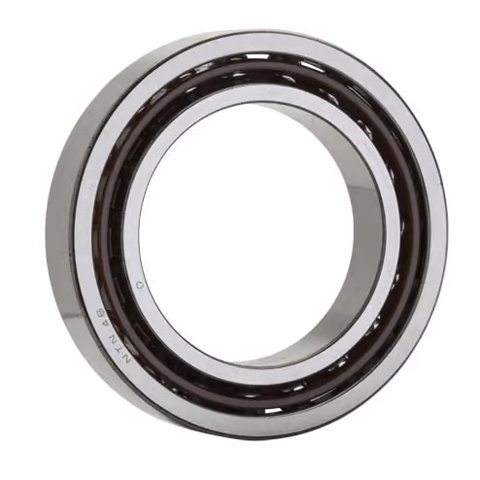
NTN NTN Angular Contact Ball Bearing ,7015
Item # d D B r Static Load Rating Dynamic Load Rating 7015 2.9528 in 75.000 mm 4.5276 in 115.000 mm 0.7874 in 20.000 mm 0.0433 in 1.100 mm 9350 lbf 41500 N 41.50 kN 9800 lbf 43500 N 43.50 kN 1. Design features and characteristics 1.1 Angular contact ball bearing Angular contact ball bearings are non-separable bearings with a defined contact angle in the radial direction relative to the straight line that runs through the point where each ball makes contact with the inner and outer rings (see Fig. 1). Table 1 provides information on contact angles and their designated codes. In addition to radial loads, angular contact ball bearings can accommodate single direction axial loads. Since an axial load is generated from a radial force, these bearings are generally used in pairs. Table 2 shows general angular contact ball bearing characteristics, Table 3 shows information on using duplex (side by side) angular contact ball bearings, and Table 4 shows information on multiple-row angular contact ball bearings. For bearings with a contact angle of 15° and bearing tolerance JIS Class 5 or higher, see special catalog “Precision rolling bearings (CAT. No. 2260/E)”. 1.2 Four-point angular contact ball bearings Four-point angular contact ball bearings have a contact angle of 30° and a split inner ring. As shown in Fig. 2, when the inner and outer rings receive a radial load, the ball contacts the inner and outer rings at four points. This construction enables a single bearing to accommodate axial loads from either direction, and when under a simple axial load or heavy axial load, the bearing relies on two contact points like ordinary bearings. 1.3 Double row angular contact ball bearings The structure of double row angular contact ball bearings is designed by arranging two single row angular contact bearings back-to-back in duplex (DB) to form a single bearing with a contact angle of 25°.These bearings are capable of accommodating radial loads, axial loads in either direction, and have a high capacity for moment loads.As shown in Fig. 4, sealed and shielded type double row angular contact ball bearings are also available. Standard loads vary from those of open type bearings.
$79.75
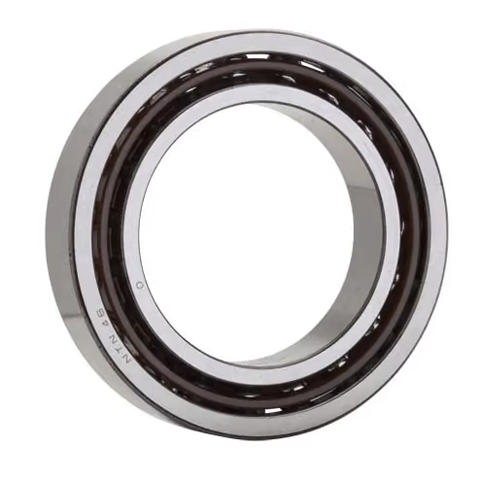
NTN NTN Angular Contact Ball Bearing ,7014
Item # d D B r Static Load Rating Dynamic Load Rating 7014 2.7559 in 70.000 mm 4.3307 in 110.000 mm 0.7874 in 20.000 mm 0.0433 in 1.100 mm 8900 lbf 39500 N 39.50 kN 9550 lbf 42500 N 42.50 kN 1. Design features and characteristics 1.1 Angular contact ball bearing Angular contact ball bearings are non-separable bearings with a defined contact angle in the radial direction relative to the straight line that runs through the point where each ball makes contact with the inner and outer rings (see Fig. 1). Table 1 provides information on contact angles and their designated codes. In addition to radial loads, angular contact ball bearings can accommodate single direction axial loads. Since an axial load is generated from a radial force, these bearings are generally used in pairs. Table 2 shows general angular contact ball bearing characteristics, Table 3 shows information on using duplex (side by side) angular contact ball bearings, and Table 4 shows information on multiple-row angular contact ball bearings. For bearings with a contact angle of 15° and bearing tolerance JIS Class 5 or higher, see special catalog “Precision rolling bearings (CAT. No. 2260/E)”. 1.2 Four-point angular contact ball bearings Four-point angular contact ball bearings have a contact angle of 30° and a split inner ring. As shown in Fig. 2, when the inner and outer rings receive a radial load, the ball contacts the inner and outer rings at four points. This construction enables a single bearing to accommodate axial loads from either direction, and when under a simple axial load or heavy axial load, the bearing relies on two contact points like ordinary bearings. 1.3 Double row angular contact ball bearings The structure of double row angular contact ball bearings is designed by arranging two single row angular contact bearings back-to-back in duplex (DB) to form a single bearing with a contact angle of 25°.These bearings are capable of accommodating radial loads, axial loads in either direction, and have a high capacity for moment loads.As shown in Fig. 4, sealed and shielded type double row angular contact ball bearings are also available. Standard loads vary from those of open type bearings.
$74.80
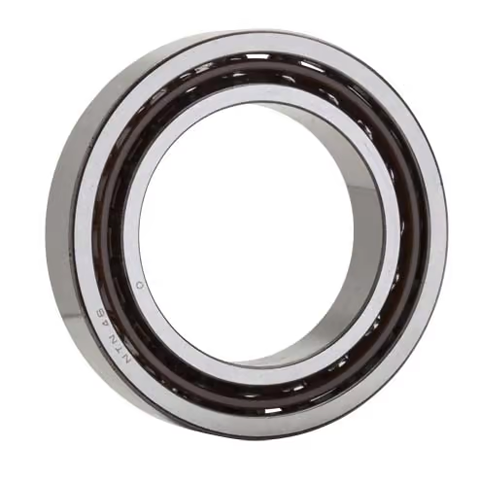
NTN NTN Angular Contact Ball Bearing ,7013
Item # d D B r Static Load Rating Dynamic Load Rating 7013 2.5591 in 65.000 mm 3.9370 in 100.000 mm 0.7087 in 18.000 mm 0.0433 in 1.100 mm 7100 lbf 31500 N 31.50 kN 7550 lbf 33500 N 33.50 kN 1. Design features and characteristics 1.1 Angular contact ball bearing Angular contact ball bearings are non-separable bearings with a defined contact angle in the radial direction relative to the straight line that runs through the point where each ball makes contact with the inner and outer rings (see Fig. 1). Table 1 provides information on contact angles and their designated codes. In addition to radial loads, angular contact ball bearings can accommodate single direction axial loads. Since an axial load is generated from a radial force, these bearings are generally used in pairs. Table 2 shows general angular contact ball bearing characteristics, Table 3 shows information on using duplex (side by side) angular contact ball bearings, and Table 4 shows information on multiple-row angular contact ball bearings. For bearings with a contact angle of 15° and bearing tolerance JIS Class 5 or higher, see special catalog “Precision rolling bearings (CAT. No. 2260/E)”. 1.2 Four-point angular contact ball bearings Four-point angular contact ball bearings have a contact angle of 30° and a split inner ring. As shown in Fig. 2, when the inner and outer rings receive a radial load, the ball contacts the inner and outer rings at four points. This construction enables a single bearing to accommodate axial loads from either direction, and when under a simple axial load or heavy axial load, the bearing relies on two contact points like ordinary bearings. 1.3 Double row angular contact ball bearings The structure of double row angular contact ball bearings is designed by arranging two single row angular contact bearings back-to-back in duplex (DB) to form a single bearing with a contact angle of 25°.These bearings are capable of accommodating radial loads, axial loads in either direction, and have a high capacity for moment loads.As shown in Fig. 4, sealed and shielded type double row angular contact ball bearings are also available. Standard loads vary from those of open type bearings.
$67.63
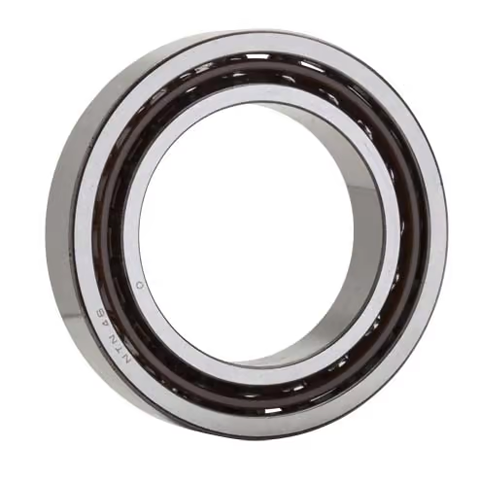
NTN NTN Angular Contact Ball Bearing ,7012
Item # d D B r Static Load Rating Dynamic Load Rating 7012 2.3622 in 60.000 mm 3.7402 in 95.000 mm 0.7087 in 18.000 mm 0.0433 in 1.100 mm 6300 lbf 28100 N 28.10 kN 7200 lbf 32000 N 32.00 kN 1. Design features and characteristics 1.1 Angular contact ball bearing Angular contact ball bearings are non-separable bearings with a defined contact angle in the radial direction relative to the straight line that runs through the point where each ball makes contact with the inner and outer rings (see Fig. 1). Table 1 provides information on contact angles and their designated codes. In addition to radial loads, angular contact ball bearings can accommodate single direction axial loads. Since an axial load is generated from a radial force, these bearings are generally used in pairs. Table 2 shows general angular contact ball bearing characteristics, Table 3 shows information on using duplex (side by side) angular contact ball bearings, and Table 4 shows information on multiple-row angular contact ball bearings. For bearings with a contact angle of 15° and bearing tolerance JIS Class 5 or higher, see special catalog “Precision rolling bearings (CAT. No. 2260/E)”. 1.2 Four-point angular contact ball bearings Four-point angular contact ball bearings have a contact angle of 30° and a split inner ring. As shown in Fig. 2, when the inner and outer rings receive a radial load, the ball contacts the inner and outer rings at four points. This construction enables a single bearing to accommodate axial loads from either direction, and when under a simple axial load or heavy axial load, the bearing relies on two contact points like ordinary bearings. 1.3 Double row angular contact ball bearings The structure of double row angular contact ball bearings is designed by arranging two single row angular contact bearings back-to-back in duplex (DB) to form a single bearing with a contact angle of 25°.These bearings are capable of accommodating radial loads, axial loads in either direction, and have a high capacity for moment loads.As shown in Fig. 4, sealed and shielded type double row angular contact ball bearings are also available. Standard loads vary from those of open type bearings.
$52.51
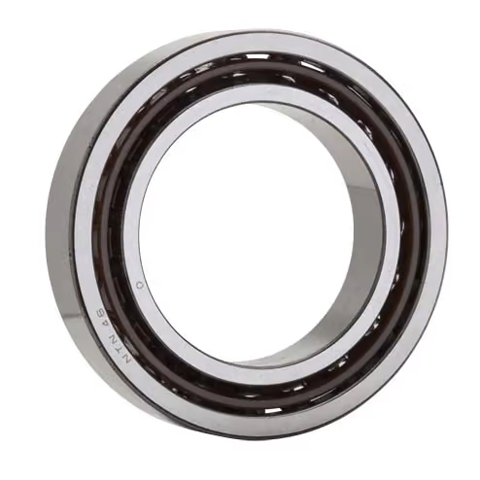
NTN NTN Angular Contact Ball Bearing ,7011
Item # d D B r Static Load Rating Dynamic Load Rating 7011 2.1654 in 55.000 mm 3.5433 in 90.000 mm 0.7087 in 18.000 mm 0.0433 in 1.100 mm 5900 lbf 26300 N 26.30 kN 6950 lbf 31000 N 31.00 kN 1. Design features and characteristics 1.1 Angular contact ball bearing Angular contact ball bearings are non-separable bearings with a defined contact angle in the radial direction relative to the straight line that runs through the point where each ball makes contact with the inner and outer rings (see Fig. 1). Table 1 provides information on contact angles and their designated codes. In addition to radial loads, angular contact ball bearings can accommodate single direction axial loads. Since an axial load is generated from a radial force, these bearings are generally used in pairs. Table 2 shows general angular contact ball bearing characteristics, Table 3 shows information on using duplex (side by side) angular contact ball bearings, and Table 4 shows information on multiple-row angular contact ball bearings. For bearings with a contact angle of 15° and bearing tolerance JIS Class 5 or higher, see special catalog “Precision rolling bearings (CAT. No. 2260/E)”. 1.2 Four-point angular contact ball bearings Four-point angular contact ball bearings have a contact angle of 30° and a split inner ring. As shown in Fig. 2, when the inner and outer rings receive a radial load, the ball contacts the inner and outer rings at four points. This construction enables a single bearing to accommodate axial loads from either direction, and when under a simple axial load or heavy axial load, the bearing relies on two contact points like ordinary bearings. 1.3 Double row angular contact ball bearings The structure of double row angular contact ball bearings is designed by arranging two single row angular contact bearings back-to-back in duplex (DB) to form a single bearing with a contact angle of 25°.These bearings are capable of accommodating radial loads, axial loads in either direction, and have a high capacity for moment loads.As shown in Fig. 4, sealed and shielded type double row angular contact ball bearings are also available. Standard loads vary from those of open type bearings.
$49.48
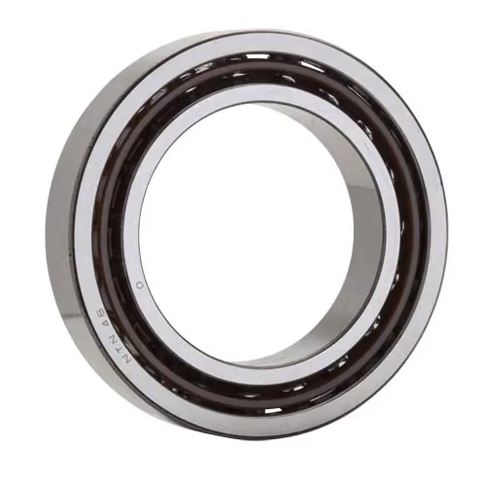
NTN NTN Angular Contact Ball Bearing ,7010
Item # d D B r Static Load Rating Dynamic Load Rating 7010 1.9685 in 50.000 mm 3.1496 in 80.000 mm 0.6299 in 16.000 mm 0.0394 in 1.000 mm 4500 lbf 20100 N 20.10 kN 5350 lbf 23700 N 23.70 kN 1. Design features and characteristics 1.1 Angular contact ball bearing Angular contact ball bearings are non-separable bearings with a defined contact angle in the radial direction relative to the straight line that runs through the point where each ball makes contact with the inner and outer rings (see Fig. 1). Table 1 provides information on contact angles and their designated codes. In addition to radial loads, angular contact ball bearings can accommodate single direction axial loads. Since an axial load is generated from a radial force, these bearings are generally used in pairs. Table 2 shows general angular contact ball bearing characteristics, Table 3 shows information on using duplex (side by side) angular contact ball bearings, and Table 4 shows information on multiple-row angular contact ball bearings. For bearings with a contact angle of 15° and bearing tolerance JIS Class 5 or higher, see special catalog “Precision rolling bearings (CAT. No. 2260/E)”. 1.2 Four-point angular contact ball bearings Four-point angular contact ball bearings have a contact angle of 30° and a split inner ring. As shown in Fig. 2, when the inner and outer rings receive a radial load, the ball contacts the inner and outer rings at four points. This construction enables a single bearing to accommodate axial loads from either direction, and when under a simple axial load or heavy axial load, the bearing relies on two contact points like ordinary bearings. 1.3 Double row angular contact ball bearings The structure of double row angular contact ball bearings is designed by arranging two single row angular contact bearings back-to-back in duplex (DB) to form a single bearing with a contact angle of 25°.These bearings are capable of accommodating radial loads, axial loads in either direction, and have a high capacity for moment loads.As shown in Fig. 4, sealed and shielded type double row angular contact ball bearings are also available. Standard loads vary from those of open type bearings.
$37.16


